
Description
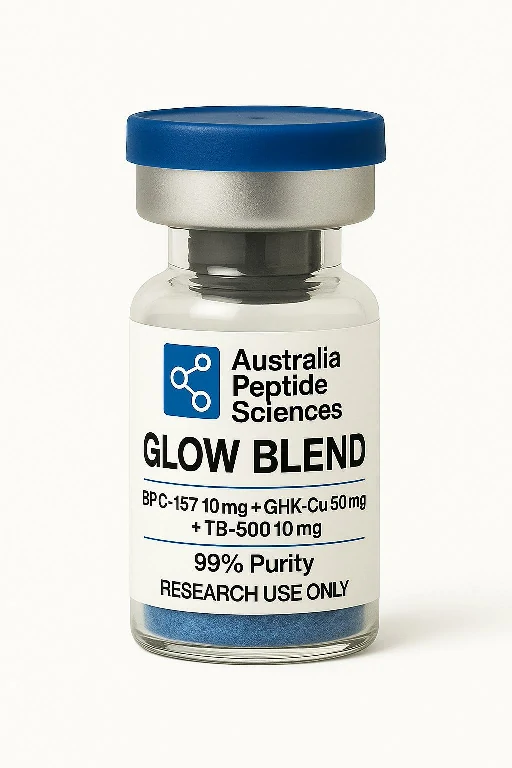
This multi-peptide formulation is supplied as a freeze-dried lyophilised powder and is intended strictly for scientific and analytical research.
For research purposes only. Not for human consumption.
What Is the Peptide Blend?
The blend is a research formulation combining three separate peptides in one vial:
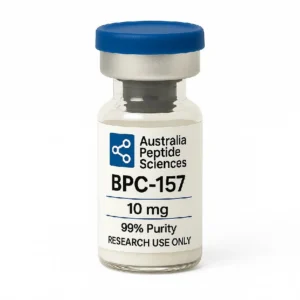
- BPC-157
- TB-500
- GHK-Cu
The combination allows researchers to examine several cellular pathways within the same experimental system. These include pathways associated with cell migration and extracellular-matrix signalling.
Evidence involving an individual ingredient should not automatically be applied to the finished blend. The combined formulation requires evaluation as its own research material, using appropriate controls and analytical documentation.
How Each Blend Component Is Studied
BPC-157
BPC-157 is investigated primarily in preclinical models examining cellular signalling.
TB-500
TB-500 is studied in relation to cell migration, actin regulation and structural cellular processes. Findings involving thymosin beta-4 or related experimental systems should be interpreted according to the specific material and model studied.
GHK-Cu
GHK-Cu is a copper-binding peptide investigated in copper-dependent signalling and extracellular-matrix biology.
Research Applications
In controlled laboratory settings, the peptide blend may be used to investigate:
- Interactions between multiple cellular signalling pathways.
- Cell migration models.
- Extracellular-matrix signalling.
- Copper-dependent biological mechanisms.
- Differences between individual peptides and combined formulations.
These are experimental research contexts only.
Peptide Blend vs Individual Peptides
| Research factor | Individual peptides | Peptide Blend |
| Composition | One peptide per sample | Three peptides in one vial |
| Experimental focus | Isolated pathway or compound | Interaction between multiple components |
| Variable control | Easier to attribute an observation to one material | Requires controls to distinguish component and combination effects |
| Interpretation | Based on the selected peptide | Individual-peptide evidence cannot automatically be applied to the blend |
| Analytical review | One compound identity | Each component and its stated quantity should be checked |
A laboratory comparing the blend with its separate ingredients should use suitable control groups. Without individual-peptide controls, an observed result cannot reliably be attributed to BPC-157, TB-500, GHK-Cu or their combination.