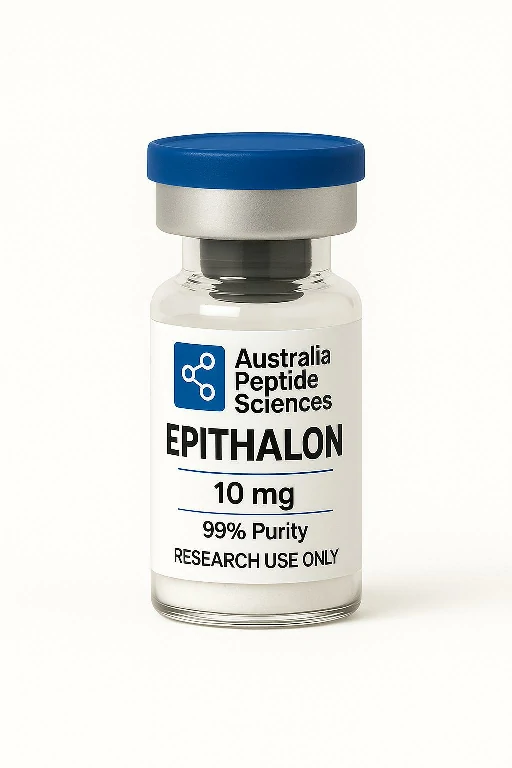
Description
Epitalon, also written Epithalon, is supplied as a freeze-dried lyophilised powder for controlled laboratory research.
For research purposes only. Not for human consumption.
What Is Epitalon Peptide?
Epitalon is a synthetic tetrapeptide composed of alanine, glutamic acid, aspartic acid and glycine. Its sequence is commonly written as Ala-Glu-Asp-Gly or AEDG.
The names Epitalon and Epithalon refer to alternative English transliterations of the same synthetic AEDG tetrapeptide. Epithalamin is different: it refers to a pineal-derived polypeptide preparation containing multiple components.
Epitalon Research Areas
Laboratory studies have examined Epitalon in relation to:
- Telomere and telomerase-related mechanisms.
- Cellular senescence markers.
- Gene-expression pathways.
- Oxidative-stress responses.
- Circadian and melatonin-related biology.
Most direct evidence comes from cell and animal models.
Epitalon and Telomere Research
Telomeres are protective structures located at the ends of chromosomes. They can shorten during repeated cell division, while telomerase is an enzyme involved in maintaining telomeric DNA.
Cell-culture studies have investigated whether Epitalon influences telomerase activity, hTERT expression and telomere-related endpoints.
Researchers should evaluate:
- The cell or animal model used.
- The method used to measure telomere length.
- Whether telomerase activity was measured directly.
- Whether findings were independently replicated.
Epitalon vs Epithalon vs Epithalamin
| Term | Meaning |
| Epitalon | Common English transliteration of the synthetic AEDG tetrapeptide |
| Epithalon | Alternative transliteration referring to the same AEDG tetrapeptide |
| Epithalamin | A pineal-derived polypeptide preparation containing multiple components |
This distinction is important when reviewing analytical documentation or comparing published findings. Evidence involving Epithalamin should not automatically be applied to structurally defined synthetic Epitalon.