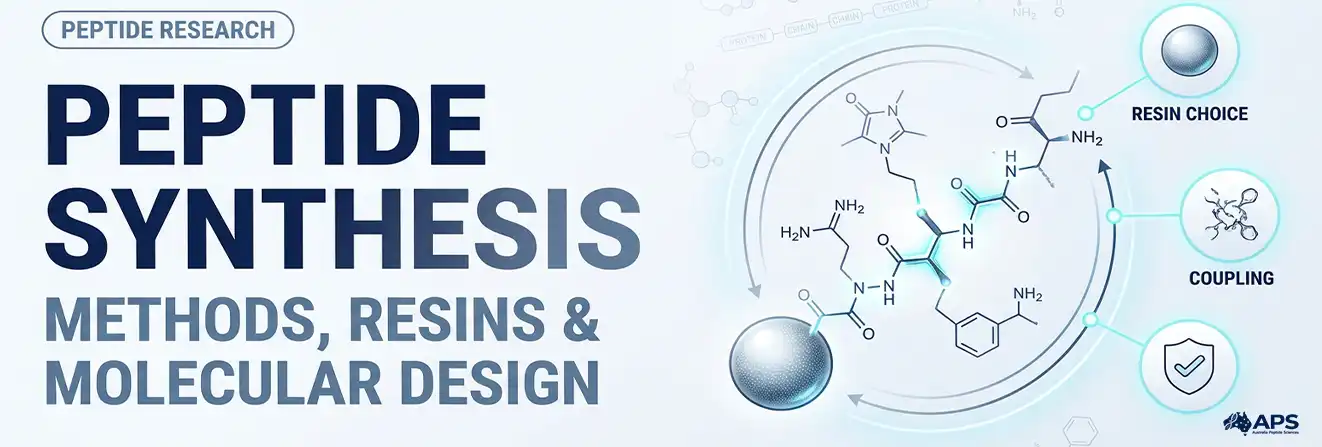
Peptide synthesis is the controlled laboratory process of assembling amino acids into a defined peptide sequence through repeated peptide-bond formation.
Peptide synthesis starts with decisions about the target structure, assembly route, resin, protecting groups, and analytical tests. Each choice affects which impurities may form, how much material can be recovered, and what evidence is needed to confirm the final research peptide.
Peptide synthesis typically involves six stages:
- Define the sequence, termini and modifications.
- Choose the synthesis route and resin/linker.
- Protect, deprotect and couple amino acids sequentially.
- Cleave the peptide and remove protecting groups.
- Purify the crude peptide.
- Characterise identity and purity using appropriate analytical methods.
What Must Be Specified Before Peptide Synthesis?
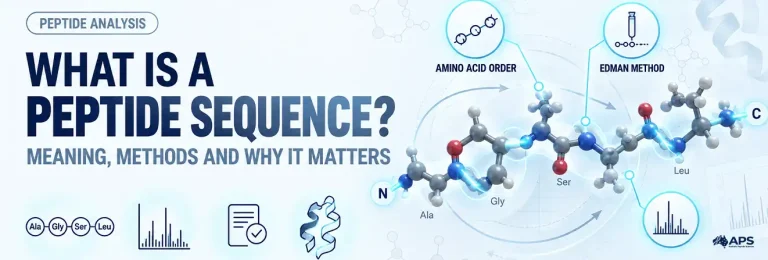
A peptide sequence records the order of amino acid residues, conventionally from the N-terminus to the C-terminus. The sequence alone does not fully specify a synthesis target. Peptides with identical residue order can differ in terminal groups, stereochemistry, disulphide connectivity, isotopic labels, side-chain modifications, or counterions. These differences can affect molecular mass and chemical behaviour.
Before selecting a peptide synthesis process, a chemist defines the complete target structure. The specification should state whether the C-terminus is a free carboxylic acid or an amide, whether the N-terminus is free or acetylated, and how any disulphide bonds are paired. Non-standard residues and attached groups also need precise identification. A name or sequence alone may describe more than one chemical product.
For most short and medium research peptides, chemical peptide synthesis provides control over residue placement and defined modifications. The route must suit the target structure and produce an impurity profile that can be assessed analytically.
Peptide Bond Formation and the Need for Selective Coupling
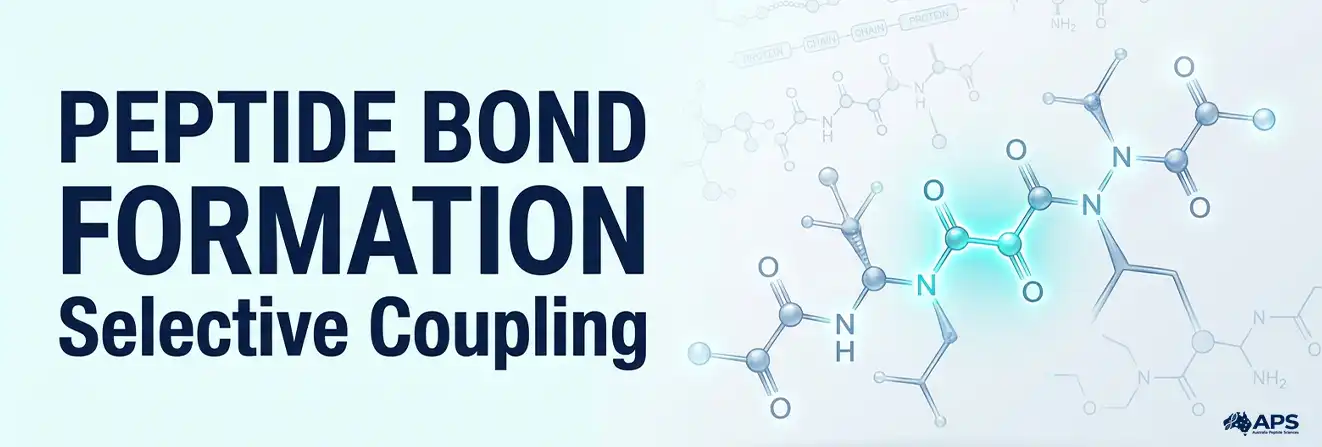
The choice of coupling conditions affects both peptide bond formation and the impurities that may arise during synthesis:
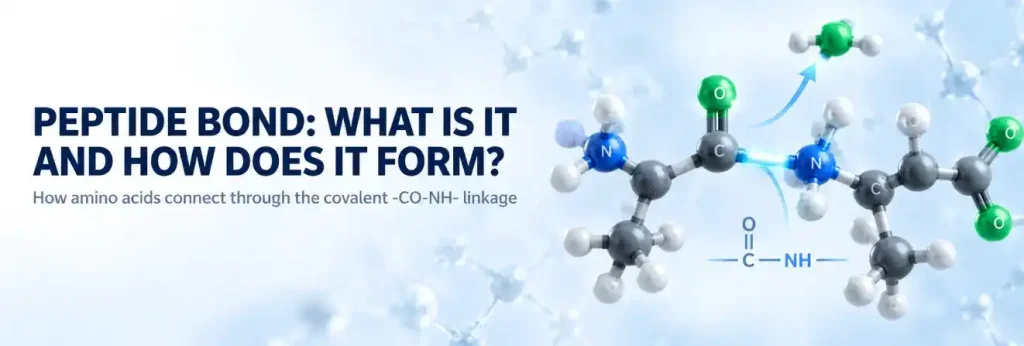
- Form the intended bond.A peptide bond is an amide linkage between the carboxyl group of one amino acid residue and the amino group of another. A tripeptide such as KPV has two backbone peptide bonds. In laboratory synthesis, chemists protect groups that must remain unreactive and activate the carboxyl group selected for coupling.
- Choose the coupling conditions.During amino acid coupling, the activated carboxyl group reacts with the exposed amino group at the end of the growing chain. Activation may use a carbodiimide with an additive or selected uronium or phosphonium reagents. The choice depends on the residue, steric hindrance, solvent, temperature, and risk of epimerisation; faster coupling does not necessarily yield a cleaner peptide.
- Limit incomplete coupling.A chain that misses a coupling step but continues to grow can form a deletion sequence. Capping blocks unreacted amino groups from later cycles, leaving shorter, terminated chains that must be separated from the target peptide. Monitoring the coupling step helps identify incomplete reactions before the chain grows further.
Peptide Synthesis Methods: Choosing a Route
Choosing between peptide synthesis methods means deciding what must be controlled during assembly. Solid-phase peptide synthesis keeps the growing chain on a resin; liquid-phase peptide synthesis can allow intermediates to be isolated and assessed; fragment assembly may help when extending one long chain becomes difficult. The choice depends on the specified molecular form, sequence behaviour, modification sites, and expected purification burden. The broader production stages are covered in our guide to how peptides are made; here, the focus is how chemists choose between assembly routes.
| Route | Where the growing peptide sits | Main practical advantage | Principal planning challenge |
| Solid phase peptide synthesis | Attached to an insoluble resin through a linker | Repeated coupling and washing can be automated | Incomplete reactions can accumulate on resin-bound chains |
| Liquid phase peptide synthesis | Dissolved in solution | Intermediates can be analysed and sometimes isolated or crystallised | Each isolation step may add time and material loss |
| Fragment assembly or ligation | Shorter segments are joined after separate preparation | Can make selected long or difficult targets more accessible | The junction and fragment solubility require careful design |
SPPS is often chosen for stepwise assembly because the resin can be washed between cycles. Liquid phase peptide synthesis can suit short sequences, protected fragments, or routes where intermediates are readily isolated. Sequence composition, aggregation, and required modifications may matter more than chain length alone.
How Peptide Synthesis Resin and Linker Choice Determine the Product
In SPPS, the first amino acid is attached through its C-terminal end to an insoluble support. The polymer provides a surface that can be washed after each reaction. The linker is the chemical connection between that support and the peptide. Linker chemistry determines how the chain can be released and often which C-terminal group the released peptide will carry.
| Intended C-terminal form | Common Fmoc-compatible example | What the choice accomplishes |
| Free carboxylic acid | Wang resin | Cleavage can deliver a peptide with a C-terminal acid |
| C-terminal amide | Rink amide resin | Cleavage can deliver a peptide with a C-terminal amide |
| Protected fragment for later chemistry | Selected 2-chlorotrityl-based linkers | Milder release can preserve certain side-chain protections, depending on the route |
Resin loading affects how closely growing chains sit. Higher loading increases theoretical capacity but can promote aggregation and limit reagent access. Lower loading may help difficult sequences while reducing capacity.
Resin swelling and linker stability also matter. Poor swelling restricts reagent access even with a suitable coupling system, so support, linker, and solvent should be chosen together.
In Fmoc solid-phase peptide synthesis, resin, linker, and protecting-group choices must work together so that chain extension and final cleavage produce the specified molecular form.
Peptide Protecting Groups: How Fmoc and Boc Strategies Control Deprotection
Peptide protecting groups block reactive sites during chain extension. The incoming amino acid carries a removable group on its alpha amino group, while reactive side chains may need separate protection. The groups must be selected so that one can be removed without prematurely exposing the others.
- In Fmoc peptide synthesis, the Fmoc group is removed under basic conditions. Side-chain protections in the Fmoc/tBu strategy generally remain intact until acid treatment near the end. This separation, called orthogonality, exposes the backbone amino group for the next coupling while side chains stay protected.
- In classical Boc peptide synthesis, the Boc group is removed with acid during each cycle. Benzyl-type side-chain protections tolerate these treatments, while their final removal traditionally requires much stronger acid conditions. The resin, linker, and protecting groups must therefore be selected as a compatible system.
The Fmoc solid-phase peptide synthesis methods chapter explains that the approach’s usefulness depends on the sequence and the compatibility of its protection and cleavage conditions.
The term peptide deprotection covers both removal of the temporary N-terminal group between coupling cycles and removal of side-chain groups after assembly. Cleavage releases the chain from the resin; in some Fmoc routes, cleavage and side-chain deprotection occur together. Keeping these stages distinct clarifies what the crude material contains before purification.
The SPPS Coupling Cycle: Efficiency, Monitoring, and Troubleshooting
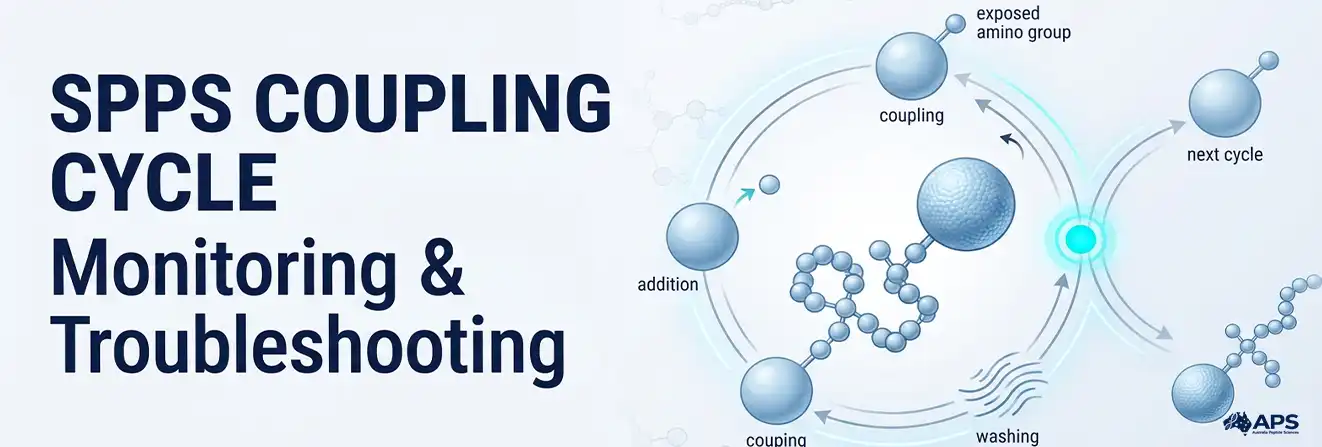
An SPPS cycle exposes the chain’s amino group, couples the next protected residue, and washes away excess reagents. The important planning decision is where to test conversion, repeat a coupling, cap unreacted chains, or change conditions before an incomplete step affects every later cycle.
Monitoring becomes especially useful at residues or chain lengths where incomplete coupling is suspected, because an uncorrected step can carry impurities through later cycles.
If each of 30 couplings succeeds for 99% of chains, about 74% would be full-length before other losses; at 98%, about 55%. These idealised figures are not isolated yields, which also depend on cleavage and purification.
A ninhydrin or Kaiser test can detect free primary amines after coupling, but a negative result cannot confirm the full structure. Some amino groups are not reliably detected by that test; in a 2023 study of an alternative amine-detection method, closer monitoring of a test sequence improved its crude purity. Analysis of a small released sample can help assess a difficult step.
Slow coupling may respond to repetition. Aggregation, poor resin swelling, steric hindrance, or unsuitable activation may require different conditions. Conditions that improve coupling conversion also need to be checked for epimerisation, because an epimer can retain the expected mass while having the wrong stereochemistry.
In a parallel manual SPPS study, researchers produced up to eight peptides simultaneously and reported average crude purity of 70%, compared with 50% for their in-house automated comparison. The result applies to the sequences and conditions tested; speed alone does not establish suitability for another target.
For a visual explanation of the chemistry discussed above, this video walks through how the Fmoc strategy is used in solid-phase peptide synthesis
Sequence-Dependent Challenges in Peptide Synthesis
Peptide synthesis can be difficult even for short research-only peptides. Hydrophobic segments may aggregate on the resin and make the terminal amino group less accessible. Incomplete coupling can then produce closely related deletion products that are difficult to separate.
For selected aggregation-prone targets, SynTag reduced aggregation during SPPS and improved the solubility of cleaved peptides in the sequences studied. It remains a route option to evaluate for a specific target, rather than a general solution to aggregation.
Certain sequences pose additional risks:
- Aspartic acid-containing sequences can form aspartimide during basic Fmoc removal. Asp-Gly is a recognised high-risk motif.
- Activation can cause epimerisation of susceptible residues, changing their stereochemistry without changing the written sequence.
- Cysteine-containing targets require control of oxidation and disulphide pairing, particularly when several pairings are possible.
- Oxidation-sensitive residues and some side-chain protecting groups can generate by-products during processing or cleavage.
Because repeated basic Fmoc removal can promote aspartimide formation in susceptible sequences, chemists may assess alternative side-chain and backbone protection strategies or deprotection conditions that reduce exposure to the triggering chemistry.
Sequence review helps identify these risks before assembly. Depending on the problem, a chemist may adjust protection, deprotection exposure, resin loading, or the assembly route. Each change needs assessment for new side reactions. Peptides in the Cellular & Recovery Research Peptides category differ in sequence and chemical form, so sharing a research category does not mean they share one synthesis plan.
Fragment Assembly and Ligation for Difficult Peptide Sequences
If a long resin-bound chain aggregates or accumulates impurities, chemists may prepare shorter fragments separately and join them. Each fragment can be assessed before assembly. The joining site must allow the required reactive ends to be prepared while preserving the intended peptide structure.
Native chemical ligation is one such route. In its classical form, a C-terminal peptide thioester reacts with a fragment bearing an N-terminal cysteine to form a native amide bond. These requirements constrain where the fragments can be joined, although modified ligation strategies can expand the options.
When suitable fragments and a ligation junction are available, templated native chemical ligation can favour joining at the intended site while limiting unwanted cross-ligation and cyclisation. Its compatibility with the fragments still has to be assessed for the target.
Explore laboratory research peptides in the Shop
How C-Terminal Acid and Amide Targets Determine Resin Choice
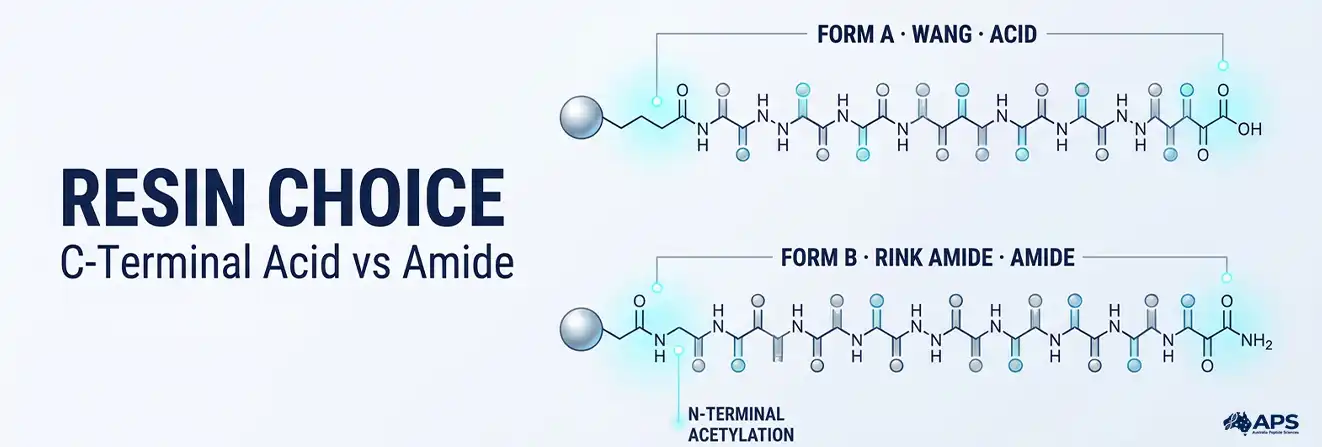
1. Specify the two target forms
Form A has a free C-terminal carboxylic acid. Form B has a C-terminal amide and an acetylated N-terminus. Both share the same 18-residue sequence, but require different molecular specifications.
2. Choose a compatible linker
For an Fmoc-based SPPS route, a chemist might evaluate a Wang-type linker for Form A and a Rink amide linker for Form B. Form B also requires a planned N-terminal acetylation step after chain extension. The order of any other modifications depends on the protection scheme.
3. Account for structural details beyond the sequence
SS-31 provides another example: its reported structure includes a C-terminal amide, D-arginine, and a modified tyrosine residue. Analytical reference values must be calculated for the specified form rather than copied from the unmodified amino acid sequence.
4. Assess sequence-specific risks
An Asp-Gly motif may raise the risk of aspartimide formation, while a hydrophobic stretch may complicate assembly. The synthesis specification should therefore include the molecular form, relevant sequence risks, and purity target alongside the peptide name.
Peptide Purification and Characterisation After Cleavage
Peptide purification should be planned around the impurities expected from the chosen route. Deletion sequences, incompletely deprotected chains, epimers and oxidation products may differ in how readily they separate from the target. A route can give substantial crude material yet remain impractical if its main impurity is difficult to resolve.
Peptide characterisation should test the risks identified during route design. Chromatography assesses the components detected by a specified method, while mass spectrometry checks whether an observed mass matches the target. Modified or disulphide-containing peptides may need further evidence because neither result alone establishes sequence, stereochemistry or connectivity.
Mass spectrometry of synthetic peptides can support identity assessment by comparing an observed mass with the specified target. A mass match alone does not establish every feature of sequence, stereochemistry, or connectivity.
For batch-level documentation, see our peptide certificate of analysis. guide.
A synthetic peptide product intended for research should have a defined molecular form supported by batch-specific analytical evidence. For GHK-Cu, the Gly-His-Lys sequence identifies the peptide component, while the copper(II) complex is part of the specified research material.
Convenient assembly does not establish that the intended structure was obtained. Identity and purity results alone do not establish suitability for injection; injectable peptides involve separate formulation, delivery, and safety questions. Research Use Only materials are for their labelled laboratory purpose and are not represented as suitable for human or veterinary administration.
Peptide Synthesis: Route Design and Analytical Verification
Peptide synthesis begins with a complete target structure and a compatible choice of resin, protecting groups, and coupling conditions. Sequence-specific risks shape the route and the impurities to check after cleavage. Analytical testing then assesses whether the material matches its specification. For research, the outcome is a defined peptide supported by batch-specific evidence of identity and composition.
Learn more about Australia Peptide Sciences
Frequently Asked Questions About Peptide Synthesis
What is the process of peptide synthesis?
Chemists join protected amino acids in a defined order, then remove protecting groups, purify the peptide, and verify its identity.
Can you synthesize your own peptides?
Yes, in a properly equipped laboratory with trained personnel, chemical safety controls, and access to purification and analytical testing.
Is peptide synthesis difficult?
It can be, especially when a sequence aggregates, couples incompletely, or undergoes unwanted side reactions.
How is BPC 157 synthesized?
Its 15 amino acids are typically assembled by stepwise chemical synthesis, followed by purification and analytical testing.
What are the four types of peptides?
There is no universal four-type classification; structural examples include linear, disulphide-linked, side-chain-cyclised, and head-to-tail cyclic peptides.
Is peptide synthesis legit?
Chemical peptide synthesis is an established laboratory method, but each product still needs batch-specific identity and purity testing.
Is it legal to make peptides?
In Australia, the applicable rules depend on the compound, its intended use, and whether chemical or therapeutic goods requirements apply.
What do I need to start peptides?
For laboratory synthesis, you need trained personnel, suitable equipment and reagents, safety controls, and access to purification and testing.
How much does it cost to synthesize a peptide?
Cost depends on sequence difficulty, length, modifications, quantity, purification, and testing, so there is no reliable universal price.
What destroys peptides?
Depending on the sequence and formulation, heat, moisture, oxidation, light, or unsuitable pH can cause degradation.
Sources
- Al Musaimi O, et al. “Towards green, scalable peptide synthesis: leveraging DEG-crosslinked polystyrene resins to overcome hydrophobicity challenges.” RSC Advances. 2024;14(54):40255–40266. doi:10.1039/D4RA07484J.
- Hansen PR, Oddo A. “Fmoc Solid-Phase Peptide Synthesis.” Methods in Molecular Biology. 2024;2821:33–55. doi:10.1007/978-1-0716-3914-6_3.
- Umeno T, et al. “Quantitative and Nondestructive Colorimetric Amine Detection Method for the Solid-Phase Peptide Synthesis as an Alternative to the Kaiser Test.” Analytical Chemistry. 2023;95(42):15803–15809. doi:10.1021/acs.analchem.3c03350.
- Overby C, et al. “A Rapid Manual Solid Phase Peptide Synthesis Method for High-Throughput Peptide Production.” Journal of Biomedical Materials Research Part A. 2025;113(5):e37922. doi:10.1002/jbm.a.37922.
- Bürgisser H, et al. “A Versatile ‘Synthesis Tag’ (SynTag) for the Chemical Synthesis of Aggregating Peptides and Proteins.” Journal of the American Chemical Society. 2024;146(50):34887–34899. doi:10.1021/jacs.4c14247.
- Kong MJW, van den Braak TJHP, Neumann K. “Aspartimide Formation and Its Prevention in Fmoc Chemistry Solid-Phase Peptide Synthesis.” ChemBioChem. 2025;26(18):e202500490. doi:10.1002/cbic.202500490.
- Spaltenstein P, et al. “Selective Activation of Peptide-Thioester Precursors for Templated Native Chemical Ligations.” Angewandte Chemie International Edition. 2025;64(1):e202413644. doi:10.1002/anie.202413644.
- Li M, et al. “Discovery of novel SS-31 (d-Arg-dimethylTyr-Lys-Phe-NH₂) derivatives as potent agents to ameliorate inflammation and increase mitochondrial ATP synthesis.” RSC Advances. 2024;14(41):29789–29799. doi:10.1039/D4RA05517A.
- Chrone VG, Lorentzen A, Højrup P. “Characterization of Synthetic Peptides by Mass Spectrometry.” Methods in Molecular Biology. 2024;2821:83–89. doi:10.1007/978-1-0716-3914-6_7.
- Greco V, et al. “Copper Complexes with New Glycyl-l-histidyl-l-lysine-Hyaluronan Conjugates Show Antioxidant Properties and Osteogenic and Angiogenic Synergistic Effects.” Bioconjugate Chemistry. 2025;36(4):662–675. doi:10.1021/acs.bioconjchem.4c00545.