
Reta peptide hair loss is a growing concern as interest in retatrutide and its effects on body weight increases. Current evidence does not show that retatrutide directly damages hair follicles or causes permanent baldness. However, substantial weight reduction, reduced food intake, nutritional changes and physiological stress can disrupt the normal hair-growth cycle and may contribute to temporary shedding.
Retatrutide is an investigational compound that activates the GIP, GLP-1 and glucagon receptors. Phase 3 studies have reported substantial reductions in body weight, but the compound remains under development and is not available as an approved medicine for public use. In Australia, the Therapeutic Goods Administration identifies retatrutide as an unapproved peptide product that has not been evaluated for safety, quality or effectiveness.
Does Reta Peptide Cause Hair Loss?
Current clinical evidence does not confirm that retatrutide directly causes hair loss. Hair loss has not been identified among the most common adverse events listed in major retatrutide trial reports. Temporary shedding could nevertheless occur during periods of rapid weight reduction, especially when appetite, food intake or nutritional status changes substantially.
The most common adverse events reported in the Phase 2 obesity trial were mainly gastrointestinal. In the May 2026 TRIUMPH-1 Phase 3 topline results, the most frequently listed events were nausea, diarrhoea, constipation, vomiting and upper respiratory tract infection. Hair loss was not included in that list, although a topline report does not provide a complete assessment of every event that may have occurred.
Possible contributors to shedding during major weight changes include:
- Rapid or substantial weight reduction
- A prolonged reduction in energy intake
- Inadequate protein consumption
- Iron or other micronutrient deficiencies
- Persistent nausea, vomiting or diarrhoea
- Recent illness, surgery or emotional stress
- Thyroid disorders
- Existing male or female pattern hair loss
- Other medicines or medical conditions
Experiencing hair loss after exposure to a compound does not, by itself, establish that the compound directly caused the hair loss. The timing, distribution and type of shedding must also be considered.
Learn more about Australia Peptide Sciences and our research-focused approach to peptides.
What the Current Evidence Shows
Retatrutide, covered in more detail in our retatrutide research overview and also known as LY3437943, is a single molecule designed to activate three receptor pathways involved in appetite, glucose regulation and energy balance:
- Glucose-dependent insulinotropic polypeptide receptors
- Glucagon-like peptide-1 receptors
- Glucagon receptors
Its effects on these pathways can produce substantial changes in appetite and body weight. These changes are relevant to hair health because rapid weight loss is a recognised trigger for telogen effluvium, a temporary form of diffuse hair shedding.
A 2025 review examining alopecia reports associated with GLP-1 receptor agonists identified a possible safety signal but also highlighted major limitations. Most reports lacked confirmation by a dermatologist, and only limited evidence distinguished telogen effluvium from other forms of hair loss. These findings concern the broader GLP-1 medicine class and do not prove that retatrutide has the same risk profile.
What Has Not Been Proven
Current evidence has not established that retatrutide:
- Directly destroys hair follicles
- Causes permanent baldness
- Produces a specific pattern of alopecia
- Causes hair loss in a known percentage of people
- Prevents follicles from returning to the growth phase
- Causes more hair loss than other incretin-based compounds
- Directly creates iron, zinc or vitamin deficiencies
- Produces the same effects in every person
A reliable incidence rate cannot be calculated from personal reports, social media discussions or unverified product use.
| Question | Current answer | Main limitation |
| Does retatrutide directly damage hair follicles? | Direct follicle toxicity has not been demonstrated | Hair-specific clinical assessments are limited |
| Can shedding occur during rapid weight loss? | Yes, rapid weight loss can trigger diffuse shedding | Several nutritional and medical factors may contribute |
| Is hair loss a common retatrutide adverse event? | It has not been listed among the most common events in major reports | Complete long-term safety data are still developing |
| Is shedding always temporary? | Telogen effluvium is usually non-scarring | Not every case of hair loss is telogen effluvium |
| Is there a confirmed incidence rate? | No reliable retatrutide-specific rate is available | Trials have not primarily focused on hair outcomes |
Why Hair Shedding May Occur During Weight Loss

Rapid weight loss, reduced nutrient intake and physiological stress may disrupt the normal hair-growth cycle and contribute to temporary shedding. Compounds such as GHK-Cu peptide are also studied in laboratory research related to hair-follicle biology.
What Is Telogen Effluvium?
Telogen effluvium is a diffuse, non-scarring form of hair shedding. It occurs when a higher-than-usual number of follicles leave the active growth phase and enter the resting phase after a physical, nutritional or psychological stressor.
Potential triggers include:
- Rapid weight loss
- Restrictive dieting
- High fever or serious illness
- Surgery
- Childbirth
- Thyroid dysfunction
- Iron deficiency
- Certain medicines
- Major psychological stress
A retrospective study of people diagnosed with telogen effluvium following weight loss supports rapid weight reduction as a recognised trigger. However, the amount and speed of weight loss needed to trigger shedding vary between individuals.
Telogen effluvium usually affects the scalp diffusely rather than creating one or two clearly defined bald patches. The hair follicles remain present and are generally capable of producing new hair.
How the Hair-Growth Cycle Changes
Scalp hair normally moves through three main stages:
- Anagen: The active growth phase, during which the hair shaft lengthens.
- Catagen: A short transition phase when active growth stops.
- Telogen: The resting phase before the hair is released.
A major physiological change can cause more follicles to enter the resting phase at approximately the same time.
Shedding does not usually begin immediately. Affected hairs may remain attached for several weeks before falling, which means the visible hair loss may occur well after the original trigger.
This delay makes it difficult to identify a single cause. Hair shedding noticed during retatrutide-related research or weight change could reflect an event that happened weeks or months earlier.
Reduced Energy Intake
Appetite reduction can lead to a meaningful decrease in total food intake. If that reduction becomes substantial or prolonged, the body may reduce energy allocated to normal hair production.
The likelihood of shedding can be influenced by:
- The size of the energy deficit
- The duration of reduced intake
- The speed of weight loss
- Baseline nutritional status
- Age and general health
- Other illnesses or medicines
Not every calorie deficit leads to hair loss, and appetite reduction alone does not prove that a person has developed a nutritional deficiency.
Protein and Hair Structure
The visible hair shaft consists mainly of keratin, a structural protein. Normal follicle activity therefore depends on an adequate supply of amino acids and sufficient overall nutrition.
When appetite is significantly reduced, total protein intake may fall alongside total calorie intake. This can be especially relevant during rapid weight loss because protein is also needed to maintain other tissues, including skeletal muscle.
Hair shedding alone cannot diagnose inadequate protein intake. Dietary patterns, body composition, health conditions and other symptoms must also be considered.
Iron and Other Nutritional Factors
Iron deficiency is one possible contributor to diffuse hair loss. Low iron stores can occur independently of weight loss or develop when dietary intake becomes restricted.
Other nutrients involved in normal follicle and hair-shaft function include:
- Zinc
- Vitamin D
- Vitamin B12
- Folate
- Copper
- Selenium
- Essential fatty acids
These nutrients should not be treated as universal explanations for hair loss. Taking supplements without identifying a deficiency can be unnecessary and may sometimes be harmful. Excessive intake of one nutrient can also interfere with the absorption or function of another.
Gastrointestinal Symptoms
Nausea, vomiting, diarrhoea and constipation have been among the most frequently reported adverse events in retatrutide trials. These symptoms could influence hair health indirectly if they result in persistent difficulty eating, maintaining fluid intake or following a balanced diet.
Reduced food intake should not be confused with proven nutrient malabsorption. Delayed gastric emptying or digestive discomfort does not automatically mean that the body cannot absorb nutrients.
When Can Reta Peptide Hair Loss Begin?
There is no confirmed retatrutide-specific timeline for hair shedding. If the underlying condition is telogen effluvium, the visible hair loss is usually delayed because affected follicles enter the resting phase before the hairs are released.
Possible signs include:
- More hair than usual in the shower
- Increased strands on pillows or clothing
- More shedding during brushing
- Reduced overall hair volume
- A thinner ponytail
- Diffuse thinning across the scalp
- A wider-looking part
Shedding that begins within only a few days is less typical of classic telogen effluvium. In such cases, an earlier trigger, another hair condition or hair-shaft breakage may offer a more plausible explanation.
| Stage | Possible change | What may be noticed |
| Initial change | Appetite, food intake or body weight changes | Hair usually appears unchanged |
| Follicle transition | More follicles enter the resting phase | No obvious shedding may be visible |
| Shedding phase | Resting hairs are released | Diffuse hair fall becomes noticeable |
| Stabilisation | The trigger improves or the body adapts | Shedding may gradually decrease |
| Regrowth | Follicles return to active growth | Short new hairs may become visible |
Online timelines vary because product identity, nutritional status, medical history, weight-loss speed and other potential triggers are often unknown.
Is Reta Peptide Hair Loss Permanent?
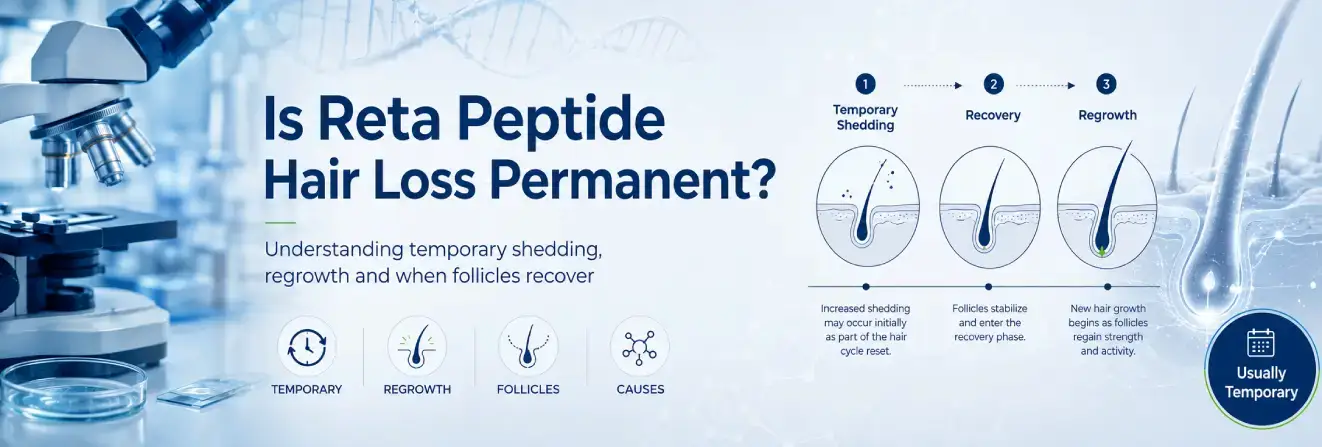
Hair loss caused by telogen effluvium is generally temporary and non-scarring. The follicle is not destroyed, so it can return to the active growth phase once the trigger has resolved or stabilised.
Regrowth is slow. Even after shedding decreases, several months may pass before new hairs become long enough to improve visible density.
Complete recovery cannot be guaranteed because hair loss occurring during weight reduction may have another cause or involve more than one condition.
Temporary Shedding Versus Follicle Damage
Temporary shedding means the hair shaft has been released while the follicle remains capable of producing new hair.
Progressive or potentially permanent hair loss may involve:
- Male or female pattern hair loss
- Scarring inflammatory disorders
- Autoimmune alopecia
- Untreated endocrine disease
- Persistent nutritional deficiency
- Chronic scalp inflammation
Rapid weight reduction can also make an existing condition more noticeable. A person with early androgenetic alopecia may first recognise thinning at the crown, temples or central part during an episode of diffuse shedding.
In that situation, the temporary component may improve while the underlying pattern hair loss continues.
How to Distinguish Different Types of Hair Loss
The distribution and appearance of hair loss can provide useful clues, but they cannot confirm a diagnosis on their own.
| Hair-loss type | Typical appearance | Important distinction |
| Telogen effluvium | Diffuse shedding across the scalp | Usually non-scarring and associated with a recent stressor |
| Androgenetic alopecia | Progressive thinning at the temples, crown or central part | Involves follicular miniaturisation and genetic susceptibility |
| Alopecia areata | Smooth, round or oval bald patches | Autoimmune condition requiring assessment |
| Hair breakage | Short strands of different lengths | Hair shafts break rather than shedding from the root |
| Scalp inflammation | Hair loss with redness, pain, itching or scaling | May indicate infection or inflammatory disease |
| Scarring alopecia | Loss of follicle openings, sometimes with shiny or inflamed skin | Can cause permanent loss and requires prompt assessment |
Patchy baldness, loss of eyebrows, scalp pain or visible inflammation is not typical of uncomplicated weight-loss-related telogen effluvium.
Who May Be More Susceptible to Hair Shedding?
There is no validated method for predicting who will experience reta peptide hair loss. Several factors may increase susceptibility during substantial changes in body weight:
- Rapid or extensive weight reduction
- A major reduction in food intake
- Low protein intake
- Low iron stores or other existing deficiencies
- Previous episodes of telogen effluvium
- Existing pattern hair loss
- Thyroid disease
- Recent surgery, infection or serious illness
- Persistent gastrointestinal symptoms
- Significant emotional stress
- Multiple medication changes
- A restrictive or unbalanced diet
The identity of the product is another important factor. Unapproved products promoted as retatrutide may not contain the stated ingredient or concentration.
The TGA warns that unapproved peptide products may have unknown composition, manufacturing standards and sterility. Risks can include contamination, dosing uncertainty and exposure to unidentified substances. These uncertainties make it impossible to assume that an adverse event resulted from genuine clinical-trial retatrutide.
Does Reta Peptide Cause Muscle Loss?
The question does reta peptide cause muscle loss requires a distinction between total weight loss, lean-mass reduction and direct skeletal-muscle damage.
Significant weight loss usually consists mainly of fat mass but can also include some fat-free mass. Fat-free or lean mass is not identical to skeletal muscle. Depending on the measurement method, it may include water, organs, connective tissue and glycogen as well as muscle.
A retatrutide peptide body-composition substudy in adults with type 2 diabetes found reductions in total body fat and lean mass. The proportion of lean-mass loss relative to total weight loss was similar to that reported with other obesity treatments. The findings did not demonstrate that retatrutide causes uniquely disproportionate lean-mass loss.
Lean Mass Is Not the Same as Muscle Function
A body-composition scan estimates tissue compartments but does not show whether a person has lost strength, mobility or physical performance.
A broader assessment of muscle health may consider:
- Skeletal-muscle quantity
- Muscle strength
- Physical performance
- Age
- Baseline fitness
- Rate and amount of weight loss
- Protein and energy intake
- Physical activity
- Existing medical conditions
| Term | Meaning | What a reduction may show |
| Body weight | Total mass of the body | Combined changes in fat, lean tissue and fluid |
| Fat mass | Stored adipose tissue | Reduction in body fat |
| Lean mass | All measured non-fat components | May include muscle, water, organs and connective tissue |
| Skeletal muscle | Contractile tissue responsible for movement | Best interpreted with strength and function |
| Muscle strength | The ability to produce force | A functional outcome not measured by body weight alone |
Hair shedding and lean-mass reduction may share contributing factors, such as inadequate energy or protein intake. The presence of one does not prove the presence of the other.
Can Reta Peptide Cause Infertility?

The question can reta peptide cause infertility cannot currently be answered with a confirmed yes or no. Published human evidence has not established infertility as a retatrutide adverse effect, but dedicated reproductive-safety data remain insufficient.
Fertility involves several separate outcomes, including:
- Ovulation
- Menstrual-cycle regularity
- Reproductive hormone levels
- Sperm concentration
- Sperm motility and morphology
- Sexual function
- Conception
- Pregnancy maintenance
- Fetal development
- Live-birth outcomes
Changes in metabolic health and body weight can affect reproductive function independently of a direct drug effect. Research involving medical weight loss and GLP-1 receptor agonists suggests that improved metabolic health may influence menstrual cycles, ovulation and some male reproductive parameters. However, reviews emphasise that more human research is needed and that indirect effects of weight loss must be separated from direct effects on the reproductive system.
Evidence involving semaglutide, tirzepatide or another GLP-1-based medicine cannot automatically be applied to retatrutide. Retatrutide activates an additional glucagon receptor pathway and has not undergone a dedicated published human fertility assessment sufficient to establish either harm or safety.
Infertility and pregnancy safety are also different questions. A compound may have no demonstrated effect on the ability to conceive while still lacking adequate evidence about pregnancy exposure or fetal development.
| Reproductive question | Current position |
| Has retatrutide been confirmed to reduce male fertility? | No direct causal evidence has been established |
| Has it been confirmed to reduce female fertility? | No direct causal evidence has been established |
| Is retatrutide proven safe during pregnancy? | No |
| Can evidence from other GLP-1 medicines be applied directly? | No |
| Are dedicated human reproductive data sufficient? | No |
When Hair Loss Needs Further Assessment
Hair shedding should not automatically be attributed to retatrutide, weight loss or telogen effluvium.
Further assessment may be important when there is:
- Sudden patchy baldness
- Scalp redness, pain, scaling or discharge
- Loss of eyebrows, eyelashes or body hair
- Rapidly progressive thinning
- Severe fatigue or weakness
- Persistent vomiting or inability to maintain food intake
- Symptoms associated with thyroid dysfunction
- Significant menstrual or reproductive changes
- Loss of muscle strength or physical function
- Shedding that does not begin to stabilise
- A strong family history of pattern hair loss
Evaluation may involve a medical history, scalp examination, hair-pull test, trichoscopy or laboratory assessment for nutritional, thyroid or other health conditions.
Abruptly changing medicines, using unverified treatments or taking large doses of supplements can make the underlying cause harder to identify.
Limitations of Current Reta Peptide Hair Loss Research
Retatrutide studies have primarily focused on body weight, glycaemic control, metabolic outcomes and common adverse events. Hair-specific outcomes have not generally been primary study endpoints.
Current limitations include:
- Limited dermatologist-confirmed diagnoses
- Lack of standardised scalp photographs or hair counts
- Incomplete separation of telogen effluvium from pattern hair loss
- Confounding from rapid weight reduction
- Changes in diet, protein intake and nutritional status
- Pre-existing thyroid or hair conditions
- Follow-up periods that may not capture the complete hair-growth cycle
- Reliance on self-reported adverse events
- Limited retatrutide-specific fertility data
- Lean-mass measurements that do not directly measure muscle strength
A 2025 review of alopecia associated with GLP-1 receptor agonists concluded that the available evidence was insufficient to determine a clear causal relationship and called for studies using confirmed dermatological diagnoses and standardised assessments.
More complete retatrutide data are likely to emerge as Phase 3 results undergo peer review and regulatory assessment. Until then, direct trial evidence should be separated from findings involving related medicines, biological hypotheses and personal reports.
Explore the available research peptide range in our online shop.
Current evidence does not establish that retatrutide directly damages hair follicles or causes permanent baldness. Reta peptide hair loss may instead reflect telogen effluvium associated with rapid weight reduction, reduced food intake, nutritional changes or other physiological stressors.
Hair loss was not listed among the most common adverse events in major retatrutide trial reports, but a reliable retatrutide-specific incidence has not been established. Less common events and long-term outcomes require more detailed safety data.
Retatrutide-related weight loss can include some lean-mass reduction, although current body-composition evidence does not show uniquely disproportionate loss compared with other weight-loss interventions. Retatrutide has also not been confirmed to cause infertility, but direct reproductive data remain insufficient to establish safety.
Retatrutide remains investigational and is not approved for public use. In Australia, products promoted as retatrutide outside regulated research should not be assumed to have the identity, purity or safety profile of material used in clinical trials.
FAQs about reta peptide hair loss
Can retatrutide cause hair thinning?
Current research has not shown that retatrutide directly harms hair follicles. Hair loss has also not been identified as one of the most common side effects in major clinical trial reports. However, reta peptide hair loss may occur indirectly when rapid weight reduction, lower food intake, nutrient deficiencies or physical stress disrupt the normal hair-growth cycle.
How can I reduce the risk of hair loss while using retatrutide?
There is no guaranteed way to prevent hair shedding. Reducing possible risk factors may help, including maintaining adequate nutrition, avoiding extreme calorie restriction and addressing ongoing nausea, vomiting or other symptoms that make it difficult to eat properly.
Iron, zinc, biotin and other supplements should not be taken automatically, as hair loss does not always indicate a deficiency and excessive supplementation may cause additional problems.
What are the common side effects of retatrutide?
The side effects reported most often in retatrutide studies have mainly affected the digestive system. These include nausea, diarrhoea, constipation and vomiting. Some participants have also experienced reduced appetite.
These effects have generally been more noticeable at higher doses or while the dose was being increased. Because retatrutide remains investigational, its complete long-term safety profile has not yet been established.
How can hair recover after rapid weight loss?
Hair shedding caused by telogen effluvium often improves once weight loss, nutrition and general health become more stable. Maintaining adequate food and protein intake may support recovery, while possible causes such as iron deficiency, thyroid problems or another hair-loss condition should be identified when shedding persists.
Gentle hair care can help limit breakage, but shampoos and cosmetic products cannot correct an underlying medical or nutritional problem. Visible regrowth may take several months because scalp hair grows slowly.
What nutrient deficiency can cause hair loss?
Low levels of iron, zinc, vitamin D, vitamin B12 or folate may contribute to hair shedding. However, hair loss alone cannot determine which nutrient is deficient.
Other causes may include thyroid disorders, illness, stress, genetic pattern hair loss or medication changes. Excessive amounts of certain nutrients, including vitamin A and selenium, may also contribute to hair loss, so supplementation should be based on an identified need.
Can hair lost after weight reduction grow back?
Hair commonly grows back when the cause is telogen effluvium because the follicles remain intact. Shedding may appear several weeks or months after rapid weight loss and can continue for a period before gradually slowing.
Recovery may be less complete when another condition is also present, such as androgenetic alopecia, alopecia areata, thyroid disease, persistent nutritional deficiency or scarring hair loss.
Sources
- Hair Loss Associated With Glucagon-Like Peptide-1 (GLP-1) Receptor Agonist Use: A Systematic Review
https://pubmed.ncbi.nlm.nih.gov/41111833/ - Glucagon-Like Peptide-1 Receptor Agonist Medications and Hair Loss: A Retrospective Cohort Study
https://pubmed.ncbi.nlm.nih.gov/39863171/ - Increased Risk of Telogen Effluvium With Tirzepatide Compared to Other Weight Loss Medications: A Retrospective Cohort TriNetX Database Study
https://pubmed.ncbi.nlm.nih.gov/40848975/ - Triple-Hormone-Receptor Agonist Retatrutide for Obesity: A Phase 2 Trial
https://pubmed.ncbi.nlm.nih.gov/37366315/ - Effects of Retatrutide on Body Composition in People With Type 2 Diabetes: A Substudy of a Phase 2, Double-Blind, Parallel-Group, Placebo-Controlled, Randomised Trial
https://pubmed.ncbi.nlm.nih.gov/40609566/ - Infertility Improvement After Medical Weight Loss in Women and Men: A Review of the Literature
https://pubmed.ncbi.nlm.nih.gov/38339186/