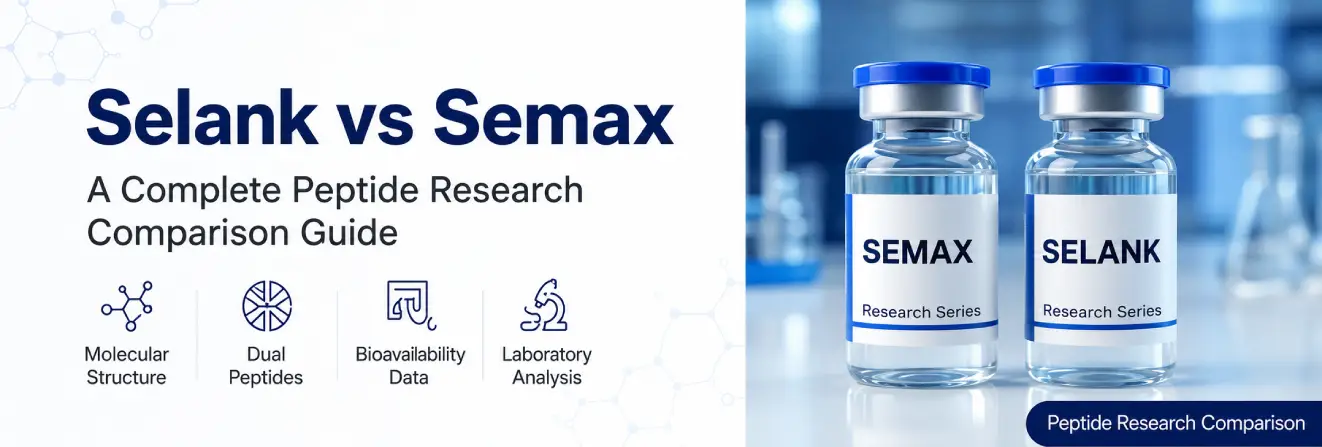
Selank vs Semax is one of the most searched peptide comparisons among laboratory researchers studying synthetic neuropeptides used in neurological research. Semax is most often examined for its neurotrophic and cognitive-pathway activity, while Selank is more frequently studied for its GABAergic and stress-related signaling.
This guide breaks down the structure, mechanisms, published findings, and side-effect data associated with each peptide, along with a practical framework researchers use to choose between them. Everything below is intended for laboratory and research use only.
Selank and Semax Peptides: What Is Their Structure and Origin?
Selank and Semax peptides are both classified as heptapeptides, short chains of seven amino acids, but they are derived from entirely different parent molecules.
| Feature | Semax | Selank |
| Parent molecule | ACTH(4–10) fragment | Tufts in (immune peptide) |
| Sequence type | Met-Glu-His-Phe-Pro-Gly-Pro | Thr-Lys-Pro-Arg-Pro-Gly-Pro |
| Developed at | Institute of Molecular Genetics, RAS | Institute of Molecular Genetics, RAS |
| Primary research focus | Neurotrophic signaling, cognition | GABAergic signaling, stress response |
| Delivery route studied | Intranasal | Intranasal |
Semax was engineered to retain the neuromodulator properties of adrenocorticotropic hormone without its hormonal activity, while Selank was built by extending the tufts in sequence for improved metabolic stability. Both compounds sit within the broader category of neuropeptides, sharing a heptapeptide backbone and an intranasal delivery history in published research, which is why they’re frequently discussed side by side despite diverging biological targets.
What Is Semax Peptide Research Focused On?
Semax peptide studies concentrate heavily on neurotrophic factor expression, particularly brain-derived neurotrophic factor (BDNF).
| Research Area | What Published Work Has Examined |
| Neurotrophic signaling | Upregulation of BDNF and TrkB receptor signaling in models associated with synaptic plasticity |
| Monoamine pathways | Modulation of dopaminergic and serotonergic pathways in animal studies |
| Neuroprotection | Neuroprotective gene expression patterns following ischemic injury models |
| Cognitive metrics | Attention and short-term memory measures in controlled experimental settings |
Researchers studying post-injury recovery models have also examined Semax alongside markers such as NGF and NT-3, positioning the compound within a broader neurotrophic signaling framework rather than a single-pathway mechanism, alongside other CNS-focused compounds such as Pinealon peptide.
What Does Semax Peptide Focus On?
Semax peptide studies focus heavily on neurotrophic factor expression, particularly brain-derived neurotrophic factor (BDNF).
| Research Area | What Published Work Has Examined |
| GABAergic modulation | Allosteric modulation of the GABA_A receptor system in experimental models |
| Gene expression | Shifts related to neurotransmission following administration |
| Serotonin pathways | Metabolic changes observed in animal models. |
| Immune signaling | Cytokine and Bcl6 network activity in spleen and hippocampal tissue |
This immune-CNS crosstalk is a distinguishing feature of Selank research, since it extends the compound’s study scope beyond the central nervous system alone and into stress-immune interaction models, a research angle far less associated with Semax, though it parallels sleep-and-stress pathway work seen in compounds like DSIP peptide.
Semax vs Selank: How Do Their Mechanisms Differ?
The clearest distinction between Semax and Selank is which biological axis each compound engages in published research.
| Research Axis | Semax | Selank |
| Primary target | BDNF/TrkB, monoamine systems | GABA_A receptor system |
| Secondary target | Dopamine, serotonin | Serotonin, immune-gene pathways |
| Associated study models | Cognition, ischemia recovery | Stress, anxiety-like behaviour in animal models |
| Reported functional theme | Neuroplasticity, attention | Stress-response modulation |
This split explains why the two compounds are commonly discussed together despite pursuing different research questions. A study investigating neuroplasticity or post-ischemic recovery models is more likely to reference Semax, particularly where oxidative stress markers are part of the injury model, while a study investigating GABAergic stress-response pathways is more likely to reference Selank.

What Are the Side Effects of Semax and Selank?
Semax is most often associated with mild nasal irritation, while Selank is most often associated with taste or Odor discomfort during administration, both generally described as well tolerated in the available literature.
| Peptide | Reported Observation | Study Context |
| Semax | Nasal mucosa irritation | The most frequently reported effect in intranasal administration studies |
| Semax | Mild blood glucose elevation | Noted in a subset of diabetic study subjects |
| Semax | Nasal cavity discoloration | Reported in a minority of cases in clinical literature |
| Selank | Unpleasant taste or Odor sensation | Associated with the solution reaching the throat during administration |
| Selank | Transient headache | Occasionally noted in published safety data |
| Selank | Allergic-type reactions | Rare, documented in product literature |
Across the available literature, both peptides are generally described as well tolerated within the studies examined. However, long-term human safety data outside of the original Russian research base remain limited, which is an important caveat for any research team designing extended-duration studies, particularly for neuropeptides more broadly.
Why Are Selank and Semax Used as Nasal Sprays?
Selank and Semax are most often studied as a nasal spray because the nasal mucosa offers a direct route to the central nervous system, bypassing the rapid gastrointestinal degradation typical of peptide compounds.
| Observation | Detail Reported in the Literature |
| Solution stability | Generally consistent for several weeks under refrigerated storage after reconstitution |
| Administration technique | Solution reaching the throat rather than the nasal mucosa correlates with more taste/Odor reports for Selank |
| Vasoconstrictive sprays | Noted as a variable to control for, since combined use may alter local absorption dynamics |
Some published studies have also investigated intravenous and subcutaneous routes for both compounds, though intranasal remains the dominant route referenced in the comparative literature, alongside broader delivery patterns covered in our peptide list guide.
What Does the Semax and Selank Dosage Chart Show?
Published protocols report different Semax and Selank administration patterns depending on concentration, study design, and research indication. Reported protocols include Semax concentrations ranging from 0.1% to 1%, while Selank is commonly reported at 0.15% concentration.
1. Semax 0.1% Protocol
- Reported administration: 1–2 drops per nostril
- Frequency reported in literature:Twice daily
- Reported course length:10–16 days, depending on the study indication
2. Semax 1% Protocol
- Reported administration:2–3 drops per nostril
- Frequency reported in literature:Three times daily
- Reported course length:Up to 10 days in selected neurological study models
3. Selank 0.15% Protocol
- Reported administration:2–3 drops per nostril
- Frequency reported in literature:Three times daily
- Reported course length:10–14 days, with some reports describing a 1–3-week interval before repeat courses
The semax and selank dosing protocol reported in the literature varies according to indication, formulation strength, and administration route. These differences highlight why comparisons between studies require careful evaluation of concentration and protocol design.
Semax and Selank Together: What Do Combined Study Designs Show?
Semax and Selank are studied together in some research designs because they target different biological pathways. Current literature explores whether combined administration may produce additive effects compared with individual compounds.
1. Imaging Findings in Combined Study Designs
- Functional connectivity changes have been reported in experimental designs where both compounds are administered within the same study framework.
- These findings are mainly used to explore potential interactions between neuropeptide activity and brain network regulation.
2. Theoretical Rationale Behind Combining Semax and Selank
- Researchers have explored the concept of pairing compounds with different proposed mechanisms:
- Semax:associated with neurotrophic and neuroplasticity-related pathways in research models.
- Selank:associated with GABAergic pathway modulation and stress-response research models.
- Combined models are designed to examine interactions between cognition, stress regulation, and neural signaling pathways.
3. Current Evidence Base for Semax and Selank Combination Studies
- The available literature on combined Semax and Selank administration remains limited but continues to develop.
- Many published studies evaluate Semax and Selank separately, focusing on different research endpoints.
- Combined-arm studies represent a smaller and more recent subset of the available research.
Overall, current evidence does not establish routine combined study protocols, and comparisons between combined and individual administration models require careful interpretation of study design, formulation, and measured outcomes.
Selank vs Semax: Which One Fits Your Study Design?
Semax is typically chosen for cognitive and neuroprotective study designs, while Selank is typically chosen for GABAergic, stress-response, or immune-crosstalk study designs.
| Research Endpoint | Compound Typically Referenced |
| Cognitive pathways, memory encoding, neuroprotective mechanisms | Semax |
| GABAergic modulation, stress-response behaviour, anxiety-like models | Selank |
| Stress-immune crosstalk | Selank, given its documented effects on immune-gene expression |
| Post-ischemic recovery models | Semax, given its neurotrophic and monoamine-pathway data |
Product sourcing is a separate consideration from mechanism selection. Researchers working with Semax peptide for research or Selank 10mg peptide for research should confirm third-party purity testing and certificates of analysis, since formulation quality affects study reliability, the same standard covered in our Mitochondrial Peptides guide.
Selank vs Semax: Final Takeaway
Semax is more frequently cited in cognitive and neuroprotective research, while Selank is more frequently cited in stress-response and anxiety-model research, both with substantial published data but limited long-term safety information.
FAQs About Selank vs. Semax
What is the main difference between Selank and Semax?
Semax is studied primarily for neurotrophic and cognitive-pathway signaling, while Selank is studied primarily for GABAergic and stress-related signaling.
Are Selank and Semax the same type of peptide?
Both are synthetic heptapeptides, but Semax derives from the ACTH(4–10) fragment while Selank derives from the immune peptide tufts in.
What side effects are reported in Semax and Selank research?
Published literature reports mild nasal irritation with Semax and taste or Odor discomfort with Selank, both generally described as well tolerated in the studies examined.
Is there research on Semax and Selank together?
Some study designs have used both compounds as comparison arms or in combined-administration models, though this remains a smaller and more recent area of the literature.
What administration route is used in Selank and Semax nasal spray studies?
Intranasal delivery is the most consistently reported route across the published research on both compounds.
Does the literature include a standard Semax and Selank dosage chart?
Published studies report varying concentrations and course lengths depending on the indication studied, so there is no single universal protocol across the literature.
Is there a Selank and Semax injection route mentioned in published studies?
A small number of earlier pharmacological studies reference an injection route for both compounds, though intranasal delivery is the dominant format in more recent literature.
What is the difference between Semax and Selank dosing protocols reported in the literature?
Semax protocols are typically shorter at 10 to 16 days, while Selank protocols include a longer 1-to-3-week interval before any repeat course.
Why are Semax and Selank studied together in some research designs?
Their complementary mechanisms neurotrophic signaling for Semax and GABAergic modulation for Selank make them useful comparison arms in stress-cognition interaction models.
Is Semax or Selank more frequently referenced in neuroprotection research?
Semax is more frequently referenced in neuroprotection and post-ischemic recovery research, given its established BDNF and monoamine-pathway data.