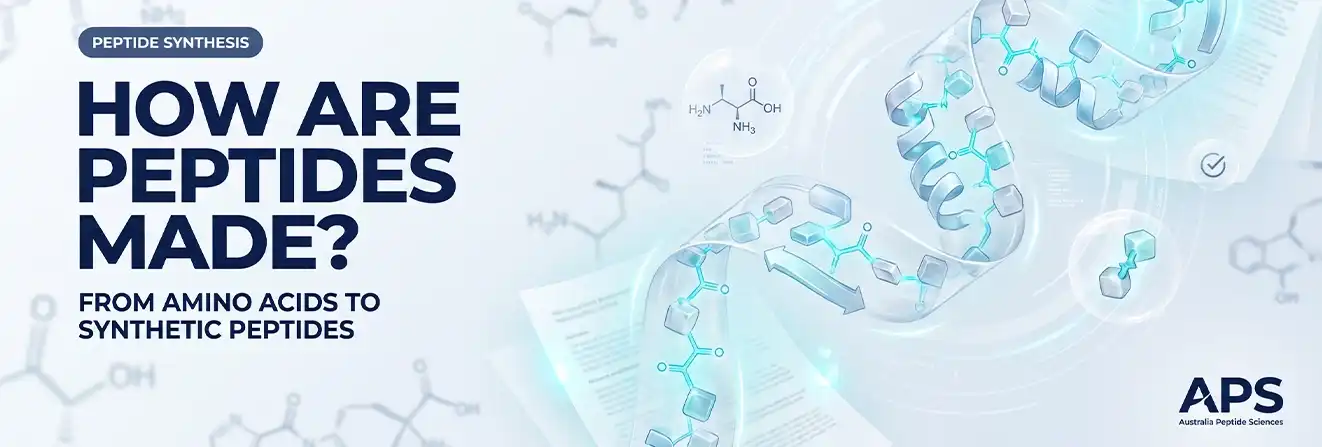
How are peptides made? Peptides form when amino acids are linked in a defined sequence by peptide bonds. Living cells produce them through biological machinery, while laboratories use chemical synthesis, recombinant expression and, in selected cases, enzymatic methods.
Laboratory production involves more than simply joining amino acids. Researchers define the target sequence, protect reactive groups, control each coupling reaction, remove by-products, purify the resulting material and confirm its identity.
This guide explains the complete process, from selecting the first amino acid to producing a characterised peptide, and compares the main production methods used in research.
How Are Peptides Made from Amino Acids?
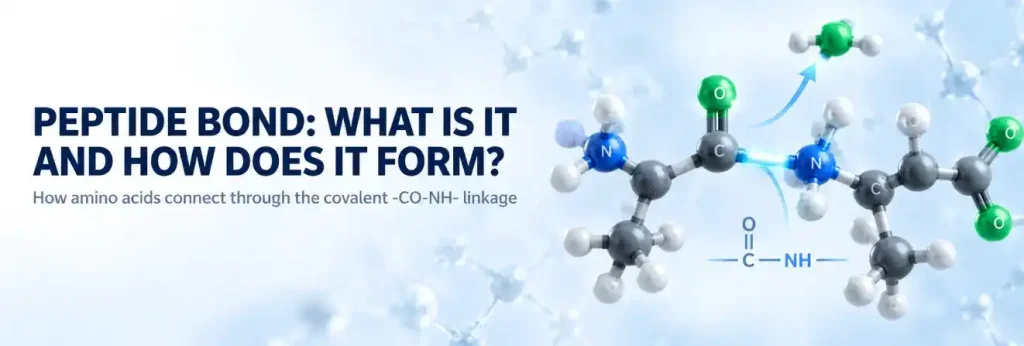
At the molecular level, answering “how are peptides made?” requires understanding controlled peptide bond formation. The carboxyl group of one amino acid reacts with the amino group of another, creating an amide linkage. The resulting chain has an N-terminus at one end and a C-terminus at the other.
In a simplified condensation model, forming this linkage releases water. Practical chemical peptide synthesis requires greater control because amino acids contain several reactive groups. Protecting groups block unwanted reaction sites, while activating reagents promote coupling at the intended position.
Amino-acid order is critical. Two entries in a research peptide list may contain the same amino acids but have different structures, chemical properties, and molecular interactions. Their sequence, modifications, and final molecular form therefore help determine how they behave in research.
How Natural and Laboratory Peptide Production Differ
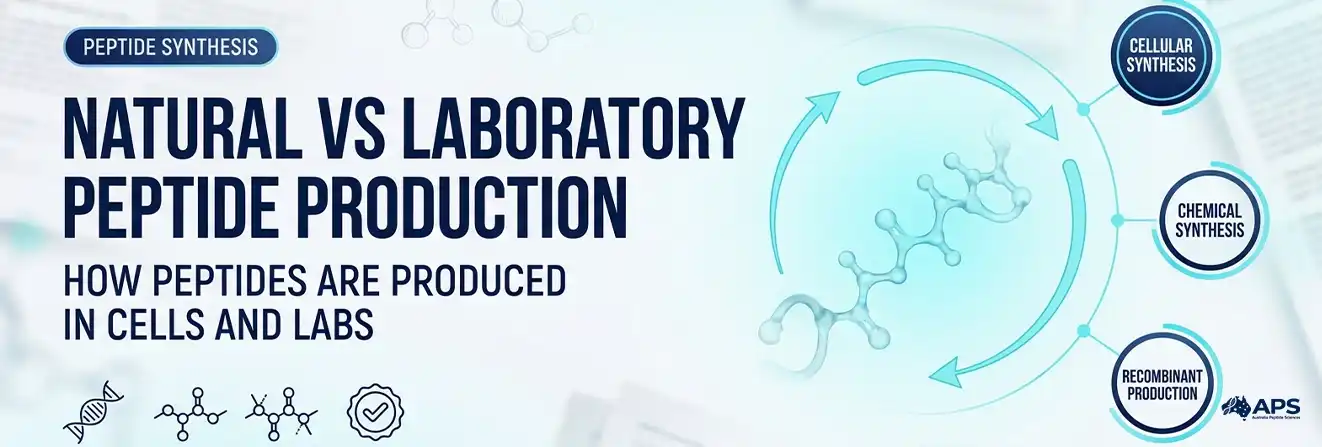
Answering “how are peptides produced?” requires distinguishing biological synthesis from laboratory manufacturing, especially when producing research peptides for controlled laboratory studies.
In cells, peptides are usually built from messenger RNA templates and then processed by enzymes into their mature forms. Some bacteria and fungi use non-ribosomal systems instead, allowing them to assemble more specialised peptide structures.
How Are Peptides Synthesized in Laboratories?
The query “how are peptides synthesized?” usually refers to three laboratory routes:
- Chemical synthesis: Most commonly solid-phase peptide synthesis.
- Liquid-phase synthesis: Used for selected peptides, protected fragments or particular manufacturing processes.
- Recombinant production: Uses engineered cells to express a peptide precursor or peptide-containing construct.
Enzymatic ligation and hybrid methods can also join peptide fragments when producing the complete sequence through one conventional route would be inefficient.
How Are Peptides Made in a Lab? The Complete Workflow
When researchers ask “how are peptides made in a lab?”, the practical answer is a controlled series of design, assembly, purification, and analytical steps.
| Stage | Main task | Why it matters |
| Sequence design | Define residues, termini and modifications | Establishes the target molecular structure |
| Route selection | Choose SPPS, LPPS, recombinant or hybrid production | Matches the method to sequence length, scale, and complexity |
| Chain assembly | Join amino acids in the correct order | Creates the peptide backbone |
| Cleavage and deprotection | Release the chain and remove protecting groups | Exposes the intended functional groups |
| Folding or modification | Form disulphide bonds, cyclise the peptide or attach specified groups | Produces the required molecular form |
| Purification | Separate the target from related substances | Removes process-related impurities |
| Characterisation | Confirm identity and assess purity | Determines whether the batch meets its specifications |
| Finishing | Exchange counterions, formulate or lyophilise the peptide where appropriate | Supports stability, handling and storage |
Solid Phase Peptide Synthesis: The Main Chemical Method
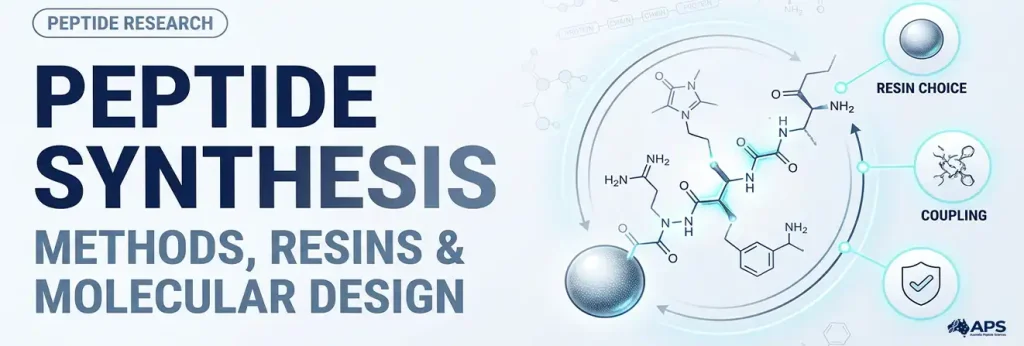
Solid phase peptide synthesis, or SPPS, anchors the first amino acid to an insoluble resin so the chain can be extended through repeated, controlled cycles.
SPPS is central to the question “how are peptides made?” because it supports precise sequence control and many defined modifications. Reviews of Fmoc solid-phase peptide synthesis explain why this approach became widely used for building synthetic peptide sequences.
Fmoc and Boc Protection Strategies
Fmoc and Boc are temporary protecting groups used to control which amino group reacts during chain extension. Their removal conditions differ, affecting resin selection, side-chain protection, and the final cleavage procedure. Comparative SPPS studies show that the selected protection strategy can influence route design and downstream chemistry.
| Strategy | Temporary deprotection | General process characteristic |
| Fmoc | Removed under basic conditions, commonly using a secondary amine reagent | Compatible with acid-labile side-chain protection and widely used in automated SPPS |
| Boc | Removed under acidic conditions during each cycle | Requires protection chemistry that tolerates repeated acid treatment and traditionally involves stronger final cleavage conditions |
Neither strategy guarantees successful synthesis. The appropriate route depends on sequence behaviour, protecting-group compatibility, coupling efficiency and the stability of any planned modifications.
For a practical visual overview, this video shows the main laboratory steps used in solid phase peptide synthesis, from resin preparation to purification and analytical checks.
How Solid Phase Peptide Synthesis Works
In practice, SPPS proceeds through repeated cycles. The temporary protecting group is removed, the next protected amino acid is coupled to the growing chain, and excess reagents are washed away before the next cycle begins.
After the full sequence is assembled, the peptide is cleaved from the resin and side-chain protecting groups are removed. The crude material then requires purification and analytical testing before it can be treated as a characterised research peptide.
Defined synthetic sequences such as BPC-157 may therefore share the same general SPPS workflow while still requiring sequence-specific optimisation.
Liquid Phase Peptide Synthesis and Fragment Assembly
The liquid phase peptide synthesis method performs coupling reactions with intermediates dissolved in solution rather than attached to a resin. Each intermediate may need to be isolated and purified before the next stage.
LPPS can be useful when intermediates crystallise well, when solution chemistry suits the required scale, or when protected peptide fragments are prepared for later assembly.
Fragment condensation and native chemical ligation divide a long or difficult sequence into shorter sections. These fragments are produced separately, purified, and joined through a selective chemical reaction, which may reduce incomplete couplings that accumulate during long stepwise synthesis.
How Are Synthetic Peptides Made and Modified?
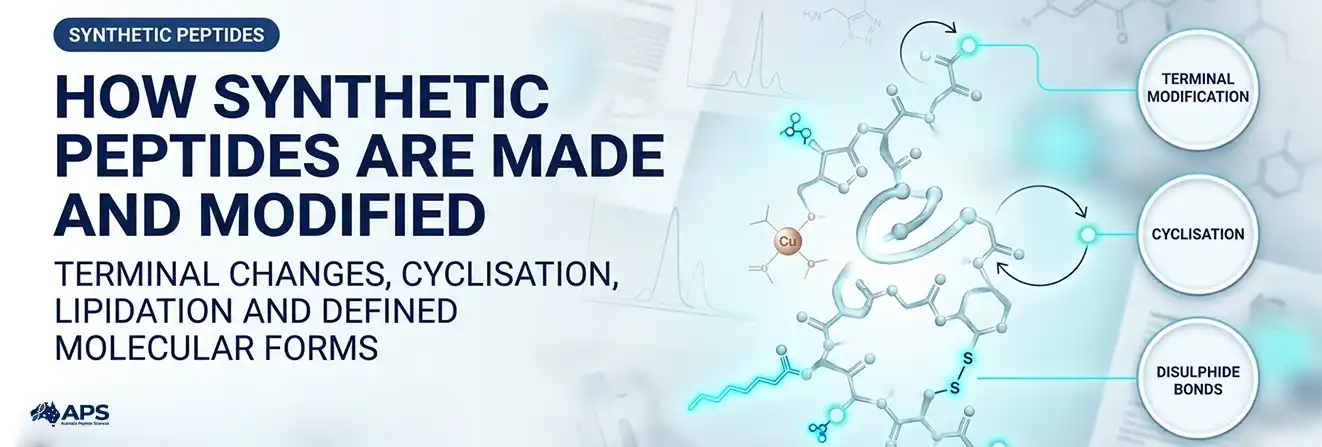
Making synthetic peptides involves more than assembling the peptide backbone.
- Terminal modification, cyclisation, lipidation, labelling or another defined chemical change.
- Modification timing, because some changes are introduced on-resin, while others are added after cleavage or during fragment ligation.
- Final molecular composition, especially for defined metal-binding forms such as GHK-Cu.
- Disulphide-bond formation, particularly in peptides containing several cysteine residues.
- Sequence behaviour, because even among cellular and recovery research peptides, a short hydrophobic sequence may be harder to synthesise and purify than a longer soluble one.
Explore related peptide products in the APS Shop
Recombinant Peptide Production
By contrast, recombinant peptide production uses engineered bacteria, yeast, or other host cells to express a peptide precursor or fusion construct.
Small peptides are often attached to a carrier to limit degradation or interference with host growth. The carrier is removed after expression.
How Recombinant Peptide Production Works
- Design and clone the sequence: Prepare the DNA sequence encoding the target peptide.
- Introduce the sequence into a host: Transfer the construct into a suitable bacterial, yeast, or other expression system.
- Grow the culture: Expand the host cells and induce expression of the target construct.
- Harvest the material: Collect the cells or culture medium containing the expressed product.
- Isolate the construct: Separate the peptide-containing material from other cellular components.
- Remove the carrier: Cleave any fusion partner or affinity tag used during expression.
- Purify and characterise the peptide: Isolate the target, support any required folding, and confirm its identity.
Research on recombinant expression systems shows how fusion partners and purification tags can support peptide production, although cleavage efficiency remains sequence-dependent. Chemical or hybrid synthesis may still be more suitable for non-natural amino acids and certain site-specific modifications.
Peptide Purification and Process-Related Impurities
After synthesis, peptide purification separates the target from related substances. Crude chemical material may contain deletion sequences, truncated chains, oxidised forms or incompletely deprotected molecules, while recombinant material may contain host proteins, nucleic acids or residual processing reagents.
1. How Peptides Are Separated and Purified
Reverse-phase HPLC separates peptides according to their interaction with a stationary phase and solvent gradient. Fractions containing the target are collected, analysed, and pooled. Ion-exchange or size-based methods may also be appropriate for certain peptide properties.
A production-scale answer to “how are peptides made?” cannot treat purification as an afterthought. A high crude yield provides limited value if the target cannot be separated efficiently from closely related impurities.
2. Why Peptide Purity Does Not Confirm Identity
Purity describes the relative composition detected by a specified analytical method. For a named research material such as TB-500, the reported percentage does not independently confirm molecular identity, biological activity, or suitability for a particular research application.
The APS guide to peptide purity explains why chromatographic purity should be interpreted alongside identity testing and other batch-specific evidence.
Peptide Quality Control Confirms Identity and Composition
Within manufacturing, peptide quality control uses complementary tests because no single method can confirm every aspect of a peptide batch. Guidance on peptide quantification, storage, and analytical handling notes that purified peptides are commonly assessed with reversed-phase chromatography, but a chromatogram alone cannot prove that the main peak represents the intended sequence.
Tests Used to Assess Peptide Quality
| Test | Main question answered | Important limitation |
| HPLC or UPLC | What components are separated and detected? | Results depend on the analytical method and detector response. |
| Mass spectrometry | Does the observed molecular mass match the target? | A matching mass alone may not confirm the complete sequence or molecular connectivity. |
| Peptide mapping or sequencing | Is the intended amino acid sequence supported? | The method’s suitability depends on the peptide and its structure. |
| Water or residual-solvent testing | Are volatile residues within the specified limits? | These tests do not establish peptide identity. |
How Quality-Control Results Support Batch Release
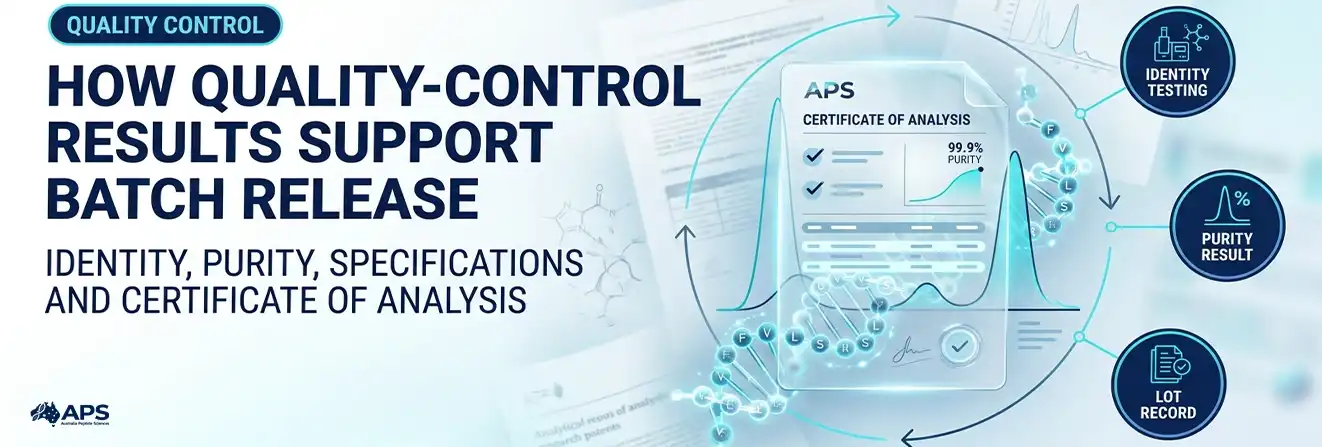
A controlled-process account of “how are peptides made?” begins with predefined release specifications. Analytical methods require suitable specificity, accuracy, and precision, while batch records must connect each result to the relevant lot.
A peptide Certificate of Analysis should be interpreted alongside the stated methods and specifications. A reported purity percentage cannot replace identity testing, and neither measurement demonstrates efficacy.
Why Peptide Synthesis Can Fail
Each added residue creates another opportunity for incomplete coupling. Even consistently efficient reactions can produce numerous deletion products across a long sequence.
Common Causes of Peptide Synthesis Failure
- Incomplete coupling caused by steric hindrance
- Aggregation of the resin-bound chain
- Side reactions during activation or deprotection
- Racemisation of susceptible residues
- Oxidation or poor solubility during processing
- Incorrect disulphide-bond pairing
Changing the resin, protecting groups, reagents, solvent, or assembly strategy may improve the outcome. The best peptide synthesis process is sequence-specific rather than a fixed recipe.
Explore Peptide Products at APS
Selecting peptide products for laboratory work is not only about matching a name to a sequence. Researchers also consider format, documentation, storage needs, and how each material fits within the wider study design. This helps keep product selection aligned with the practical requirements of the research workflow.
Explore peptide research resources at Australia Peptide Sciences
From Purified Solution to Lyophilised Peptide
A purified peptide may undergo counterion exchange, concentration adjustment or filtration before it remains in solution or is freeze-dried for later peptide reconstitution as part of a controlled laboratory workflow.
Lyophilisation freezes the solution before removing water under reduced pressure. Final stability depends on the peptide sequence, residual moisture, oxygen exposure, packaging and storage conditions. Freeze-drying cannot correct problems caused by poor synthesis or purification.
The APS guide to lyophilised peptides explains this format, its stability factors and relevant handling considerations. Research materials should be used only for their labelled purpose and are not automatically suitable for human or veterinary use.
Frequently Asked Questions how are peptides made
Is Ozempic a synthetic peptide?
Ozempic contains semaglutide, a modified GLP-1 peptide analogue whose peptide backbone is produced through yeast fermentation before further chemical modification, rather than entirely through conventional chemical synthesis.
What are peptides made from?
Peptides are made from amino acids linked together by peptide bonds. Their final properties depend on the amino-acid sequence, chain length, structural modifications, and how the peptide is purified and characterised.
Can I make my own peptide?
Peptides can be synthesised only with suitable laboratory equipment, specialised chemistry, purification and quality-control testing, so attempting to make them at home is unsafe and unreliable.
Why don’t doctors like peptides?
Doctors prescribe approved peptide medicines when clinically appropriate, but may avoid unapproved products because their identity, purity, safety and effectiveness may not have been established.
Are peptides a drug or steroid?
Peptides are chains of amino acids rather than steroids, although certain peptides are developed and regulated as medicines.
How do I get peptides naturally?
The body produces peptides naturally, while dietary proteins are broken down into amino acids and smaller peptide fragments during digestion.
Is there a downside to taking peptides?
Potential disadvantages depend on the specific peptide, but may include side effects, interactions, and uncertain composition, particularly with unapproved or inadequately tested products.
How is BPC 157 synthesized?
BPC-157 is generally produced as a synthetic 15-amino-acid peptide through stepwise chemical synthesis, followed by cleavage, purification, and analytical verification.
What are the top 3 peptides?
There is no scientifically valid top three because peptides have different structures and functions, and comparisons depend on the specific research or clinical purpose.
Who is the biggest manufacturer of peptides?
There is no single independently verified answer because manufacturers differ by production capacity, pharmaceutical sales, contract manufacturing volume, and peptide type.