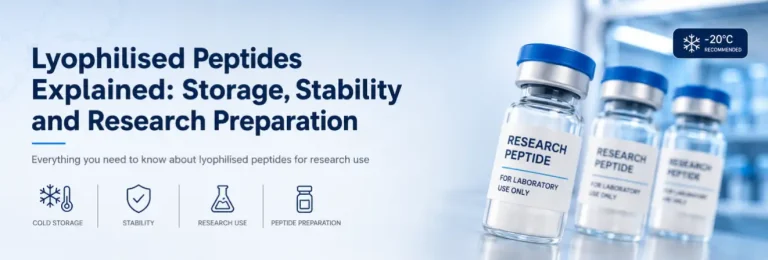

Reta peptide storage depends primarily on whether the material is still lyophilised or has been reconstituted into a liquid solution.
There is no single storage temperature or shelf life that can be applied confidently to every retatrutide product. The correct conditions depend on the formulation, packaging, diluent, concentration and stability information supplied with the material.
For a broader understanding of retatrutide, including its characteristics, research background and current development status, read our complete guide explaining what is reta peptide.
The information below concerns the storage and handling of research-use-only peptides. It does not provide dosage, injection or human-use instructions.
Reta Peptide Storage at a Glance
For GLP-1 Peptides such as retatrutide, the most important storage distinction is between dry lyophilised material and a reconstituted solution.
Unopened lyophilised material should remain sealed, dry and protected from light under the temperature conditions specified in its documentation.
After reconstitution, the storage period is usually shorter because the presence of water increases the possibility of chemical degradation, aggregation and microbial contamination.
| Material condition | Main concern | General storage approach | Storage-time basis |
| Unopened lyophilised material | Moisture, light and temperature fluctuations | Keep sealed under the stated cold-storage conditions | Labelled expiry and validated product data |
| Opened lyophilised material | Condensation and repeated exposure to air | Minimise opening time and return promptly to storage | Opening history and product instructions |
| Reconstituted solution | Degradation, aggregation and contamination | Refrigerate when specified and protect from light | Formulation-specific post-reconstitution data |
| Frozen liquid aliquot | Freeze–thaw damage and container compatibility | Freeze only when an approved protocol permits it | Validated freezing and thawing conditions |
| Material with unknown history | Uncertain integrity | Separate from confirmed usable stock | Technical assessment or replacement |
When different sources provide conflicting advice, use the following order of priority:
- Instructions on the product label.
- Lot-specific peptide Certificate of Analysisand technical documentation.
- Validated stability data for the exact formulation.
- Supplier-issued handling specifications.
- Established general peptide-storage guidance.
- Online articles, forums and personal experiences.
A storage recommendation is only meaningful when it applies to the same material form, formulation and handling conditions.
Why Storage Requirements Change After Reconstitution
Reconstitution changes the environment surrounding the peptide.
The lyophilised form contains very little water, which slows many degradation reactions. Once a liquid is added, the peptide becomes more vulnerable to chemical and physical changes.
Lyophilised Material Versus Liquid Solution
Lyophilisation, also known as freeze-drying, removes most of the water from a peptide solution. This usually improves stability during storage and transport.
Dry material can still be affected by:
- Moisture entering the vial.
- High temperatures.
- Direct light.
- Oxygen exposure.
- Damaged seals.
- Repeated movement between cold and warm conditions.
After reconstitution, water is present throughout the solution. This creates an environment in which hydrolysis, oxidation, aggregation and microbial growth may occur more readily.
Storage instructions for lyophilised powder should therefore not be applied automatically to the reconstituted solution.
Chemical Degradation
Several chemical processes can affect peptide integrity.
Hydrolysis involves water contributing to the breakdown of susceptible chemical bonds. It becomes more relevant after reconstitution.
Oxidation can affect certain amino-acid residues and may be accelerated by oxygen, light, unsuitable containers or reactive impurities.
Deamidation can alter the molecular structure and charge of susceptible residues. Temperature, pH and storage duration may influence the rate at which it occurs.
Lower temperatures generally slow these processes, but refrigeration or freezing does not preserve every formulation indefinitely.
Physical Instability
A peptide may also change physically without showing immediate chemical breakdown.
Possible forms of physical instability include:
- Aggregation, where peptide molecules associate with each other.
- Precipitation, where material falls out of solution.
- Adsorption to the vial or transfer container.
- Separation caused by freezing or thawing.
- Structural stress caused by vigorous shaking.
- Local changes in concentration or pH during freezing.
Cloudiness or particles may indicate a problem, but clear material is not automatically unchanged or suitable for continued use.
Stability and Sterility Are Different
Chemical stability, physical stability and microbiological quality are separate considerations.
A solution may remain chemically detectable while becoming contaminated. It may also look clear even though its purity or concentration has changed.
A preservative may help limit microbial growth, but it does not create an unlimited storage period. Handling method, storage temperature, container closure and the number of vial entries can all affect contamination risk.
Reta Peptide Storage Temperature Before Reconstitution
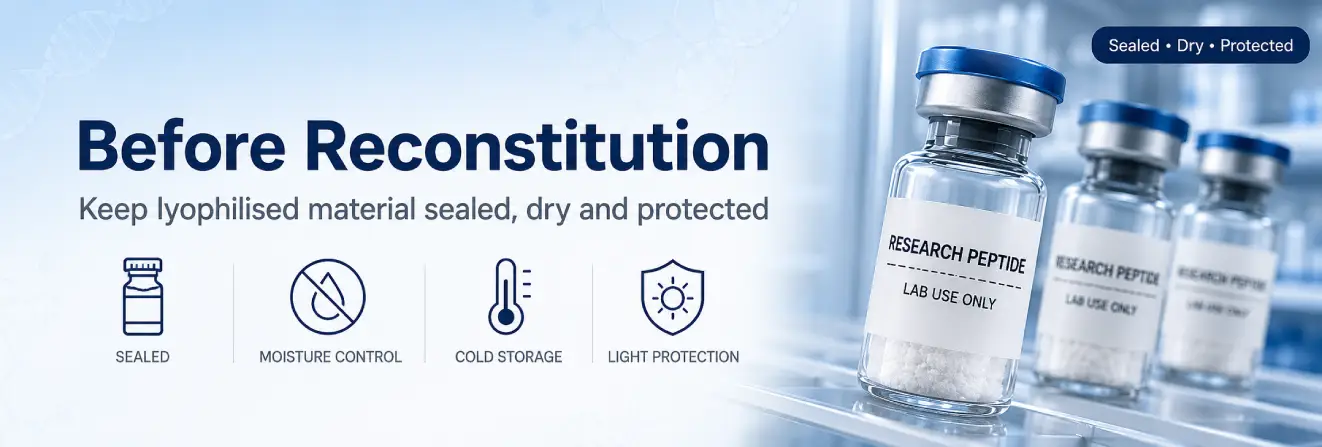
Reta peptide storage temperature before reconstitution should follow the instructions supplied with the exact Retatrutide peptide for research formulation.
General peptide-handling references often use frozen storage at approximately −20°C or colder for long-term preservation of lyophilised material. Refrigerated conditions of 2–8°C may be permitted for shorter-term storage where supported by the product documentation.
These ranges are general handling references rather than universal guarantees for every retatrutide formulation.
Short-Term and Long-Term Storage
The appropriate condition partly depends on how soon the material will be handled.
Short-term stock may sometimes be kept under refrigeration when the accompanying specifications allow it. Longer-term storage commonly requires a stable freezer with monitored temperature control.
Colder storage is not the only consideration. The following factors are equally important:
- Whether the vial remains sealed.
- Whether the storage temperature is stable.
- How often the vial is removed.
- Whether the material is exposed to moisture.
- Whether the original packaging protects it from light.
- Whether the appliance uses automatic defrost cycles.
A stable, documented storage environment is more reliable than repeatedly transferring material between different temperatures.
Protecting Lyophilised Material From Moisture
Lyophilised peptides can absorb moisture from the surrounding air. Even a small amount of condensation may increase molecular movement and accelerate degradation.
Useful moisture-control measures include:
- Keeping the original vial tightly sealed.
- Using a suitable airtight secondary container.
- Storing the vial in a dry environment.
- Opening it only when necessary.
- Inspecting the stopper and crimp seal for damage.
- Using desiccant in the secondary container where appropriate.
Desiccant should not come into direct contact with the peptide unless the packaging system was designed for that purpose.
Warming a Cold Vial Before Opening
A cold lyophilised vial should generally be allowed to approach room temperature while it remains sealed.
Opening a very cold vial in warmer, humid air can cause condensation to form inside the container. This introduces moisture directly to material intended to remain dry.
A suitable handling sequence is:
- Remove the sealed vial from cold storage.
- Keep it closed while its temperature gradually equilibrates.
- Protect it from sunlight and direct heat.
- Open it only after the temperature difference has reduced.
- Complete the required handling efficiently.
- Reseal it properly and return it to the specified storage condition.
Do not use hot water, heaters or other rapid warming methods.
Light Protection
Direct sunlight and strong ultraviolet exposure may contribute to peptide degradation.
Light exposure can be reduced by:
- Keeping the vial in its original box.
- Using an amber vial where supplied.
- Placing clear vials inside an opaque secondary container.
- Avoiding windows and direct sunlight.
- Limiting unnecessary exposure under strong lighting.
Any protective covering should leave the product name, lot number and storage instructions readable.
Opened and Unopened Vials
An unopened vial normally has better protection from moisture, oxygen and contamination.
Once the container has been opened or its stopper punctured, the original shelf-life assumptions may no longer apply. The following information should then be recorded:
- Date first opened.
- Number of times accessed.
- Condition of the stopper and seal.
- Any visible moisture.
- Any known temperature excursions.
- Date returned to cold storage.
A vial with an unknown opening history should not be treated as equivalent to unopened stock.
Retatrutide Storage After Reconstitution
Retatrutide storage after reconstitution depends on the composition of the final solution. The diluent, concentration, pH, preservative system, container and handling method may all affect stability.
Refrigeration is commonly used for short-term peptide-solution storage, but no universal number of days can be assigned to every formulation.
Refrigerated Storage
Where supported by the product documentation, reconstituted solutions are commonly stored at 2–8°C.
To maintain a more consistent refrigerated environment:
- Keep the vial away from the refrigerator door.
- Store it towards the centre or rear of the appliance.
- Avoid direct contact with a cooling plate.
- Protect it from the internal refrigerator light.
- Return it promptly after handling.
- Monitor the temperature where the vial is actually stored.
- Record minimum and maximum temperatures where possible.
Household refrigerators may experience changes caused by frequent opening, uneven airflow, overfilling and automatic cooling cycles.
The appliance setting alone does not confirm the temperature around the vial.
Can Reconstituted Reta Peptide Be Frozen?
Reconstituted material should not be frozen unless the exact formulation has documented instructions allowing it.
Freezing a peptide solution may create:
- Ice crystals.
- Localised concentration changes.
- Buffer pH shifts.
- Precipitation during thawing.
- Structural changes that are not visible.
Some controlled research protocols freeze single-use aliquots, but this does not mean freezing is suitable for every reconstituted product.
Repeated freeze–thaw cycles should be avoided because each cycle exposes the solution to further physical and chemical stress.
Diluent, pH and Concentration
Storage recommendations cannot be separated from the composition of the reconstituted solution.
Different diluents, including bacteriostatic water for peptide when specified by the product protocol, may affect:
- Surface adsorption.
- Microbial growth.
- Buffer stability.
- Compatibility with the intended research method.
The final pH may influence molecular charge, solubility and degradation pathways.
Concentration also matters. Very dilute solutions may lose a larger proportion of material through adsorption to container surfaces, while concentrated solutions may be more likely to aggregate or precipitate.
The selected diluent, concentration and preparation date should always be documented.
Aliquoting and Repeated Access
Aliquoting means transferring the solution into smaller quantities intended for separate uses.
When supported by a suitable handling protocol, it may reduce:
- Repeated access to the original vial.
- Exposure to air and light.
- Temperature cycling.
- Stopper punctures.
- Repeated freeze–thaw cycles where freezing is validated.
Aliquoting can create additional risks if the transfer container is unsuitable, non-sterile or prone to surface adsorption.
Each container should be labelled with the material name, lot number, concentration, preparation date and required storage condition.
Reta Peptide Storage Time
Reta peptide storage time cannot be determined from temperature alone. It also depends on the material form, formulation, packaging, seal integrity and complete storage history.
Online sources may provide timeframes ranging from weeks for reconstituted solutions to months or years for unopened lyophilised material. These figures usually describe different conditions and should not be treated as interchangeable.
Storage Time Before Reconstitution
For unopened lyophilised material, use the labelled expiry or validated shelf life provided for the product.
That timeframe generally assumes:
- The vial remains unopened.
- The seal is undamaged.
- The required temperature is maintained.
- The product stays dry.
- Light exposure is controlled.
- The material remains in its original packaging.
- No significant temperature excursion occurs.
If one or more of these conditions is not met, the labelled shelf life may no longer be a reliable indication of material integrity.
Storage Time After Reconstitution
Reconstitution creates a new and normally shorter storage period.
The appropriate period depends on:
- The exact formulation.
- The selected diluent.
- The final pH.
- The concentration.
- Whether a preservative is present.
- The storage temperature.
- The number of times the vial is accessed.
- The container material.
- Light exposure.
- Available chemical and microbiological stability data.
Claims that every reconstituted vial lasts exactly 28, 30 or 60 days are too broad. A timeframe established for one formulation should not be applied automatically to another.
Where no validated post-reconstitution period is available, do not select the longest estimate found online.
Why Storage-Time Recommendations Conflict
Different sources may be referring to entirely different conditions, such as:
- Unopened lyophilised powder.
- Opened dry material.
- A solution prepared with a particular buffer.
- A preserved multi-access vial.
- An unpreserved laboratory solution.
- A frozen single-use aliquot.
- A short analytical experiment.
- Visual appearance rather than tested chemical purity.
The word “stable” may also have different meanings.
It might mean:
- No visible change.
- A specified percentage of purity remains.
- Concentration remains within an acceptable range.
- No microbial contamination is detected.
- The material continues to perform in a particular assay.
- The product remains within an internally defined specification.
These measures are not equivalent.
Factors That Affect Reta Peptide Storage Time
| Factor | Why it matters | What to check |
| Material form | Dry and liquid material degrade differently | Is it lyophilised or reconstituted? |
| Seal status | Opening increases environmental exposure | Has the vial been opened or punctured? |
| Temperature history | Excursions may accelerate degradation | Were temperatures recorded? |
| Diluent | Solution composition affects stability | What liquid was used? |
| pH | May affect solubility and degradation | Is the final pH known? |
| Concentration | May affect adsorption and aggregation | Is the concentration documented? |
| Light | May contribute to photodegradation | Was the vial protected? |
| Container | Surface compatibility affects material recovery | Was a suitable container used? |
| Handling frequency | Repeated access increases variability | How often was it removed or opened? |
| Stability evidence | Generic advice may not apply | Is product-specific data available? |
Expiry Date Versus Reconstitution Date
The original expiry date normally applies to the unopened product when stored under the conditions stated on the label.
It should not automatically be used as the expiry date for a reconstituted solution.
After reconstitution, record:
- The date prepared.
- The diluent used.
- The final concentration.
- The required storage temperature.
- Any applicable review or discard date.
- Any temperature excursions.
- The number of times the vial has been accessed.
What to Do After a Temperature Excursion

A temperature excursion occurs when the material is exposed to conditions outside its specified range.
Do not make a decision based only on whether the vial still looks normal. The material form, maximum temperature, exposure duration and product-specific limits must all be considered.
Material Left at Room Temperature
Lyophilised material generally tolerates brief temperature changes better than a reconstituted solution, but that does not make every room-temperature exposure acceptable.
Record:
- Whether the material was dry or reconstituted.
- Whether the vial remained sealed.
- The estimated temperature.
- The exposure duration.
- Whether it was exposed to sunlight.
- Whether condensation was visible.
- Whether similar excursions happened previously.
Return it to the specified storage condition unless the product instructions state otherwise.
Refrigerator or Freezer Power Failure
Keep the appliance closed where possible during a power failure. Opening the door allows cold air to escape and speeds up warming.
Document:
- When the outage began.
- When power returned.
- The highest recorded temperature.
- Whether the appliance was opened.
- Where the material was stored.
- Whether it remained frozen, chilled or became warm.
A thermometer or data logger with minimum and maximum records makes the assessment more reliable.
Reconstituted Material Frozen Accidentally
Accidental freezing may affect a solution even if it appears clear after thawing.
Record the approximate freezing duration and thawing conditions. Check for cloudiness, particles, sediment, colour change or visible separation.
Do not repeatedly freeze and thaw the vial while assessing it. The absence of visible changes does not confirm that its original integrity has been preserved.
Delivery Delays and Australian Heat
Australian transport conditions can expose parcels to substantial heat, especially when packages are left in vehicles, outdoor delivery areas or parcel lockers.
On delivery:
- Record the arrival time.
- Inspect the external packaging.
- Check any temperature indicator provided.
- Note the condition of cold packs.
- Photograph damaged or unusually warm packaging.
- Transfer the material promptly to the specified storage condition.
- Separate it from confirmed usable stock if its temperature history is uncertain.
A warmed cold pack does not prove that the material has degraded, but it indicates that the shipping conditions should be reviewed.
How to Minimise Avoidable Storage Problems
Consistent handling and accurate records are more reliable than repeatedly changing storage conditions.
Maintain a Stable Temperature
Store the vial in a suitable position and avoid removing it unnecessarily.
Measure temperature where the material is stored rather than relying entirely on the number displayed by the appliance.
Avoid Refrigerator and Freezer Doors
Appliance doors experience frequent warming whenever they are opened. Door shelves may also be exposed to more movement and light.
Keep temperature-sensitive material in a protected secondary container towards the centre or rear of the appliance, without placing it where it may accidentally freeze.
Control Light and Moisture
Keep the vial in its original protective packaging whenever practical.
Store clear containers inside an opaque secondary box and avoid leaving material near windows or under direct light.
Keep lyophilised vials sealed while they warm to room temperature to minimise condensation.
Limit Repeated Handling
Repeated handling may increase:
- Temperature cycling.
- Light exposure.
- Air exchange.
- Contamination risk.
- Damage to the closure.
- Material loss through surface adsorption.
- Labelling errors.
Prepare the required workspace before removing the vial from storage so it can be returned promptly.
Keep Complete Records
Useful storage records include:
- Compound name.
- Lot or batch number.
- Date received.
- Labelled expiry.
- Date first opened.
- Date reconstituted.
- Diluent and concentration.
- Required temperature.
- Storage location.
- Temperature excursions.
- Number of freeze–thaw cycles where relevant.
- Review or discard date.
Signs Reta Peptide May Be Compromised
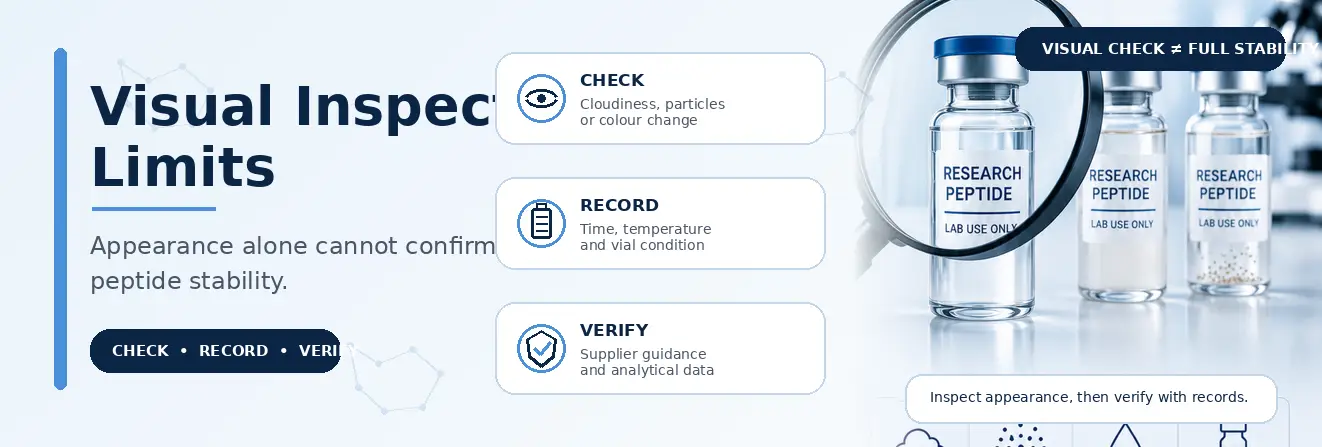
Visible changes can provide a warning, but they cannot confirm potency, peptide purity or sterility.
Visible Changes in a Reconstituted Solution
Potential warning signs include:
- Unexpected haze.
- Floating particles.
- Flakes or fibres.
- Unusual colour.
- Separation into visible layers.
- A leaking vial.
- A damaged stopper.
Unexpected changes should not be ignored simply because the material remains within an estimated storage period.
Changes in Lyophilised Material
Possible concerns include:
- Visible moisture or droplets.
- A wet-looking or collapsed powder cake.
- A cracked vial.
- A loose crimp seal.
- A damaged stopper.
- Unexplained material around the closure.
- Loss of vacuum where a vacuum seal was expected.
Some differences in appearance may result from manufacturing rather than degradation. Product-specific documentation is needed to interpret them correctly.
Why Appearance Is Not Enough
Clear, colourless material may still have experienced:
- Concentration loss.
- Reduced activity.
- Low-level contamination.
Storage history is therefore essential even when no visible change is present.
Specialised testing may be required when the integrity of important research material must be confirmed.
Reta Peptide Storage Reddit Advice: What to Trust
Reta peptide storage Reddit discussions may reveal common questions, but they are not a substitute for validated storage information.
Users may be describing different formulations, diluents, concentrations and storage appliances while using the same general product name.
Common Online Claims
Frequently repeated claims include:
- Every lyophilised vial lasts for several years.
- Every reconstituted solution lasts the same number of days.
- Freezing never damages peptide solutions.
- A clear solution remains fully unchanged.
- Leaving a vial out overnight never matters.
- Household refrigerators maintain a constant temperature.
- All peptides have the same storage requirements.
Each statement omits conditions that can materially affect stability.
Why Personal Experiences Differ
Reports may vary because of differences in:
- Product formulation.
- Packaging quality.
- Refrigerator performance.
- Local heat and humidity.
- Diluent composition.
- Final concentration.
- Number of vial entries.
- Light exposure.
- Storage duration.
- How the person decided the material remained acceptable.
A claim that something “still worked” or “still looked fine” does not establish unchanged purity or identity.
How to Assess an Online Storage Claim
Before relying on a recommendation, check whether it identifies:
- The exact material and formulation.
- Whether it was lyophilised or reconstituted.
- The actual temperature.
- The duration of storage or exposure.
- The diluent and concentration.
- Whether the vial was opened.
- The number of freeze–thaw cycles.
- The test used to assess stability.
- The original source of the recommendation.
Claims without these details should be treated as personal observations rather than storage specifications.
Australian Regulatory and Safety Context
As of July 2026, Australia’s Therapeutic Goods Administration identifies products containing retatrutide as examples of unapproved peptide products that are not included in the Australian Register of Therapeutic Goods. These products have not been assessed by the TGA for safety, quality or effectiveness. Retatrutide also remains under investigation in registered clinical trials.
Correct storage does not establish that an unapproved product is authentic, sterile, safe or suitable for human use. It also cannot compensate for unknown manufacturing quality, incorrect labelling or an uncertain supply chain.
Storage information should remain separate from:
- Dosage recommendations.
- Injection instructions.
- Weight-loss protocols.
- Therapeutic claims.
- Claims of safety or effectiveness.
- Encouragement of self-administration.
Reta Peptide Storage Checklist
Use this checklist when receiving, storing or reviewing the material:
- Confirm whether it is lyophilised or reconstituted.
- Read the product-specific storage instructions.
- Record the lot number and labelled expiry.
- Inspect the vial and seal on arrival.
- Transfer it promptly to the specified storage condition.
- Protect it from direct light.
- Keep lyophilised material dry.
- Allow a cold dry vial to equilibrate while sealed.
- Record the date first opened.
- Record all reconstitution details.
- Avoid unnecessary temperature cycling.
- Do not freeze a solution unless expressly permitted.
- Minimise repeated vial access.
- Record temperature excursions immediately.
- Do not rely solely on visual appearance.
- Separate material with an unknown storage history.
- Use the earliest applicable review or expiry date.
Effective reta peptide storage begins with identifying whether the material is lyophilised or reconstituted. Dry material is generally more stable but still requires protection from moisture, light and temperature fluctuations. Reconstituted material needs closer control because its stability depends on the solution composition, temperature, container and handling history.
No single temperature or storage period applies to every retatrutide formulation. Product-specific documentation and validated stability information should take priority over generic timeframes or forum advice.
Clear labelling, stable temperature control and accurate excursion records provide a more reliable basis for storage decisions than visual appearance alone.
FAQs about reta peptide storage:
What happens if I forget to refrigerate my reta peptide?
The impact depends on the form of the material, the temperature it reached and how long it remained outside the recommended range.
Lyophilised reta peptide is generally more tolerant of short temperature changes than a reconstituted solution, particularly when the vial remains sealed. Even so, exposure to heat, moisture or direct light may reduce its long-term stability.
Reconstituted material requires greater caution because the presence of liquid can accelerate chemical degradation and increase contamination risk.
Record the approximate temperature, exposure time and whether the vial was opened. Return it to the specified storage condition and follow the product-specific guidance. Material with an uncertain storage history should be kept separate until its condition can be properly assessed.
How long will reta peptide last in the fridge?
There is no single refrigerated shelf life that applies to every reta peptide formulation.
For lyophilised material, the correct storage period should come from the product label or supporting technical information. Refrigeration may be acceptable for short-term storage, while colder conditions may be required for longer preservation.
For reconstituted material, reta peptide storage time depends on the diluent, pH, concentration, container, handling frequency and microbial controls. General figures such as 28, 30 or 60 days should only be used when they are supported for the exact formulation.
How long can reta peptide remain out of the fridge?
A universal room-temperature limit has not been established for all reta peptide products.
A sealed lyophilised vial may withstand a brief temperature excursion better than a reconstituted solution. Its condition still depends on the temperature reached, the duration of exposure, humidity, light and packaging.
Reconstituted material should be assessed more carefully. The 21-day room-temperature limit used for some approved medicines should not be applied automatically to reta peptide storage.
Document the excursion and compare it with the instructions provided for the specific material.
Can retatrutide be stored at room temperature?
Room temperature should not be treated as the standard condition for long-term retatrutide storage.
Sealed lyophilised material may tolerate short periods at room temperature during transport or handling. However, routine storage commonly requires controlled cold conditions.
Reconstituted material generally needs more consistent temperature control and usually has a shorter storage window. Always follow the instructions for the specific formulation rather than applying storage rules from other peptide medicines.
How should reta peptide be transported?
Transport conditions should match the reta peptide storage requirements provided for the exact product.
Where cold transport is required:
- Use appropriate insulated packaging.
- Shield the vial from direct sunlight and moisture.
- Prevent direct contact with frozen packs unless protective separation is provided.
- Keep the journey as short as practical.
- Monitor the temperature where possible.
- Transfer the material to the required storage condition promptly after arrival.
In hot Australian weather, avoid leaving temperature-sensitive material in a parked vehicle, outdoor delivery box or heated parcel locker.
What happens if reconstituted reta peptide freezes?
Freezing a reconstituted solution may cause ice-crystal formation, local concentration changes, pH variation, aggregation or precipitation.
Thawing the solution does not confirm that its original condition has been restored. Look for cloudiness, particles, sediment, colour changes or separation, while recognising that some forms of degradation may not be visible.
Avoid exposing the vial to further freeze–thaw cycles. Any decision about continued handling should rely on formulation-specific freeze–thaw data rather than appearance alone.
Sources:
-ClinicalTrials.gov provides access to registered retatrutide clinical trials and their current research status.
-The National Institute for Biological Standards and Control publishes official peptide handling and storage guidance covering temperature, moisture, light and reconstituted solutions.
-The World Health Organization provides guidance for the storage and transport of time- and temperature-sensitive pharmaceutical products.