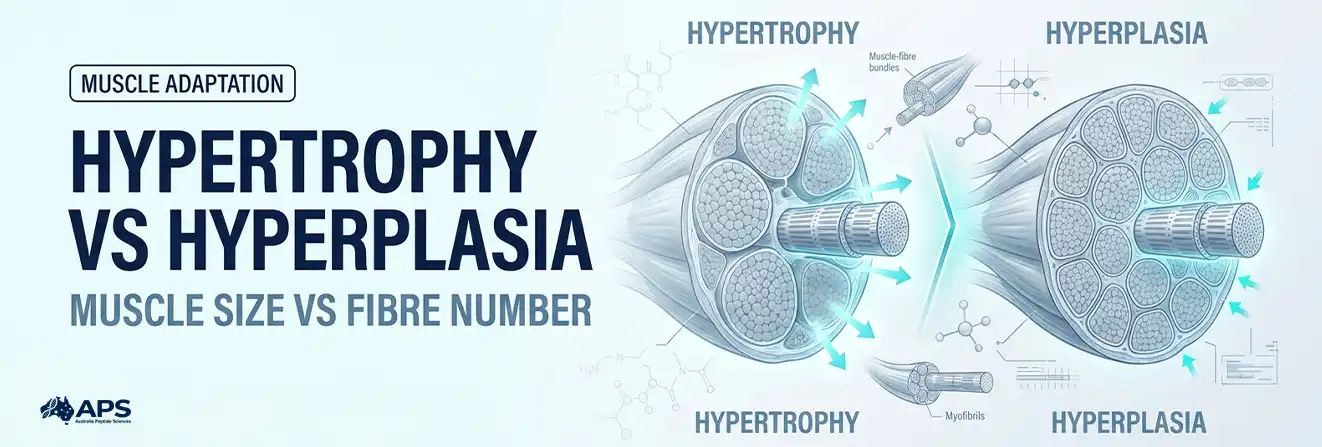
Hypertrophy vs hyperplasia describes two fundamentally different ways skeletal muscle can become larger: existing muscle fibres can increase in size, or the total number of muscle fibres can increase. Both mechanisms are biologically relevant, but the strength of human evidence differs substantially between them.
Muscle hypertrophy is well established in human skeletal muscle. Resistance training can increase whole-muscle size and the cross-sectional area of individual fibres. Muscle hyperplasia, by contrast, refers to an increase in fibre number.
Although it has been demonstrated in several animal models, current human intervention studies have not shown a meaningful increase in estimated muscle fibre number after resistance training.
Hypertrophy vs Hyperplasia: What Is the Key Difference?
The simplest distinction is size versus number. Hypertrophy enlarges muscle fibres that already exist. Hyperplasia would increase the number of fibres within a muscle.
| Feature | Hypertrophy | Hyperplasia |
| Primary change | Existing muscle fibres become larger | Total muscle fibre number increases |
| Structural outcome | Greater fibre cross-sectional area | New myofibres or additional fibres |
| Human evidence | Strong | Limited and unresolved |
| Resistance-training evidence | Consistently demonstrated | Not demonstrated in current human intervention data |
| Satellite-cell role | Can support growth through myonuclear addition | Proposed in new-fibre formation, but not established as a training response in humans |
| Main research challenge | Determining true tissue and fibre growth | Reliably estimating total fibre number |
More myofibrils within an existing muscle fibre indicate structural growth of that fibre, not an increase in the total number of fibres. Likewise, adding nuclei to an existing fibre does not by itself represent hyperplasia.
What Is Muscle Hypertrophy, and What Changes Inside a Muscle Fibre?
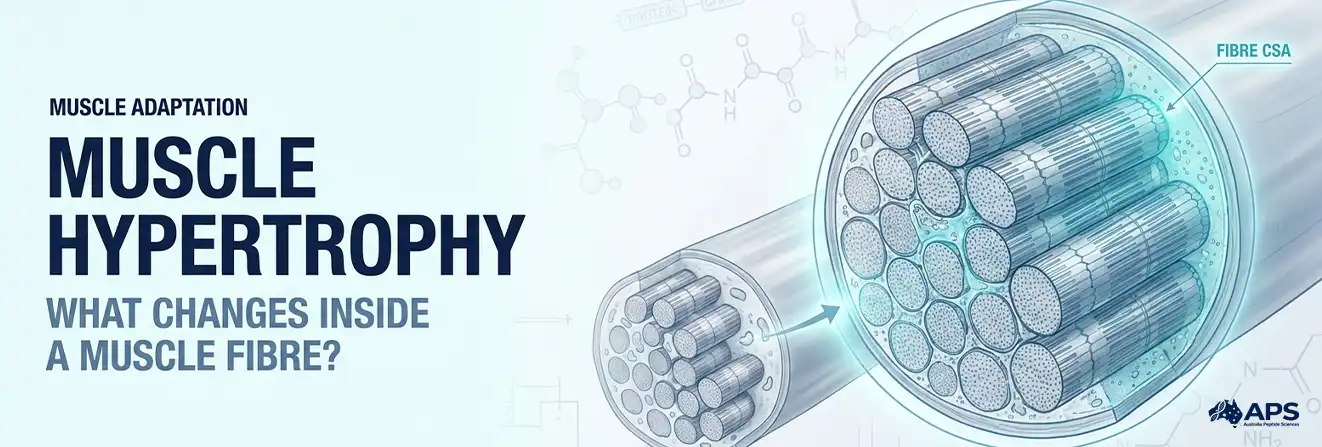
Muscle hypertrophy is the enlargement of existing skeletal muscle fibres, reflected in increases in muscle thickness, cross-sectional area and volume. Because skeletal muscle is organised from whole muscle to fascicles, fibres, myofibrils and sarcomeres, hypertrophy can be assessed at both tissue and microscopic levels.
1. Muscle Fiber Cross-Sectional Area: What It Actually Measures
Muscle fiber cross-sectional area, or fibre CSA (fCSA), estimates the size of an individual fibre in cross-section. An increase in average fibre CSA after training supports hypertrophy at the cellular level.
Whole-muscle cross-sectional area measures a different outcome. MRI and ultrasound can show that a muscle region has enlarged, but they cannot confirm that every fibre increased equally. Hypertrophy can also vary across regions, alongside changes in fascicle length and pennation angle, so a single measurement site may not represent the whole muscle. A 2024 review highlighted this regional variation in exercise-induced changes in muscle size and architecture.
2. What Becomes Larger Inside a Muscle Fibre During Hypertrophy?
A hypertrophying fibre undergoes structural and biochemical remodelling involving contractile proteins, myofibrillar organisation, sarcoplasmic components, glycogen-associated water and other cellular material.
Although “myofibrillar hypertrophy” and “sarcoplasmic hypertrophy” are sometimes presented as independently trainable forms of growth, the evidence is more nuanced. Different cellular components can change at different rates, but current research on load-induced human skeletal muscle hypertrophy does not support treating sarcoplasmic expansion as a simple, separately trainable form of long-term muscle growth.
APS explores these mechanisms in more detail in its guide to muscle growth. In this context, the important distinction is whether greater muscle size reflects larger existing fibres, additional fibres, or other structural adaptations
What Is Muscle Hyperplasia, and Does It Increase Fibre Number?
Muscle hyperplasia is an increase in the total number of muscle fibres, not simply greater muscle mass, myofibrils, nuclei or protein content. Although it occurs during development in several species, whether adult human muscle can meaningfully increase fibre number through resistance training remains unresolved.
Myofiber Formation Is Not the Same as Fibre Enlargement
Myofiber formation creates new fibres, while hypertrophy enlarges existing ones. Small, branching, or regenerating fibres do not alone prove an increase in total functional fibre number.
Two mechanisms have been proposed for adult hyperplasia:
- formation of new myofibres from muscle stem or progenitor cells;
- splitting or branching of existing fibres into separate fibres.
Both remain plausible in experimental models, but neither has been established as a meaningful adaptation to ordinary resistance training in adult humans, partly because total fibre number is difficult to measure accurately.
What Cellular Mechanisms Support Skeletal Muscle Hypertrophy?
The cellular mechanisms of muscle growth involve multiple interacting pathways rather than a single hormone or signal. Skeletal muscle adaptation begins with mechanical and metabolic demands that alter intracellular signalling, gene expression, protein turnover and cellular structure. Separate laboratory research also investigates compounds such as CJC-1295 DAC in models of growth hormone signalling; these studies should not be interpreted as evidence that the compound directly drives resistance-training hypertrophy.
Mechanical tension is a major stimulus for load-induced hypertrophy. Mechanosensitive structures convert force into intracellular signals linked to mTORC1 activity, ribosome biogenesis and translational capacity, supporting muscle growth through protein accumulation and structural remodelling over repeated training and recovery cycles. Related laboratory models also examine GHRP peptides in research on growth hormone signalling, recovery pathways and muscle adaptation.
Hypertrophy is therefore not simply the result of “micro-tears”. Muscle damage may occur after unfamiliar exercise, but it is not required for muscle growth. Research on muscle damage and resistance-training hypertrophy shows that hypertrophy can occur even when training produces relatively little muscle damage.
How Do Satellite Cells Contribute to Myonuclear Accretion?
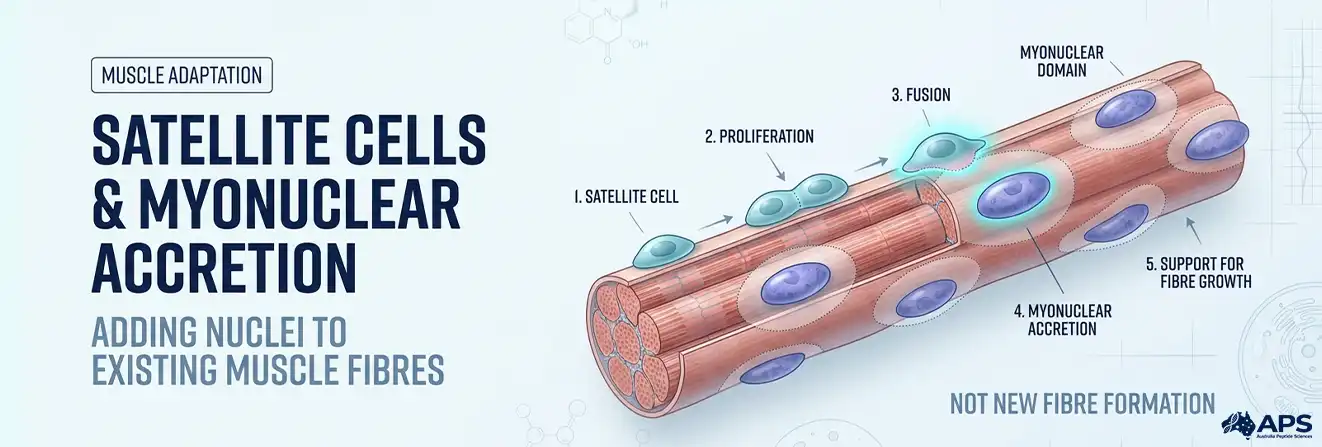
Skeletal muscle fibres contain multiple nuclei, and satellite cells can add new nuclei by proliferating and fusing with existing fibres.
1. Myonuclear Accretion
Myonuclear accretion can support the transcriptional and biosynthetic demands of growing fibres.
A systematic review and meta-analysis of muscle fibre hypertrophy and myonuclei addition found that myonuclei can increase even when fibre hypertrophy is modest.
Adding nuclei to an existing fibre does not create a new fibre, so hypertrophy and myonuclear accretion can occur without hyperplasia.
APS also discusses these pathways in its guide to growth hormone vs igf 1, while compounds such as Ipamorelin are studied in laboratory models of growth hormone signalling.
2. What Does the Myonuclear Domain Theory Mean for Muscle Growth?
The myonuclear domain theory proposes that each nucleus supports part of the muscle fibre. As fibres grow, additional nuclei may help maintain cellular function.
Rather than a fixed ceiling, current evidence suggests myonuclear domains vary by fibre type, physiological state and location. Myonuclear accretion can therefore support fibre enlargement without implying that an adult human fibre must split to form a new fibre.
Explore our Shop for research peptides
Does Muscle Hyperplasia Occur in Humans?
Evidence for exercise-induced skeletal muscle hyperplasia in adult humans remains limited.
1. What Does Human Resistance-Training Evidence Show?
A systematic review and meta-analysis published online in 2025 and in print in 2026 included 11 resistance-training studies estimating fibre number in the biceps brachii or vastus lateralis. Across these studies, resistance training did not significantly increase estimated muscle fibre number, and results were not meaningfully affected by training status, intervention duration or muscle group.
This does not rule out human hyperplasia entirely. The interventions lasted up to about six months, and total fibre number is difficult to estimate accurately. Current evidence therefore does not demonstrate a meaningful increase in muscle fibre number after resistance training in adult humans.
2. What Do Animal Studies Tell Us About Muscle Hyperplasia?
An earlier meta-analysis of 17 animal studies examining mechanical overload and skeletal muscle fibre hyperplasia found increases in fibre number under some forms of mechanical overload, with larger effects reported in stretch-overload models.
However, many animal protocols involve chronic stretching, surgical manipulation or other conditions unlike conventional human resistance training. Animal studies therefore show that hyperplasia is biologically possible, but they do not establish its magnitude or practical relevance in adult humans.
Why Is Muscle Hyperplasia So Difficult to Measure in Humans?
Proving hyperplasia requires evidence that total fibre number has increased, which is considerably harder than detecting an increase in muscle size.
1. Why Muscle Biopsy Sampling Has Important Limitations
Human muscle biopsies are valuable, but they sample only a tiny fraction of a muscle. A histology section may contain dozens or hundreds of fibres, while the complete muscle contains vastly more.
The same fibres also cannot usually be sampled before and after an intervention. Differences between biopsy locations can therefore affect estimates of fibre size, fibre type distribution and other microscopic outcomes.
More recent human muscle biopsy research shows that muscle fibre characteristics can vary across sampling locations within the same muscle. This means a small local biopsy may not fully represent whole-muscle changes.
2. Why Estimated Fibre Number Is Not a Direct Count
Researchers often estimate fibre number as:
Estimated fibre number = whole-muscle cross-sectional area ÷ average single-fibre cross-sectional area
If whole-muscle area increases more than average fibre area, the estimate may suggest additional fibres. However, regional hypertrophy, variation in fibre size, pennation angle, fascicle length, sampling error, non-contractile tissue and mismatched imaging or biopsy sites can affect the result.
Because directly counting every fibre is impractical in living human muscle, adult hyperplasia remains partly a measurement challenge.
For a clearer scientific explanation of hyperplasia and the different forms of muscle hypertrophy, this educational physiology video provides a useful visual overview.
Muscle Cell Size vs Number: Why the Distinction Matters
The muscle cell size vs number distinction is essential for interpreting muscle-growth research accurately.
An increase in muscle volume does not show whether individual fibres became larger. Likewise, greater average fibre CSA does not prove uniform growth across the whole muscle. More myonuclei indicate myonuclear accretion, not new fibre formation, while greater contractile protein content does not establish hyperplasia.
Different measurements support different biological conclusions, as summarised below:
| Finding | What it supports | What it does not prove |
| Greater muscle thickness or volume | Whole-tissue enlargement | More muscle fibres |
| Greater average fibre CSA | Cellular hypertrophy in sampled fibres | Uniform growth across the muscle |
| More myonuclei per fibre | Myonuclear accretion | Hyperplasia |
| More satellite-cell activity | Muscle remodelling potential | Formation of functional new fibres |
| Higher estimated fibre number | Possible numerical change | Directly counted hyperplasia |
| New small or regenerating fibres | Repair or myogenesis | Net increase in mature whole-muscle fibre number |
Many apparent disagreements arise because studies measure different outcomes; muscle size, fibre size and fibre number are not interchangeable endpoints.
Hypertrophy as Part of Skeletal Muscle Plasticity
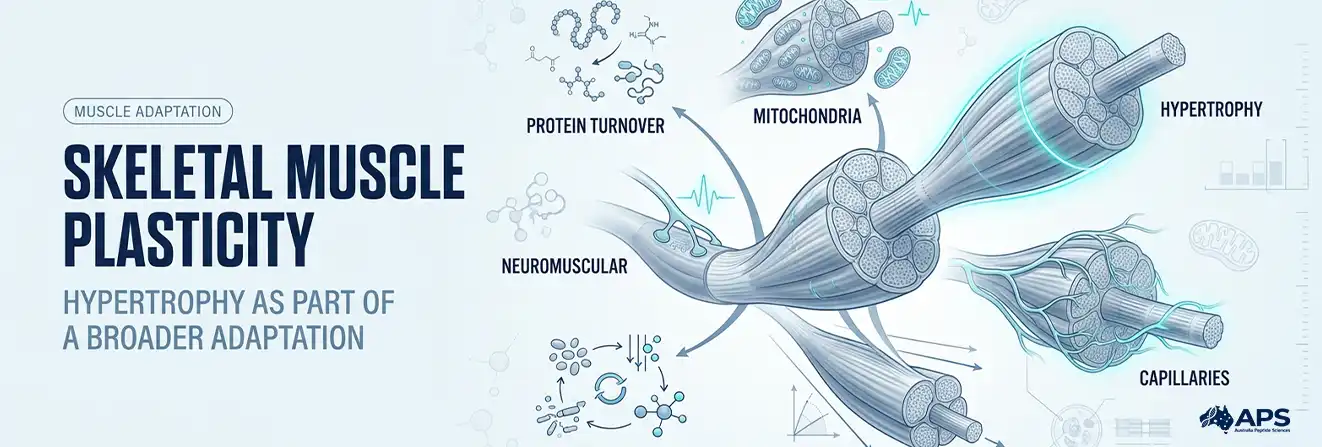
Skeletal muscle plasticity describes the capacity of muscle to adapt to loading, inactivity, energy demand and other stimuli. Hypertrophy is one form of this broader adaptation. Changes in muscle mass can also occur alongside changes in body fat, which is why body recomposition needs to be considered separately from the cellular distinction between hypertrophy and hyperplasia.
Exercise-induced muscle remodeling can also involve changes in:
- mitochondrial content and respiratory capacity;
- capillary density;
- substrate use and storage;
- fibre metabolic characteristics;
- fascicle length and pennation;
- neuromuscular function;
- protein turnover and quality control.
Current research shows that resistance and endurance exercise produce distinct but overlapping molecular and structural changes. This helps explain why skeletal muscle adaptation cannot be defined by a single pathway or measurement. Hormone-related research represents one separate area of investigation, including laboratory studies involving CJC-1295 No DAC and growth hormone signalling pathways.
APS discusses one distinct branch of this adaptation in its guide to mitochondrial biogenesis. That process expands and renews mitochondrial networks, whereas hypertrophy primarily concerns the size and structural organisation of muscle tissue.
Mechanisms of Skeletal Muscle Growth: What Does the Evidence Support?
The mechanisms of skeletal muscle growth are best understood as an evidence hierarchy rather than a list of equally established possibilities.
| Mechanism or observation | Current interpretation in adult humans |
| Enlargement of existing muscle fibres | Strongly supported |
| Increased muscle or fibre cross-sectional area | Strongly supported |
| Structural protein remodelling | Strongly supported |
| Satellite-cell activation | Supported |
| Myonuclear accretion | Supported, context dependent |
| Fixed myonuclear-domain ceiling | Not supported as a simple universal rule |
| Increased fibre number after resistance training | Not demonstrated |
| Hyperplasia as a major contributor to ordinary training adaptation | Unsupported by current human evidence |
Current human evidence does not support treating hypertrophy and hyperplasia as equally established training adaptations.
In adult human resistance training, hypertrophy is the demonstrated mechanism. Hyperplasia remains a research question whose contribution, if any, has not been quantified convincingly.
Hypertrophy vs Hyperplasia: What Can Researchers Conclude?
Human skeletal muscle clearly grows through the enlargement of existing fibres, supported by mechanical signalling, protein remodelling, satellite cell activity, and, in some cases, myonuclear accretion.
Hyperplasia is less certain. Animal models show that additional fibres can form under extreme overload, but current evidence from human resistance training does not demonstrate a meaningful increase in total fibre number.
This distinction is important when interpreting imaging, biopsies, fibre measurements and molecular markers, particularly because myonuclear addition should not be mistaken for new-fibre formation.
Discover more peptide research at Australia Peptide Sciences
FAQs About Hypertrophy vs Hyperplasia
What is the difference between hyperplasia and hypertrophy?
Hypertrophy increases the size of existing muscle fibres, while hyperplasia increases the total number of muscle fibres.
How to remember hypertrophy vs hyperplasia?
Think of hypertrophy as fibres becoming bigger and hyperplasia as the number of fibres becoming greater.
What triggers hyperplasia in muscles?
Some animal studies show hyperplasia after extreme mechanical overload or prolonged stretch, but no reliable trigger has been established in adult humans.
Is hypertrophy and hyperplasia reversible?
Hypertrophy can decrease when loading is reduced or stopped, while the reversibility of skeletal muscle hyperplasia in humans remains unclear because exercise-induced hyperplasia has not been firmly demonstrated.
What is a common example of hypertrophy in the body?
An increase in skeletal muscle fibre size after repeated resistance training is a common example of hypertrophy.
Why does hyperplasia happen?
Hyperplasia occurs when tissue increases its cell number, although the mechanisms and significance of skeletal muscle hyperplasia in adult humans remain unresolved.
Which is better, hypertrophy or hyperplasia?
Hypertrophy is the well-established mechanism of human muscle growth, while the practical contribution of hyperplasia in adult humans remains uncertain.
Can you give me an example of hyperplasia and hypertrophy?
Muscle fibre enlargement after resistance training is hypertrophy, while an increase in fibre number observed in some experimentally overloaded animal muscles is hyperplasia.
Can hyperplasia be measured directly in living human muscle?
Directly counting every muscle fibre is generally impractical in living humans, so studies typically rely on estimates derived from whole-muscle and single-fibre measurements.
What is the main cause of hypertrophy?
In skeletal muscle, repeated mechanical loading is a major stimulus that promotes the molecular and structural adaptations associated with hypertrophy.
Sources:
- Determining Changes in Muscle Size and Architecture After Exercise Training: One Site Does Not Fit All
- Load-induced human skeletal muscle hypertrophy: Mechanisms, myths, and misconceptions
- Mechanisms of mechanical overload-induced skeletal muscle hypertrophy: current understanding and future directions
- The development of skeletal muscle hypertrophy through resistance training: the role of muscle damage and muscle protein synthesis
- Muscle Fiber Hypertrophy and Myonuclei Addition: A Systematic Review and Meta-analysis
- A systematic review and meta-analysis examining if hyperplasia occurs in humans in response to resistance exercise
- Muscle biopsy research