
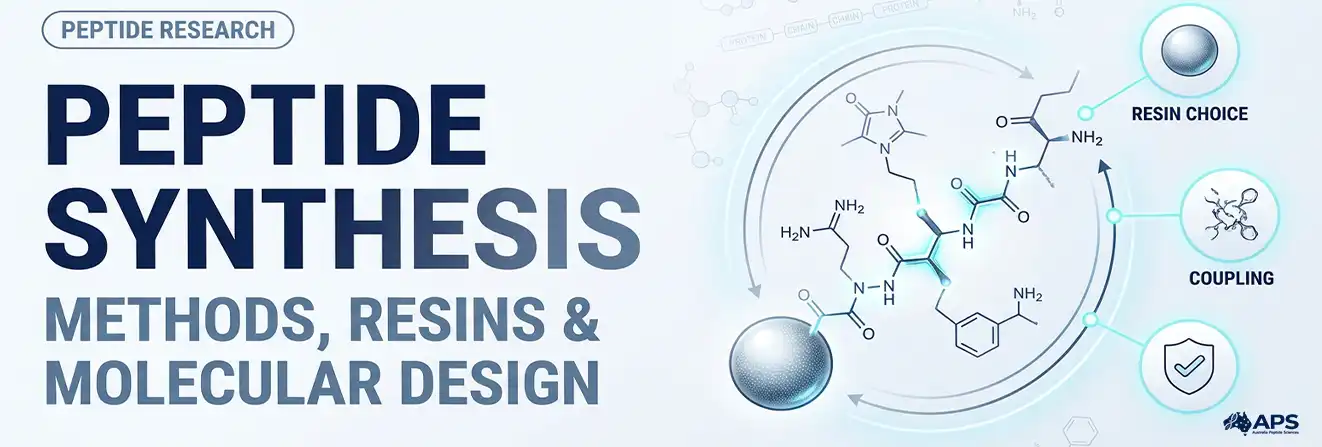
Peptide synthesis is the controlled chemical assembly of amino acids into a defined sequence. It relies on selective peptide-bond formation and a compatible combination of resin, protecting groups and coupling conditions.
The aim is not simply to build a chain. Chemists must also manage unwanted reactions and verify that the resulting research peptide matches its specified structure.
Quick Answer: How Does Peptide Synthesis Work?
Peptide synthesis starts by defining the molecular target and choosing a compatible chemical route. Chemists then protect reactive groups and join amino acids through controlled coupling reactions.
In solid-phase peptide synthesis (SPPS), the chain grows on a resin. After assembly, the peptide is released, purified and characterised.
Target Specification Before Peptide Synthesis
A peptide sequence lists amino acid residues from the N-terminus to the C-terminus. However, the sequence alone does not always define the complete chemical target.
Before selecting a peptide synthesis process, chemists must specify:
- Terminal groups: whether the C-terminus is a free acid or an amide, and whether the N-terminus is free or modified.
- Stereochemistry: the identity and configuration of any non-standard residues.
- Modifications: side-chain groups, isotopic labels and disulphide connectivity.
- Other material details: relevant counterions and the intended molecular form.
Two peptides can have the same residue order but different masses or chemical properties. The chosen route must accommodate these differences and produce an impurity profile that can be assessed analytically.
Peptide Bond Formation and Selective Coupling
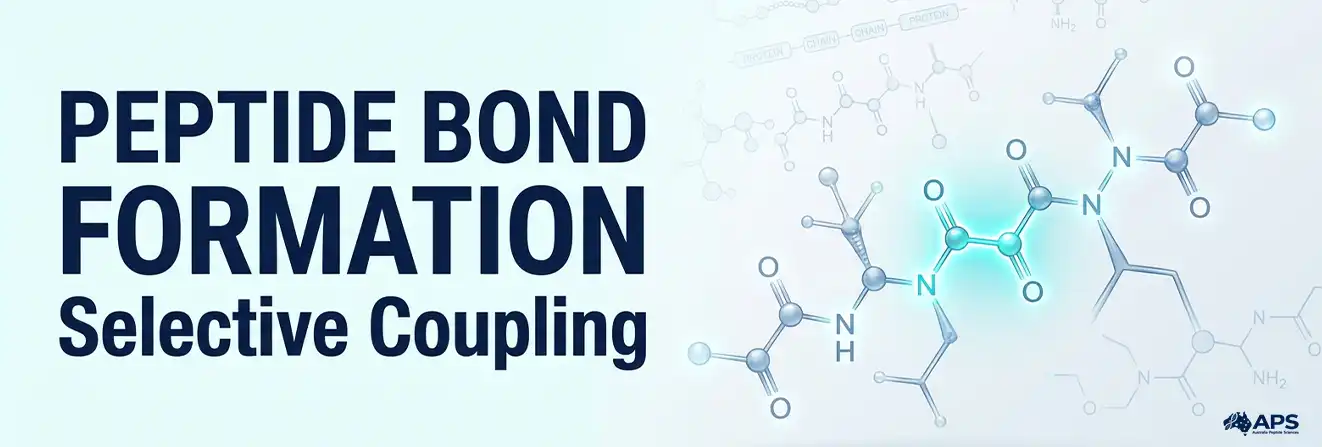
The peptide synthesis mechanism depends on forming the intended amide bond while keeping other reactive groups from interfering.
How the Peptide Bond Forms
A peptide bond connects the carboxyl group of one amino acid residue to the amino group of another. The tripeptide KPV, for example, contains two backbone peptide bonds.
During chemical assembly, protecting groups block sites that must remain unreactive. The selected carboxyl group is then activated for coupling to the growing chain.
Coupling Conditions and Impurities
An activated carboxyl group reacts with the exposed amino group of the growing peptide. Chemists may assess carbodiimide-based systems or selected uronium and phosphonium reagents.
The choice depends on residue chemistry, solvent, temperature, steric hindrance and epimerisation risk. Faster coupling does not necessarily produce a cleaner material.
If a coupling step is missed, later chain extension may generate a deletion sequence. Capping can terminate unreacted chains, while monitoring helps identify poor conversion before it affects subsequent cycles.
Peptide Synthesis Methods: Choosing a Route
Different peptide synthesis methods address different chemical constraints. SPPS builds a chain on a solid support, liquid-phase synthesis works in solution, and fragment assembly joins shorter peptide segments.
The wider production process, including biological and recombinant routes, is covered in our guide to how peptides are made.
| Chemical route | Main advantage | Main limitation |
| SPPS: chain attached to resin | Coupling and washing can be repeated or automated | Incomplete reactions can accumulate on the growing chain |
| Liquid-phase synthesis: intermediates in solution | Selected intermediates can be isolated and analysed | Isolation may increase time and material loss |
| Fragment assembly or ligation: shorter segments joined | May help with long or difficult targets | Fragment solubility and joining-site chemistry need careful design |
SPPS is useful when repeated washing simplifies stepwise assembly. Solution-based routes may suit intermediates that are easier to isolate.
The best choice depends on aggregation, chemical modifications and the intended molecular form, not chain length alone.
Resin and Linker Selection in Peptide Synthesis
In SPPS, the growing peptide is attached to an insoluble resin. A chemical linker connects the peptide to that support and influences how the chain is released.
The linker also helps determine the C-terminal group present after cleavage.
| Intended product | Common Fmoc-compatible support | Role |
| C-terminal carboxylic acid | Wang resin | Can release a peptide with a C-terminal acid |
| C-terminal amide | Rink amide resin | Can release a peptide with a C-terminal amide |
| Protected fragment | Selected 2-chlorotrityl-based linkers | Can permit release while retaining some protections, depending on conditions |
Resin Loading and Swelling
Resin loading affects how closely the growing peptide chains sit. Higher loading increases theoretical capacity but can promote aggregation or reduce reagent access.
Lower loading may help difficult sequences, although it reduces capacity. Resin swelling, solvent compatibility and linker stability must also be considered together.
The Fmoc solid-phase peptide synthesis literature explains why the support, protecting groups and cleavage strategy must function as one compatible system.
Fmoc and Boc Protecting Groups
Protecting groups prevent unwanted reactions during peptide chain extension. Temporary protection blocks the alpha-amino group, while separate groups may protect reactive side chains.
The key requirement is selective removal: chemists must expose the next coupling site without prematurely unprotecting the rest of the peptide.
Fmoc vs Boc in Peptide Synthesis
| Chemical feature | Fmoc strategy | Boc strategy |
| Temporary group removal | Basic conditions | Acidic conditions |
| Typical side-chain protection | Acid-labile groups in Fmoc/tBu schemes | Benzyl-type groups in classical Boc/benzyl schemes |
| Final deprotection | Often occurs near acid-mediated cleavage | Traditionally requires stronger acid conditions |
| Main compatibility concern | Base-sensitive sequences and linker choice | Repeated acid exposure and final cleavage chemistry |
In Fmoc peptide synthesis, temporary backbone protection can be removed while side-chain protection remains in place. This selective relationship is called orthogonality.
Classical Boc peptide synthesis uses a different removal pattern. Both approaches require matching the protecting groups, linker and final cleavage conditions to the target.
The Fmoc solid-phase peptide synthesis methods chapter explains why efficient removal of one protecting group does not, by itself, establish a successful route.
Deprotection Is Not the Same as Cleavage
Peptide deprotection may refer to removing the temporary N-terminal group between coupling cycles or removing side-chain protections after assembly.
Cleavage releases the peptide from the resin. In many Fmoc routes, cleavage and final side-chain deprotection occur together, but they remain distinct chemical events.
The SPPS Coupling Cycle and Monitoring
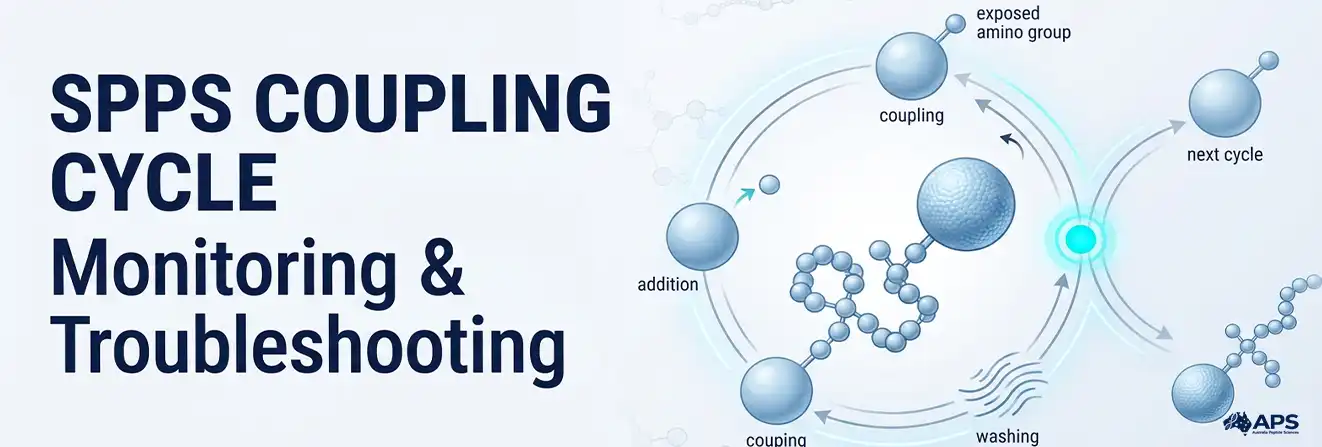
Each SPPS cycle exposes the terminal amino group, couples the next protected residue and washes away excess reagents.
Monitoring helps determine when to repeat a coupling, cap unreacted chains or adjust conditions before a difficult step affects later cycles.
Why Coupling Efficiency Matters
Small losses accumulate across repeated couplings. If each of 30 couplings succeeds for 99% of chains, roughly 74% would remain full-length before other losses.
At 98% success per coupling, that proportion drops to about 55%. These idealised figures are not isolated yields; cleavage, recovery and purification also affect the outcome.
Reaction Monitoring and Troubleshooting
A ninhydrin or Kaiser test can indicate unreacted primary amines. However, a negative result does not prove complete molecular identity, and secondary amines may require other methods.
A 2023 study of an alternative amine-detection method describes how additional monitoring can help assess selected SPPS reactions.
Slow coupling may respond to repetition. Aggregation, poor swelling or steric hindrance can require a different approach, while harsher conditions may increase epimerisation risk.
Defined sequences such as the BPC-157 research peptide still require sequence-specific route assessment and analytical evidence. No single SPPS workflow guarantees that every intended structure has been obtained.
In a parallel manual SPPS study, researchers reported higher average crude purity than in their in-house automated comparison. The result applies to the tested sequences and conditions, not every peptide target.
For a clearer understanding of Fmoc chemistry and its role in solid-phase peptide synthesis (SPPS), watch this educational video.
Sequence-Dependent Challenges in Peptide Synthesis
Even short research-only peptides can be difficult to assemble. Hydrophobic segments may aggregate on the resin, making the growing amino group less accessible.
A SynTag approach has been studied for selected aggregation-prone peptides. Its results are sequence-dependent and do not establish a universal solution.
Common Chemical Side Reactions
- Aspartimide formation: susceptible motifs, including Asp-Gly, can undergo unwanted reactions during basic Fmoc removal.
- Epimerisation: a residue may change stereochemistry without changing the molecular mass.
- Disulphide mispairing: cysteine-containing chains may form unintended connections.
- Oxidation and cleavage by-products: sensitive residues and protection systems can introduce additional impurities.
Managing Difficult Sequences
Repeated exposure to base can increase aspartimide formation in susceptible targets. Chemists may evaluate alternative side-chain and backbone protection strategies or adjust deprotection conditions.
Every correction needs a risk check. Changing resin loading, coupling conditions or protecting groups may solve one problem while introducing another.
Fragment Assembly and Chemical Ligation
For some long or aggregation-prone targets, shorter fragments can be prepared separately and then joined. Each fragment can be assessed before final assembly.
Native chemical ligation is one option. Its classical form joins a C-terminal peptide thioester with a fragment carrying an N-terminal cysteine to create a native peptide bond.
The joining site and fragment solubility can limit this approach. Modified strategies may offer more options, but compatibility still depends on the target.
Research into templated native chemical ligation has explored ways to favour the intended joining reaction while reducing selected side reactions.
Explore our Shop for research peptides.
Example: Choosing a Resin for Acid vs Amide
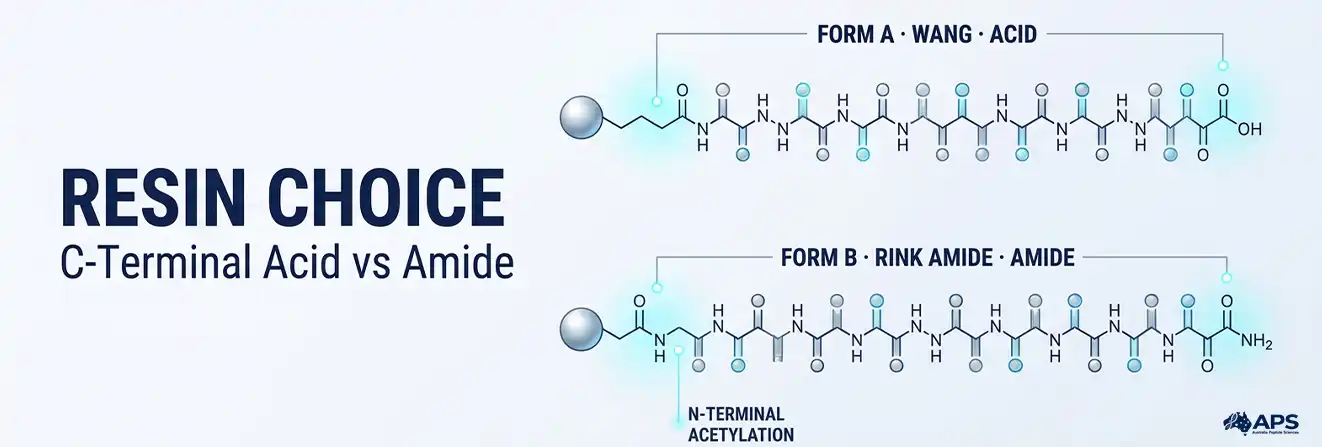
Two targets with the same amino acid sequence can need different resins and chemical specifications. Consider these hypothetical 18-residue forms:
| Specification | Form A | Form B |
| C-terminus | Free carboxylic acid | Amide |
| N-terminus | Not otherwise specified | Acetylated |
| Possible Fmoc-compatible linker | Wang-type | Rink amide |
For Form B, N-terminal acetylation must also be planned after chain extension. Any additional modifications must be compatible with the protection scheme.
Structural modifications matter. SS-31 illustrates this principle: its reported structure includes a C-terminal amide, D-arginine and a modified tyrosine residue.
Expected analytical values must therefore reflect the specified molecular form, not an unmodified amino acid sequence.
Sequence risks also matter. An Asp-Gly motif may increase aspartimide risk, while a hydrophobic region may complicate coupling. The synthesis specification should address both structure and foreseeable side reactions.
Purification and Characterisation After Cleavage
Peptide purification must account for impurities introduced by the chosen chemical route. A high crude recovery may still be unhelpful if a major impurity cannot be adequately separated.
| Chemical risk | Analytical concern | Important limitation |
| Missed coupling | Deletion sequence | A chromatogram alone may not reveal the missing residue |
| Epimerisation | Wrong stereochemistry | An epimer can have the expected mass |
| Oxidation | Altered chemical composition | The modification site may need further testing |
| Incorrect disulphide pairing | Wrong connectivity | Overall mass may remain unchanged |
What Analytical Tests Can Establish
Chromatography assesses the components detected by a defined method. Mass spectrometry helps determine whether measured signals match the expected molecular target.
However, a matching mass alone cannot establish sequence, stereochemistry or connectivity. Mass spectrometry of synthetic peptides may need to be supported by other characterisation methods.
Batch Evidence and Research Use Only
Batch-specific analytical information is available through the Peptide Certificates of Analysis (COAs).
For GHK-Cu, the Gly-His-Lys sequence identifies the peptide component, while copper coordination is part of the specified material. Identity assessment must account for both.
Analytical identity and purity do not establish clinical safety, therapeutic effectiveness or suitability for personal use. Research Use Only materials are intended solely for their labelled laboratory purposes, not human or veterinary administration.
Conclusion
Peptide synthesis depends on accurate target specification, compatible resin and protecting-group chemistry, and controlled coupling reactions.
Sequence-specific risks guide the chemical route. Purification and analytical testing then help determine whether the resulting research peptide matches its defined molecular form.
Visit the Australia Peptide Sciences
Frequently Asked Questions About Peptide Synthesis
What is the process of peptide synthesis?
Chemists join protected amino acids in a defined order, then remove protecting groups, purify the peptide, and verify its identity.
Can peptides be synthesised in a laboratory?
Yes. Chemical peptide synthesis requires trained personnel, appropriate equipment, chemical safety controls, purification capability, and analytical testing.
Is peptide synthesis difficult?
It can be, especially when a sequence aggregates, couples incompletely, or undergoes unwanted chemical side reactions.
How is BPC-157 synthesised?
The 15-residue BPC-157 research peptide can be assembled by stepwise chemical synthesis, followed by cleavage, purification, and analytical testing.
What are the four types of peptides?
There is no universal four-type classification; structural examples include linear, disulphide-linked, side-chain-cyclised, and head-to-tail cyclic peptides.
Is peptide synthesis legit?
Chemical peptide synthesis is an established laboratory technique, but each material still requires appropriate identity and purity evidence.
Is it legal to make peptides?
In Australia, requirements depend on the compound, intended purpose, and applicable chemical, research, and therapeutic goods regulations.
What is required for laboratory peptide synthesis?
Trained personnel, suitable equipment and reagents, chemical safety controls, purification methods, and analytical testing are required.
How much does it cost to synthesize a peptide?
Costs vary by length, sequence difficulty, modifications, quantity, purification requirements, and analytical testing.
What destroys peptides?
Depending on molecular structure and formulation, heat, moisture, oxidation, light, or unsuitable pH may cause degradation.
Sources
- Al Musaimi O, et al. Towards green, scalable peptide synthesis: leveraging DEG-crosslinked polystyrene resins to overcome hydrophobicity challenges. RSC Advances. 2024;14(54):40255-40266.
- Hansen PR, Oddo A. Fmoc Solid-Phase Peptide Synthesis. Methods in Molecular Biology. 2024;2821:33-55. DOI: 10.1007/978-1-0716-3914-6_3.
- Umeno T, et al. Quantitative and Nondestructive Colorimetric Amine Detection Method for the Solid-Phase Peptide Synthesis as an Alternative to the Kaiser Test. Analytical Chemistry. 2023;95(42):15803-15809.
- Overby C, et al. A Rapid Manual Solid Phase Peptide Synthesis Method for High-Throughput Peptide Production. Journal of Biomedical Materials Research Part A. 2025;113(5):e37922.
- Bürgisser H, et al. A Versatile “Synthesis Tag” (SynTag) for the Chemical Synthesis of Aggregating Peptides and Proteins. Journal of the American Chemical Society. 2024;146(50):34887-34899.
- Kong MJW, van den Braak TJHP, Neumann K. Aspartimide Formation and Its Prevention in Fmoc Chemistry Solid-Phase Peptide Synthesis. ChemBioChem. 2025;26(18):e202500490.
- Spaltenstein P, et al. Selective Activation of Peptide-Thioester Precursors for Templated Native Chemical Ligations. Angewandte Chemie International Edition. 2025;64(1):e202413644.
- Li M, et al. Discovery of novel SS-31 (D-Arg-dimethylTyr-Lys-Phe-NH2) derivatives as potent agents to ameliorate inflammation and increase mitochondrial ATP synthesis. RSC Advances. 2024;14(41):29789-29799.
- Chrone VG, Lorentzen A, Højrup P. Characterization of Synthetic Peptides by Mass Spectrometry. Methods in Molecular Biology. 2024;2821:83-89.
- Greco V, et al. Copper Complexes with New Glycyl-l-histidyl-l-lysine-Hyaluronan Conjugates Show Antioxidant Properties and Osteogenic and Angiogenic Synergistic Effects. Bioconjugate Chemistry. 2025;36(4):662-675.