Is Reta Peptide Safe? Current clinical evidence suggests that retatrutide has shown promising weight-loss and metabolic benefits, with mainly gastrointestinal side effects such as nausea, diarrhoea, vomiting and constipation. However, it remains experimental, is not approved for general use and its long-term risks are still unknown.
Trial results apply only to carefully manufactured products used under controlled medical supervision. Safety also depends on identity, purity, concentration, manufacturing and storage, as unregulated products may contain contaminants, incorrect doses or different ingredients. Overall, retatrutide appears promising, but its full benefit-risk profile is still being evaluated.
For a broader introduction to the compound, its terminology and research background, see our guide Reta Peptide Explained.
What Does Reta Peptide Do?
Retatrutide is an investigational peptide designed to activate three hormone receptors involved in appetite, glucose regulation and energy balance:
- Glucose-dependent insulinotropic polypeptide, or GIP, receptors
- Glucagon-like peptide-1, or GLP-1, receptors
- Glucagon receptors
Because it acts on three pathways, retatrutide is commonly described as a triple hormone receptor agonist or triple agonist. It is not scientifically classified as “GLP-3,” despite that informal term sometimes appearing in online discussions.
This multi-receptor approach also distinguishes retatrutide from related metabolic research compounds such as Tirzepatide Peptide for Research, which targets GIP and GLP-1 pathways rather than all three receptors.
Why Retatrutide May Affect Body Weight
Retatrutide may influence body weight through several mechanisms rather than through appetite reduction alone.
Potential mechanisms include:
- Reduced hunger and food intake
- Increased fullness after meals
- Changes in appetite-related signalling
- Improved glucose regulation
- Increased energy expenditure
- Changes in fat metabolism
The relative contribution of each pathway is still being investigated. Clinical results demonstrate that the combined mechanism can produce substantial weight reduction, but they do not establish that every participant will experience the same outcome.
Researchers examining body-weight and metabolic pathways may also study compounds such as AOD-9604 5mg Peptide, although its mechanism differs from retatrutide and the two should not be treated as interchangeable.
What Conditions Are Being Studied?
Retatrutide is being studied in people with obesity, overweight, type 2 diabetes and several obesity-related conditions, including cardiovascular disease, chronic kidney disease, obstructive sleep apnoea, knee osteoarthritis and metabolic dysfunction-associated steatotic liver disease.
Phase III studies have been completed or remain underway, but retatrutide is still investigational and has not been approved for routine therapeutic use.
Is Reta Peptide Safe According to Current Research?
Retatrutide has demonstrated a safety profile that has supported continued clinical development. Most adverse events reported in trials have been gastrointestinal and generally mild to moderate.
That description must be interpreted carefully. It does not mean that retatrutide has been proven safe for unrestricted use, that every possible risk is known or that it is suitable for every individual.
What Clinical Trials Have Found
In obesity trials, the most common adverse events were gastrointestinal. They were dose-related, mostly mild to moderate and occurred more frequently at higher doses.
Studies involving people with type 2 diabetes also reported gastrointestinal symptoms as the main adverse events. No single trial, however, can rule out uncommon or delayed risks.
More recent clinical findings have continued to show substantial effects on body weight and glucose measures. Gastrointestinal events remain the most frequently reported category, while continued research is examining cardiovascular, renal and longer-term outcomes.
What an “Acceptable Safety Profile” Means
In clinical research, an acceptable or manageable safety profile usually means that:
- The observed adverse events were sufficiently understood to continue the study.
- Most side effects were mild or moderate rather than severe.
- Serious events did not outweigh the potential benefits within the trial population.
- Participants were monitored under a controlled protocol.
- Regulators and researchers considered further investigation justified.
It does not mean that a medicine is free from risk or approved for use outside a clinical trial.
Why Controlled Trials Matter
Clinical trials minimise risk through measures such as:
- Defined eligibility criteria
- Medical screening before enrolment
- Controlled dose escalation
- Regular laboratory testing
- Monitoring for adverse events
- Standardised product manufacturing
- Rules for pausing or discontinuing treatment
- Independent safety oversight
People outside trials may not receive these protections. This is one reason results from regulated studies should not be used to justify self-directed use of products obtained online.
What Are the Known Reta Peptide Side Effects?

The known side-effect profile is still developing. Based on clinical trials completed so far, gastrointestinal reactions are the most consistently reported adverse events.
| Reported Issue | Current Understanding | Important Limitation |
| Nausea | Common and usually mild to moderate | Can be more frequent at higher doses |
| Diarrhoea | Common gastrointestinal event | Persistent symptoms may cause dehydration |
| Vomiting | Reported, particularly during escalation | Severity varies between participants |
| Constipation | Commonly reported | May require clinical assessment if persistent |
| Reduced appetite | Expected effect | Excessive reduction may affect nutrition |
| Abdominal discomfort | Reported in trials | Severe or persistent pain requires evaluation |
| Increased heart rate | Dose-dependent increase observed | Long-term significance remains under study |
| Rare adverse events | Not fully characterised | Larger and longer studies are needed |
For a more detailed overview, see our guide to Reta Peptide Side Effects.
What Are the Benefits of Reta Peptide?
The potential benefits of reta peptide are mainly related to body-weight reduction, glucose control and broader cardiometabolic improvements.
These benefits have been demonstrated in clinical trial populations, not in approved routine care. They should therefore be described as investigational findings rather than guaranteed therapeutic outcomes.
Body-Weight Reduction
Weight reduction has been the most prominent result.
Clinical trials have shown dose-dependent reductions in body weight over the study period. Participants receiving higher studied doses generally achieved larger average changes, although individual responses varied.
These findings are significant because they suggest that retatrutide may have a strong effect on body weight. They do not prove that the same results will occur in every person or outside a controlled research setting.
Appetite and Food Intake
Retatrutide may reduce appetite and food intake through GLP-1 and GIP-related signalling. Increased fullness can make it easier for participants to consume less energy.
Appetite suppression is not automatically beneficial in every circumstance. Adequate nutrition, hydration and preservation of lean mass remain important considerations in weight-loss research.
Blood Glucose and HbA1c
Studies in people with type 2 diabetes have reported reductions in HbA1c and body weight.
HbA1c reflects average blood glucose over approximately two to three months. A reduction may indicate improved glycaemic control, although the clinical importance depends on baseline values, treatment context and other health factors.
Because retatrutide remains investigational, these findings do not make it an approved substitute for established diabetes treatment.
Waist Circumference and Cardiometabolic Markers
Clinical trials have also reported improvements in measures such as:
- Waist circumference
- Blood pressure
- Fasting glucose
- Insulin-related markers
- Triglycerides
- Selected lipid measures
Some of these changes may result partly from weight loss rather than a direct independent action of retatrutide.
More evidence is needed to determine whether improvements in laboratory and physical measurements translate into fewer heart attacks, strokes, kidney complications or deaths.
Potential Effects Beyond Weight Loss
Retatrutide is being studied in obesity-related conditions such as obstructive sleep apnoea and knee osteoarthritis.
Weight reduction may improve these conditions by decreasing mechanical stress, reducing upper-airway obstruction or improving metabolic health. However, condition-specific benefits must be demonstrated directly rather than assumed from weight loss alone.
Does Reta Peptide Work?
Based on current trials, retatrutide has demonstrated biological and clinical activity. It has reduced body weight and improved several metabolic outcomes in studied populations.
The more important question is not simply whether it works, but:
- How large and durable the benefits are
- Which populations benefit most
- How the benefits compare with the risks
- Whether weight returns after treatment stops
- Whether the medicine reduces long-term complications
- Whether the safety profile remains acceptable over several years
Factors That Affect Reta Peptide Results
Individual outcomes may be influenced by:
- Starting body weight
- Presence of type 2 diabetes
- Age and general health
- Trial dose assignment
- Duration of treatment
- Tolerability and discontinuation
- Diet and physical activity
- Other medicines
- Adherence to the trial protocol
People without type 2 diabetes have sometimes experienced greater average percentage weight loss than participants with diabetes in incretin-based weight-management trials. Results should therefore be interpreted within the population studied.
Trial Averages Are Not Guarantees
A mean weight reduction describes the average result across a study group. Some participants lose more, some lose less and some discontinue because of side effects or other reasons.
High-response percentages also do not prove that the same results will occur:
- With an unverified product
- Without medical monitoring
- Outside the trial duration
- In people excluded from the study
- After treatment ends
- In combination with unstudied substances
Claims that retatrutide guarantees a particular percentage of weight loss are misleading.
Reta Peptide Results Seen in Clinical Studies
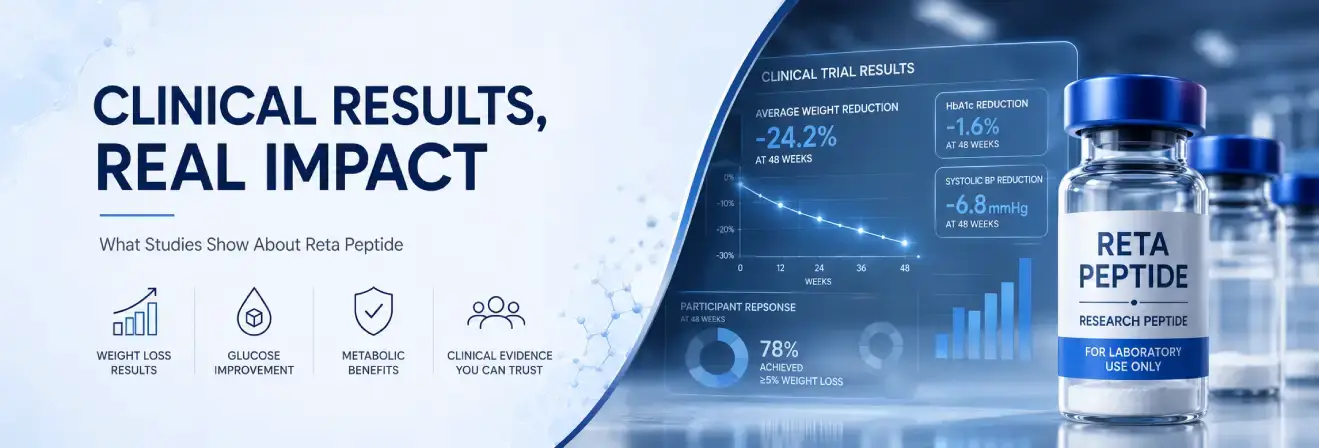
The evidence base has progressed from early trials to larger clinical programmes, but retatrutide remains under regulatory review and further study.
Weight-Loss Results
Clinical studies have reported substantial, dose-dependent reductions in body weight.
At the higher studied doses, average weight reduction reached levels considered clinically significant. In some studies, weight loss was still progressing at the end of the trial period.
These results support continued development, but they do not establish long-term safety, maintenance after discontinuation or cardiovascular benefit.
Type 2 Diabetes Results
In trials involving people with type 2 diabetes, retatrutide improved HbA1c and reduced body weight.
Gastrointestinal events remained the most common adverse effects.
These findings support the conclusion that retatrutide has clinically measurable activity in type 2 diabetes, but it remains unapproved and is not an established diabetes medicine.
Current Evidence Summary
| Outcome | What Trials Have Reported | What Remains Uncertain |
| Body weight | Large average reductions in obesity trials | Long-term maintenance and outcomes after stopping |
| HbA1c | Meaningful reductions in type 2 diabetes studies | Long-term comparative effectiveness |
| Waist circumference | Consistent reductions | Independent effect beyond weight loss |
| Blood pressure | Improvements reported | Effect on cardiovascular events |
| Appetite | Reduced appetite commonly observed | Long-term nutritional implications |
| Osteoarthritis symptoms | Improvements reported in selected trial populations | Durability and contribution of weight loss |
| Sleep apnoea | Under evaluation in clinical programmes | Full long-term clinical significance |
| Cardiovascular outcomes | Dedicated trials underway | Whether major events are reduced |
| Renal outcomes | Included in ongoing outcome research | Long-term kidney benefit or risk |
Why Is Reta Peptide Still Experimental?
Retatrutide remains experimental because completing successful trials is only one part of the medicine-approval process.
Regulators must evaluate the full evidence package, including:
- Manufacturing quality
- Dose selection
- Effectiveness
- Common side effects
- Serious adverse events
- Rare risks
- Long-term outcomes
- Product stability
- Labelling and risk-management plans
Phase III Results Do Not Equal Approval
A successful Phase III study can support an application for regulatory approval, but it does not automatically make a medicine approved or publicly available.
Regulatory authorities may request:
- Additional analyses
- Longer follow-up
- Manufacturing information
- Post-market safety plans
- Specific warnings
- Further studies in particular populations
Until approval occurs, there is no regulator-approved indication, dosage schedule, contraindication list or consumer medicine information for retatrutide.
Why Long-Term Studies Are Necessary
Weight-management medicines may be used for extended periods. Researchers therefore need to understand what happens over years rather than months.
Long-term studies can help determine:
- Whether weight loss is maintained
- Whether adverse events change over time
- Whether treatment affects cardiovascular disease
- Whether kidney outcomes improve or worsen
- What happens after discontinuation
- Whether uncommon safety signals emerge
- Whether benefits differ across populations
Why Product Quality Changes the Safety Question
The retatrutide used in clinical trials is manufactured under controlled standards and tested before administration. Products sold through unofficial channels do not necessarily meet the same requirements.
The safety findings from a clinical trial apply to the verified investigational product used in that trial. They cannot validate every vial, powder or solution advertised under the same name.
Risks of Unverified Products
An unverified product may contain:
- The wrong active ingredient
- Too much or too little of the stated ingredient
- Harmful contaminants
- Residual manufacturing chemicals
- Microbial contamination
- Degraded peptide
- Undeclared substances
- Incorrect or misleading labelling
Visual appearance cannot confirm identity or purity.
A clear solution, sealed vial or professional-looking label does not establish that a product contains authentic retatrutide.
Purity Is Not the Only Quality Measure
A purity percentage alone does not prove that a material is suitable for human use.
Quality assessment may also require:
- Verified identity
- Accurate quantity or concentration
- Sterility testing where relevant
- Endotoxin testing
- Residual solvent testing
- Stability data
- Appropriate packaging
- Traceable batch documentation
- Validated manufacturing controls
A laboratory certificate may describe a sample submitted for testing, but it does not necessarily prove that every unit sold is identical to that sample.
Research-Use Products Are Not Approved Medicines
A research-use-only label means a product is intended for laboratory or analytical research rather than human or veterinary administration.
It does not:
- Establish therapeutic safety
- Provide an approved dosage
- Replace medical supervision
- Demonstrate sterility
- Confirm suitability for injection
- Convert an unapproved substance into a medicine
Research materials should be handled only within their intended legal and technical context.
Is Reta Peptide Approved in Australia?

No. Retatrutide is not currently approved as a registered therapeutic medicine in Australia. Products supplied as reta peptide are intended solely for non-clinical laboratory, analytical and scientific research and are not intended for human or veterinary administration.
Is Retatrutide Available to the Public?
Retatrutide is not approved for routine public use. It remains available only within authorised clinical research settings while regulatory evaluation continues.
Products promoted online as retatrutide should not be assumed to be the same material studied in clinical trials.
Can an Unapproved Product Be Considered Safe?
An unapproved status does not prove that a substance is harmful. It means regulators have not authorised it for general therapeutic supply after completing the required assessment.
It is therefore inaccurate to describe retatrutide as:
- TGA approved
- An approved weight-loss medicine
- Proven safe for public use
- An approved diabetes treatment
- A substitute for prescribed treatment
Who Should Be Most Cautious?
Because retatrutide has no approved prescribing information, a definitive public list of contraindications cannot yet be provided.
Extra caution is warranted for people who:
- Are pregnant, planning pregnancy or breastfeeding
- Have significant gastrointestinal disease
- Have a history of pancreatitis or gallbladder disease
- Have cardiovascular rhythm concerns
- Have severe kidney or liver impairment
- Take glucose-lowering medicines
- Use other products that affect appetite or gastric emptying
- Have a history of eating disorders
- Are preparing for surgery or deep sedation
This list identifies areas requiring professional evaluation; it does not establish confirmed retatrutide-specific contraindications.
Anyone experiencing severe abdominal pain, persistent vomiting, signs of dehydration, fainting, breathing difficulty or another serious reaction requires prompt medical assessment.
Important Limitations of Current Research
Retatrutide research has advanced considerably, but the evidence still has limitations.
Limited Duration Compared With Lifelong Disease
Obesity and type 2 diabetes are chronic conditions. Even trials lasting more than a year provide limited information compared with potential use over many years.
Selected Trial Populations
Clinical trials use eligibility criteria. Participants may differ from the wider population in age, health status, medication use and access to monitoring.
Results may not directly apply to people with conditions that led to exclusion from the trials.
Rare Events Require Larger Exposure
Large trials include many participants, but very rare adverse events may only become clear after much broader exposure.
This is one reason continued safety monitoring remains important even after a medicine reaches the market.
Long-Term Outcome Data Are Incomplete
Changes in body weight, HbA1c and blood pressure are clinically meaningful, but they are not the same as proof that a treatment prevents heart attacks, strokes, kidney failure or premature death.
Dedicated cardiovascular and renal outcome studies are required to establish those effects.
Discontinuation and Weight Regain
The durability of benefits after stopping retatrutide remains an important question.
Experience with other chronic weight-management medicines suggests that continued treatment may be necessary to maintain some benefits, but retatrutide-specific long-term withdrawal data are still developing.
How to Interpret Claims About Reta Peptide Safely
Online discussions often present early clinical findings as though retatrutide were already an established treatment. Several checks can help separate evidence from promotion.
Look for the Study Phase
Early-stage and Phase II trials can identify promising signals, but Phase III trials provide stronger evidence across larger populations.
Even positive Phase III results do not equal regulatory approval.
Check the Population
A result in adults with obesity without diabetes may not apply equally to people with type 2 diabetes, older adults or people with serious medical conditions.
Check the Timeframe
A result measured over several months does not prove that the same effect will remain after several years.
Separate Average Outcomes From Individual Outcomes
Average weight loss is not a promise. Reporting only the highest-dose average without explaining variability, discontinuations and side effects can create a misleading impression.
Distinguish the Molecule From the Product
Evidence about pharmaceutical-grade investigational retatrutide does not validate every product bearing the same name.
Product identity and manufacturing quality are separate safety questions.
So, is reta peptide safe? Current clinical trials indicate that retatrutide has an encouraging but incomplete safety profile.
Gastrointestinal effects such as nausea, diarrhoea, vomiting and constipation are the most consistently reported side effects, and they tend to occur more frequently at higher doses.
Dose-dependent increases in heart rate have also been observed and remain relevant to ongoing safety evaluation.
The potential benefits are substantial. Clinical studies have reported major reductions in body weight, improvements in HbA1c and favourable changes in several cardiometabolic measures.
These reta peptide results demonstrate that the molecule is biologically active and may eventually become an important treatment option.
Current evidence supports continued scientific investigation, but it does not justify treating retatrutide as a proven or approved option for general use.
FAQs
Is reta a healthy peptide?
Retatrutide should not be described as a “healthy peptide.” It is an investigational medicine being studied for obesity, type 2 diabetes and related metabolic conditions. Clinical trials have shown promising results, but retatrutide can cause side effects and has not been approved for routine public use.
What organ is retatrutide hard on?
Current clinical evidence has not established that retatrutide consistently damages one specific organ. Its most common side effects involve the digestive system, including nausea, diarrhoea, vomiting, constipation and abdominal discomfort.
Researchers are also continuing to study its possible effects on heart rate, the pancreas, gallbladder, kidneys and liver. Serious liver injuries reported in Australia have been associated with unapproved products labelled as retatrutide, but authorities have not confirmed that those products were equivalent to the pharmaceutical-grade material used in clinical trials.
What is the risk of taking peptides?
The risks vary widely because peptides are a broad category of substances. Approved peptide medicines have specific evidence, quality controls and prescribing information, while unapproved products may have uncertain safety and composition.
Potential risks include side effects from the active substance, allergic reactions, medicine interactions, contamination, incorrect concentration, poor storage, microbial exposure and inaccurate labelling. Research-use-only products are not approved for human or veterinary administration.
Who should avoid taking retatrutide?
Retatrutide does not yet have an approved public contraindication list because it remains investigational.
Particular caution is appropriate for people who are pregnant or breastfeeding, have serious gastrointestinal disease, a history of pancreatitis or gallbladder problems, severe kidney or liver impairment, heart-rhythm concerns, eating disorders or use medicines that lower blood glucose.
Eligibility should be determined through an authorised clinical trial rather than through self-directed use.
What is the safest weight loss injection?
There is no single weight-loss injection that is safest for everyone. Safety depends on a person’s medical history, other medicines, pregnancy status, treatment goals and risk of side effects.
In Australia, approved injectable options for chronic weight management include tirzepatide, semaglutide and liraglutide. A qualified healthcare professional should determine whether any of these is appropriate. Retatrutide should not be included among approved options because it remains investigational.
Can I lose 10 kg in 2 months?
Losing 10 kg in two months is possible for some people, particularly those starting at a higher body weight, but it is faster than the commonly recommended gradual rate for many adults.
A frequently cited sustainable target is approximately 0.5 to 1 kg per week, which would generally equal about 4 to 8 kg over two months. Faster loss may increase the risk of muscle loss, nutritional deficiencies, gallstones and weight regain, so individual targets should be set with professional guidance.
What is the #1 weight loss injection?
There is no universally recognised “number one” weight-loss injection. The best choice depends on clinical suitability, safety, expected benefit, availability and cost.
Among approved options, tirzepatide and semaglutide have produced substantial average weight loss in clinical trials, while liraglutide is another established option. A medicine that produces greater average weight loss is not automatically the safest or most appropriate choice for every person.
How to get retatrutide?
Retatrutide is not approved for routine prescription or public sale. The legitimate route to access it is participation in an authorised clinical trial, subject to the trial’s location and eligibility criteria.
Products advertised online as retatrutide should not be assumed to contain the same material used in regulated trials. They may have uncertain identity, purity, concentration and manufacturing quality.
Sources:
- Therapeutic Goods Administration: Public Health Risks Associated with Unapproved Peptide Products
- Sport Integrity Australia: Retatrutide Explained
- ClinicalTrials.gov: Phase 3 Retatrutide Study in Obesity and Overweight
- ClinicalTrials.gov: Retatrutide Cardiovascular Outcomes Study
- U.S. Food and Drug Administration: The Drug Development Process