

Research use only peptides are materials supplied for controlled laboratory and scientific investigation rather than personal, therapeutic or veterinary use.
The phrase “Research Use Only” describes the supplier’s stated intended use, but it should not be treated as a regulatory exemption by itself. Product classification and legal obligations can also depend on the product’s composition, presentation, claims, advertising and how it is supplied.
This guide explains what RUO means in laboratory practice, how research-use materials differ from approved therapeutic goods, which documentation researchers should review and why the entire product presentation must remain consistent with research-only positioning.
Note: This article is educational and does not provide medical advice, dosing guidance, administration instructions or recommendations for human or veterinary use.
What Are Research Use Only Peptides?
Research use only peptides are peptide compounds intended for laboratory research applications. When supplied specifically as RUO materials, they are presented for laboratory investigation rather than as medicines, supplements, consumer cosmetics or personal-use products.
Peptides are short chains of amino acids. In scientific research, peptides may be studied because they can interact with biological systems in highly specific ways. Depending on the compound and research model, laboratory research peptides may be investigated in areas such as:
- Biochemical analysis
- Cell-based research
- Molecular pathway investigation
- Stability testing
- Analytical method development
- Preclinical research models where legally permitted
- Compound comparison studies
- Peptide structure and purity analysis
The RUO materials discussed here are not intended for personal ingestion, injection, topical self-application or other human or veterinary administration.
For a broader overview of research peptide categories, supplier transparency, and research-focused product selection, read our Research Peptides Australia Guide.
Research Use Only Meaning: What Does RUO Actually Mean?
The research use only meaning is simple but important:
Research Use Only means that the supplier presents the material for laboratory and scientific investigation rather than human, clinical, therapeutic, diagnostic or veterinary use.
RUO wording does not by itself determine whether a product falls outside therapeutic-goods regulation. Regulatory status depends on the specific product, intended purpose, claims, presentation and applicable Australian law.
In the peptide industry, RUO is often used to clarify that a compound is being supplied for non-human laboratory investigation. However, a research use disclaimer should be more than a small phrase at the bottom of a page. The whole product presentation should support the same message.
That includes:
- Product page copy
- Labels
- Checkout notices
- Certificates of Analysis
- Email communications
- Shipping documents
- Terms and conditions
- Blog content
- Product category descriptions
- Advertising and social-media content
If the product says “research use only” but the surrounding content suggests human benefits, dosage, transformation, treatment, or self-administration, the disclaimer becomes inconsistent with the overall message.
TGA guidance assesses advertising according to the overall effect and whether material directly or indirectly promotes the use or supply of therapeutic goods.
| Term | Meaning | Intended for Human Use? |
| Research Use Only | For laboratory research purposes only | No |
| RUO Peptides | Peptides supplied for research settings | No |
| Not for Human Consumption | Not intended to be ingested, injected, applied, or personally used | No |
| Research-Only Compounds | Compounds supplied for scientific investigation | No |
| Approved Peptide Medicine | A medicine included in the ARTG for specified therapeutic uses | Only under approved conditions |
Does “Research Use Only” Automatically Exempt a Peptide From TGA Regulation?
No. An RUO label by itself does not automatically determine the regulatory status of a peptide product in Australia.
Whether a product is regulated as a therapeutic good can depend on factors including its composition, intended purpose, claims, presentation, advertising and how it is supplied.
If a peptide product is presented or promoted for therapeutic purposes, TGA requirements may apply even when “Research Use Only” or “Not for Human Consumption” wording appears elsewhere.
Businesses should assess the exact product and intended activity rather than treating RUO wording as a universal regulatory exemption.
Research Peptides and Australian Regulatory Context
The TGA has increased its regulatory focus on peptide products during 2026. It states that many peptide products promoted online are unapproved therapeutic goods and may be unlawful to import, supply or advertise depending on the circumstances (TGA: peptide products).
Unapproved therapeutic peptide products have not undergone the standard TGA assessment for safety, quality or effectiveness. Their availability online does not establish approval or lawful therapeutic supply.
For any specific product, the relevant questions are whether it is a therapeutic good, whether it is included in the ARTG or covered by an applicable exemption or pathway, and what advertising and supply rules apply.
Research Use Only Peptides vs Approved Peptide Medicines
Peptides can appear in very different regulatory and scientific contexts. Some peptide-based medicines are included in the ARTG for specified therapeutic uses, while separately supplied laboratory materials may be presented for research only. Registered medicines are assessed for quality, safety and efficacy for their approved indications; other regulated categories may have different assessment requirements.
Research use only peptides are different. RUO peptides are not supplied as approved medicines and should not be presented as products for human use.
The distinction matters because people often confuse peptide research with peptide therapy. A peptide may be scientifically interesting, but that does not automatically mean it is approved, safe, effective, or suitable for personal use.
| Feature | Approved Peptide Medicine | Research Use Only Peptide |
| Intended use | Specific approved medical use | Laboratory research |
| Human use | Only under approved medical conditions | Not intended |
| Dosing guidance | Established through clinical and regulatory pathways | Not provided |
| Claims | Based on approved indication | Research-focused only |
| Audience | Healthcare professionals and patients | Researchers and laboratories |
| Documentation | Regulated medicine documentation | Research documentation such as batch identity, analytical results and COA |
A responsible research supplier should avoid presenting research-only compounds as shortcuts, alternatives, or substitutes for medical products.
A research-material page should be evaluated through its laboratory documentation and stated intended use rather than through clinical outcomes associated with separately manufactured medicines.
Why Are Some Peptides Labelled Not for Human Consumption?
For an APS RUO material, “not for human consumption” means the product is not intended for ingestion, injection, topical self-application or other personal administration.
This phrase is especially important because many peptides discussed online are promoted with exaggerated claims. These claims may relate to body composition, recovery, energy, sleep, aging, skin appearance, or performance. For research-only products, that kind of positioning can create confusion and increase misuse risk.
It should not be presented as:
- an approved medicine
- a dietary supplement
- a consumer therapeutic product
- a personal-use injectable
- a product authorised for human or veterinary administration
The product should only be handled in appropriate research settings.
However, the phrase should not be used as a weak disclaimer while the rest of the page promotes human outcomes. The full content should remain consistent with laboratory research intent.
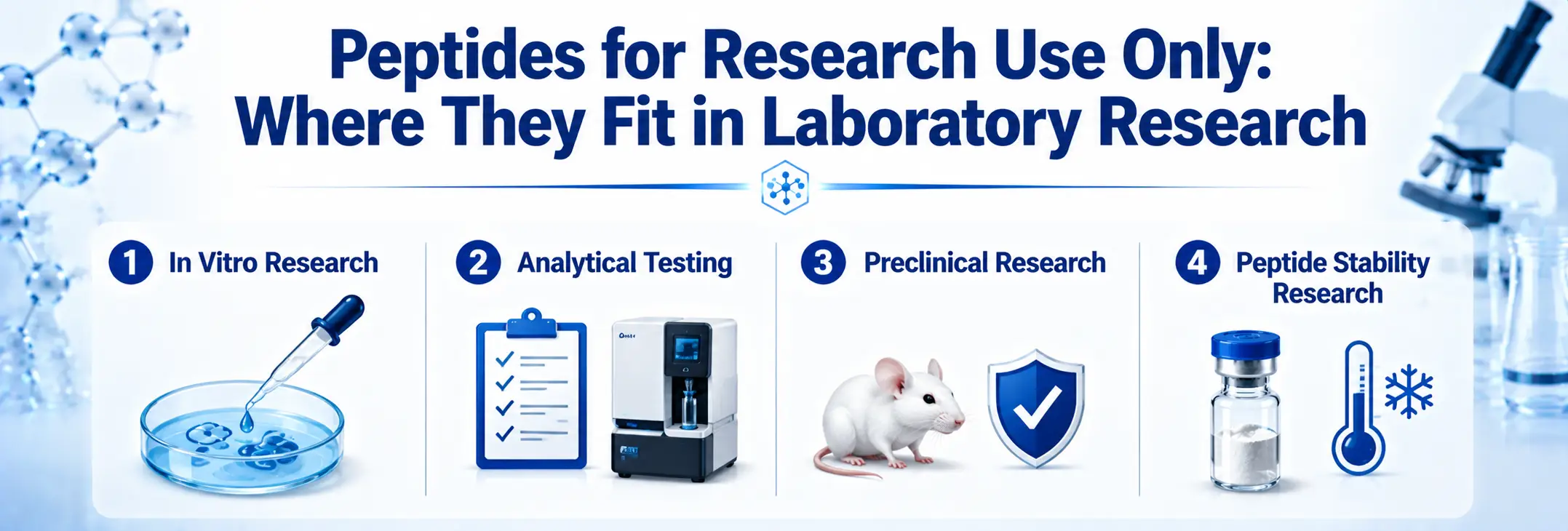
Peptides for Research Use Only: Where They Fit in Laboratory Research
Peptides for research use only may be studied in several scientific contexts. The exact research application depends on the peptide, the model, the study design, and local regulations.
Common research contexts may include:
1. In Vitro Research
In vitro research refers to studies conducted outside a living organism, often using controlled laboratory systems such as cell-based models or biochemical assays.
In this context, laboratory research peptides may be investigated for their interaction with specific receptors, enzymes, proteins, or molecular pathways.
2. Analytical Testing
Analytical testing may focus on identity, purity, stability, degradation, solubility, or batch consistency.
Researchers may evaluate:
- Molecular weight
- Peptide sequence
- Purity percentage
- Impurity profile
- Stability under specific storage conditions
- Response to temperature, light, or moisture
- Compatibility with research solvents or buffers
3. Preclinical Research
Some research-only compounds may be studied in preclinical models where permitted under applicable institutional, ethical and regulatory requirements. Preclinical research does not mean a product is suitable for human use. It is an early research stage designed to explore mechanisms, safety signals, biological pathways, or further study potential.
4. Peptide Stability Research
Peptide stability is an important area of laboratory interest. Researchers may study how a peptide behaves under different conditions, including storage temperature, post-preparation stability, light exposure, or freeze-thaw cycles.
This is one reason why product documentation, storage guidance, and handling information are important when selecting research use only peptides.
Research-Only Compounds and Quality Documentation
When evaluating research-only compounds, documentation is essential. A clear product description is helpful, but research buyers often need batch-level details to assess whether a compound is suitable for their laboratory purpose.
Important documentation may include:
- Certificate of Analysis
- Batch number
- Product name
- Peptide sequence where applicable
- Molecular formula
- Molecular weight
- Analytical purity result and method
- Testing method
- Appearance
- Storage recommendation
- Date of testing
- Supplier identification
- Research use disclaimer
A Certificate of Analysis can provide batch-specific analytical information and support traceability, but a COA does not establish therapeutic approval, sterility, clinical safety or suitability for human use. See our Certificate of Analysis Guide.
| Documentation Element | Why It Matters |
| COA | Provides batch-level testing information |
| Batch number | Supports traceability and record keeping |
| Purity data | Helps assess research suitability |
| Testing method | Shows how the compound was evaluated |
| Storage guidance | Supports peptide stability |
| Research disclaimer | Clarifies intended non-human use |
| Product label | Reduces confusion during handling |
Transparent documentation does not make a compound suitable for human use. It simply supports responsible laboratory research evaluation.
To better understand why purity percentage, batch testing, and analytical methods matter, researchers can review our Peptide Purity Explained guide.
View Certificates of Analysis for Research Materials →
Research-Only Positioning: What Responsible Presentation Should Include
Research-only positioning should be consistent across product descriptions, labels, supporting documents, site architecture and promotional material. A disclaimer cannot cure contradictory claims elsewhere on the page.
Responsible research-only positioning should include:
- Clear “research use only” wording
- Clear “not for human consumption” wording
- No medical claims
- No disease treatment claims
- No dosage instructions
- No injection instructions
- No personal-use protocols
- No before-and-after claims
- No body transformation claims
- No anti-aging promises
- No injury recovery promises
- No weight loss claims
- No bodybuilding claims
- No testimonials suggesting human effects
- Batch-specific documentation where available
- Clear laboratory storage and stability information where supported
- Consistent messaging across the site
Research-Only Presentation Checklist
| Compliance Area | Good Practice | Red Flag |
| Intended use | Clearly states laboratory research only | Vague or hidden disclaimer |
| Product claims | Describes research interest only | Claims human benefits |
| Dosage | No human dosing guidance | Gives injection or cycle instructions |
| Documentation | COA and batch details available | No test documentation |
| Audience | Researchers and laboratories | Consumers seeking personal results |
| Language | Research-focused wording | Medical or performance claims |
| Checkout | Reinforces RUO restriction | No intended-use confirmation |
The goal is clarity. A researcher should immediately understand that the product is not for personal use.
This checklist supports consistent research-focused communication, but it is not a substitute for determining the legal classification and regulatory obligations of the specific product.
Research Use Disclaimer: What Should It Say?
A research use disclaimer should be direct, visible, and consistent with the rest of the page.
A strong disclaimer may say:
“For laboratory and scientific research use only. Not intended for human or veterinary administration, personal use, diagnosis, treatment or therapeutic application.”
A good research use disclaimer should be:
- Easy to find
- Written in plain language
- Repeated where appropriate
- Consistent with product descriptions
- Included on product pages
- Supported by checkout and policy pages
- Aligned with labels and documentation
A disclaimer should never be used to excuse content that suggests human use. For example, a product page should not include a research use disclaimer while also discussing personal benefits, self-administration, or expected human results.
TGA guidance makes clear that whether content is advertising depends on its overall context and whether it promotes the use or supply of therapeutic goods, directly or indirectly.
Common Misunderstandings About RUO Peptides
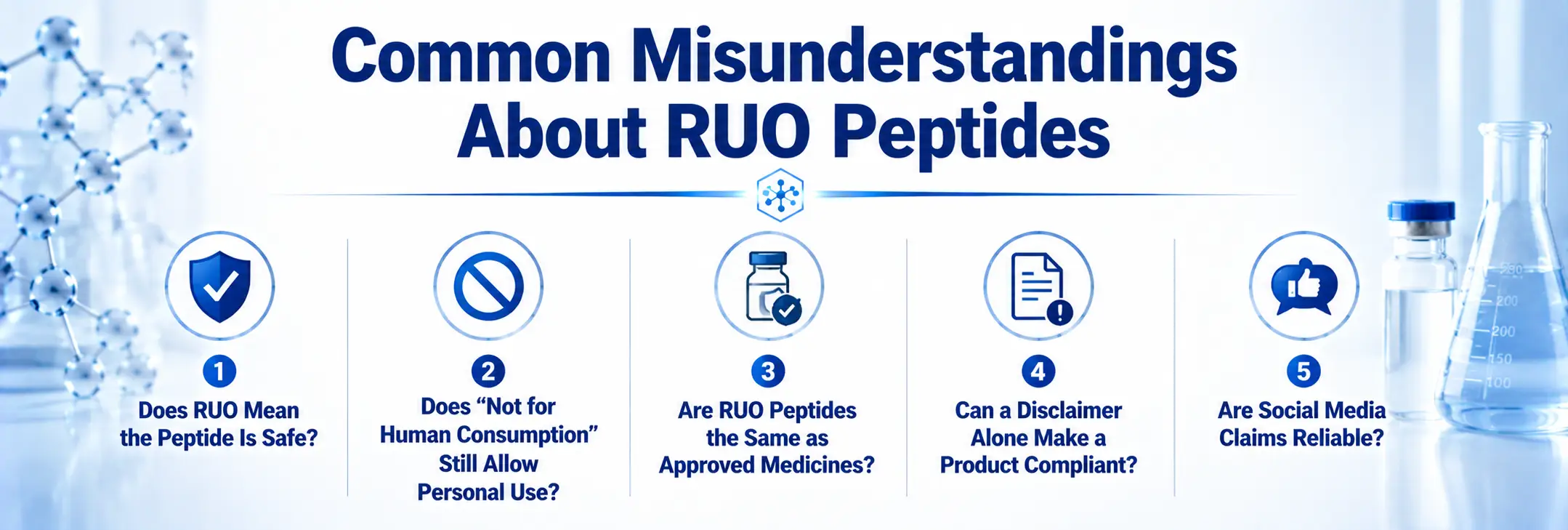
Because peptide content is widely discussed online, several misunderstandings are common.
Does RUO Mean the Peptide Is Safe?
No. RUO describes the stated intended laboratory use; it does not establish human safety, therapeutic effectiveness, sterility or regulatory approval.
Does “Not for Human Consumption” Still Allow Personal Use?
No. It means the opposite. Not for human consumption peptides should not be used personally in any form.
Are RUO Peptides the Same as Approved Medicines?
No. Approved medicines and RUO peptides are different categories. A peptide compound may be studied in research, but that does not make it an approved medical product.
Can an RUO Disclaimer Alone Determine Regulatory Compliance?
No. Classification and compliance depend on the entire product context, including intended use, claims, labels, advertising and supply arrangements.
Are Social Media Claims Reliable?
Social media claims are not a substitute for controlled research, regulatory review, or professional scientific evaluation. Many online claims are anecdotal, promotional, or incomplete.
How Researchers Should Evaluate Laboratory Research Peptides
Researchers selecting laboratory research peptides should focus on transparency, documentation, and suitability for the intended research model.
Important evaluation points include:
- Is the product clearly labelled for research use only?
- Is there a visible not-for-human-consumption statement?
- Is a COA available?
- Is the batch number shown?
- Are purity and testing details provided?
- Is storage guidance included?
- Is the supplier clear about the product’s intended use?
- Does the page avoid medical and personal-use claims?
- Are transport and stability conditions documented where relevant?
- Are product categories easy to understand?
| What to Check | Positive Sign | Warning Sign |
| Intended use | Clear RUO wording | Human-use language |
| COA | Batch-specific document | No supporting documentation |
| Product description | Research-focused | Medical or wellness claims |
| Storage guidance | Clear temperature and handling notes | No storage information |
| Label | Compound name and batch details | Vague or incomplete label |
| Website copy | Compliance-focused | Promotional personal-use claims |
This type of evaluation helps researchers select products based on research suitability rather than marketing language.
Research Use Only Peptides and Storage Awareness
Research use only peptides may require specific storage and handling conditions depending on their form, sequence, stability profile, and supplier documentation.
Peptides are often sensitive to environmental factors such as:
- Temperature
- Moisture
- Light exposure
- Repeated freeze-thaw cycles
- Contamination risk
- Post-preparation time and stability
- Storage duration
Lyophilised materials may have different stability characteristics from prepared solutions. Researchers should rely on compound- and batch-specific stability information rather than universal storage assumptions.
General storage awareness may include:
- Reviewing the product-specific storage recommendation
- Keeping containers sealed until use in research
- Avoiding unnecessary exposure to light and moisture
- Maintaining consistent temperature conditions
- Recording opening, preparation or testing dates where relevant
- Following laboratory handling procedures
- Avoiding assumptions across different peptide compounds
Storage information is part of responsible research handling. It should not be interpreted as human-use guidance.
For more detailed handling and temperature guidance, review our Peptide Storage Guide and Peptide Storage Stability guide.
Why Consistent Research-Only Positioning Matters
Consistent research-only positioning reduces ambiguity about intended laboratory use, supports informed research-material evaluation and makes scientific documentation easier to interpret.
For research buyers, clear positioning helps answer important questions:
- What is this product intended for?
- What documentation is available?
- How should it be handled in a research environment?
- What claims are not being made?
- What limitations should be understood before laboratory use?
For suppliers, clear positioning helps maintain consistency across the website and reduces the risk of mixed messaging.
Strong research-only positioning usually includes:
- Educational content
- Clear disclaimers
- Transparent documentation
- Consistent product labels
- Research-focused descriptions
- No exaggerated claims
- No personal-use instructions
- No clinical promises
Where peptide-related information is often unclear, consistent and accurate communication supports clearer interpretation of research materials.
Final Thoughts on Research Use Only Peptides
Research Use Only is an intended-use statement for laboratory and scientific materials, not a shortcut to therapeutic approval or a standalone regulatory exemption.
Responsible RUO positioning requires consistency between labels, product descriptions, analytical documentation, educational content and promotional material. Human-benefit claims, personal-use guidance or administration instructions can conflict with that positioning.
Researchers should evaluate materials according to compound identity, batch traceability, analytical documentation, stability information and the requirements of their specific research setting.
In Australia, businesses should separately determine whether a particular peptide product is a therapeutic good and what ARTG, advertising, supply, import or other regulatory obligations apply.
Explore Research Peptide Guides →
FAQs About Research Use Only Peptides
What does research use only mean?
Research Use Only means the supplier presents the material for laboratory and scientific investigation rather than human, therapeutic, diagnostic, veterinary or personal use.
What are RUO peptides?
RUO peptides are peptide materials supplied for laboratory research. The RUO label describes intended use but does not by itself determine the product’s complete regulatory status.
Are research use only peptides safe for human consumption?
RUO materials are not intended for human consumption or administration, and an RUO label does not establish human safety.
What does not for human consumption peptides mean?
For an RUO product, it means the material is not intended for personal ingestion, injection, topical self-application or other human administration.
Are peptides for research use only the same as approved medicines?
No. Research-use materials and approved or otherwise authorised therapeutic products are different contexts with different intended uses, documentation and regulatory requirements.
Why Is Consistent Research-Only Positioning Important?
It reduces contradictory messaging between labels, documentation, educational content and marketing, and helps make the intended laboratory use clear.
What should a research use disclaimer include?
It should clearly state that the product is for laboratory and scientific research only and is not intended for human or veterinary administration, therapeutic use or personal use.
How should researchers evaluate laboratory research peptides?
Researchers should review identity, batch traceability, analytical methods, COA, purity data, stability information and research-use labelling.
Can a product be labelled RUO and still make human benefit claims?
An RUO label does not neutralise contradictory therapeutic or personal-use claims. The full context of the product presentation matters.
Why do suppliers use research use disclaimers?
They help communicate the stated laboratory intended use, but they do not independently establish regulatory classification or legal compliance.
Does Research Use Only Mean TGA Exempt?
No. RUO wording alone does not automatically exempt a product from therapeutic-goods regulation. The exact product, intended use, claims, presentation and supply context must be considered.
Can Educational Peptide Content Be Considered Advertising?
Potentially. TGA guidance states that content may be advertising when its overall effect directly or indirectly promotes the use or supply of therapeutic goods. Context matters.
Does a COA Make a Research Peptide Approved or Safe for Human Use?
No. A COA provides analytical information about the tested batch; it does not establish therapeutic approval, clinical effectiveness or suitability for human administration.