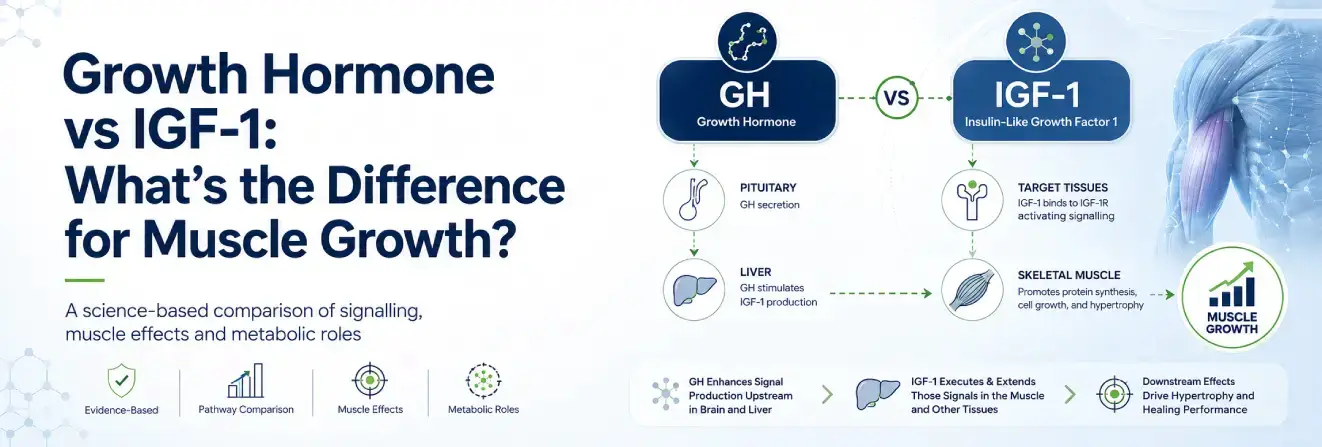
Growth hormone vs IGF-1 compares two closely connected but distinct parts of the body’s growth-signalling system. GH is released mainly by the pituitary gland and stimulates IGF-1 production, while IGF-1 is produced primarily by the liver and supports tissue growth, protein synthesis and muscle maintenance. However, their natural roles do not mean that increasing either hormone will safely or reliably build more muscle in healthy adults.
Growth Hormone vs IGF-1: Key Differences at a Glance
Growth hormone and IGF-1 belong to the same hormonal axis, but they are not interchangeable. They differ in where they are produced, which receptors they activate, how their levels change and how they affect metabolism.
| Comparison factor | Growth hormone | IGF-1 |
| Full name | Growth hormone or somatotropin | Insulin-like growth factor 1 |
| Main source | Anterior pituitary gland | Primarily the liver, with local production in muscle and other tissues |
| Release pattern | Pulsatile and highly variable throughout the day | More stable in circulation |
| Primary receptor | Growth hormone receptor | IGF-1 receptor |
| Major signalling pathway | JAK2/STAT5 | PI3K/Akt/mTOR |
| Position in the hormonal axis | Upstream signal | Major downstream mediator |
| Main growth role | Stimulates IGF-1 and produces additional direct effects | Transmits growth, repair and protein-synthesis signals |
| Effect on fat metabolism | Directly promotes lipolysis | Less directly lipolytic |
| Effect on glucose | Can reduce insulin sensitivity | Can produce insulin-like glucose-lowering effects |
| Evidence for muscle gain in healthy adults | May alter lean mass without consistently improving strength or true muscle hypertrophy | Clear biological role, but limited evidence for safe, predictable muscle gain from external use |
| Medical context | Specific growth disorders and diagnosed GH deficiency | Specific cases of severe primary IGF-1 deficiency |
| Status in tested sport | Prohibited at all times | Prohibited at all times, including its analogues |
The simplest explanation is that GH helps initiate and coordinate the growth process, while IGF-1 delivers part of the downstream signal. This description is useful but incomplete because GH also has effects that do not depend entirely on IGF-1.
Australia Peptide Sciences supplies peptides intended for laboratory and scientific research.
What Is Growth Hormone?
Growth hormone is a peptide hormone produced by specialised cells called somatotrophs in the anterior pituitary gland. Growth hormone is involved in childhood growth, adult tissue maintenance, body composition, fat metabolism, glucose regulation, protein turnover and broader metabolic health.
Human growth hormone, or HGH, usually refers to the human form of GH. Somatotropin is another name for naturally occurring growth hormone. Somatropin generally refers to recombinant human growth hormone manufactured as a prescription medicine.
These terms are often used interchangeably in general fitness discussions, but naturally produced GH and pharmaceutical somatropin do not represent the same physiological situation.
Where Is Growth Hormone Produced?
Growth hormone is produced in the anterior pituitary, a small endocrine gland located at the base of the brain. Its release is controlled largely by signals from the hypothalamus.
Two hypothalamic hormones are particularly important:
- Growth hormone-releasing hormone, or GHRH, stimulates GH secretion, CJC-1295 No DACis studied as a synthetic GHRH analogue in growth hormone signalling research.
- Somatostatin inhibits GH secretion.
GHRP peptides are synthetic growth hormone secretagogues studied for their interaction with the growth hormone secretagogue receptor, the same receptor activated by ghrelin to influence GH release. Sleep, exercise, age, stress, nutritional status, blood glucose and sex hormones can further influence the timing and size of GH pulses.
GH is not released at a constant rate. Its concentration rises and falls throughout the day, with some of the largest pulses commonly occurring during deep sleep. Production is generally highest during childhood and puberty and tends to decline with age.
This pulsatile pattern makes a single random GH blood result difficult to interpret. A low result may have been collected between pulses, while a higher result may reflect a temporary physiological response. Clinical assessment may therefore require IGF-1 testing and structured stimulation or suppression tests rather than relying on one random measurement.
How Does Growth Hormone Work?
Growth hormone travels through the bloodstream and binds to growth hormone receptors on target cells. This activates intracellular signalling, particularly the JAK2/STAT5 pathway.
The resulting signals can:
- Stimulate IGF-1 production in the liver and other tissues.
- Support normal bone and cartilage growth.
- Influence protein synthesis and amino acid utilisation.
- Increase the mobilisation of stored fatty acids.
- Affect glucose production and insulin sensitivity.
- Support collagen and connective-tissue turnover.
- Influence sodium and water balance.
GH therefore acts both indirectly through IGF-1 and directly through its own receptor. The relative importance of each mechanism depends on the tissue and biological outcome.
Much of normal linear growth is mediated by IGF-1. By contrast, GH has important direct effects on adipose tissue, where it promotes lipolysis and increases the availability of fatty acids.
How Does Growth Hormone Affect Muscle Growth?
Research into muscle growth peptides, also examines how growth hormone influences protein metabolism, IGF-1 production and lean-tissue maintenance. Its contribution is clearest during normal development and in people with clinically confirmed GH deficiency.
Adults with GH deficiency may have reduced lean body mass, increased fat mass and impaired physical capacity. Appropriate medical replacement can improve aspects of this abnormal physiology. However, correcting a deficiency does not prove that additional GH will produce similar benefits in a healthy person with normal hormone function.
In healthy adults, GH administration may increase measured lean body mass, but lean body mass is not the same as skeletal muscle. It includes:
- Body water.
- Organs.
- Bone.
- Connective tissue.
- Glycogen and associated water.
- Skeletal muscle.
GH can increase extracellular water and stimulate collagen turnover. These effects can raise lean-mass measurements without producing a comparable increase in contractile muscle protein.
Controlled studies in healthy adults have generally not shown consistent improvements in maximal strength or true muscle hypertrophy when GH is added to resistance training. Some research has reported limited changes in certain short-duration performance measures, but these findings do not establish broad improvements in muscle size, strength or athletic performance.
The evidence supports several separate conclusions:
- Normal GH function contributes to muscle development and maintenance.
- Treating GH deficiency can improve an abnormal body-composition profile.
- Additional GH has not consistently increased functional muscle or strength in healthy adults.
- A rise in lean body mass should not automatically be described as muscle growth.
What Is IGF-1?
IGF-1 is a peptide growth factor with structural similarities to insulin. It plays an essential role in childhood growth and continues to influence tissue maintenance, metabolism and cell signalling throughout adulthood.
Most circulating IGF-1 is produced by the liver in response to GH. Skeletal muscle, bone and other tissues can also produce IGF-1 locally.
The difference between circulating and locally produced IGF-1 is particularly important when evaluating muscle growth. A blood IGF-1 result and the activity occurring inside skeletal muscle are related, but they do not provide identical information.
Where Is IGF-1 Produced?
The liver is the principal source of the IGF-1 found in circulation. When GH binds to receptors in liver cells, it stimulates the synthesis and release of IGF-1.
Most circulating IGF-1 is bound to specialised proteins. A substantial proportion travels in a complex containing IGF-binding protein 3, or IGFBP-3, and an acid-labile subunit. This arrangement helps extend IGF-1’s time in circulation and regulates its delivery to tissues.
IGF-binding proteins can influence:
- How long IGF-1 remains in circulation.
- How much reaches specific tissues.
- Whether it is available to bind to a receptor.
- How its activity is regulated outside cells.
IGF-1 is also produced locally in skeletal muscle and other tissues. It can act through three forms of signalling:
- Endocrine signalling:Circulating IGF-1 travels through the bloodstream to distant tissues.
- Autocrine signalling:A cell responds to IGF-1 that it has produced.
- Paracrine signalling:IGF-1 acts on nearby cells within the same tissue.
Local IGF-1 production may be especially relevant to muscle repair and adaptation after mechanical loading. This helps explain why circulating IGF-1 is not a complete measurement of anabolic activity inside muscle.
How Does IGF-1 Signal Muscle Cells?
IGF-1 binds primarily to the type 1 IGF receptor, commonly abbreviated as IGF1R. This receptor has tyrosine kinase activity and activates several intracellular pathways.
One of the most important is the PI3K/Akt/mTOR pathway. Its activation can:
- Increase protein-synthesis signalling.
- Support cell growth and survival.
- Reduce the activity of pathways involved in protein breakdown.
- Participate in muscle repair and remodelling.
- Influence satellite-cell activity.
Satellite cells are muscle-associated stem cells located close to existing muscle fibres. When activated by training or tissue damage, they can proliferate and contribute new nuclei to muscle fibres. These additional nuclei may help support the increased cellular demands associated with repair and long-term hypertrophy.
IGF-1 signalling can also influence FOXO transcription factors. FOXO proteins help regulate genes involved in protein breakdown and autophagy. Reducing their activity can shift the cellular environment towards protein retention.
These mechanisms explain why IGF-1 is described as anabolic. They do not mean that increasing circulating IGF-1 will automatically create more muscle.
Muscle growth is regulated by an integrated network that includes:
- Mechanical tension.
- Amino acid availability.
- Total energy intake.
- Insulin and other hormones.
- Cellular energy status.
- Inflammatory and repair signals.
- Neural input.
- Multiple growth-signalling pathways.
IGF-1 is an important participant within this network, not an independent switch that determines muscle growth by itself.
Does IGF-1 Really Build Muscle?
IGF-1 supports muscle growth and repair at the cellular level, but the practical answer depends on the context.
In normal physiology, IGF-1 contributes to muscle development, protein synthesis and tissue adaptation. Cell and animal studies also show that local IGF-1 signalling can promote muscle-fibre growth.
However, the question “Does IGF-1 participate in muscle growth?” is different from “Will externally administered IGF-1 build additional muscle in a healthy adult?”
Human evidence supporting external IGF-1 use for bodybuilding is limited. Results from animals, cultured muscle cells or patients with severe endocrine disorders cannot be transferred directly to healthy, trained adults.
Externally administered IGF-1 may also produce systemic exposure that differs from the controlled local production occurring inside muscle. It can affect glucose regulation and growth signalling in multiple tissues rather than acting only on the muscle being trained.
A balanced answer is:
- IGF-1 is involved in normal muscle growth.
- Local IGF-1 signalling may contribute to adaptation after resistance training.
- Higher circulating IGF-1 does not guarantee greater hypertrophy.
- External IGF-1 has not been established as a safe, predictable muscle-building intervention for healthy adults.
- Its effects on blood glucose and tissue growth create clinically important risks.
Understanding the Growth Hormone and IGF-1 Relationship
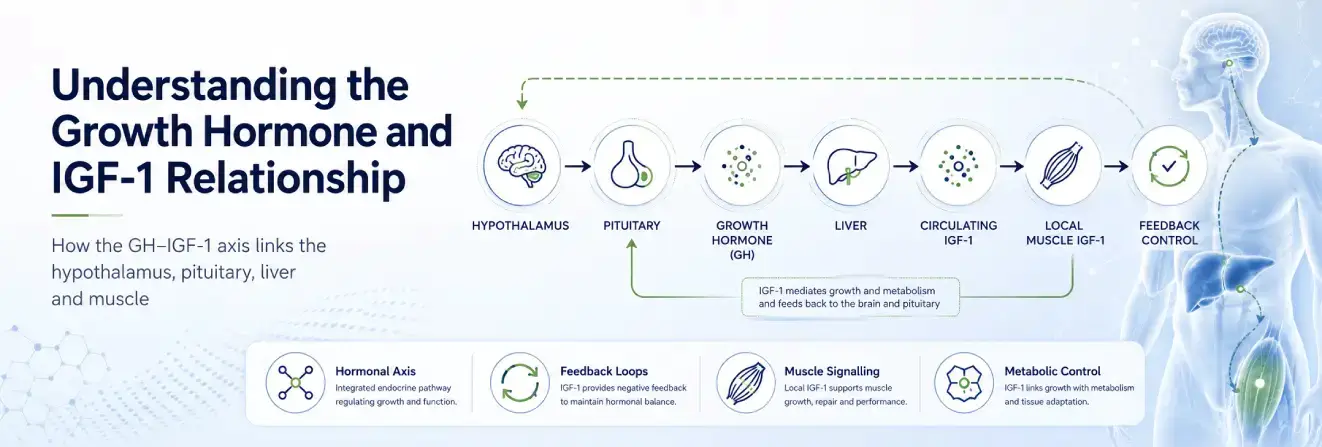
The growth hormone and IGF-1 relationship is commonly described as the GH–IGF-1 axis. It connects the hypothalamus, pituitary gland, liver, circulating growth factors and peripheral tissues.
This axis is not a simple one-directional pathway. It contains feedback loops, tissue-specific signals, binding proteins and metabolic influences that regulate how much hormone is produced and how strongly tissues respond.
How the GH–IGF-1 Axis Works
The main sequence can be summarised in six steps:
- The hypothalamus releases GHRH and regulates somatostatin.
- The anterior pituitary releases GH in pulses, while GHRP-6 Acetateis studied as a growth hormone secretagogue that can influence this secretory pathway in research models.
- GH enters the bloodstream and binds to receptors in the liver and other tissues.
- The liver produces much of the IGF-1 found in circulation.
- Muscle and other tissues produce additional IGF-1 for local activity.
- Circulating IGF-1 participates in negative feedback that regulates further GH release.
When IGF-1 activity rises, it can reduce GH secretion through effects on the hypothalamus and pituitary. This feedback helps prevent uncontrolled activity within the axis.
The relationship can be influenced by:
- Age.
- Pubertal and sex-hormone status.
- Sleep.
- Energy and protein intake.
- Liver function.
- Thyroid function.
- Insulin availability.
- Chronic illness or inflammation.
- Physical activity.
- Endocrine disorders.
- Certain medicines.
An abnormal IGF-1 result therefore requires clinical interpretation. It cannot independently identify the cause of a hormonal disorder.
Which Effects of GH Depend on IGF-1?
Many growth-related effects of GH are mediated substantially by IGF-1, including:
- Normal linear growth.
- Growth-plate activity.
- Some aspects of bone development.
- Tissue growth and repair.
- Activation of anabolic signalling in muscle.
GH also produces direct or partly independent effects, including:
- Mobilising fatty acids from adipose tissue.
- Influencing liver glucose production.
- Reducing insulin sensitivity under certain conditions.
- Affecting sodium and water retention.
- Supporting collagen and connective-tissue turnover.
- Regulating gene expression through the GH receptor.
These differences demonstrate why GH and IGF-1 cannot be treated as equivalent substances. GH can oppose some actions of insulin, while IGF-1 has insulin-like activity and may lower blood glucose.
Circulating IGF-1 vs Local IGF-1
Circulating IGF-1 mainly reflects liver production and the broader activity of the GH–IGF-1 axis. Local IGF-1 is produced within tissues and may act close to where it is released.
A blood test primarily measures the circulating pool. It cannot directly show every change in muscle IGF-1 expression, receptor sensitivity or downstream signalling.
Local activity may be affected by:
- Mechanical loading.
- Training history.
- Muscle damage and repair.
- Energy and nutrient availability.
- Inflammatory signals.
- Muscle-fibre characteristics.
- IGF-binding protein expression.
- IGF-1 receptor abundance and sensitivity.
A temporary rise in circulating IGF-1 does not therefore predict how much muscle a person will gain over the following weeks or months.
IGF-1 vs HGH for Bodybuilding: What Does the Evidence Show?
The IGF-1 vs HGH bodybuilding comparison is often reduced to the statement that HGH works indirectly while IGF-1 works directly. Although GH stimulates IGF-1 and IGF-1 directly activates anabolic receptors, this explanation overlooks the complexity of human physiology.
Externally administering a growth-related substance does not reproduce the body’s normal timing, tissue-specific production, feedback control or receptor exposure.
The most relevant evidence comes from measurable human outcomes rather than the theoretical strength of an isolated molecular pathway.
Normal Hormone Function vs External Administration
A hormone can be essential without providing additional benefits when raised beyond normal requirements.
GH deficiency can reduce lean mass and alter body composition. Severe primary IGF-1 deficiency can disrupt normal growth. Replacing a deficient hormone may restore function towards a physiological range.
This does not establish that increasing GH or IGF-1 beyond normal levels will produce additional functional muscle in a healthy adult.
| Research context | Common observation | What it demonstrates | Main limitation |
| GH deficiency | Reduced lean mass and altered body composition | Normal GH supports tissue maintenance | Does not represent healthy adults |
| Medical GH replacement | Improvement in some deficiency-related abnormalities | Correcting a deficiency can restore function | Results are not bodybuilding outcomes |
| Severe primary IGF-1 deficiency | Impaired growth despite adequate GH | IGF-1 has an essential independent role | Represents a rare clinical condition |
| Healthy adult GH studies | Possible lean-mass increase without consistent strength gains | GH can change body composition | Water and connective tissue may affect measurements |
| Cell and animal IGF-1 studies | Strong anabolic signalling | Establishes biological mechanisms | Does not determine human safety or effectiveness |
| Resistance-training studies | Changes in local muscle signalling | Exercise activates growth pathways | Acute changes do not predict long-term hypertrophy |
Lean Body Mass vs Actual Muscle Hypertrophy
Lean body mass is total body mass excluding fat. It includes skeletal muscle, body water, bone, organs, connective tissue and other non-fat components.
Muscle hypertrophy refers more specifically to an increase in muscle-fibre size and contractile tissue. It is usually assessed through imaging, muscle cross-sectional area, fibre measurements or a combination of methods.
Strength is a separate outcome. It is influenced by muscle size but also depends on:
- Motor-unit recruitment.
- Neural coordination.
- Exercise technique.
- Muscle architecture.
- Tendon properties.
- Familiarity with the tested movement.
- Fatigue and motivation.
A person can gain strength without substantial hypertrophy, particularly during the early stages of training. A person can also gain lean body mass without a proportional increase in strength.
This distinction is important in GH research because fluid retention and connective-tissue changes can increase lean-mass measurements. These are genuine biological effects, but they should not automatically be described as new functional muscle.
Does Growth Hormone Increase Muscle Strength?
In healthy adults, GH has not consistently improved maximal strength when compared with appropriate resistance training and placebo conditions.
Research has generally found that adding GH does not reliably enhance the strength gains already produced by training. Studies involving people with GH deficiency may show improvement because treatment corrects an abnormal hormonal state.
Some studies have reported changes in certain short-duration, high-intensity performance measures. These limited findings do not demonstrate general improvements in hypertrophy, maximal strength, power or endurance.
GH clearly has biological effects, but those effects do not consistently translate into stronger or larger skeletal muscle in healthy adults.
Does External IGF-1 Produce Predictable Hypertrophy?
External IGF-1 has not been studied in healthy bodybuilding populations with the depth required to establish a safe, predictable muscle-building effect.
Interest in its anabolic potential comes largely from:
- Cell-culture experiments.
- Animal studies.
- Local muscle-expression research.
- Research involving hormonal deficiency.
- Studies of severe catabolic illness.
- The known activity of the IGF1R–Akt–mTOR pathway.
These sources help explain biological mechanisms, but they cannot establish an appropriate benefit-to-risk ratio for healthy athletes.
Systemically administered IGF-1 may affect the insulin receptor, IGF-binding proteins, hormonal feedback and tissues throughout the body. It cannot be assumed to reproduce the limited local signalling generated naturally inside a trained muscle.
Claims that an IGF-1 analogue can produce precise growth in one selected muscle are also unsupported by sufficient controlled human evidence. Injection location does not ensure that biological effects remain confined to that area.
Which Is Better for Muscle Growth?
There is no sound basis for declaring GH or IGF-1 the better bodybuilding option for a healthy adult.
GH has more direct effects on fat mobilisation and body water, but it has not consistently increased true hypertrophy or strength. IGF-1 activates more direct anabolic signalling, but external use lacks sufficient evidence for safe, predictable muscle gain and introduces significant glucose-related and tissue-growth risks.
Their approved medical uses address diagnosed disorders rather than routine physique enhancement.
The interventions with the strongest practical evidence for muscle growth remain:
- Progressive resistance training.
- Adequate weekly training volume.
- Appropriate training intensity and proximity to muscular failure.
- Sufficient dietary protein.
- Suitable total energy intake.
- Consistent sleep and recovery.
- Long-term progression.
How Exercise Influences Growth Hormone and IGF-1
Exercise can temporarily alter GH secretion and influence IGF-related signalling inside muscle. The size of the response varies according to exercise type, intensity, duration, rest periods, training status and individual physiology.
These acute changes form part of the body’s response to physical stress. They are not direct measurements of how much muscle will be gained.
Acute Growth Hormone Responses to Exercise
High-intensity exercise can produce a temporary increase in circulating GH. Resistance-training sessions involving substantial muscle mass, moderate-to-high volume and shorter rest periods often create a greater acute GH response than low-volume sessions with longer rest periods.
Metabolic stress, lactate accumulation, reduced pH and total work performed may contribute to this response.
A larger GH spike does not necessarily make a workout more effective for hypertrophy. Training methods that produce different hormonal responses can still stimulate muscle growth when they provide sufficient mechanical tension and progressive overload.
Trying to maximise discomfort or metabolic stress during every session can increase fatigue without delivering a proportional benefit.
How Exercise Affects IGF-1
The effect of a single training session on circulating IGF-1 varies. Measurement timing, nutrition, training status and exercise type can all influence the result.
Mechanical loading can also affect IGF-1 expression and downstream signalling inside skeletal muscle. These local changes may support repair and adaptation even when circulating IGF-1 changes very little.
Exercise activates growth pathways that are not entirely dependent on circulating GH or IGF-1. Mechanical tension can influence mTOR-related signalling through several cellular sensors and molecular intermediates.
Muscle can therefore adapt to resistance training even when the acute systemic hormonal response is modest.
Do Post-Workout Hormone Spikes Predict Muscle Growth?
No. A temporary increase in GH or IGF-1 after exercise does not reliably predict long-term hypertrophy.
An acute hormone measurement describes a limited period in the bloodstream. Muscle growth develops over weeks and months through repeated training, recovery and protein remodelling.
Long-term hypertrophy is more closely associated with:
- Consistent mechanical tension.
- Progressive increases in training demand.
- Appropriate volume for each muscle group.
- Suitable exercise selection and technique.
- Adequate protein and total energy.
- Recovery between sessions.
- Individual training history and responsiveness.
The acute endocrine response may contribute to the overall training environment, but it should not be the primary basis for programme design.
Local IGF-1 vs Circulating IGF-1 After Training
Resistance exercise can alter IGF-related activity inside the trained tissue. This response may not be reflected fully in a blood test.
Circulating IGF-1 cannot reveal:
- How much IGF-1 was produced locally by a specific muscle.
- How strongly IGF1R was activated.
- Whether downstream protein-synthesis signalling remained elevated.
- Whether protein synthesis exceeded protein breakdown.
- How well the person recovered.
- How much long-term hypertrophy will occur.
Training outcomes are better assessed through consistent measurements of performance, muscle size, body composition and recovery rather than through isolated post-workout hormone results.
Growth Hormone and IGF-1 Effects Beyond Muscle Growth
The difference between growth hormone and IGF-1 becomes especially clear when their effects on fat, glucose, bone and connective tissue are compared.
Both affect multiple organs. Changing one part of the GH–IGF-1 axis can therefore produce consequences far beyond skeletal muscle.
Fat Metabolism and Body Composition
GH has a direct lipolytic effect. It promotes the release of fatty acids from adipose tissue, making them available for energy production.
This helps explain why GH replacement can reduce fat mass in people with GH deficiency.
This distinction is important when comparing fat loss vs weight loss, because reducing fat mass is not the same as reducing total body weight.
A reduction in fat mass can improve muscular definition without increasing muscle-fibre size. An increase in body water can raise lean mass without improving strength. Body-composition results must therefore be interpreted according to what was actually measured.
IGF-1 is not simply a stronger or weaker version of the same fat-metabolism signal. It has different metabolic actions, including insulin-like effects. It should not be regarded as a direct fat-loss substance.
Glucose and Insulin Sensitivity
GH and IGF-1 can have opposing effects on glucose regulation.
GH can reduce insulin sensitivity, increase fatty acid availability and support liver glucose production. With excessive exposure, the pancreas may need to produce more insulin to maintain normal blood glucose. Susceptible individuals may experience impaired glucose tolerance or a greater risk of type 2 diabetes.
IGF-1 can increase glucose uptake and produce insulin-like effects. External administration can therefore cause hypoglycaemia, particularly when food intake, physical activity and other medicines are not coordinated under medical supervision.
| Metabolic effect | Growth hormone | IGF-1 |
| Insulin sensitivity | May reduce it | Produces insulin-like activity |
| Blood glucose | May increase glucose availability | May lower blood glucose |
| Major concern with excess exposure | Insulin resistance and hyperglycaemia | Hypoglycaemia |
| Fat mobilisation | Stronger direct lipolytic action | Less direct than GH |
| Monitoring focus | Glucose and wider endocrine effects | Glucose and wider growth-related effects |
These opposing effects are a major reason the two substances should not be treated as interchangeable bodybuilding compounds.
Bone, Collagen and Connective Tissue
The GH–IGF-1 axis supports normal bone growth and remodelling. It also influences cartilage, tendons, skin and other connective tissues.
GH can increase collagen synthesis, but greater collagen production does not automatically mean that a tendon has become stronger or more resistant to injury. Tendon adaptation depends on loading history, structure, recovery and the balance between tissue synthesis and breakdown.
The involvement of GH and IGF-1 in repair signalling also does not prove that external administration will accelerate recovery from every injury. Different injuries affect different tissues and require different rehabilitation strategies.
Pain reduction or changes in swelling should not be used alone to determine whether an injured structure is ready for unrestricted activity.
Growth Hormone and IGF-1 Risks and Side Effects
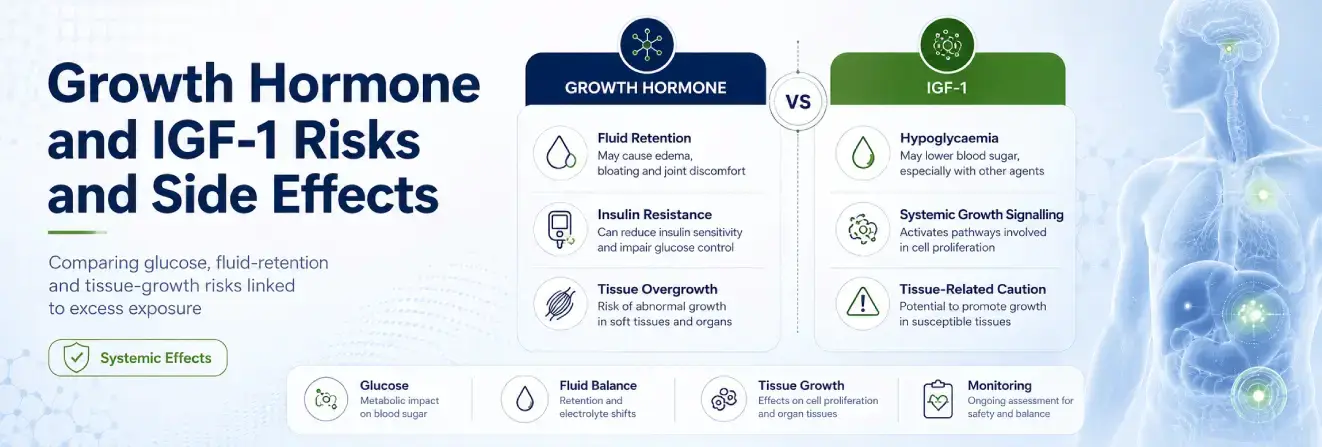
GH and IGF-1 affect systems throughout the body. Their risks cannot be limited to the muscle a person intends to train.
Risk also depends on the substance involved. Naturally produced GH, prescription somatropin, endogenous IGF-1, prescription mecasermin and modified IGF-1 analogues are not identical.
Potential Risks of Excess Growth Hormone
Excessive GH exposure can cause effects associated with fluid retention, altered glucose metabolism and abnormal tissue growth.
Potential adverse effects include:
- Swelling and peripheral oedema.
- Joint or muscle discomfort.
- Carpal tunnel syndrome.
- Headaches.
- Increased blood pressure.
- Reduced insulin sensitivity.
- Impaired glucose tolerance.
- Increased risk of type 2 diabetes in susceptible individuals.
- Abnormal bone and soft-tissue growth with prolonged excess.
- Cardiovascular complications associated with chronic GH excess.
Acromegaly is the condition most commonly associated with prolonged excessive GH and IGF-1 activity in adults. It usually results from a pituitary disorder and can involve enlargement of the hands, feet and facial bones, soft-tissue changes, hypertension, heart disease, sleep apnoea, impaired glucose regulation and joint problems.
Acromegaly is not equivalent to short-term medically supervised GH treatment. However, it demonstrates why prolonged uncontrolled growth signalling is not harmless.
People with longstanding GH excess may also develop muscle dysfunction despite having increased muscle or soft-tissue volume. Larger-looking tissue does not necessarily mean greater functional strength.
Potential Risks of IGF-1 Administration
IGF-1 has significant glucose-lowering activity. Hypoglycaemia is therefore one of the most important risks associated with pharmaceutical IGF-1 treatment.
Possible signs of low blood glucose include:
- Sweating.
- Shaking.
- Dizziness.
- Hunger.
- Headache.
- Weakness.
- Confusion.
- Changes in behaviour.
- Loss of consciousness or seizures in severe cases.
Prescription mecasermin requires structured medical supervision because its effects extend beyond muscle. Other recognised concerns can include injection reactions, headaches, enlargement of certain tissues and other growth-related effects.
IGF-1 activates pathways involved in cell survival and proliferation. This does not mean that normal IGF-1 causes cancer. Cancer develops through multiple genetic, environmental and metabolic factors.
However, unnecessary external growth-factor exposure warrants caution, particularly in anyone with an existing or suspected tumour. Claims that IGF-1 is completely harmless or that it inevitably causes cancer are both misleading.
Endogenous IGF-1, Mecasermin and IGF-1 Analogues Are Not the Same
Several different substances are frequently grouped together under the name IGF-1.
Endogenous IGF-1 is produced naturally by the body. Its release, transport and activity are controlled by GH, binding proteins, receptors and feedback mechanisms.
Mecasermin is recombinant human IGF-1 manufactured as a prescription medicine for a narrowly defined medical use. It is not approved as a general muscle-building treatment.
IGF-1 LR3 is a modified analogue designed to differ from natural IGF-1 in its interaction with binding proteins and biological persistence. Evidence about endogenous IGF-1 or mecasermin cannot automatically be applied to it.
IGF-1 DES is another modified form with different structural and pharmacological characteristics. Claims about highly localised muscle growth are not supported by sufficient controlled human evidence.
Several assumptions should be avoided:
- A longer half-life automatically produces a better outcome.
- Stronger receptor activity automatically creates more functional muscle.
- An injection near a muscle guarantees a local-only effect.
- A research-use label confirms pharmaceutical quality.
- Animal data establish a safe human protocol.
- The absence of immediate symptoms proves long-term safety.
- Combining GH with an IGF-1 analogue makes external use physiological.
No non-medical cycle or combination can remove the endocrine and metabolic risks.
Quality Risks Associated With Unapproved Products
Products obtained outside regulated medical supply channels may be inaccurately labelled, contaminated, degraded or supplied at a concentration that differs from the label.
A product described as being for research use should not be assumed to be approved for human administration. Research materials and prescription medicines are manufactured, evaluated and supplied under different requirements.
Potential quality problems include:
- Incorrect substance identity.
- Inaccurate concentration.
- Microbial contamination.
- Endotoxin contamination.
- Degradation during transport or storage.
- Undeclared ingredients.
- Incomplete safety information.
- Lack of validated instructions for human use.
These quality uncertainties are additional to the known biological risks of altering the GH–IGF-1 axis.
Medical and Sporting Status in Australia
Growth hormone medicines and pharmaceutical IGF-1 have specific medical roles in Australia. Their availability for defined conditions does not mean they are approved for bodybuilding, general anti-ageing use or performance enhancement.
Approved Medical Uses
Somatropin is used under medical supervision for specified paediatric growth disorders and eligible adults with severe GH deficiency.
Assessment may involve:
- Medical history and physical examination.
- IGF-1 testing using an age-adjusted reference range.
- Evaluation of other pituitary hormones.
- Investigation of possible structural causes.
- Formal GH stimulation testing when appropriate.
- Ongoing clinical and laboratory monitoring.
Mecasermin is indicated for the long-term treatment of growth failure in children and adolescents with severe primary IGF-1 deficiency who satisfy defined diagnostic criteria. It is not interchangeable with GH and is not approved as a general treatment for adults seeking greater muscle mass.
Australia’s Pharmaceutical Benefits Scheme provides subsidised access to certain growth hormone medicines for eligible patients under specific restrictions. Prescribing authority, eligibility and monitoring depend on the patient’s condition and age group.
Are GH and IGF-1 Banned in Sport?
Under the 2026 WADA Prohibited List, growth hormone, its analogues and fragments, as well as IGF-1 and its analogues, are prohibited at all times.
“At all times” includes both in-competition and out-of-competition periods.
Athletes are responsible for prohibited substances found in their bodies under the principle of strict liability. Having a prescription does not automatically remove the athlete’s anti-doping obligations.
An athlete who requires a prohibited medicine for a legitimate medical condition may need a Therapeutic Use Exemption supported by appropriate medical evidence.
Sport Integrity Australia provides an official video overview of the 2026 WADA Prohibited List:
Browse Peptides for Research Only
Australia Peptide Sciences offers a diverse selection of peptides for laboratory and scientific research, including compounds associated with growth hormone, IGF-1 and metabolic signalling pathways. Explore our complete product range to find the compound that best matches your research requirements.
Growth hormone and IGF-1 work within the same hormonal axis but differ in their sources, receptors and effects. GH stimulates IGF-1 production while also influencing fat metabolism, glucose regulation and connective tissue. IGF-1 supports growth, protein synthesis and tissue repair, but neither hormone has been established as a safe or predictable bodybuilding option for healthy adults. In Australia, their medical uses are restricted, and both are prohibited in tested sport.
FAQs About Growth Hormone vs IGF-1
Which is better for bodybuilding, IGF-1 or HGH?
When comparing growth hormone vs IGF-1 for bodybuilding, neither is an approved or reliably proven option for increasing muscle in healthy adults. HGH influences several metabolic processes and encourages the body to produce IGF-1, while IGF-1 works further downstream on growth-related signalling. Although HGH may increase lean body mass, this does not always represent functional muscle or improved strength. Both substances carry significant health risks and are prohibited in competitive sport.
Does IGF-1 really build muscle?
IGF-1 plays an important physiological role in muscle protein synthesis, repair, and adaptation. However, this does not mean that externally administered IGF-1 will safely or predictably produce muscle growth in healthy people. Laboratory findings and biological mechanisms alone are not sufficient to establish effective bodybuilding outcomes, particularly given the risks associated with excessive IGF-1 activity.
What is the best growth hormone for building muscle?
No form of growth hormone is approved or medically recommended for muscle building in healthy individuals. Prescription somatropin is used to treat confirmed medical conditions, including growth hormone deficiency. Products containing somatropin should therefore be evaluated as prescription medicines for specific clinical needs, not ranked according to bodybuilding potential.
Can you take IGF-1 and HGH together?
Researchers have examined combined HGH and IGF-1 administration in limited medical settings, but the combination is not an established bodybuilding treatment. Taking both may compound risks such as fluid retention, disrupted glucose control, hypoglycaemia, and excessive tissue growth. Any medically necessary use would require close supervision from an appropriately qualified specialist.
Does HGH actually build muscle?
HGH may raise measured lean body mass, but some of this change can reflect retained fluid or growth in non-contractile tissues rather than additional functional muscle. Research involving healthy adults has not consistently demonstrated meaningful improvements in strength or power. Progressive resistance training, adequate nutrition, sufficient protein, and proper recovery remain the most dependable foundations for muscle growth.
How long can I take IGF-1?
There is no scientifically established safe cycle or recommended duration for using IGF-1 or IGF-1 LR3 for bodybuilding. Mecasermin is prescribed only for defined medical indications, with treatment length determined by a specialist according to the patient’s condition and response. IGF-1 LR3 has no validated bodybuilding protocol or established long-term safety profile for healthy users.
Does IGF-1 boost testosterone?
IGF-1 has not been shown to function as a reliable testosterone booster. Although IGF-1 and testosterone participate in related growth and metabolic processes, administering IGF-1 does not appear to directly or consistently increase testosterone production in healthy individuals.
Do you keep muscle gains after stopping HGH?
Changes associated with HGH may not all remain after use stops. Increases caused by fluid retention can diminish, while genuine muscle developed through resistance training may be preserved if consistent training, nutrition, and recovery continue. HGH does not independently create permanent muscle gains that remain without those supporting factors.
Sources (English)
- National Center for Biotechnology Information (NCBI). Normal Physiology of Growth Hormone in Normal Adults
- Liu H, et al. Systematic Review: The Effects of Growth Hormone on Athletic Performance. Annals of Internal Medicine. 2008;148(10):747–758.
- S. Food and Drug Administration (FDA). Humatrope (Somatropin) Prescribing Information
- Therapeutic Goods Administration (TGA). Too Much of a Good Thing: The Health Risks of Human Growth Hormone
- Therapeutic Goods Administration (TGA). Increlex
- World Anti-Doping Agency (WADA). 2026 Prohibited List
- Sport Integrity Australia. 2026 WADA Prohibited List – Official Video