
GHK-Cu peptide is a copper-binding tripeptide studied in skin biology, collagen regulation, tissue remodelling and hair-related laboratory models.
It consists of glycyl-L-histidyl-L-lysine coordinated with copper(II), forming the complex commonly written as GHK-Cu or GHK-Cu(II).
Evidence spans biochemical assays, cell models, animal studies and limited human research. Laboratory findings therefore should not be interpreted as proof of therapeutic benefit.
The strongest evidence relates to mechanistic skin, extracellular-matrix and copper-binding research, while direct human and hair-related evidence remains more limited.
Research-use note: GHK-Cu materials supplied by Australia Peptide Sciences are intended for laboratory and scientific research only and are not intended for human or veterinary administration. For broader context, see our Research Use Only Peptides guide.
What Is GHK-Cu Peptide?
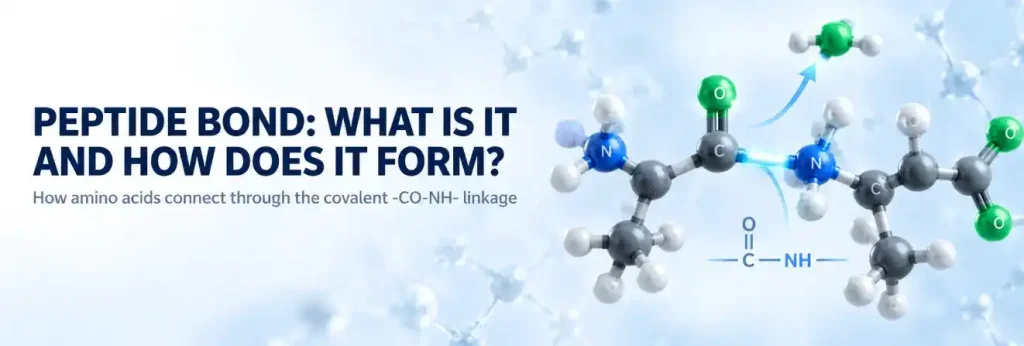
GHK-Cu peptide is the copper(II)-coordinated form of GHK, a tripeptide composed of glycine, histidine, and lysine. The peptide binds a copper ion to form the complex commonly written as GHK-Cu or GHK-Cu(II).
This coordination is relevant to research examining copper transport, cellular signalling, and extracellular matrix regulation.
GHK vs GHK-Cu: What Is the Difference?
GHK, GHK-Cu, and AHK-Cu are distinct compounds, while copper tripeptide-1 is an ingredient name and copper peptides describe a broader category.
| Term | Meaning | Key distinction |
| GHK | The Gly-His-Lys tripeptide | Does not specify that copper is coordinated |
| GHK-Cu | GHK coordinated with copper(II) | The primary copper complex discussed in this guide |
| Copper tripeptide-1 | An ingredient name commonly associated with GHK-Cu | Does not confirm the formulation, concentration, or analytical identity |
| AHK-Cu | Ala-His-Lys coordinated with copper | A chemically distinct compound examined in some hair studies |
| Copper peptides | A broad category of copper-binding peptides | Findings for one copper peptide cannot automatically be applied to another. |
Several frequently cited hair findings concern AHK-Cu rather than GHK-Cu and therefore cannot be treated as direct evidence for GHK-Cu.
Because closely related copper-binding peptides can differ in sequence and coordination chemistry, compound identity should be confirmed before interpreting experimental findings. Researchers can also review our Peptide Sequence guide for background on how sequence differences define peptide identity.
How Does GHK-Cu Work in Research Models?
There is no single accepted mechanism that explains every reported observation. Current GHK-Cu research focuses on several connected biological processes.
1. Copper Coordination and Availability
Copper is an essential trace element involved in enzymes associated with connective-tissue biology, antioxidant defence and cellular metabolism. GHK can coordinate Cu(II), potentially influencing how copper is presented within an experimental system. Observed responses may vary according to free copper concentration, background copper already present in the medium and other metal-binding components.
This makes matched controls especially important in copper-peptide studies. Free GHK, matched copper and GHK-Cu should be distinguished analytically rather than treated as equivalent materials.
2. Extracellular-Matrix Regulation
The extracellular matrix is a structured network of collagen, elastin, glycosaminoglycans, and other molecules that support cells and tissues. Its maintenance depends on a controlled balance between matrix production and breakdown.
Common experimental endpoints include:
- Collagen or procollagen production
- Glycosaminoglycan synthesis
- Fibroblast migration and viability
- Matrix metalloproteinase activity
- Tissue inhibitor of metalloproteinase expression
- Matrix deposition and organisation
Matrix metalloproteinases (MMPs) break down selected matrix components, while tissue inhibitors of metalloproteinases (TIMPs) regulate their activity.
The most informative collagen studies assess matrix degradation, deposition and organisation alongside collagen production.
3. Cellular Stress and Signalling
GHK-Cu peptide research examines oxidative stress, inflammatory signalling and cell migration. Related research on cellular movement and tissue response also includes compounds such as TB-500 peptide.
Related tissue-response research also includes compounds such as TB-500 peptide. However, findings from TB-500 cannot be attributed to GHK-Cu because the compounds differ in structure, targets and evidence base.
GHK-Cu Research: Evidence at a Glance
GHK-Cu research includes biochemical assays, cell cultures, tissue models, and limited human studies.
| Research area | Evidence measured | Main limitation |
| Copper binding | Complex formation and binding behaviour | Does not show cellular effects |
| Skin and collagen | Cell viability, migration, collagen, MMPs and TIMPs | Cell cultures do not reproduce complete human skin |
| Tissue response | Wound closure and matrix deposition | Preclinical models do not confirm human outcomes |
| Hair biology | Follicle elongation and dermal papilla cell activity | Direct evidence is limited, and some studies use AHK-Cu |
| Human studies | Skin appearance, elasticity and structure | Studies are often small and formulation-specific |
Biochemical findings confirm properties such as copper binding, while claims about skin, hair or tissue outcomes require relevant and well-controlled human evidence.
The table highlights why GHK-Cu evidence should remain separated by model type. Biochemical findings can establish properties such as copper coordination, while claims involving tissue structure, hair or visible skin outcomes require higher-level evidence.
GHK-Cu Skin Research
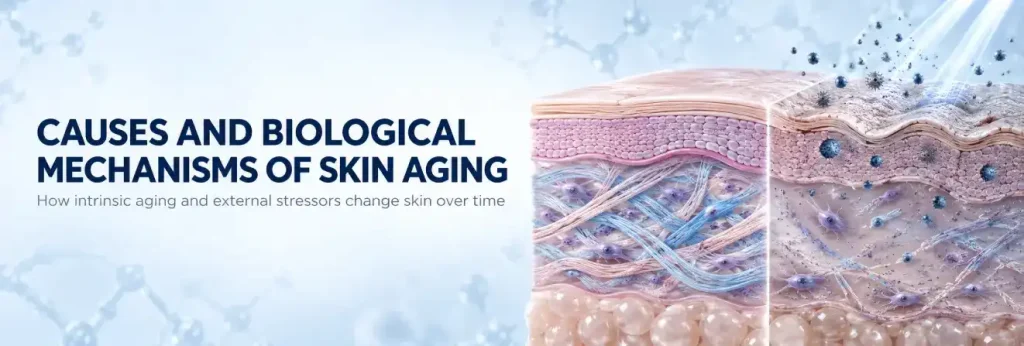
GHK-Cu is studied alongside other compounds in skin-ageing research using dermal fibroblasts, epidermal keratinocytes and reconstructed skin models. For broader context on skin-related peptide research, see our What Do Peptides Do for Aging Skin and What Causes Skin Aging guides.
Common study endpoints include:
- Cell proliferation and migration
- Collagen and glycosaminoglycan markers
- MMP and TIMP expression
- Oxidative-stress and inflammatory markers
- Tissue structure in reconstructed or ex vivo skin
Results vary by model, concentration, formulation and handling conditions. Cell-based findings do not directly establish clinical skin repair or wrinkle reduction, while pH, temperature, light and storage conditions may affect material stability and biological availability.
GHK-Cu Collagen Research
Unlike research on dietary collagen supplementation, GHK-Cu studies examine collagen-related signalling, synthesis and matrix remodelling within defined laboratory models. These experimental findings should not be interpreted as confirmation of clinical benefit.
Common measurements include:
- Procollagen and total collagen
- MMP and TIMP activity
- Fibroblast viability and proliferation
- Matrix deposition and organisation
These measurements help distinguish increased collagen production from changes caused by cell number or matrix remodelling.
Tissue Remodelling and Wound-Response Models
GHK-Cu is investigated in tissue-remodelling models that assess cell migration, fibroblast activity, matrix deposition, and vascular responses.
Common models include:
- Scratch assays for cell migration
- Three-dimensional tissue models
- Animal wound models
- Formulation-specific human studies
Related tissue-response research includes compounds such as BPC peptides, although BPC-157 findings cannot be attributed directly to GHK-Cu because the compounds have different structures and experimental evidence bases.
Oxidative Stress and Inflammatory Signalling
GHK-Cu research examines its effects on:
- Reactive oxygen species
- Oxidative-damage markers
- Antioxidant enzyme activity
- Inflammatory cytokines
- Cell survival under stress
These findings vary across cell, animal, and human models, and changes in laboratory markers alone do not confirm a clinical antioxidant or anti-inflammatory effect.
GHK-Cu Hair Research
GHK-Cu hair research remains limited, and some frequently cited findings involve AHK-Cu, a chemically distinct copper-binding peptide. AHK-Cu findings therefore should not be presented as direct evidence for GHK-Cu.
How Researchers Evaluate a GHK-Cu Research Compound

A purity claim alone does not fully characterise GHK-Cu peptide. Batch-specific documentation is also required to evaluate identity, composition, copper content and analytical quality.
1. Identity and Composition
Relevant records may include:
- Amino-acid sequence
- Confirmation of GHK-Cu rather than free GHK
- Expected and observed molecular mass
- Copper content or copper-to-peptide ratio
- Counter-ion or salt form
- Batch number and physical form
Mass spectrometry can support identity testing, while copper content and complex formation may require additional analytical methods.
2. Purity and Peptide Content
Under a validated chromatographic method, HPLC area percentage estimates the relative abundance of detected components.
It is not equivalent to peptide content or total vial mass.
| Quality attribute | What it indicates |
| Identity | Whether the expected compound is present |
| HPLC purity | The proportion of the main detected component |
| Peptide content | The peptide mass in the sample |
| Copper content | The amount of copper associated with the material |
| Sterility | The absence of viable microorganisms under a validated test |
| Endotoxin | Whether bacterial endotoxin is below a stated limit |
A batch-specific Certificate of Analysis may report selected analytical attributes, but it does not by itself establish biological activity or experimental suitability. Sterility and endotoxin status should only be stated when supported by validated batch-specific testing.
Researchers can review our Certificate of Analysis guide for guidance on interpreting batch-specific analytical documentation.
3. Storage Records
Moisture, temperature, light, oxygen, pH and repeated freeze–thaw cycles may affect GHK-Cu stability. Records of solvent, concentration, preparation date and storage conditions improve experimental traceability and reproducibility.
For broader storage guidance, see our Peptide Storage Stability guide.
Features of Reliable GHK-Cu Peptide Studies
More reliable GHK-Cu studies typically use:
- Untreated and vehicle controls
- Free GHK and matched copper controls
- Multiple tested concentrations
- Cell viability testing
- Biological and technical replicates
- Defined endpoints and sampling times
- Control of pH and background copper
Biological replicates test reproducibility across independent samples, while technical replicates measure assay variation. Concentration–response testing also provides more information than a single tested concentration.
GHK-Cu in Australia: Regulatory Status
In Australia, the classification of a GHK-Cu product depends on its formulation, route of administration, intended use and the claims made about it.
Products represented or supplied for therapeutic use in Australia are subject to applicable therapeutic-goods regulation, including ARTG requirements where relevant. This regulatory context is separate from laboratory research use.
The TGA has identified injectable GHK-Cu products among examples of unapproved peptide products when they are supplied outside applicable regulatory pathways. This does not convert laboratory research materials into approved therapeutic products.
For a broader explanation of this distinction, see our Research Use Only Peptides guide.
Limitations of the Current Evidence
GHK-Cu peptide has extensive mechanistic research, but evidence of clinical effects remains limited.
Key limitations include:
- Many findings come from cell or animal models
- Several foundational studies are relatively old
- Human studies are often small or formulation-specific
- GHK, GHK-Cu, and AHK-Cu are sometimes confused
- Biomarker changes may not produce visible or functional outcomes
- Topical and laboratory findings do not establish injectable effects
Overall, the literature supports continued mechanistic and laboratory investigation but remains insufficient for broad therapeutic claims or direct extrapolation from cell and animal models to human outcomes.
For an independent dermatologist’s overview of GHK-Cu and the limitations of current human evidence, watch the video below:
What Does the Current Evidence Show?
Current evidence supports continued investigation of GHK-Cu peptide in copper-binding, fibroblast, extracellular-matrix and tissue-remodelling research models.
Human evidence remains more limited, particularly for hair-related outcomes, and interpretation depends on verified compound identity, appropriate controls, defined concentrations and clear separation between laboratory findings and clinical claims.
For broader compound-specific research information, browse our Research Peptide Guides.
FAQs About GHK-Cu Peptide
What does a GHK-Cu peptide do?
GHK-Cu coordinates copper(II) and is studied in laboratory models involving extracellular-matrix regulation, collagen-related signalling, fibroblast activity, oxidative stress and tissue remodelling.
Is GHK-Cu available for laboratory research in Australia?
GHK-Cu may be supplied as a laboratory research material in Australia, but research availability does not mean the material is approved as a therapeutic product.
How strong is the current GHK-Cu evidence?
Mechanistic evidence is strongest in copper-binding, fibroblast and extracellular-matrix research. Human evidence remains more limited and is often formulation-specific.
Does GHK-Cu have an established biological response timeframe?
No single timeframe applies across GHK-Cu research because response timing depends on the model, concentration, endpoint, formulation and exposure conditions being studied.
How is GHK-Cu regulated in Australia?
Regulatory status depends on formulation, intended use, route of administration and therapeutic claims. Laboratory research materials and therapeutic products should not be treated as equivalent regulatory categories.
Does GHK-Cu research establish a complete safety profile?
No. Laboratory and limited human findings do not establish a complete safety profile across all formulations, routes or exposure conditions.
What variables affect GHK-Cu compatibility in laboratory studies?
Compatibility may depend on pH, buffer composition, copper concentration, solvent, container material and other components present in the experimental system.
How does GHK-Cu affect hair growth?
Hair-related evidence remains limited, and some frequently cited studies involve AHK-Cu rather than GHK-Cu. Current evidence does not establish predictable human hair-growth outcomes for GHK-Cu.
Is GHK-Cu approved as a therapeutic medicine?
Therapeutic approval depends on the specific product, formulation and jurisdiction. A laboratory research material should not be treated as an approved therapeutic product simply because it contains GHK-Cu.