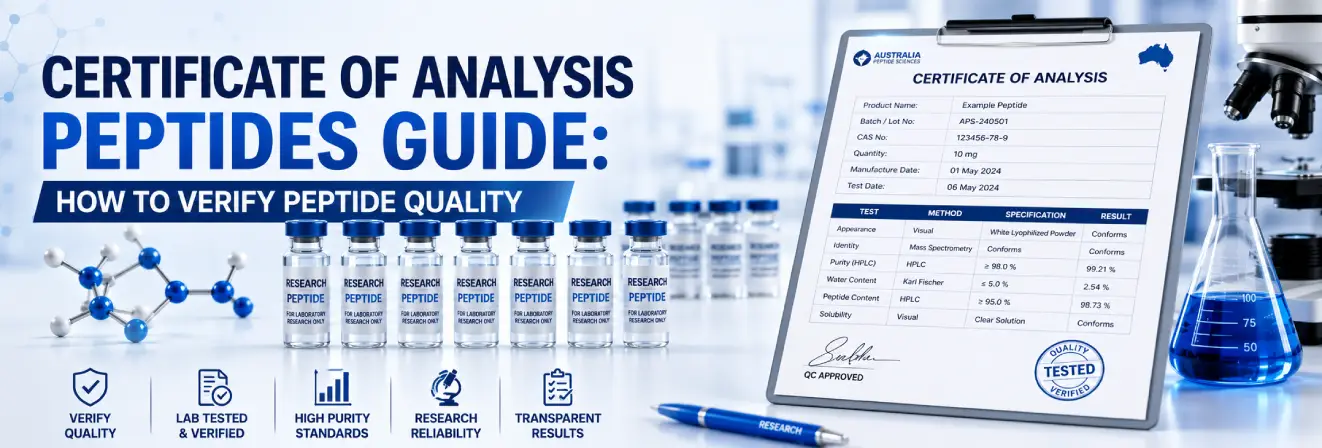
A peptide Certificate of Analysis (COA) reports analytical results for a defined batch and should be interpreted alongside the stated test methods and product specifications. COA data describe laboratory characteristics of the material and do not establish therapeutic effectiveness or suitability for human or veterinary use.
Reading a peptide COA involves checking the compound name, batch identifier, analytical methods and reported results. Each detail helps establish whether the document corresponds to the material being evaluated and what the laboratory tests actually demonstrate.
What Is a Certificate of Analysis for Peptides?
A peptide Certificate of Analysis reports batch-specific analytical information such as compound identification, measured purity and the testing methods used. The meaning of those results depends on the analytical method, specification and batch referenced in the document.
Researchers commonly review a COA because it provides greater transparency around:
- Peptide identity
- Purity percentage
- Batch or lot number
- Testing methods used
- Quality verification
A COA allows researchers to compare reported laboratory findings with the material specification. Its usefulness depends on the test methods, completeness of the results and traceability to the relevant batch.
Batch-specific analytical documentation can be reviewed through the Peptide Certificates of Analysis (COAs), where available for the relevant material.
Why Do Researchers Review Peptide COAs?
Researchers review peptide COAs to understand which tests were performed on a particular batch and whether the reported findings meet the relevant material specifications.
Many researchers check COAs to:
- Review the reported peptide purity result
- Confirm the batch or lot identifier
- Identify the analytical methods used, including HPLC and mass spectrometry
- Check whether the reported results meet the stated specifications
Differences in material identity, purity or other reported characteristics can affect experimental reproducibility. A COA helps document those characteristics but does not replace appropriate laboratory verification.
Broader laboratory-quality and supplier considerations are covered in the Research Peptides Australia guide.
Why a Peptide Certificate of Analysis Matters
A COA provides a documented basis for evaluating a specific batch rather than relying solely on product descriptions or supplier claims. Relevant information may include identity, purity, lot number, analytical method and test date. These data can support material traceability and experimental reproducibility when interpreted with the laboratory protocol and product specifications.
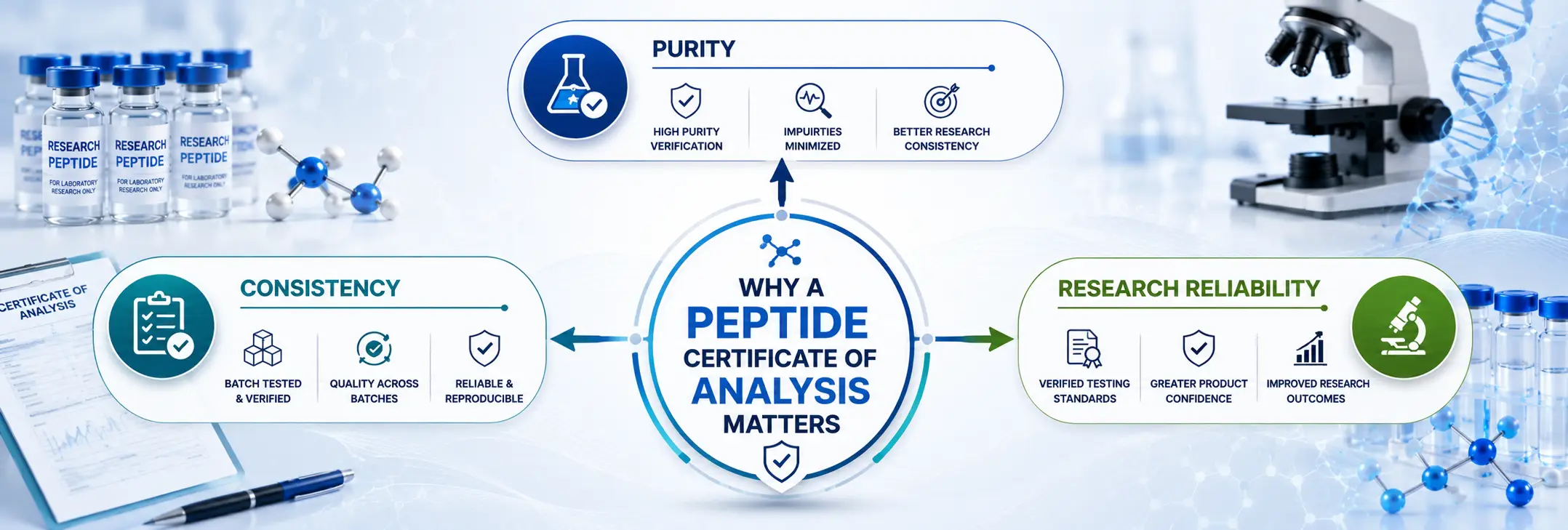
Purity
A COA may report chromatographic purity for the tested batch. The result should be evaluated using the specified method and analytical conditions.
A purity percentage does not necessarily represent the mass fraction of the target peptide in the complete sample. For a detailed explanation of HPLC peak-area results and their limitations, see Peptide Purity Explained.
When reviewing the certificate, researchers should compare the reported purity value with the stated specification and determine whether the method provides sufficient information for the intended laboratory study.
Consistency
Batch-specific testing is important because production lots may differ. Comparing analytical documentation between batches can help laboratories identify changes in purity, identity or other reported characteristics that may affect experimental consistency.
Researchers often review COAs to better understand:
- Whether a batch has been tested
- If quality remains consistent
- Whether compound information aligns with expected standards
Comparing batch-specific results can help identify differences between production lots, provided the analytical methods and reporting conditions are suitable for comparison.
Research Reliability
A COA provides a record of reported analytical findings, but the document should not be treated as independent proof of experimental suitability. Its results must be considered alongside the laboratory’s own requirements.
What Information Should a Peptide COA Include?
A peptide COA may report the batch or lot identifier, compound identity, analytical result, testing method and test date. Additional information can vary by supplier and document type. Storage instructions and product-handling information should be reviewed from the applicable product documentation where provided.
Batch Number
A batch number (or lot number) is one of the most important details on a COA. It identifies the specific production run a peptide came from, helping researchers track consistency across different batches.
Why does this matter?
The batch number connects the analytical report to a specific production lot. When evaluating a different batch, researchers should confirm that the documentation corresponds to that lot rather than assuming earlier results still apply.
Purity Percentage (%)
The reported purity result should be read alongside the analytical method. For HPLC peak-area measurements, the percentage represents the proportion of integrated detector response attributed to the main peak under the stated conditions, not necessarily the percentage of peptide by total sample mass.
Purity percentages should be interpreted according to the analytical method and specification used. A numerical purity result alone does not establish overall material quality, identity or suitability for a particular experiment.
A purity result is meaningful only when the method, specifications and requirements of the intended experiment are considered together.
Testing Method
The COA should identify the analytical methods used to obtain the reported results.
Common testing methods used in research peptide testing include:
| Testing Method | Purpose |
| HPLC (High-Performance Liquid Chromatography) | Can evaluate chromatographic purity under the stated method conditions |
| Mass Spectrometry (MS) | Can support evaluation of molecular mass and compound identity |
These testing methods help support peptide quality assurance by providing greater transparency around how compounds are verified.
Storage Information
Storage recommendations may appear on a COA or in separate product documentation. These conditions should be appropriate for the material and supported by relevant stability information.
Storage guidance may include:
- Recommended temperature
- Handling considerations
- Stability conditions
Proper storage can be important for supporting consistent laboratory workflows and research preparation.
Manufacturing or Testing Date
The testing date identifies when the reported analysis was performed. Where available, manufacturing dates and other batch records can provide additional context about the material’s history.
Researchers often review this information to better understand:
- Product recency
- Batch timelines
- Quality tracking
Laboratory materials supplied for controlled research use are listed in the research peptide catalogue.
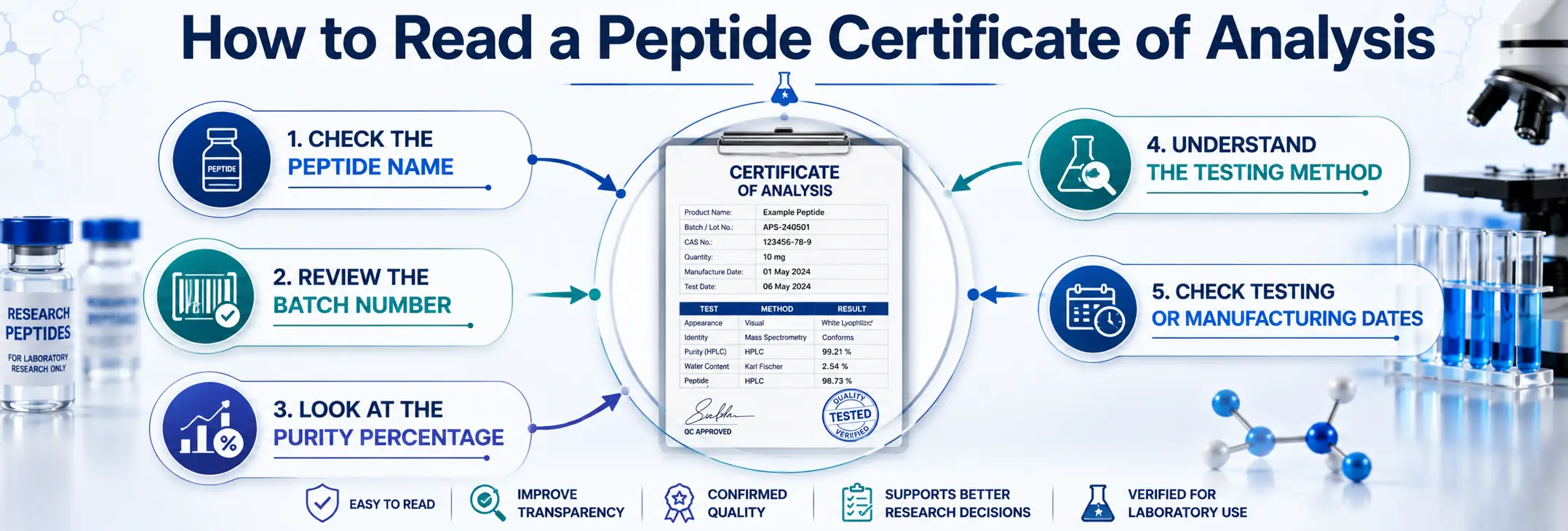
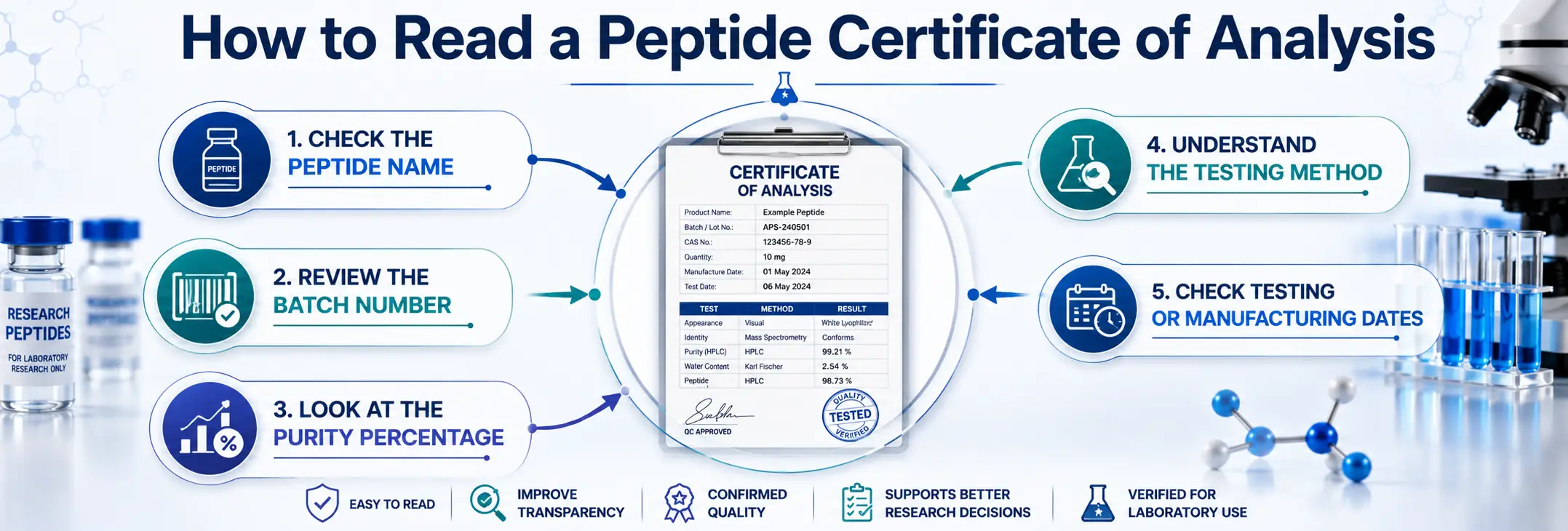
How to Read a Peptide Certificate of Analysis
Reading a peptide COA begins with checking whether the document matches the material being evaluated. Researchers should then examine the reported tests, analytical methods, results and dates to determine what the certificate establishes and whether any important information is missing.
Five checks provide a practical starting point for reviewing a peptide COA:
1. Check the Peptide Name
Confirm the compound name and, where relevant, its specified molecular form.
The COA should clearly state the compound being tested. This helps ensure the document matches the specific peptide being sourced.
The compound name should agree with the material specification. A matching name alone does not establish that the tested material has the correct molecular identity.
2. Review the Batch Number
Locate the batch or lot identifier on the certificate.
This identifies the specific production run linked to the tested peptide.
Compare the identifier on the COA with the batch information supplied for the material. A certificate for a different lot does not establish the analytical characteristics of the batch being evaluated.
3. Look at the Purity Percentage
The purity percentage is often one of the most important sections of a peptide purity certificate.
Check the reported purity result, the analytical method and any stated acceptance criteria. A chromatographic peak-area percentage should not be treated as a complete measurement of sample composition.
| Purity Level | What It Generally Means |
|---|---|
| Reported purity percentage | Should be interpreted with the analytical method, chromatogram, specification and intended experimental requirements. A percentage alone should not be used as a universal quality grade. |
The suitability of a purity result depends on the experimental requirements and the analytical specification, rather than a universal percentage threshold.
4. Understand the Testing Method
The certificate should identify the method used for each reported analytical result.
Two of the most common methods in research peptide testing include:
| Testing Method | Purpose |
| HPLC (High-Performance Liquid Chromatography) | Estimates chromatographic purity under defined method conditions |
| Mass Spectrometry (MS) | Provides evidence about molecular mass and supports identity assessment |
Researchers often look for these methods because they support greater peptide quality assurance and transparency.
5. Check Testing or Manufacturing Dates
Check when the analysis was performed and whether the dates correspond to the relevant batch records.
This helps provide context around:
- Batch timing
- Product verification
- Quality tracking
Missing dates, unclear analytical methods or mismatched batch identifiers should be resolved before relying on the certificate as evidence for a laboratory material.
What a Peptide COA Cannot Confirm
A peptide COA reports the analytical findings included in the document. It does not automatically establish sterility, absence of endotoxins, full sequence confirmation, biological activity or long-term stability unless appropriate tests are documented. A COA also does not establish therapeutic approval or suitability for human or veterinary use.
Understanding Peptide Purity Certificates
Purity is one of the most frequently reviewed results on a peptide COA, but its interpretation depends on the test method and the information provided.
When a COA reports 98% chromatographic purity, researchers should check the method and chromatographic data before interpreting the result.
A reported purity value represents the result obtained using the stated analytical method and conditions. It should not automatically be interpreted as the percentage of every possible component in the sample or as complete confirmation of molecular identity.
Peptide production and purification can influence the impurities detected during analytical testing. These processes are explained in the Peptide Synthesis guide.
For example:
A reported 99% HPLC peak-area result indicates that approximately 99% of the integrated chromatographic signal was attributed to the main peak under the stated method. It does not necessarily establish the peptide’s percentage by total sample mass.
Evaluating a Research Peptide Supplier
 Laboratories can evaluate suppliers according to transparent compound identification, batch-specific analytical documentation, clearly stated testing methods, storage information, research-use-only positioning and consistency between product specifications and COA data. Unsupported biological claims should remain separate from analytical quality documentation.
Supplier evaluation also involves factors beyond analytical documentation. These are covered in the Where to Buy Research Peptides in Australia guide.
COA Interpretation Across Research Compounds
Batch-specific analytical documentation is relevant across peptide chemistry, receptor-pharmacology, cellular-signalling, mitochondrial, neuropeptide and multi-receptor research. The analytical principles used to evaluate identity, purity and batch traceability remain distinct from the biological pathway being investigated.
At Australia Peptide Sciences, researchers can explore clearly organized categories supported by educational information and research-focused positioning, including:
- Recovery & Cellular Research Peptides (bpc & cell) - commonly studied for tissue signaling, cellular repair, and recovery biology
- Growth Hormone & Recovery Peptides (GHRP for research) - researched for GH signaling and hormonal communication pathways
- Metabolic & Appetite Research Peptides (GLP1 Peptides) - commonly explored in studies involving energy balance and metabolic signaling
- Brain, Sleep & Healthy Aging Peptides (Neuropeptides) - studied for cognitive pathways, sleep biology, and longevity-related research
Why COA Transparency Matters for Research Compounds
Each research compound and production batch requires its own analytical documentation. A COA for one material cannot establish the identity, purity or other characteristics of a different compound or batch, even when the materials belong to the same research category.
COA data describe analytical characteristics and do not convert a research compound into an approved therapeutic product. The distinction is explained further in the Research Use Only Peptides guide.
Use the Research Peptide Guides to explore how analytical documentation relates to purity, storage and laboratory preparation.
FAQs about Certificate of Analysis Peptides
What is a certificate of analysis for peptides?
A peptide Certificate of Analysis (COA) is a document reporting analytical findings for an identified batch. It may include the compound name, batch number, testing methods, results and applicable specifications.
Why do researchers review peptide COAs?
Researchers review COAs to check which tests were performed, whether the results meet the relevant specifications and whether the document corresponds to the batch being evaluated.
What does a reported 98% purity result mean on a peptide COA?
It indicates the purity result obtained using the stated analytical method and conditions. The value should be interpreted together with the testing method, chromatographic data, specification and identity information rather than as a universal measure of overall quality.
What is HPLC in peptide testing?
HPLC separates and detects components within a peptide sample. It is commonly used to assess chromatographic purity under defined analytical conditions.
What is mass spectrometry in peptide testing?
Mass spectrometry measures ion mass-to-charge ratios and can help determine whether the observed molecular mass is consistent with the expected peptide. A matching mass alone does not establish the complete molecular structure.
Why does batch testing matter for peptides?
Batch-specific testing helps researchers identify differences between production lots and connect reported analytical results to the material used in a particular experiment.
What are common red flags in peptide COA documentation?
Potential concerns include a missing batch identifier, unsupported purity claims, unclear testing methods, COA data that cannot be linked to the relevant product batch or limited analytical transparency.
Why does peptide quality assurance matter?
Peptide quality assurance matters because research often depends on consistency, transparency, and reliable product verification. Researchers commonly prioritize suppliers that provide clearer testing information and stronger quality standards.
What should laboratories evaluate in a research peptide supplier?
Relevant factors include transparent compound identification, batch-specific analytical documentation, clearly stated test methods, consistent product specifications, storage information and research-use-only positioning.