TB-500 peptide is a synthetic research compound studied in relation to actin regulation, cellular migration and tissue-response pathways. It is associated with a short region of Thymosin beta-4, but TB-500 and full-length Tβ4 are structurally different compounds and their findings should not be treated as interchangeable.
This guide examines the proposed laboratory mechanisms, compound-specific evidence, analytical considerations and Australian research context for TB-500.
Research-use note: TB-500 materials supplied for research are intended strictly for laboratory and scientific investigation and are not intended for human or veterinary administration. For broader context, see our [Research Use Only Peptides guide](https://australiapeptidesciences.com/blogs/research-use-only-peptides/).
What Is TB-500 Peptide?
TB-500 is commonly identified as the N-terminally acetylated 17–23 fragment of human Thymosin beta-4, with the seven-amino-acid sequence Ac-LKKTETQ.
Thymosin beta-4, often abbreviated as Tβ4, is a naturally occurring 43-amino-acid peptide found in many mammalian cells and tissues. It is involved in actin regulation, cellular movement, and several biological processes associated with tissue responses.
TB-500 differs from the parent peptide because it represents only a short section of the full Tβ4 sequence.
This structural difference may influence characteristics such as:
- Molecular structure
- Chemical stability
- Susceptibility to enzymatic degradation
- Cellular uptake
- Distribution within an experimental system
- Binding behaviour
- Biological activity
Researchers examining related cellular-repair pathways can also review the, which has a distinct structure, proposed mechanism, and evidence base.
Researchers examining related tissue-response pathways can also review our BPC-157 peptide guide for research. BPC-157 has a different amino-acid sequence, proposed mechanism and evidence base and should not be treated as interchangeable with TB-500.
TB-500 vs Thymosin beta-4
The two terms are frequently used interchangeably, although they describe structurally different peptides with different levels of supporting evidence.
| Feature | TB-500 | Thymosin beta-4 |
| Structure | Short synthetic peptide fragment | Naturally occurring full-length peptide |
| Length | Commonly identified as seven amino acids | 43 amino acids |
| Associated sequence | Ac-LKKTETQ | Complete Tβ4 sequence |
| Natural occurrence | Laboratory synthesised | Expressed naturally in numerous cells and tissues |
| Research base | Limited direct evidence | Broader biochemical, cellular, animal and investigational research |
| Human evidence | No robust direct clinical evidence | Investigated in limited clinical contexts, but not equivalent to TB-500 |
| Evidence transfer | Requires compound-specific validation | Findings do not automatically establish TB-500 activity |
A doping-control analysis identified the N-terminal acetylated fragment Ac-LKKTETQ in a product marketed as TB-500; the study focused on chemical identification and detection rather than clinical effects.
Because peptide sequence defines molecular identity, the seven-amino-acid TB-500 fragment should not be treated as equivalent to the complete 43-amino-acid Tβ4 peptide. For background on why sequence differences matter, see our Peptide Sequence guide.
How Does TB-500 Peptide Work in Research Models?
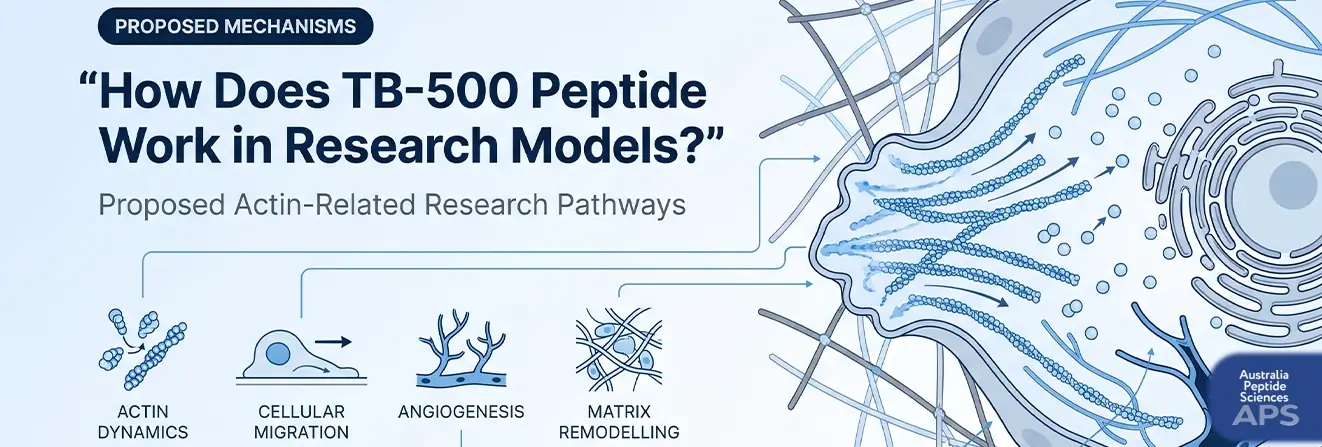
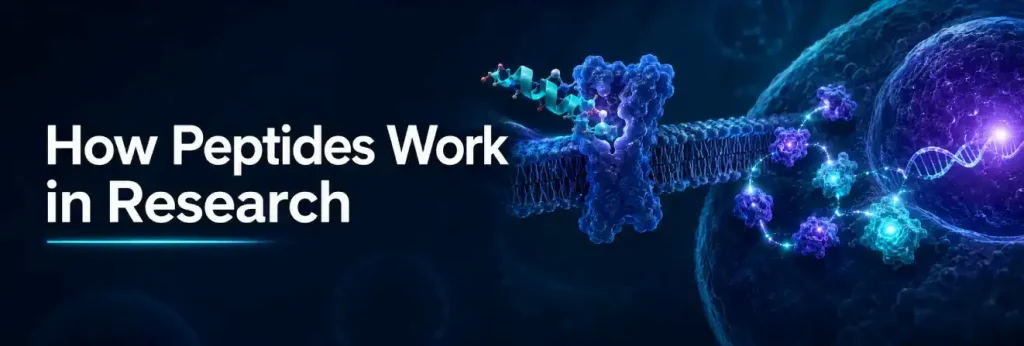
Proposed TB-500 research mechanisms are discussed in relation to the actin-associated region of Thymosin beta-4 and pathways involved in cell structure and motility. Because the fragment and full-length peptide are not identical, activity attributed to Tβ4 should not automatically be assigned to TB-500.
1. Actin Dynamics and the Cellular Cytoskeleton
The cytoskeleton supports cell structure and movement, with actin as one of its main components. Actin occurs as individual G-actin molecules or polymerised F-actin filaments.
Full-length Tβ4 binds G-actin and influences processes such as cell movement, adhesion, and changes in cell shape. It remains unclear whether isolated TB-500 reproduces the same biological activity.
2. TB-500 Cellular Migration
TB-500 cellular migration is investigated as a potential research area involving fibroblasts, keratinocytes, endothelial cells and myoblasts. Experimental findings should remain linked to the specific compound, concentration, model and assay used.
Cell migration also depends on receptors, adhesion molecules, growth factors, and the extracellular matrix. Activity observed in laboratory assays does not establish faster recovery or tissue healing in humans.
3. Angiogenesis and Endothelial Responses
Angiogenesis is the formation of new blood vessels from existing vascular structures. Full-length Tβ4 has been studied for its relationship with endothelial migration and vascular development, but equivalent activity has not been confirmed for TB-500.
4. Extracellular Matrix Remodelling
Researchers examining extracellular-matrix pathways can also review our GHK-Cu Peptide Research Guide, which covers a structurally distinct copper-binding peptide studied in matrix and fibroblast models.
What Does Current TB-500 Research Show?
Current TB-500 research remains limited. Available evidence includes analytical detection studies, proposed molecular mechanisms, and fragment-specific laboratory experiments, while most tissue-related findings involve full-length Tβ4.
Interpretation depends on whether a study examined TB-500 itself or full-length Tβ4, as well as the experimental model used.
Laboratory and Preclinical Evidence
Analytical studies can evaluate peptide identity, chromatographic purity, stability and degradation products, but these measurements do not establish biological activity or therapeutic effectiveness.
Possible TB-500 peptide research endpoints include cell migration, wound-gap closure, cell viability, actin organisation and cytokine expression.
| Evidence type | Research focus | Main limitation |
| Analytical studies | Identity, purity, stability and degradation | Do not demonstrate biological effects |
| In vitro studies | Cellular migration, viability and signalling | Results depend on cell type and experimental conditions |
| Animal studies | Tissue responses across interacting biological systems | Findings may not translate to humans |
Most preclinical evidence concerning wound closure, muscle injury and endothelial responses involves full-length Tβ4. These findings provide scientific context but do not directly establish TB-500 activity.
For more detail on analytical interpretation, see our Peptide Purity Explained guide and COA (Certificate of Analysis) guide.
Human Evidence
Direct human evidence for TB-500 remains inadequate. Robust clinical trials have not established a validated human pharmacological profile, therapeutic efficacy or long-term safety for the TB-500 fragment.
In its July 2026 review of TB-500 free base and TB-500 acetate for pharmacy compounding, the FDA identified no clinical studies or human exposure data and found insufficient evidence to assess clinical safety or effectiveness.
TB-500 Tissue Repair Research Areas
TB-500 tissue repair studies are generally discussed in relation to cellular movement, cytoskeletal organisation, endothelial responses, and extracellular matrix remodelling. These pathways are examined across several experimental tissue models.
| Research model | Main areas examined | Evidence limitation |
| Skin and wound models | Keratinocyte migration, fibroblast movement, wound-gap closure and matrix organisation | Cell-culture results do not establish faster wound healing in humans. |
| Skeletal muscle | Myoblast migration, cell differentiation, actin organisation and remodelling markers | Much of the available evidence involves full-length Tβ4 |
| Tendons and ligaments | Fibroblast migration, collagen alignment, matrix remodelling and mechanical properties | Direct human evidence for TB-500 remains insufficient. |
| Cardiovascular and endothelial models | Cell survival under stress, endothelial migration and vessel formation | Findings are primarily based on preclinical Tβ4 research |
| Inflammation-related models | Cytokine expression, immune-cell migration and vascular responses | Changes in individual markers do not establish an anti-inflammatory effect |
For a broader comparison of related tissue-response research compounds, see our BPC-157 vs TB-500 Research Guide.
TB-500 as a Research Compound
For a TB-500 research compound, verified sequence identity, analytical purity, stability and batch traceability are core variables when assessing suitability for a defined laboratory model.
| Quality measure | What it evaluates |
| Sequence identity | Whether the amino-acid sequence is correct |
| Purity and content | Peptide quantity and detectable impurities |
| Biological activity | Response in a validated assay |
| Sterility and endotoxins | Contamination-related quality attributes |
A high HPLC purity result does not independently confirm sequence identity, sterility, safety, or effectiveness.
1. Documentation and Experimental Controls
Reproducible TB-500 laboratory research depends on batch-specific documentation, lot identification, sequence confirmation, chromatographic data, mass-spectrometry results where applicable and relevant stability information.
Reliable experiments also require appropriate controls, replicates, and predefined endpoints. Comparisons with Thymosin beta-4 require verified materials tested under equivalent conditions.
Researchers can review our Certificate of Analysis guide for guidance on batch numbers, identity testing, purity results and analytical documentation.
2. Research Limitations and Safety Questions
Human safety data for TB-500 remain insufficient. Research uncertainties include toxicity, immunogenicity, metabolism, repeated-exposure effects, off-target activity and the influence of impurities or aggregation.
The FDA has also identified potential concerns involving peptide impurities, aggregation, and immunogenicity.
Does Angiogenesis Require Additional Safety Investigation?
Angiogenesis is involved in normal tissue biology but can also contribute to pathological processes, including tumour vascularisation. Existing evidence does not establish that TB-500 causes cancer, and the limited human dataset prevents firm conclusions about long-term risk.
4. Research-Use Boundaries
Published TB-500 evidence does not provide a validated human administration protocol. Online injection schedules, cycles and stacking discussions should not be treated as research protocols or scientific evidence.
TB-500 supplied as a laboratory research material is intended for controlled research only and is not intended for human or veterinary administration.
TB-500 Australia: Research and Regulatory Status
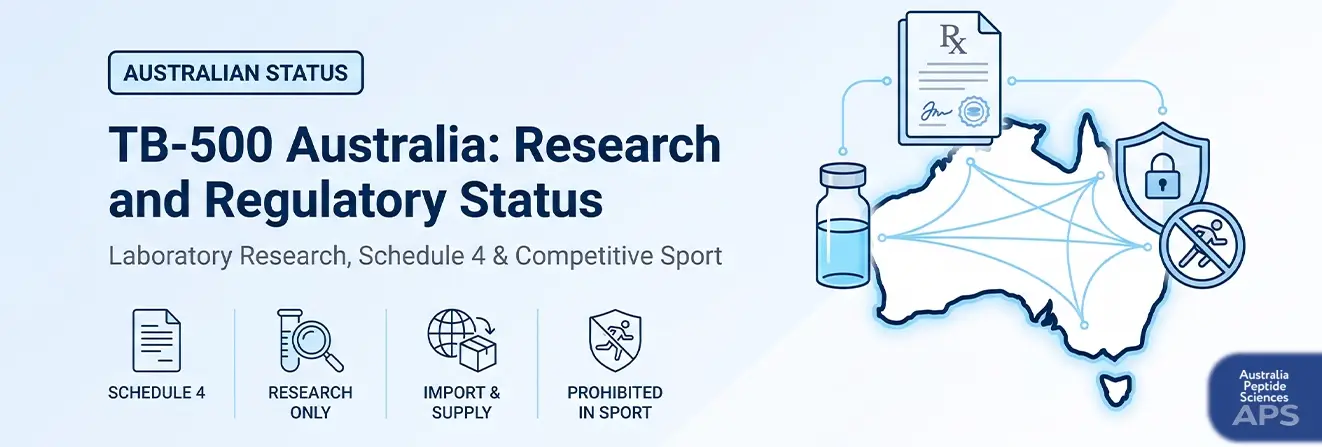
The Australian regulatory context for TB-500 distinguishes laboratory research materials from therapeutic supply, personal use and products represented for human administration.
TB-500 is treated within Australian regulatory controls applicable to unapproved peptide substances. A “research use only” label does not itself authorise human use or override applicable importation, possession, supply or advertising requirements.
TB-500 and Competitive Sport
Thymosin beta-4 and its derivatives, including TB-500, are prohibited under the WADA Prohibited List. This anti-doping classification is separate from evidence of therapeutic efficacy or laboratory activity.
The restriction applies in and out of competition, although prohibited status does not prove performance or recovery benefits.
How Does TB-500 Differ from Other Research Peptides?
Peptides associated with tissue research differ in their structure, proposed mechanisms, and available evidence.
| Compound | Structure | Main research context | Evidence limitation |
| TB-500 | Short fragment associated with Tβ4 | Actin dynamics and cellular migration | Limited direct evidence |
| Thymosin beta-4 | Naturally occurring 43-amino-acid peptide | Actin regulation, migration and tissue models | Findings do not automatically apply to TB-500 |
| BPC-157 | Synthetic 15-amino-acid peptide | Gastrointestinal and tissue-response models | Human evidence remains insufficient |
| GHK-Cu | Copper-binding tripeptide | Skin biology and extracellular matrix research | Results depend on the formulation and experimental model |
For structured comparisons between research compounds, browse our Peptide Comparison Guides.
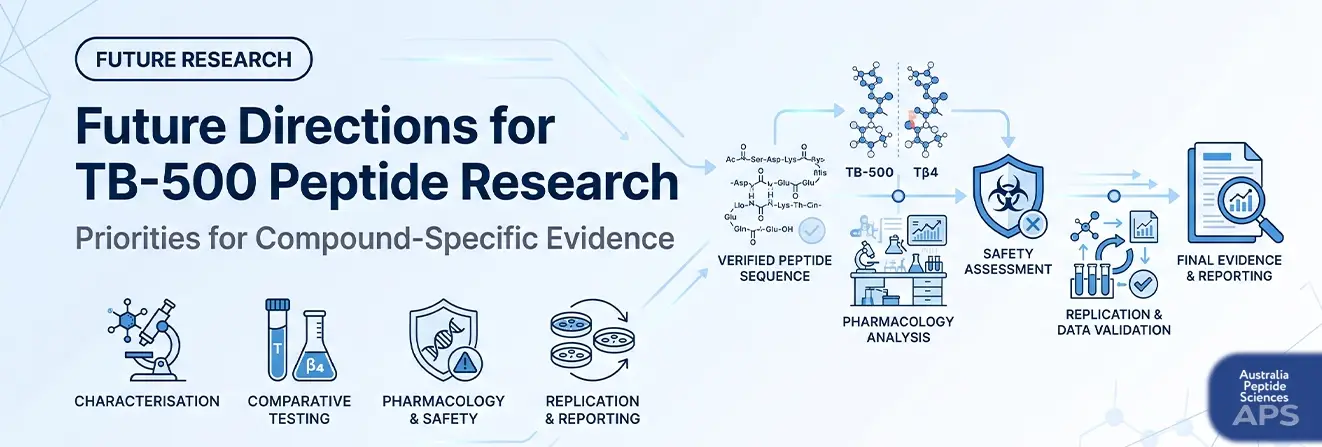
Future Directions for TB-500 Peptide Research
Future studies may clarify whether TB-500 has biological activity distinct from full-length Tβ4. Key research areas include:
- Compound characterisation:Sequence, salt form, stability, and aggregation.
- Comparative testing:Direct evaluation of TB-500 and Tβ4 under equivalent conditions.
- Pharmacology:Metabolism, distribution, target interactions, and concentration-response relationships.
- Safety assessment:Toxicity, immunogenicity, and off-target activity.
- Replication and reporting:Independent studies with transparent methods and results.
What the Evidence Says About TB-500
TB-500 remains an experimental peptide fragment with substantially less direct evidence than full-length Thymosin beta-4. Current research does not establish that TB-500 reproduces all Tβ4 activities or produces established clinical outcomes in humans.
Future research requires verified compound identity, appropriate controls, defined concentrations and compound-specific experimental methods. Cellular migration, actin dynamics and tissue-response pathways should therefore remain framed as laboratory research questions rather than established human effects.
For broader compound-specific information, browse our Research Peptide Guides.
FAQs About TB-500 Peptide
Is TB500 legal in Australia?
TB-500 is subject to Australian regulatory controls applicable to unapproved peptide substances. Requirements can differ depending on intended use, supply, importation and jurisdiction, and a research-use label does not by itself authorise human use.
How does TB-500 differ from BPC-157 in research?
TB-500 and BPC-157 are structurally different compounds investigated through different proposed pathways. TB-500 research commonly focuses on actin dynamics and cellular migration, while BPC-157 has a separate preclinical evidence base. Neither compound’s findings should be transferred directly to the other.
Is TB-500 directly supported by cardiovascular research?
Direct TB-500 evidence is limited. Many cardiovascular and endothelial findings discussed in this area involve full-length Thymosin beta-4 rather than the shorter TB-500 fragment.
Does TB-500 have an established biological response timeframe?
No single response timeframe has been established. Experimental responses depend on the compound identity, model, concentration, endpoint and exposure conditions being studied.
What safety questions remain in TB-500 research?
Key research uncertainties include toxicity, immunogenicity, metabolism, off-target effects, aggregation and the influence of impurities. Human safety evidence remains insufficient.
Is TB-500 prohibited in competitive sport?
Yes. Thymosin beta-4 and its derivatives, including TB-500, are prohibited under WADA anti-doping rules. This classification is separate from laboratory research evidence.
Is TB-500 available for laboratory research?
Australia Peptide Sciences lists TB-500 Peptide as a laboratory research material. It is supplied for research purposes only and is not intended for human or veterinary use.
What does TB-500 do in research models?
TB-500 is investigated in relation to actin-associated pathways, cellular migration and tissue-response models. Direct human biological effects have not been established.
References
- N-terminally acetylated 17–23 fragment
- FDA review of TB-500-related substances
- angiogenesis and tumour growth