
Peptide storage stability depends on molecular structure, formulation, temperature, and handling history. These factors determine whether a research material retains its identity, purity, and physical properties over time.
Quick Answer: What Determines Peptide Storage Stability?
No single temperature or shelf life applies to every peptide. Lyophilised materials may be more stable than prepared solutions, but reliable storage periods require compound-specific data and suitable analytical testing.
This article concerns laboratory research materials only, not human or veterinary administration.
What Is Peptide Storage Stability?
Peptide storage stability describes how consistently a peptide maintains its quality during a defined storage period. A clear solution or unchanged powder can still contain degradation products.
Three types of change must be distinguished:
- Chemical degradation: oxidation, hydrolysis, or deamidation changes the peptide molecule.
- Physical instability: aggregation or precipitation alters the material’s physical behaviour.
- Material loss or contamination: adsorption reduces peptide recovery, while microbial contamination creates a separate quality concern.
These outcomes require different measurements. The ICH Q5C stability guidance provides relevant analytical principles for certain biological products, but does not assign shelf lives to research peptides.
What Affects Peptide Storage Stability?
Peptide stability depends on interacting factors. The WHO stability testing guidelines describe how environmental conditions are investigated for pharmaceutical materials; their principles must be applied to research peptides with appropriate limitations.
| Factor | Possible effect | What laboratories should assess |
| Temperature | Changes degradation rates | Actual temperature history |
| Moisture | Hydrolysis or dry-state changes | Residual water and packaging |
| Oxygen and light | Oxidative or photochemical damage | Exposure and impurity profiles |
| pH and buffer | Deamidation, hydrolysis or precipitation | Formulation-specific compatibility |
| Freeze-thaw cycles | Aggregation or altered recovery | Validated repeated-cycle behaviour |
| Container surface | Peptide adsorption | Material compatibility and recovery |
Peptide Form and Sequence
Lyophilisation removes much of the water, reducing some degradation risks without eliminating them. A review of solid-state peptide stability explains why moisture, temperature and formulation still affect dry material.
In solution, pH, dissolved oxygen and concentration introduce further variables. Sequence matters too: cysteine, methionine and tryptophan may be oxidation-sensitive, while asparagine and glutamine can undergo deamidation under suitable conditions.
For the production process and physical characteristics of dried material, see lyophilised peptides.
Solvent, Buffer and Container Compatibility
The choice of bacteriostatic water for peptide research or another diluent may influence solubility and stability. Preservative content does not determine how long a dissolved peptide remains chemically stable.
Solvent composition must be assessed for the individual compound. The distinctions are explained in bacteriostatic water vs saline and sterile water vs bacteriostatic water.
Containers can also affect results. A 2026 study of peptide adsorption to plastics found recovery losses in low-input chemical proteomics that varied with plastic, buffer, pH, and volume. Its findings are workflow-specific and should not be treated as universal storage data.
Lyophilised Peptide Storage Versus Reconstituted Peptide Stability
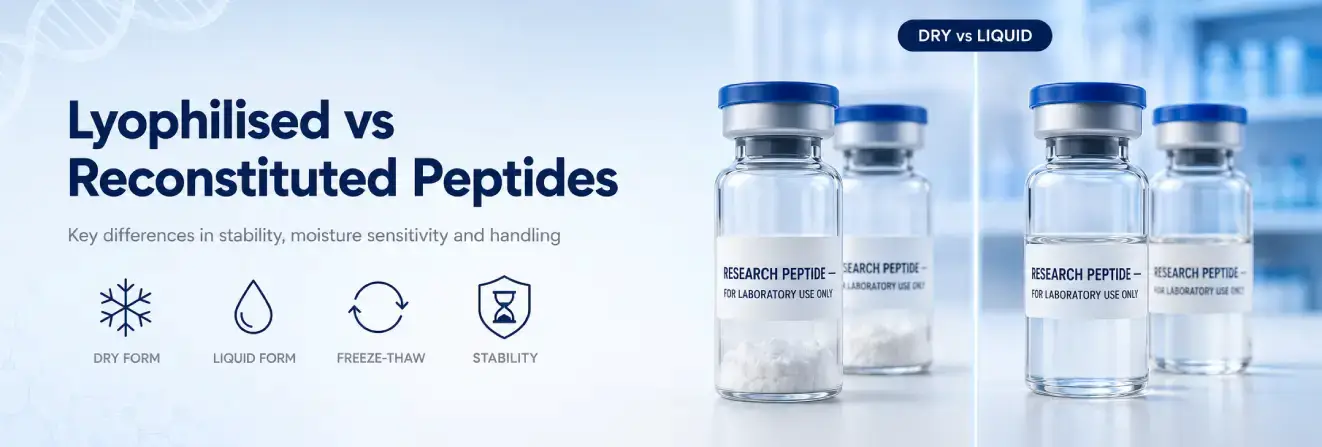
Dry and prepared peptides face different stability risks. A review of peptide aggregation describes how formulation and environmental factors can affect physical behaviour.
| Stability issue | Lyophilised peptide | Reconstituted peptide |
| Water-related reactions | Often reduced | Generally more relevant |
| Main concerns | Moisture, oxygen and packaging | pH, oxygen, aggregation and contamination |
| Freeze-thaw behaviour | Material-specific | Solution-specific |
| Shelf-life evidence | Required for the dry formulation | Required separately for the solution |
An expiry assigned to a sealed powder cannot automatically be applied after dissolution. The practical preparation process is covered in the peptide reconstitution guide.
Peptide Storage Temperature Explained
The correct peptide storage temperature must reflect validated product information. Shipping tolerance, temporary handling, and long-term storage are different conditions.
| Condition | What it means for stability |
| Room temperature | Requires evidence for the relevant duration |
| Refrigeration | May slow reactions without stopping degradation |
| Approximately −20°C | Suitable for certain dry or validated frozen materials |
| Approximately −80°C | May suit sensitive samples when packaging allows |
The FDA Q1A(R2) guidance describes approaches to testing storage conditions for regulated pharmaceuticals. For research materials, peptide temperature stability should be established from the relevant compound and conditions rather than inferred from a general temperature chart.
Stability During Laboratory Handling
Handling affects the interpretation of stability data when actual exposure differs from documented conditions. The WHO good storage and distribution practices emphasise environmental control and traceability within their medical-product scope.
How to Store Lyophilised Peptides Correctly
Opening a cold dry vial in humid air can introduce condensation. Repeated access can also increase oxygen and moisture exposure, so assess the full handling history against the material’s documented requirements.
For instance, GHK-Cu is a copper-associated peptide for which compound-specific information matters. Researchers can explore GHK-Cu Peptide for Laboratory Research Only and consult its applicable handling documentation.
Record the lot, opening dates, storage conditions, and deviations. Our Certificate of Analysis guide for peptides explains how batch documentation supports quality assessment without proving future shelf life.
How to Handle Reconstituted Peptide Solutions
Peptide reconstitution changes the material’s environment through solvent, pH, concentration, and surface interactions. Therefore, stability evidence for a dry vial cannot automatically be used for its prepared solution.
When a protocol specifies bacteriostatic water, the preservative does not establish the chemical stability of the dissolved peptide. Researchers can explore Bacteriostatic Water for Laboratory Research to review the supplied material information.
Document preparation dates, concentration, and freeze-thaw history. The TGA-adopted in-use stability guidance illustrates why opened or prepared products can require separate evaluation in its regulated-medicine context.
How Long Is Peptide Shelf Life?
There is no universal peptide shelf life. A defensible expiry or retest period depends on the formulation, packaging, storage environment, and evidence used to establish it. The TGA stability testing guidance explains the role of supporting studies for regulated medicines.
What Determines Peptide Shelf Life?
Key variables include sequence, impurity profile, salt or counter-ion form, residual moisture, buffer, concentration, and exposure history. Results for an unopened vial do not necessarily apply after repeated access or reconstitution.
An expiry date describes an assigned period of acceptable quality under specified conditions. A retest date signals when a material may need reassessment; the distinction depends on the material’s regulatory and research context.
Visit our shop for research materials.
Which Shelf-Life Information Should Take Priority?
Give priority to product-specific stability studies, labelled requirements, and relevant batch information. A single purity measurement does not establish long-term stability.
For background on quality testing, see the peptide purity guide and Certificates of Analysis.
How Is Peptide Stability Tested?
Stability studies compare samples at defined time points against baseline results and acceptance criteria. Real-time studies evaluate the proposed storage condition; stress studies identify possible degradation pathways but cannot independently establish shelf life.
| Method | Main use |
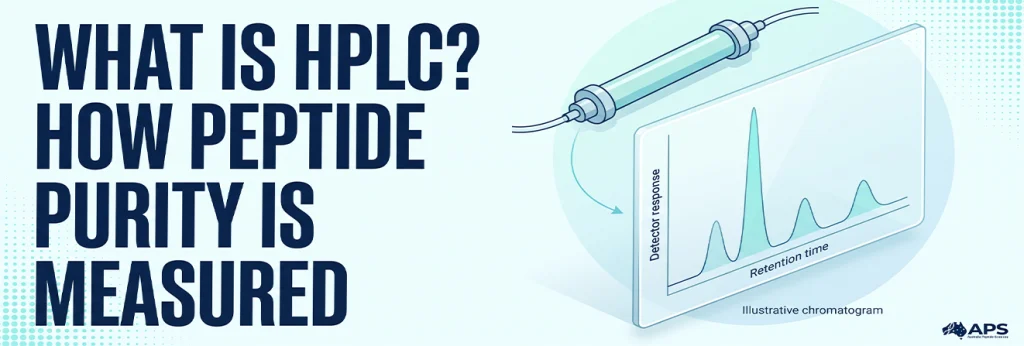
| RP-HPLC | Assay and separation of suitable impurities |
| LC-MS | Identifying peptide species and degradants |
| Size-exclusion chromatography | Assessing suitable soluble aggregates |
| Ion-exchange chromatography | Separating certain charge-related variants |
| Moisture analysis | Measuring water content of dry material |
| Microbiological tests | Assessing specified microbial quality attributes |
No one method captures every relevant change. A study should document its testing intervals, packaging, analytical methods, and pass/fail limits.
A 2026 study in the Journal of Chromatography A found that ion-exchange chromatography could complement reversed-phase chromatography for impurity analysis of selected therapeutic peptides. It does not establish a universal analytical method or storage duration.
The FDA draft ICH Q1 revision discusses updated stability-study principles, but remains draft guidance rather than a final standard.
Sequence-Related Peptide Stability Risks
A peptide’s sequence helps identify possible degradation routes. A review of therapeutic peptide oxidation describes oxidation mechanisms and their effects on molecular structure.
| Residue or feature | Main concern |
| Cysteine, methionine, tryptophan | Oxidation-related changes |
| Asparagine, glutamine | Deamidation in susceptible conditions |
| Certain aspartic acid sequences | Hydrolysis or rearrangement |
| Hydrophobic sequences | Solubility problems or aggregation |
Oxidation, hydrolysis and deamidation can create new chemical species. Precipitation and adsorption may instead reduce sample recovery without altering the peptide molecule. Our peptide sequence guide covers the structural background.
Recognising Instability and Storage Deviations
How to Recognise Possible Peptide Instability
Cloudiness, discolouration, precipitation, gel formation, or damaged seals require assessment. However, visual appearance cannot verify chemical stability: clear solutions may contain degradants, and cloudiness can reflect incomplete dissolution.
Confirm significant findings through appropriate analytical tests; see Peptide Purity Explained for the distinction between identity and purity information.
What to Do After a Temperature Excursion
Record the estimated temperature, duration, physical state, container condition, and earlier deviations. Compare the event with applicable stability evidence before deciding whether the material remains suitable for research.
Do not treat a single excursion as proof of degradation or continued stability. Set aside uncertain stock until the deviation has been assessed against the laboratory’s documented acceptance criteria.
Practical Research Peptide Storage Checklist
- Confirm identity, lot, formulation and container integrity.
- Review labelled temperature, expiry and retest requirements.
- Record temperature excursions, opening dates and preparation history.
- Distinguish chemical degradation from adsorption and contamination.
- Use stability-indicating methods appropriate for the material.
- Never apply dry-state shelf-life claims automatically to solutions.
Additional laboratory context is available in the Research Peptide Guides.
Key Considerations for Peptide Storage Stability
Peptide storage stability cannot be established from appearance or generic temperature advice. Reliable shelf-life decisions depend on the compound, formulation, exposure history, and analytical evidence. These materials are intended for laboratory research only, not human or veterinary administration.
Discover Australia Peptide Sciences.
FAQs About Peptide Storage Stability
What is the best temperature for peptide storage?
Follow the peptide’s validated storage conditions; no universal temperature applies.
How long do lyophilised peptides last?
Shelf life depends on sequence, moisture, packaging, and documented storage evidence.
How long are reconstituted peptides stable?
The duration depends on solvent, pH, concentration, temperature, and handling history.
Are lyophilised peptides more stable than reconstituted peptides?
Often, but not always; their relative stability depends on the formulation.
Can peptides be stored at room temperature?
Only where evidence supports that temperature for the relevant period.
Should peptides be stored in the refrigerator or freezer?
Use the documented requirements for the particular material and preparation.
Can a peptide be refrozen after thawing?
Only if its freeze-thaw behaviour and handling protocol support doing so.
How can peptide degradation be identified?
Use suitable analytical tests; appearance alone cannot establish stability.
What should be done if a peptide becomes warm during shipping?
Document the exposure and assess it against product-specific evidence.
Does every peptide have the same shelf life?
No. Each peptide and formulation requires appropriate stability evidence.
Sources
- ICH Q5C - Stability Testing of Biotechnological/Biological Products
- WHO - Guidelines on Stability Testing of APIs and Finished Products
- Lai and Topp - Solid-State Chemical Stability of Proteins and Peptides
- Zapadka et al. - Factors Affecting the Physical Stability of Peptide Therapeutics
- Date et al. - Peptide Adsorption to Plastics (2026)
- FDA - Q1A(R2) Stability Testing Guidance
- WHO - Good Storage and Distribution Practices
- TGA - In-Use Stability Testing Guidance
- TGA - Stability Testing for Prescription Medicines
- Goyon et al. - Ion-Exchange Chromatography for Peptide Impurity Profiling (2026)
- FDA - Q1 Stability Testing of Drug Substances and Drug Products (Draft)
- Torosantucci et al. - Oxidation of Therapeutic Proteins and Peptides