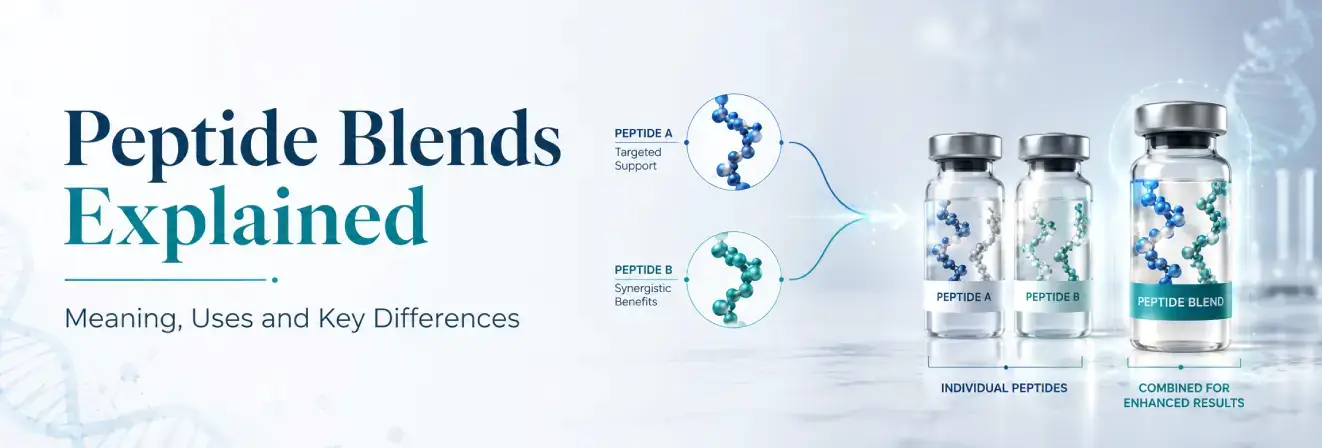
Peptide blends combine two or more defined peptides within a single formulation. They may be created to investigate related biological pathways, maintain a predetermined component ratio or simplify the handling of a combination that has a clear research rationale.
A blend is not automatically more effective or more scientifically valuable than an individual peptide. Adding components also adds variables, making it harder to determine which peptide produced an observed result and whether the ingredients interact positively, negatively or not at all.
The usefulness of a blend depends on the research objective, the identity and quantity of each component, formulation compatibility, stability and supporting quality documentation.
What Are Peptide Blends?
The basic peptide blend meaning is a product or formulation containing multiple peptide components rather than one isolated peptide.
Peptides are short chains of amino acids. Different peptide sequences can interact with different receptors, enzymes or signalling pathways. Combining them allows more than one peptide signal to be examined within the same formulation.
A properly documented blend should clearly identify:
- Every peptide included in the formulation.
- The quantity of each component.
- The ratio between the components.
- The total amount of material.
- The physical format of the product.
- The batch or lot number.
- Relevant quality and testing information.
A total vial amount alone is not enough. For example, a label stating that a blend contains 10 mg does not show whether it contains 5 mg of each component or a different proportion.
What Is a Multi Peptide Blend?
A multi peptide blend contains two or more peptides within one formulation. It may be a simple two-component combination or a more complex product containing three or more peptides.
As the number of components increases, so does the complexity of evaluating the product. More ingredients may require additional analytical testing, stability assessment and comparison groups to understand the contribution of each peptide.
The term should not be treated as a quality indicator. A blend containing four peptides is not necessarily better designed than one containing two. Every component should have a clear purpose.
Defined Blends, Cocktails and Random Mixtures
Several different formulations may be described informally as peptide mixtures, even though they are not scientifically equivalent.
| Term | Typical Composition | Main Characteristic | Key Consideration |
| Defined peptide blend | Two or more named peptides | Fixed and disclosed composition | Amount of each component must be clear |
| Single peptide | One identified peptide | One principal peptide variable | Easier result attribution |
| Peptide combination study | Multiple peptides assessed together | Components may remain separately supplied | Ratios can be changed independently |
| Peptide cocktail | Several peptide components | Meaning varies by context | Full composition must be disclosed |
| Random peptide mixture | A large population of different sequences | Overall characteristics may be defined without listing every sequence | Different research category from a fixed blend |
| Oral peptide product | Peptides formulated for consumption | Commonly nutritional or supplement-based | Not equivalent to a research peptide |
| Cosmetic peptide complex | Peptides incorporated into a topical product | Designed for skin or cosmetic application | Formulation and evidence differ |
A random peptide mixture may contain a highly diverse range of sequences produced according to controlled synthesis parameters. This is different from combining two named peptides in stated quantities.
Research Blends Are Not the Same as Supplements or Cosmetics
Peptide terminology is used across medicine, nutrition, cosmetics and scientific research. Products from these categories should not be treated as interchangeable.
Collagen peptides, for example, are commonly used as nutritional ingredients. Cosmetic formulas may contain signalling peptides alongside moisturisers, preservatives and delivery ingredients. Approved peptide medicines are manufactured and regulated for specific therapeutic indications.
Research peptide blends have a different intended purpose and quality context. Their composition, concentration, packaging and supporting evidence may differ substantially from consumer or medical products.
Evidence involving an oral supplement or topical cosmetic formula should not automatically be applied to a laboratory research blend. The route of exposure, formulation, concentration and study model all affect whether the evidence is relevant.
Why Are Peptides Combined?
Peptides are usually combined to investigate a defined relationship between two or more components.
The strongest justification is a testable hypothesis explaining why the peptides belong in the same research model. Convenience may be useful, but it is not sufficient evidence that a combination has scientific value.
Studying Related Biological Pathways
Different peptides may interact with separate targets within the same broad biological system. A combination can be used to examine whether these signals influence a shared endpoint.
Peptide combination research may investigate whether:
- Two peptides produce independent effects.
- Their effects are additive.
- One peptide modifies the response to another.
- The combination affects multiple connected pathways.
- The ratio changes the measured outcome.
- The complete formulation behaves differently from either component alone.
A connection between two biological mechanisms makes a combination plausible. It does not establish that the peptides will enhance one another.
Evaluating a Fixed Formulation
Sometimes the complete formulation, rather than its individual ingredients, is the subject being studied.
A CJC-IPA fixed blend may be appropriate when researchers need to evaluate:
- The consistency of a predefined combination.
- Stability during a specified period.
- The behaviour of the complete formulation.
- Differences between production batches.
- A combination intended to remain at a constant ratio.
This approach is most informative when the composition is transparent and individual-component comparisons are also available.
Maintaining a Consistent Component Ratio
A premixed formulation can maintain the same ratio between peptides across repeated experiments.
This may reduce variation caused by preparing the components independently. However, a fixed ratio also reduces flexibility.
If the ratio is unsuitable, researchers may be unable to adjust one component without changing the concentration of the entire blend. A fixed formulation is therefore most useful when the selected proportion already has a clear rationale.
Convenience and Product Handling
Potential practical advantages include:
- Fewer separate containers.
- Reduced inventory complexity.
- A predefined composition.
- Less risk of selecting the wrong individual component.
- Consistent formulation across repeated assessments.
These advantages relate to handling rather than biological performance. A more convenient product may still be harder to evaluate or interpret.
Commercial Positioning Does Not Prove Value
Some peptide blend products are supported by a clear formulation rationale. Others may be developed primarily to create a distinctive product name or to group popular compounds together.
Before accepting claims made about a combination, consider:
- Why is each peptide included?
- Is the exact amount of each component disclosed?
- Is the fixed ratio explained?
- Has the actual combination been studied?
- Are compatibility and stability addressed?
- Can the individual components be evaluated separately?
Descriptions such as advanced, complete, optimised or synergistic should not replace measurable product information.
Peptide Blends vs Single Peptides
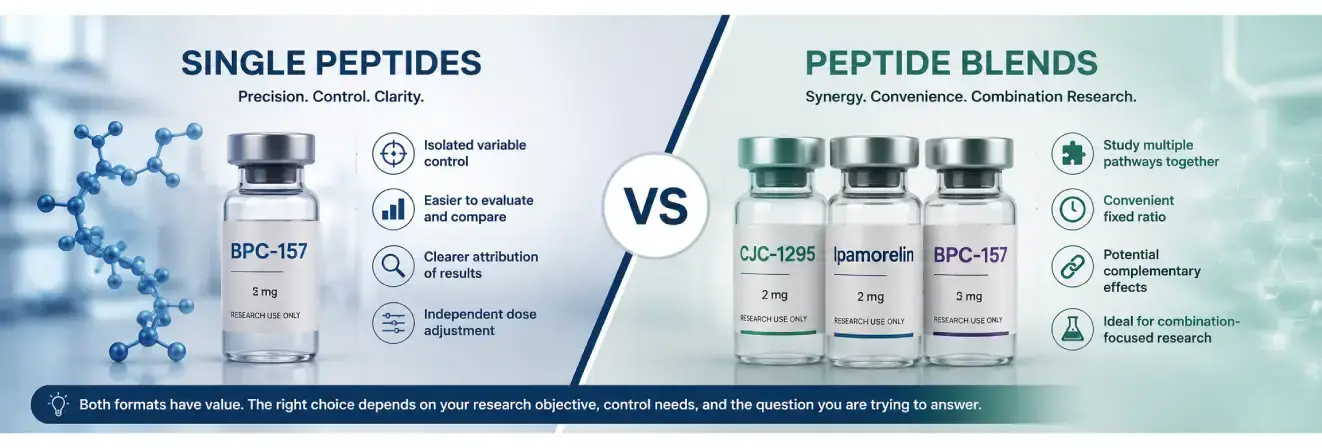
Peptide blends and single peptides serve different purposes. Neither format is universally superior.
Single peptides are generally better for isolating one variable. Blends may be suitable when the interaction or complete combination is the main focus.
| Research Factor | Single Peptide | Peptide Blend |
| Number of peptide variables | One | Two or more |
| Attribution of results | Usually clearer | More difficult |
| Component ratio | Not applicable | Usually fixed |
| Concentration changes | Independent | May change all components together |
| Dose-response analysis | More straightforward | More complex |
| Multi-pathway assessment | Limited | Possible |
| Formulation compatibility concerns | Fewer | Greater |
| Analytical requirements | Focused on one component | Must address every component |
| Interpretation difficulty | Lower | Higher |
| Most suitable for | Mechanism isolation and controlled comparison | Defined combination research |
Advantages of Single Peptides
Single peptides usually provide greater experimental control. They make it easier to:
- Connect an observed result to one compound.
- Test a range of concentrations.
- Compare findings with single-compound literature.
- Identify degradation or unexpected assay behaviour.
- Modify one variable at a time.
- Reproduce a narrowly defined study.
- Determine whether a peptide has measurable activity on its own.
This clarity is particularly important during early research, when the basic activity and concentration range of each component have not yet been established.
Potential Advantages of Peptide Blends
Research peptide blends may be appropriate when the combination itself is scientifically relevant.
Potential advantages include:
- Assessment of several connected signals.
- Evaluation of a formulation as one complete product.
- Consistent ratios between repeated experiments.
- Reduced handling of separate materials.
- Investigation of interactions between components.
- Screening of a predefined multi-component concept.
These advantages only apply when the blend is properly characterised and the study design can account for multiple variables.
Why More Peptides Do Not Guarantee Better Results
Adding a peptide may produce several possible outcomes:
- A stronger response.
- A simple additive response.
- No meaningful change.
- A weaker response.
- Greater variability.
- An antagonistic interaction.
- Reduced stability of the formulation.
The evidence for individual peptides cannot simply be added together to prove the performance of the blend.
If peptide A has been investigated separately and peptide B has also been investigated separately, those findings do not establish how A and B behave when placed in the same formulation.
When a Blend May Be the Better Format
A blend may fit the intended purpose when:
- The research hypothesis specifically concerns the combination.
- The components relate to connected biological pathways.
- The fixed ratio is part of the study design.
- The complete formulation is being assessed.
- Individual peptide data are already available.
- Appropriate single-component controls can be included.
- Independent concentration adjustment is not required.
When Single Peptides May Be More Appropriate
Separate peptides may be preferable when:
- One mechanism is being investigated.
- The study is intended to reproduce single-compound research.
- Component concentrations must be changed independently.
- The best combination ratio is not yet known.
- The source of an observed effect must be identified.
- Unexpected findings require troubleshooting.
- Maximum interpretability is required.
Separately supplied peptides also allow several ratios to be assessed before a fixed blend is selected.
What Does Synergy Mean in Peptide Combination Research?
Synergy does not simply mean that two peptides have different functions.
A synergistic interaction occurs when the measured effect of the combination exceeds a clearly defined expectation based on the effects of the individual components.
Additive, Synergistic and Antagonistic Effects
The main possible interactions are:
- Additive effect: The combination produces the expected total effect of the individual components.
- Synergistic effect: The measured combination effect exceeds the predefined additive expectation.
- Antagonistic effect: One component reduces or interferes with the effect of another.
- Neutral interaction: The combination does not meaningfully change the outcome beyond one component alone.
- Indeterminate interaction: The study design cannot establish how the components affected one another.
Using the word synergy without direct comparative evidence can be misleading.
Complementary Mechanisms Are Not Proof of Synergy
Two peptides can act through different mechanisms without strengthening each other.
Their interaction may depend on:
- Concentration.
- Component ratio.
- Exposure time.
- Study model.
- Measured endpoint.
- Formulation conditions.
- Sequence of exposure.
- Stability during the experiment.
Complementary pathways provide a reason to test the combination. They do not determine the result in advance.
What Is Needed to Demonstrate an Interaction?
A basic two-component comparison commonly includes:
- A negative or vehicle control.
- Peptide A alone.
- Peptide B alone.
- Peptides A and B together.
- Equivalent, clearly reported concentrations.
- Predefined outcome measures.
- Appropriate experimental replication.
- A stated statistical method.
- A model defining the expected additive response.
Without the single-component groups, the result applies only to the complete blend. It cannot establish which component was responsible or whether an interaction occurred.
| Proposed Statement | Evidence Required | What Does Not Prove It |
| Both peptides are present | Identity testing for each component | The label alone |
| The component ratio is correct | Quantitative content data | Total vial weight |
| The peptides are compatible | Formulation and stability evidence | A clear-looking solution |
| The effect is additive | Direct component and combination comparisons | Separate unrelated studies |
| The effect is synergistic | Controlled analysis of each peptide and the blend | Different mechanisms alone |
| The product is consistent | Batch-specific documentation | One historical report |
Formulation and Compatibility Factors for Peptide Blends

A scientifically plausible combination must also function as a stable physical and chemical formulation.
Peptides may differ in size, charge, structure, solubility and sensitivity to environmental conditions. Combining them may change the behaviour of each component.
Component Amounts and Ratios
A blend should disclose both the total quantity and the amount of each individual peptide.
Important information includes:
- Quantity per component.
- Total peptide content.
- Mass or molar ratio.
- Target specification.
- Measured content where available.
- Acceptable batch variation.
Without component-level information, researchers cannot determine the concentration of each peptide or compare the formulation accurately with other materials.
Fixed Ratios: Benefit and Limitation
A fixed ratio can improve consistency when the same formulation must be tested repeatedly.
It may become a limitation when:
- One component requires a lower concentration.
- The optimal ratio is unknown.
- A single peptide needs to be removed.
- A dose-response assessment is required.
- One component displays unexpected activity.
- Separate stability conditions would be preferable.
The ratio should match the research objective rather than being accepted solely because it is commercially available.
Solubility and Formulation Environment
Peptides that are stable separately may not behave identically when combined.
Compatibility can be influenced by:
- pH.
- Buffer composition.
- Ionic strength.
- Temperature.
- Peptide concentration.
- Excipients.
- Container material.
- Time in solution.
- Interactions between peptide molecules.
Visual inspection alone cannot confirm compatibility. A solution may appear clear while containing degradation products or soluble aggregates.
Chemical and Physical Stability
Factors that can affect peptide stability include:
- Oxidation.
- Hydrolysis.
- Deamidation.
- Aggregation.
- Precipitation.
- Moisture.
- Light.
- Heat.
- Adsorption to surfaces.
- Repeated freeze-thaw exposure.
The usable stability period of a blend may be limited by its least stable component. The combination may also create degradation behaviour that is not seen when the peptides are stored separately.
Lyophilised Blends and Prepared Solutions
Lyophilised material has had water removed under controlled conditions. This format can improve the stability of certain peptides, but it does not make a formulation permanently stable.
Reconstituted peptide solutions may be more sensitive to temperature, light, concentration, pH and storage time.
No universal storage period can be applied to every peptide blend. Product-specific stability information should take priority over general handling advice.
Why Individual Stability Data May Not Be Enough
Data for each peptide alone provide useful background but do not fully establish the stability of the blend.
Combining components may create:
- New molecular interactions.
- A different pH environment.
- Greater aggregation risk.
- Competition for solubility.
- Changed sensitivity to surfaces.
- More complex degradation products.
- Analytical peaks that are harder to separate.
Blend-specific stability assessment is therefore preferable to assuming that individual storage data remain unchanged.
How to Evaluate Peptide Blend Products
A reliable blend requires transparent composition, batch traceability and appropriate analytical documentation.
The evaluation standard should become more detailed as the number of components increases.
Read the Composition Carefully
Product information should state:
- The full name of every peptide.
- The amount of each component.
- The total content.
- The component ratio.
- The physical product format.
- The lot or batch number.
- Relevant storage information.
A brand name, code or general category such as recovery blend does not provide enough information unless the full formulation is also disclosed.
Check Whether the Ratio Is Clearly Stated
A product may list the names of several peptides without confirming how much of each one is present.
Look for clear information showing whether the formulation contains:
- Equal quantities.
- A deliberately unequal ratio.
- A total amount divided across several components.
- Measured content or only a nominal label claim.
The component ratio affects concentration calculations, interpretation and comparison with published research.
Look for a Batch-Specific Certificate of Analysis
A Certificate of Analysis should correspond to the actual batch being supplied.
Useful details normally include:
- Product or sample name.
- Lot or batch number.
- Testing date.
- Analytical method.
- Test results.
- Specifications or acceptance criteria.
- Laboratory or testing entity.
- Authorisation or review details.
A generic certificate that cannot be connected to the supplied batch offers limited traceability.
Understand Identity, Purity and Content
These terms answer different questions.
Identity determines whether the expected peptide is present.
Purity estimates how much of the analysed material corresponds to the intended component relative to detected impurities under a specified method.
Content or assay evaluates how much of a component is present.
A high purity percentage does not necessarily prove that each peptide is present in the labelled quantity. It also does not confirm that the ratio between components is correct.
For peptide blends for research, useful documentation should support:
- The identity of every intended component.
- The amount of each component.
- The expected ratio.
- The suitability of the analytical method.
- Relevant impurities or degradation products.
Analytical Methods Have Different Purposes
No single test confirms every quality attribute.
Depending on the product, analytical methods may include:
- Chromatography to separate components and assess purity.
- Mass spectrometry to support molecular identity.
- Quantitative testing to assess component content.
- Water-content analysis for lyophilised products.
- Physical or microbiological tests where relevant.
The method must be suitable for the specific blend. A method designed for one peptide may not adequately separate or quantify several components in one sample.
Verify Traceability
Product documentation should connect the labelled material to the reported results.
Important details include:
- Matching product and report names.
- Matching lot numbers.
- Clearly dated records.
- Defined specifications.
- Storage requirements.
- Packaging information.
- Component quantities.
- Testing methods.
- Identifiable supplier details.
Common Warning Signs
Potential red flags include:
- The quantity of each component is not disclosed.
- Only the total vial amount is shown.
- The product has no lot number.
- The report has no testing date.
- The analytical method is not identified.
- One generic certificate is used for multiple batches.
- Purity is stated without identity confirmation.
- The formulation is described as synergistic without comparison data.
- Product names obscure the ingredients.
- Human-use directions accompany a research-only product.
- Regulatory status is implied without supporting evidence.
| What to Verify | Why It Matters | Useful Evidence | Warning Sign |
| Identity of each peptide | Confirms the intended components | Component-specific analytical data | Ingredients appear only in promotional text |
| Quantity per component | Confirms concentration and ratio | Quantitative result or specification | Total content only |
| Purity | Helps assess detected impurities | Chromatographic results | Percentage without a method |
| Batch matching | Supports traceability | Lot-specific documentation | Generic certificate |
| Stability information | Supports consistent handling | Product-specific data | Unsupported universal shelf life |
| Labelling | Reduces identification errors | Clear component and batch details | Code-only or incomplete label |
| Intended-use language | Clarifies product context | Consistent research-focused information | Therapeutic promises or personal protocols |
Designing Clear Peptide Combination Research
Designing Clear Peptide Combination Research
A defined research question is essential when several components are being evaluated together.
Without appropriate comparisons, an observed change may be incorrectly attributed to the blend, one component or a proposed interaction.
Begin With a Testable Hypothesis
A useful hypothesis should define:
- Why the peptides are being combined.
- Which biological relationship is being tested.
- What outcome will be measured.
- Under what conditions it will be measured.
- What result would not support the hypothesis.
A general expectation that more peptides will produce a better result is not sufficiently specific.
Include Appropriate Comparison Groups
For a two-component blend, a basic design may include:
- Negative or vehicle control.
- Peptide A alone.
- Peptide B alone.
- The complete blend.
- A positive control where appropriate.
Additional groups may be needed when the formulation contains more components or when several ratios are being compared.
Define Outcomes Before Testing
Relevant outcome categories may include:
- Receptor activity.
- Cell signalling.
- Gene expression.
- Protein or biomarker levels.
- Cell viability.
- Concentration-dependent responses.
- Time-dependent changes.
- Chemical or physical stability.
- Consistency between batches.
Predefining the outcome reduces the risk of treating every detected change as significant after the results are known.
Record Important Formulation Variables
Reproducibility requires more than recording the product name.
Relevant information may include:
- Batch number.
- Quantity of each component.
- Component ratio.
- Final concentration.
- Formulation environment.
- Storage history.
- Preparation time.
- Exposure duration.
- Container type.
- Number of freeze-thaw cycles.
- Analytical method.
Products sold under the same blend name may not be comparable if these variables differ.
Interpret Results at the Correct Level
A result obtained from a blend initially describes the behaviour of the complete formulation.
It should not automatically be attributed to:
- The best-known component.
- The peptide with the most existing research.
- The ingredient present in the highest amount.
- A proposed mechanism.
- A claimed synergistic relationship.
Further comparison with the individual components is needed before drawing those conclusions.
Research Peptide Blends in Australia
The regulatory position of a peptide product in Australia depends on its ingredients, intended use, presentation, claims, supply pathway and other product-specific circumstances.
It is not accurate to state that all peptide blends have the same legal or regulatory status.
What Does Research Use Only Peptide Mean?
Research use only peptides indicates the purpose for which a product is presented. It does not, by itself, confirm that the product has been approved by the Therapeutic Goods Administration.
The TGA defines unapproved therapeutic goods as products not included in the Australian Register of Therapeutic Goods. These products have not been assessed by the TGA for safety, quality or effectiveness. Some unapproved goods may be accessed through specific legal pathways, but they are not equivalent to products included in the ARTG.
Adding a research disclaimer does not automatically:
- Change a product’s regulatory classification.
- Authorise its importation.
- Make its supply lawful.
- Remove advertising restrictions.
- Override Commonwealth, state or territory requirements.
Regulatory assessment considers the complete circumstances, not one sentence on a product label.
Product Presentation and Claims Matter
The way a product is presented may influence whether it is treated as a therapeutic good or therapeutic advertising.
Relevant material can include:
- Product names.
- Website descriptions.
- Labels.
- Claimed health outcomes.
- Testimonials.
- Instructions.
- Social media posts.
- Images and before-and-after comparisons.
- Sales and checkout language.
Businesses publishing educational peptide content should avoid personal-use instructions, unsupported therapeutic claims and language suggesting that an unapproved research product has been evaluated as a medicine.
Approved Peptide Medicines and Research Products Are Different
Some peptide-based medicines are included in the ARTG for specific indications. This does not mean that every product containing the same or a related peptide is approved.
Important distinctions include:
- ARTG-included therapeutic goods.
- Unapproved therapeutic goods.
- Prescription-only medicines.
- Products accessed through specific regulatory pathways.
- Genuine laboratory research materials.
- Oral supplements.
- Cosmetic products.
A research product should not borrow the approval status, safety evidence or therapeutic claims of a separately manufactured medicine.
Considerations for Tested Athletes
Not every peptide has the same anti-doping status, so each component in a blend must be checked individually.
The 2026 World Anti-Doping Agency Prohibited List came into force on 1 January 2026. It includes categories covering peptide hormones, growth factors, related substances and mimetics. Non-approved substances may also fall under the S0 category when they have no approval from a governmental regulatory health authority for human therapeutic use.
Being included in a blend does not change the status of a prohibited component.
Tested athletes should:
- Check every ingredient rather than the product name alone.
- Consult the current Prohibited List.
- Use official medication and substance-checking resources.
- Consider contamination and inaccurate-labelling risks.
- Obtain qualified advice when a component’s status is unclear.
Questions to Ask Before Selecting a Peptide Blend
A structured review can help determine whether a blend is sufficiently transparent and suitable for its intended purpose.
- What is the exact objective?
- Why is each peptide included?
- Is the complete composition disclosed?
- Is the quantity of every component stated?
- Is the component ratio clear?
- Is the fixed ratio appropriate?
- Is there evidence involving the actual combination?
- Can individual components be evaluated separately?
- Would separate peptides provide better control?
- Can each component be analytically identified?
- Is content confirmed as well as purity?
- Does the COA match the supplied batch?
- Are compatibility and stability addressed?
- Can the results be interpreted clearly?
- Does the product presentation match its stated purpose?
- Have relevant Australian requirements been considered?
- Are any ingredients prohibited in sport?
A blend that cannot answer these questions may add complexity without providing meaningful additional value.
Peptide blends combine two or more peptides in a defined formulation and are most useful when the combination, fixed ratio or component interaction is the research focus. Their main advantage is consistency, while their key limitation is reduced control over individual components and more difficult result attribution.
A well-characterised blend should disclose each peptide, its amount and ratio, batch-specific quality data and relevant stability information. Claims of synergy require direct comparative evidence. Single peptides remain preferable when variable isolation, independent concentration adjustment and clearer interpretation are priorities. A blend may be more appropriate when the complete formulation is the research subject and suitable component-level comparisons are included. For a product-specific example of a defined formulation, see the KLOW peptide blend.
In Australia, “research use only” wording does not determine regulatory status on its own. Ingredients, claims, presentation, importation and supply conditions must all be considered, making clear documentation and accurate, non-promotional communication essential.
FAQs About Peptide Blends
What Is the Best Peptide Combination?
There is no universal combination that is best in every situation. The most suitable option depends on the research objective, the pathways being studied, the proportions of each component, formulation stability and the quality of the supporting evidence.
Peptide blends should be chosen for a clear scientific reason rather than simply because they include several compounds.
Do Peptide Blends Actually Work?
Peptide blends can produce measurable results in certain research settings, but they are not automatically more effective than single peptides.
The outcome may be additive, synergistic, neutral or even antagonistic depending on the specific peptides, their concentrations and the study conditions.
Reliable conclusions require direct testing of the blend alongside suitable controls and the individual components.
What Peptides Should Not Be Mixed Together?
There is no single list of peptide combinations that should always be avoided. Compatibility depends on factors such as peptide structure, concentration, pH, buffer conditions, solubility and chemical stability. Peptides should not be combined when their formulation requirements conflict or when the mixture leads to precipitation, aggregation or degradation.
Can You Buy Peptides in Australia?
Certain peptide products may be legally supplied in Australia when they are included in the Australian Register of Therapeutic Goods or accessed through an approved pathway.
However, many peptide products available online are unapproved and have not been assessed by the TGA for safety, quality or effectiveness. A “research use only” label does not automatically make importation, supply or personal use lawful.
Sources:
National Center for Biotechnology Information. “Biochemistry, Peptides.”
PubMed Central. “Methods for Evaluating Drug Combination Effects.”
International Council for Harmonisation. “ICH Q1A(R2): Stability Testing of New Drug Substances and Products.”
International Council for Harmonisation. “ICH Q2(R2): Validation of Analytical Procedures.”
Therapeutic Goods Administration. “Understanding Your Responsibilities When Importing, Compounding and Supplying Unapproved Peptide Products.”
Therapeutic Goods Administration. “About the Australian Register of Therapeutic Goods.”