Description
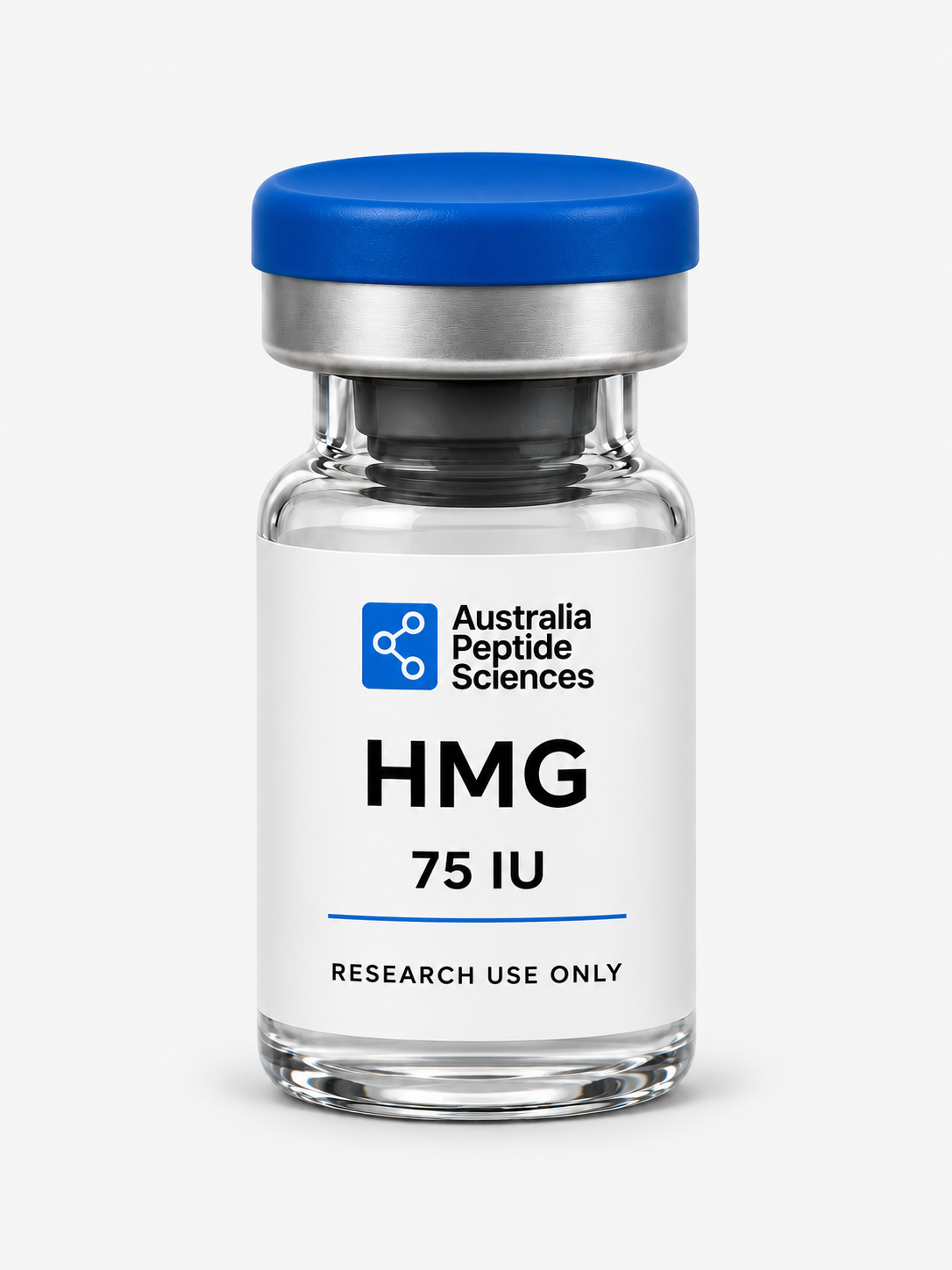
Human menopausal gonadotropin (HMG), also known as menotrophin, is a complex glycoprotein hormone preparation used in endocrine and receptor-signalling research. Unlike a short synthetic peptide, HMG is described by the biological activity of its gonadotropin components and may contain different hormone species depending on the preparation and purification process.
For Australian laboratories reviewing HMG 75 IU, the most useful product information is the declared FSH activity, the stated LH-like activity, the source of that activity, and the method used to establish potency. A product name alone does not verify batch composition.
HMG 75 IU Specifications
| Specification | Research product information |
| Product name | HMG 75 IU |
| Scientific name | Human menopausal gonadotropin (menotrophin) |
| Labelled strength | 75 IU (activity-based designation) |
| Molecular class | Glycoprotein gonadotropin preparation |
| Biological activities | FSH and LH / LH-like activity, depending on preparation |
| Batch assay and COA | Batch-specific - source, assay and identity are stated on the Certificate of Analysis (COA) |
| Intended use | Controlled laboratory and analytical research only |
What Does 75 IU Mean for HMG?
An international unit (IU) is a standardised measure of biological activity, not a direct measurement of mass. Therefore, an HMG 75 IU label should not be interpreted as a 75 mg vial or as a fixed amount of each protein.
Researchers should check these particulars against the technical specification:
- Whether 75 IU refers to the FSH potency and how LH-like activity is separately declared.
- Which potency standards and assay methods were used.
- Whether LH-like activity is attributable partly or mainly to human chorionic gonadotropin (hCG).
- The batch identifier, manufacturer documentation and any analytical limitations.
HMG in Laboratory Research
HMG research examines gonadotropin receptor systems and hormone-associated signalling in well-defined experimental models. Findings vary with the source material, biological model and measured endpoint.
FSH Receptor Signalling
FSH receptor (FSHR) research commonly evaluates receptor binding and downstream signalling responses, including cAMP-linked pathways, in suitable cell systems. A preparation-specific FSH activity measurement is needed for meaningful comparison.
LH/hCG Receptor Signalling
The LH/hCG receptor (LHCGR) can be activated by LH and hCG. Studies of highly purified menotrophin have shown that the molecular basis of LH-like activity can differ across products. Consequently, equivalent nominal IU values do not establish identical molecular composition.
Experimental endpoints
Depending on the research model, investigators may evaluate:
- Receptor activation and intracellular cAMP response.
- Cell-based hormone signalling endpoints.
- Differences between FSH-driven and LH/hCG-driven responses.
- Preparation-to-preparation variability in biological activity.
These applications describe published research contexts, not instructions for administration or proof of clinical suitability.
HMG vs HCG: What Is the Difference?
HMG is described by both FSH and LH/LH-like activities. HCG (human chorionic gonadotropin) primarily activates the LH/hCG receptor; it does not replace FSH receptor signalling. Some purified HMG preparations contain hCG as a contributor to LH-like activity, but the exact composition cannot be presumed from the product name.
| Research comparison | HMG (menotrophin) / HCG |
| Primary characterisation | HMG: FSH plus LH/LH-like activity; HCG: LH/hCG receptor agonist |
| FSH receptor activity | HMG: expected from FSH fraction; HCG: not an FSH substitute |
| Material comparability | Depends on specific preparations, analytical tests and cell models |
What to Verify Before Procuring HMG 75 IU for Research
For laboratory procurement in Australia, documentation should support both experimental reproducibility and applicable regulatory obligations.
- Confirm the exact product identity and biological activity declared on the label.
- Request batch-matched FSH and LH-like activity specifications and relevant assay methods.
- Check for any hCG contribution to the preparation’s LH-like activity.
- Review the batch COA and any available manufacturer documentation.
- Confirm Australian legal requirements for possession, advertising, importation and supply before procurement.
Australia Peptide Sciences maintains a Certificates of Analysis (COA) library. A COA for another product or batch cannot verify this new HMG 75 IU listing.
Research Use Only - Not for Human Use
This product page is written exclusively for analytical and controlled laboratory research. HMG 75 IU is not presented here for human consumption, injection, fertility treatment, self-administration, diagnostic use or veterinary use. No clinical or therapeutic outcome is claimed.
In Australia, menotrophin is included in Schedule 4 of the current Poisons Standard. A “Research Use Only” label does not, by itself, establish lawful advertising or supply.
HMG 75 IU is a menotrophin preparation relevant to research on FSH and LH/hCG receptor pathways. Its biological-activity designation must be understood alongside the actual composition and assay documentation. Australian laboratories should rely on product-specific evidence and applicable regulatory requirements, rather than assuming that different HMG preparations are analytically identical.