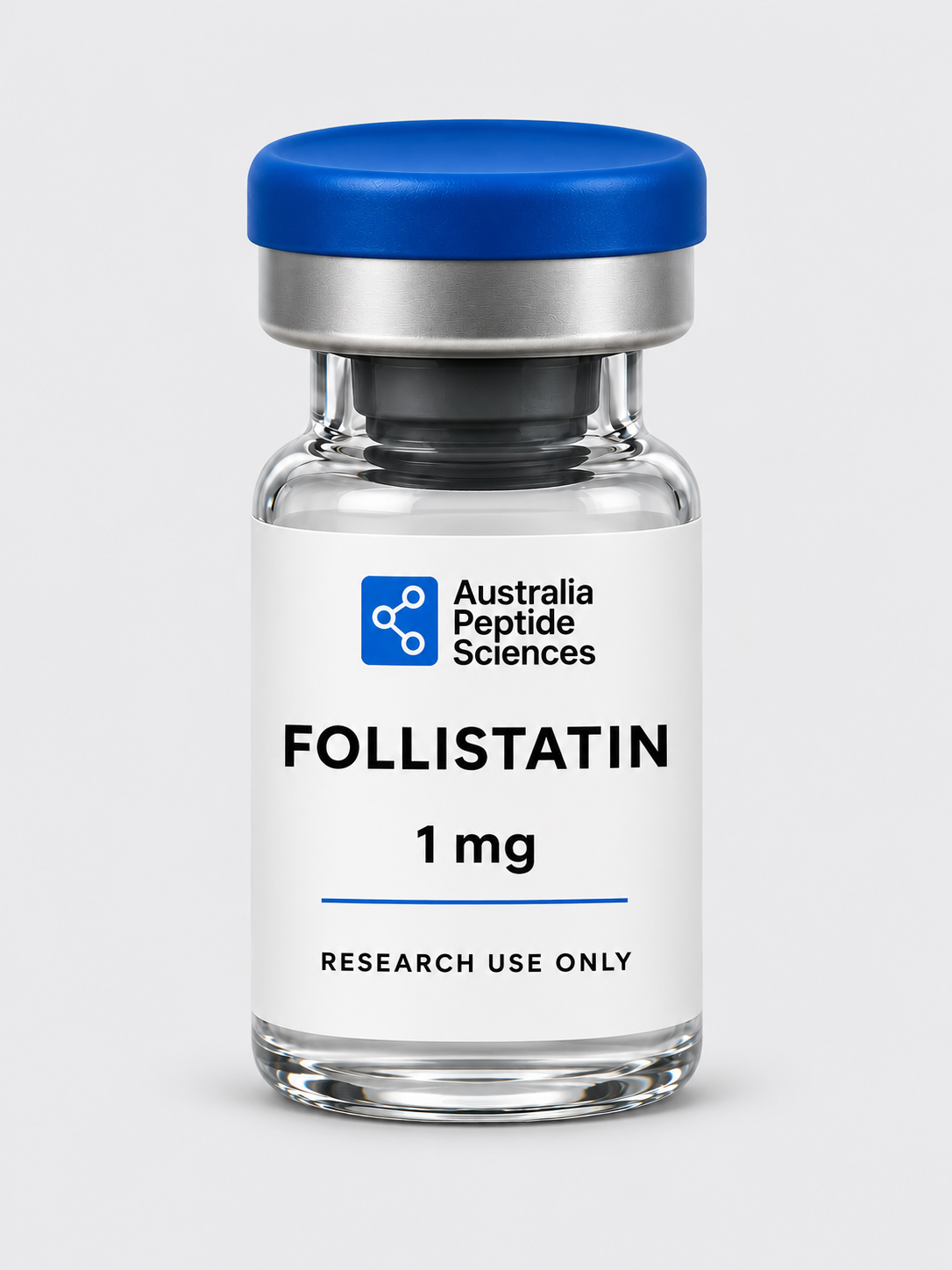
Description
Follistatin is a naturally occurring glycoprotein that binds several signalling ligands. Unlike a short synthetic peptide, it is a larger, structurally complex protein whose biological properties can depend on isoform, processing and production method. A “1mg” designation describes a labelled mass; it does not independently establish protein identity, purity or functional activity.
Product Specifications
| Specification | Product information |
| Listed product | Follistatin 1mg |
| Labelled quantity | 1mg |
| Material class | Follistatin-family research protein / glycoprotein |
| Purity, identity and assay results | Batch-specific - isoform, purity and identity are stated on the Certificate of Analysis (COA) |
| Intended context | Controlled laboratory and analytical research only |
What Is Follistatin?
Follistatin is an extracellular binding protein associated with regulation of activin signalling. It can also bind myostatin and certain other members of the transforming growth factor-beta (TGF-β) superfamily. Those interactions make it relevant to receptor-signalling models, ligand-binding experiments and protein-characterisation studies.
Common research themes include:
- Activin binding and receptor-access assays.
- Myostatin-related ligand interaction models.
- Comparisons of follistatin isoforms and their cell-surface association.
- Protein identity, binding specificity and assay reproducibility.
These are research areas, not established outcomes for this specific 1mg product. A catalogue label cannot substitute for experimental validation.
Follistatin Isoforms: Why Protein Identity Matters
The human FST gene yields precursor forms that can be processed into distinct mature proteins. Follistatin-344 refers to a 344-amino-acid precursor that yields mature Follistatin-315 after removal of its 29-residue signal peptide. An alternative 317-residue precursor gives rise to Follistatin-288. Follistatin-303 may result from additional processing of Follistatin-315.
The isoform cannot be inferred from the commercial name “Follistatin 1mg”. Some investigations report different cell-surface binding behaviour between isoforms; conclusions require knowing exactly which protein was tested.
Follistatin and Myostatin in Laboratory Research
Myostatin (GDF-8) is a TGF-β-family ligand studied in skeletal-muscle regulatory pathways. Follistatin can bind myostatin and alter its access to signalling receptors in experimental systems. However, follistatin also interacts with activins and other ligands. Therefore, a change in a cell-based assay should not automatically be attributed to myostatin inhibition alone.
A clear study description should distinguish binding to a purified target from downstream signalling in cells, and both from outcomes in animal models. None establishes a human-use benefit for the material listed here.
Analytical Documentation for Follistatin Research
Before considering a research protein, laboratories should review:
- Exact identity: isoform, complete sequence, signal-peptide processing and any relevant tags.
- Protein quantity: labelled mass and a method for determining actual protein content.
- Batch identity: lot number, applicable test dates and sample traceability.
- Analytical characteristics: purity, identity and, where relevant to the experiment, functional binding or bioactivity results.
- Formulation: excipients, carrier proteins and other constituents that may alter an assay.
For an explanation of batch documentation, see the Peptide Certificates of Analysis (COA) resource. A certificate for another item does not verify this Follistatin batch.
Evaluating Follistatin Research Material in Australia
When reviewing follistatin Australia listings or comparing laboratory suppliers, use the following checks:
- Confirm that the supplied molecule is a defined follistatin protein rather than a generic “myostatin blocker”.
- Request the precise isoform and sequence before applying published findings to the supplied material.
- Match all Certificates of Analysis and analytical claims to the actual batch.
- Check applicable Australian importation, supply and advertising rules before any transaction.
For broader terminology and evidence considerations, read What Are Peptides for Research? (noting that follistatin is a larger protein, not a typical short-chain research peptide).
Research Use Only - Not for Human Use
This product is described solely for controlled scientific or analytical research. It is not intended for human consumption, injection, veterinary use, clinical treatment or performance enhancement. No claim is made that it increases muscle mass, treats a disease or is safe for human administration.
Follistatin 1mg is best evaluated as a defined research protein whose experimental relevance depends on confirmed molecular identity, appropriate assay design and batch-specific documentation. Researchers should avoid assuming that results reported for Follistatin-344, Follistatin-315 or other isoforms apply to an unverified product.