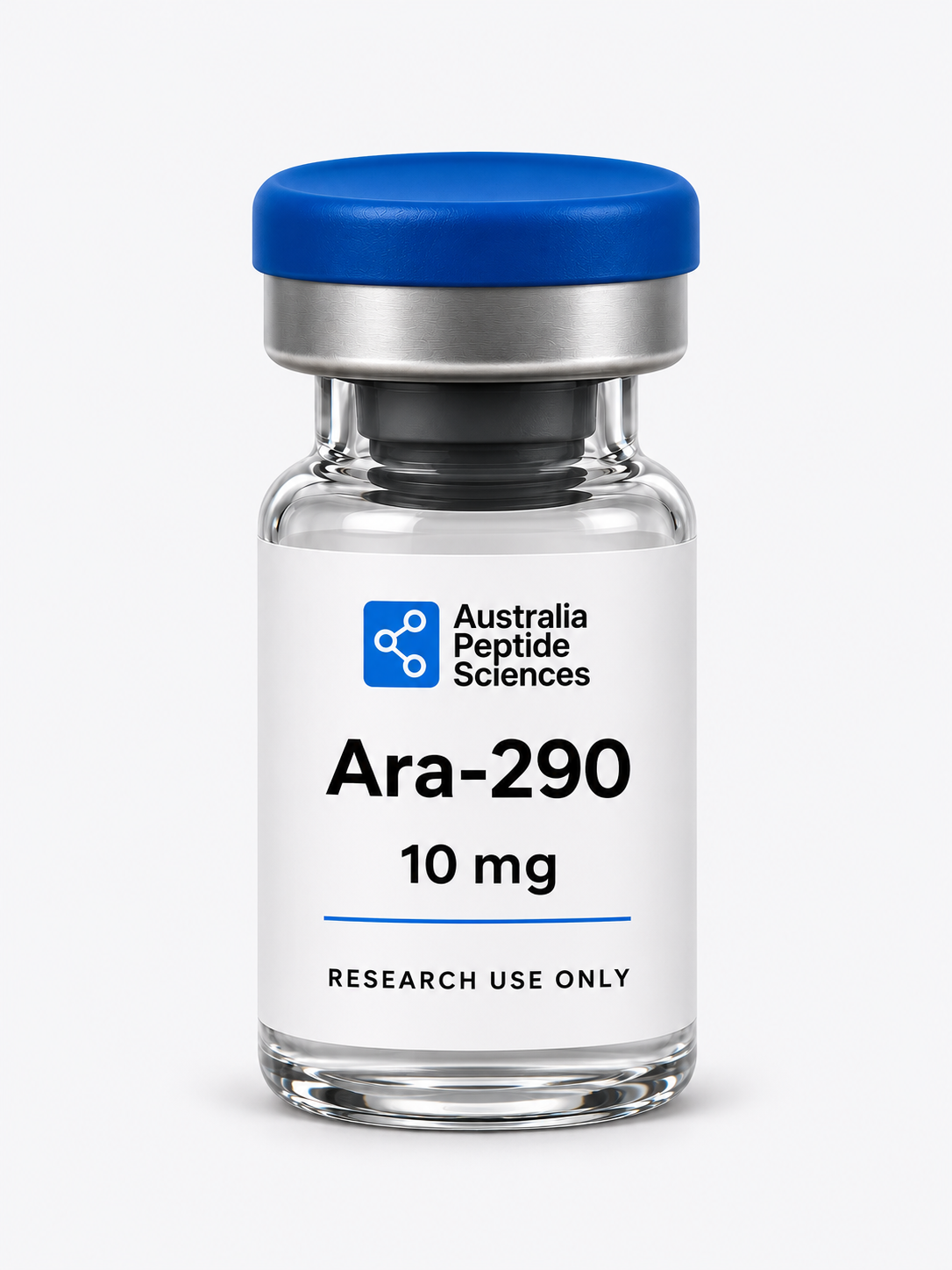
Description
ARA-290 has been examined in preclinical investigations of receptor-associated signalling, inflammatory responses and peripheral nerve-related models. It is also known in the scientific literature as cibinetide or pHBSP. Those names describe a defined research molecule; a supplier’s vial label alone is not proof of sequence identity, purity or equivalence to any material used in a published study.
For Australian laboratories evaluating ARA-290 10mg, reliable product information is more useful than broad therapeutic claims. Confirming sequence identity, batch traceability and analytical results is essential for interpreting experiments with a specific research material.
ARA-290 10mg: Product Specifications
| Specification | Research product information |
| Product designation | ARA-290 10mg |
| Research identity | ARA-290 / cibinetide / pHBSP (CAS 1208243-50-8) |
| Scientific classification | Synthetic 11-amino-acid peptide |
| Labelled amount | 10mg |
| Sequence / molecular form | pGlu-Glu-Gln-Leu-Glu-Arg-Ala-Leu-Asn-Ser-Ser · C₅₁H₈₄N₁₆O₂₁ · 1257.3 g/mol |
| Purity / analytical method | Batch-specific - see the Certificate of Analysis (COA) |
| Research context | Analytical and controlled laboratory research |
| Use restriction | Not for human or veterinary use |
What Is ARA-290 Peptide?
ARA-290 is an erythropoietin-derived peptide designed from the surface of helix B. Unlike full-length erythropoietin (EPO), which is known for its role in erythropoiesis, ARA-290 was developed for investigating signalling associated with the proposed tissue-protective, or innate repair, receptor pathway.
In the research literature, the peptide is described using several related terms:
- ARA-290 or ARA290 - development and research names.
- Cibinetide - the nonproprietary name associated with the investigational peptide.
- pHBSP - pyroglutamate helix B surface peptide.
These terms should be treated as identifiers for the literature-defined compound, not as proof that an unverified commercial sample has the same structure or analytical quality.
How Is ARA-290 Studied in Preclinical Research?
Innate repair receptor signalling
ARA-290 has been used to explore pathways involving an erythropoietin-receptor-related complex and the beta-common receptor subunit (CD131). Researchers describe this proposed receptor system as the innate repair receptor. Results depend on the assay, receptor expression and experimental model; a mechanistic hypothesis does not establish clinical effectiveness.
Inflammation-associated and cellular responses
Experimental studies have assessed changes in immune-related signalling and cellular responses to injury or stress. Such observations are model-specific and should not be translated into claims that an ARA-290 research vial treats inflammation, injury or disease.
Peripheral nerve and sensory models
Animal experiments and early clinical investigations of cibinetide have examined peripheral nerve-associated endpoints, including sensory measures. Clinical-study materials, controlled protocols and observed outcomes do not validate the identity, safety or suitability of a separately marketed 10mg research product.
Research Questions This Peptide Can Help Frame
- How does receptor expression influence measured responses in a defined assay?
- Which cell-signalling or inflammation-associated markers change under controlled experimental conditions?
- Are findings reproducible across different preclinical models and analytical methods?
- How does verified peptide identity affect the interpretation of published ARA-290 findings?
ARA-290, Cibinetide and Erythropoietin: Key Distinctions
| Name | Meaning in research |
| Erythropoietin (EPO) | Full-length glycoprotein hormone involved in red-cell production and other investigated signalling pathways. |
| ARA-290 / cibinetide | Short, synthetic, literature-defined peptide modelled on EPO helix B. |
| pHBSP | Descriptive term for pyroglutamate helix B surface peptide, associated with ARA-290. |
ARA-290 should not be described as interchangeable with erythropoietin, and their biological observations must not be merged. Research claims about the literature-defined cibinetide molecule should be linked only to a product whose identity has been verified.
Analytical Documentation for ARA-290 10mg
Before evaluating ARA-290 for a laboratory project, review the available batch documentation and ask whether it establishes:
- Sequence and molecular identity, including relevant terminal modifications.
- Batch number, labelled quantity and measured peptide content where available.
- Chromatographic purity, test method and supporting chromatogram.
- Mass-spectrometry results and any complementary structural identity evidence.
- Traceability of the reported results to the precise material supplied.
For a practical explanation of why molecular mass does not establish the complete sequence, see the APS peptide sequence guide.
To understand chromatographic results and their limitations, read What Is HPLC?.
Available documentation can be reviewed through the APS Certificates of Analysis library. A COA for another product or batch does not verify ARA-290 10mg.
ARA-290 Australia: Research Procurement Considerations
Laboratories searching for ARA-290 in Australia should distinguish online availability from lawful procurement. The terms “buy ARA-290” and “ARA-290 for sale” indicate commercial search interest but do not establish that a particular listing can lawfully be imported, supplied or advertised.
Before making a purchasing decision for an authorised research programme:
- Confirm the exact compound identity against the technical and batch records.
- Check whether documented purity and quantity fit the analytical requirements of the research.
- Verify the applicable Australian regulatory and import/supply rules for the proposed activity.
For further background on laboratory-only material descriptions, see Research Use Only Peptides.
Research Use Only - Not for Human Use
ARA-290 10mg is presented solely as a material for scientific and analytical research. It is not intended for human consumption, administration, diagnosis, treatment, veterinary use or any other personal use. No therapeutic, recovery or performance claims are made for this product.
Research-only labelling does not establish legal supply, regulatory approval, clinical safety or suitability for administration. Australian requirements must be assessed separately for the product and proposed activities.
ARA-290 10mg is a research peptide designation associated with cibinetide and pHBSP in the scientific literature. Its experimental context includes innate repair receptor signalling, inflammation-associated mechanisms and nerve-related models. For a specific research vial, molecular identity, batch-specific documentation and Australian regulatory compliance remain essential before any product claim or procurement decision.