Retatrutide is an investigational GIP, GLP-1 and glucagon receptor agonist being studied in the Phase 3 TRIUMPH clinical programme.
In May 2026, Eli Lilly reported topline TRIUMPH-1 results showing substantial body-weight reductions over 80 weeks, with additional 104-week data from a prespecified extension in participants who entered the study with a BMI of 35 or higher.
This article reviews the reported findings, trial design, mechanism and important limitations. It describes the clinical trial formulation studied by Lilly and should not be interpreted as evidence about APS research materials.
What Were the Retatrutide Phase 3 Results?
In TRIUMPH-1, Lilly reported dose-dependent body-weight reductions across the 4 mg, 9 mg and 12 mg groups at 80 weeks.
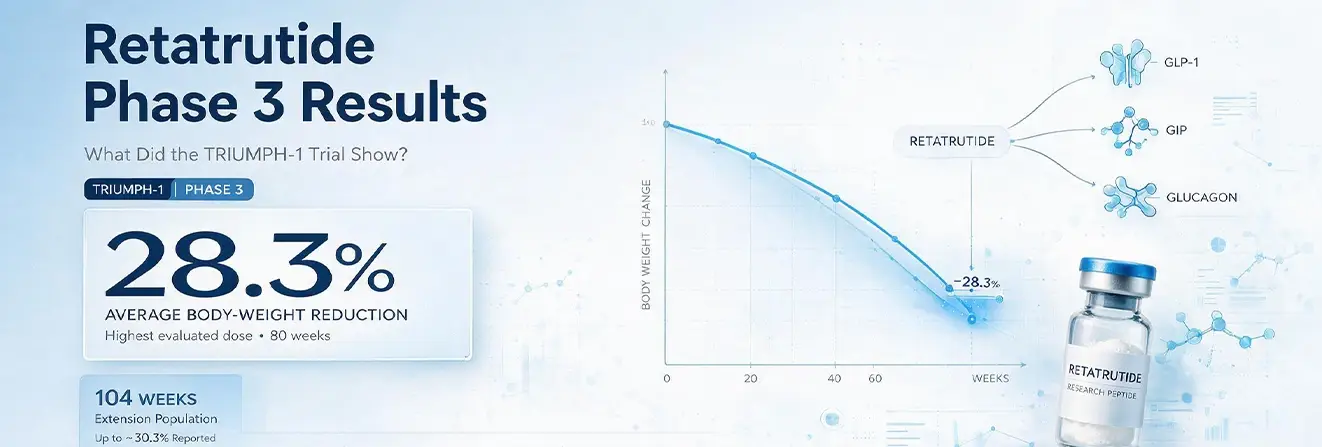
Under Lilly’s efficacy estimand, participants assigned to 12 mg retatrutide lost an average of 70.3 lb (28.3%) at 80 weeks. Participants assigned to 9 mg lost 64.4 lb (25.9%), while the 4 mg group lost 47.2 lb (19.0%).
In a prespecified blinded extension limited to participants with baseline BMI ≥35, those who continued 12 mg through 104 weeks lost an average of 85.0 lb (30.3%). This 30.3% figure therefore should not be presented as the overall 104-week TRIUMPH-1 result for the full study population.
TRIUMPH-1 Key Findings
| Key Finding | Reported Outcome |
| Primary analysis | 80 weeks (efficacy estimand) |
| 4 mg group | −19.0% average body weight |
| 9 mg group | −25.9% average body weight |
| 12 mg group | −28.3% average body weight |
| Prespecified BMI ≥35 extension (12 mg, 104 weeks) | −30.3% average body weight |
| Trial stage | Phase 3 (topline results reported by Lilly) |
TRIUMPH-1 in One Sentence
TRIUMPH-1 reported average body-weight reductions of 19.0%, 25.9% and 28.3% at 80 weeks across the 4 mg, 9 mg and 12 mg retatrutide groups, respectively, with a prespecified BMI ≥35 extension reporting 30.3% at 104 weeks in the 12 mg group.
The magnitude of the reported reductions has drawn substantial scientific and industry attention, but interpretation should remain tied to the specific population, estimand, trial duration and investigational formulation studied.
Are the TRIUMPH-1 Results Peer Reviewed?
As of September 2026, the headline TRIUMPH-1 efficacy results discussed here were reported publicly by Eli Lilly as topline Phase 3 data. ClinicalTrials.gov lists TRIUMPH-1 as completed, but the registry does not currently display posted study results.
This is different from the 2023 Phase 2 obesity trial, which was published in the New England Journal of Medicine and underwent peer-reviewed publication.
Topline company results can provide important information, but full peer-reviewed publication may add additional detail on statistical methods, subgroup analyses, adverse events and study limitations.
Why Have the TRIUMPH-1 Results Attracted Attention?
The results attracted attention because TRIUMPH-1 is a pivotal Phase 3 obesity study, retatrutide targets three metabolic receptors, and the 12 mg group reported a 28.3% average body-weight reduction at 80 weeks under the efficacy estimand.
Researchers have become increasingly interested in multi-pathway approaches because metabolism is regulated through numerous biological systems rather than a single signaling pathway.
What Is Retatrutide and How Is It Different?
Retatrutide is an investigational unimolecular agonist of the GIP, GLP-1 and glucagon receptors currently being evaluated in multiple Phase 3 trials.
Unlike earlier metabolic peptides that focused on one or two receptor systems, Retatrutide targets:
- GLP-1 receptors
- GIP receptors
- Glucagon receptors
Retatrutide at a Glance
| Feature | Retatrutide |
| Category | Metabolic peptide |
| Type | Triple agonist |
| Pathways | GLP-1 + GIP + Glucagon |
| Research Focus | Appetite, metabolism, energy balance |
| Development Status | Investigational; multiple Phase 3 trials |
The addition of glucagon receptor agonism distinguishes retatrutide mechanistically from dual GIP/GLP-1 agonists such as tirzepatide.
Why Retatrutide’s Triple-Receptor Design Is Being Studied
Retatrutide combines GIP, GLP-1 and glucagon receptor agonism within one molecule, allowing researchers to study coordinated effects across appetite-related, nutrient-sensing and energy-metabolism pathways.
Why Retatrutide Is Being Studied
| Research Area | Research Context |
| Appetite regulation | Hunger and satiety signaling |
| Metabolic health | Energy balance research |
| Body composition | Weight and body-composition endpoints |
| Energy expenditure | Glucagon receptor-related energy-metabolism endpoints |
| Triple agonism | Three pathways studied simultaneously |
These areas describe research questions rather than established therapeutic outcomes.
Inside the TRIUMPH-1 Trial: How Was the Study Conducted?
To understand the significance of the new findings, it is important to look at how the TRIUMPH-1 study was designed.
TRIUMPH-1 is a Phase 3 obesity trial sponsored by Eli Lilly. It enrolled adults with obesity, or overweight with at least one weight-related comorbidity, without diabetes in the main obesity cohort.
The main efficacy analysis was at 80 weeks. ClinicalTrials.gov lists the overall study duration at approximately 89 weeks, with additional prespecified extension follow-up in selected participants.
The trial used protocol-defined titration schedules across assigned maintenance doses. These schedules are clinical-trial procedures and should not be presented as dosing guidance.
TRIUMPH-1 Study Overview
| Study Characteristic | Details |
| Trial | TRIUMPH-1 |
| Sponsor | Eli Lilly |
| Phase | Phase 3 |
| Population | Adults with obesity, or overweight with a weight-related comorbidity, without diabetes |
| Primary efficacy assessment | 80 weeks |
| Primary Focus | Weight-related outcomes |
Longer follow-up can provide additional information on efficacy persistence and adverse-event patterns, although 80–104 weeks should not be equated with definitive long-term safety.
Three Key TRIUMPH-1 Findings
While the study contains numerous data points, three findings are central to interpreting the topline results.
1. Weight-Related Outcomes
The most widely discussed finding from the TRIUMPH-1 trial was the reported magnitude of weight-related outcomes observed during the study period.
Under Lilly’s efficacy estimand, participants assigned to 12 mg retatrutide lost an average of 70.3 lb (28.3%) at 80 weeks. Participants assigned to 9 mg lost 64.4 lb (25.9%), while the 4 mg group lost 47.2 lb (19.0%).
In a prespecified blinded extension limited to participants with baseline BMI ≥35, those who continued 12 mg through 104 weeks lost an average of 85.0 lb (30.3%). This 30.3% figure therefore should not be presented as the overall 104-week TRIUMPH-1 result for the full study population.
Retatrutide groups showed greater average reductions than placebo.
2. Triple-Pathway Activity
Another major reason the study attracted attention is Retatrutide’s unique mechanism of action.
Unlike traditional GLP-1 compounds, Retatrutide simultaneously activates three receptor pathways:
- GLP-1
- GIP
- Glucagon
Researchers have spent years studying GLP-1 and GIP signaling because of their role in appetite regulation and metabolic communication. Retatrutide adds a third component by activating glucagon receptors, creating what is known as a triple agonist peptide.
The three-receptor profile distinguishes retatrutide mechanistically from single- and dual-receptor incretin therapies.
3. Extended Follow-Up
TRIUMPH-1 extends the evidence base beyond the 48-week Phase 2 obesity trial, with the main Phase 3 analysis at 80 weeks and a prespecified BMI ≥35 extension through 104 weeks.
What Did TRIUMPH-1 Report About Safety and Tolerability?
Lilly reported that the most common adverse events were gastrointestinal and were generally similar to those seen with incretin-based therapies. Discontinuation rates due to adverse events varied by dose and should be interpreted alongside the full Phase 3 dataset when it becomes available in peer-reviewed form.
The trial also collected broader safety and cardiometabolic outcomes, but topline efficacy percentages should not be interpreted independently of tolerability and adverse-event data.
Can TRIUMPH-1 Be Directly Compared With Earlier GLP-1 Trials?
Not reliably from separate trials alone. Retatrutide studies have reported larger numerical body-weight reductions than some earlier GLP-1 or dual-agonist trials, but populations, trial durations, estimands, dose strategies and endpoints differ.
Without a direct randomized head-to-head trial, cross-trial percentages should be treated as descriptive rather than proof that one compound outperforms another.
How Do These Results Compare With Earlier Retatrutide Studies?
The Phase 3 findings build upon earlier research that first drew attention to Retatrutide’s potential.
The 2023 NEJM Phase 2 Study
The 2023 Phase 2 trial, published in the New England Journal of Medicine, enrolled 338 adults and reported a mean 24.2% body-weight reduction at 48 weeks in the 12 mg group versus 2.1% with placebo. These findings helped establish the rationale for Phase 3 investigation.
The newer TRIUMPH-1 results build upon this earlier evidence by extending the observation period and providing additional data from a larger Phase 3 program.
Retatrutide Research Timeline
| Study | Duration | Key Observation |
| Phase 2 (NEJM 2023) | 48 weeks | Up to ~24.2% reduction reported |
| TRIUMPH-1 Phase 3 | 80 weeks | ~28.3% average reduction reported |
| TRIUMPH-1 prespecified BMI ≥35 extension | 104 weeks | 30.3% average reduction (12 mg, BMI ≥35 subgroup) |
Sources: New England Journal of Medicine (2023); Eli Lilly TRIUMPH-1 Phase 3 Results.
Which Receptors Does Retatrutide Target?
Retatrutide has attracted attention largely because of the biological pathways it targets.
GLP-1 Pathway
GLP-1 is one of the most studied pathways in metabolic research.
Researchers investigate GLP-1 because it plays an important role in appetite signaling, satiety communication, and glucose-related biological processes. Many well-known metabolic compounds target this pathway.
GIP Pathway
GIP is another hormone involved in nutrient sensing and metabolic communication.
Researchers study GIP because it interacts with pathways related to energy balance, nutrient processing, and metabolic regulation. Combining GLP-1 and GIP activity has already been explored successfully in earlier dual-agonist compounds.
Glucagon Pathway
Glucagon receptor agonism is the main mechanistic difference from dual GIP/GLP-1 agonists.
Researchers study glucagon because it is associated with:
- Energy expenditure
- Liver metabolism
- Substrate utilisation and energy-expenditure-related pathways in mechanistic research
The addition of glucagon receptor activity is one reason Retatrutide has generated such significant interest within the scientific community.
Why the Third Pathway Matters
Retatrutide’s triple-agonist design allows researchers to investigate three metabolic pathways simultaneously.
Retatrutide Pathway Profile
| Pathway | Retatrutide |
| GLP-1 | ✓ |
| GIP | ✓ |
| Glucagon | ✓ |
The triple-receptor profile provides a distinct experimental and pharmacological strategy within incretin-based obesity research.
Retatrutide vs Tirzepatide: Why Researchers Are Making Comparisons
Comparisons between Retatrutide and Tirzepatide have increased substantially since the release of the new Phase 3 findings.
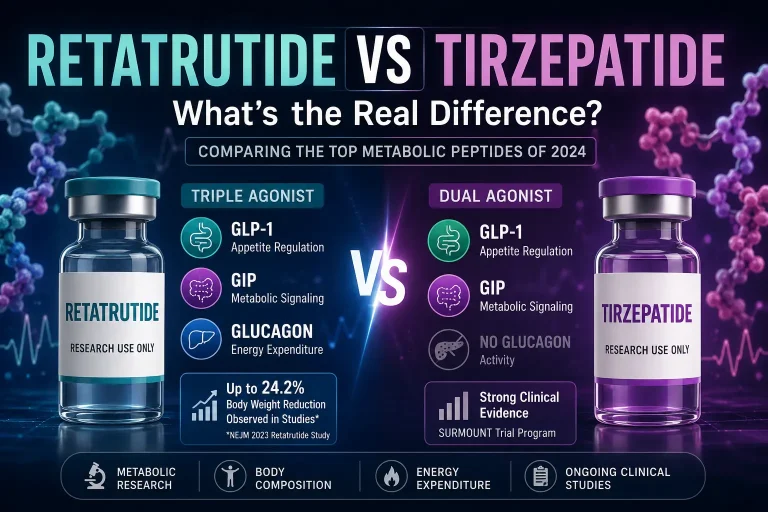
Both compounds share GLP-1 and GIP receptor activity, making them closely related from a scientific perspective. However, Retatrutide adds glucagon receptor activity, creating an additional pathway that researchers continue to evaluate.
Retatrutide vs Tirzepatide
| Feature | Retatrutide | Tirzepatide |
| Type | Triple agonist | Dual agonist |
| GLP-1 | ✓ | ✓ |
| GIP | ✓ | ✓ |
| Glucagon | ✓ | ✗ |
| Research Status | Phase 3 | Approved for specified indications |
The mechanistic difference is glucagon receptor agonism; whether this translates into superior clinical outcomes requires direct comparative evidence.
What Do the New Findings Mean for Obesity Research?
The latest Retatrutide Phase 3 results arrive at a time when obesity and metabolic health remain major global public health challenges.
TRIUMPH-1 provides late-stage clinical evidence that a GIP/GLP-1/glucagon triple-receptor strategy can produce substantial body-weight changes in the studied population. It does not establish that all multi-pathway approaches will produce similar outcomes.
Retatrutide also represents a broader shift in obesity research. Earlier generations of compounds primarily focused on single pathways, while newer investigational peptides are designed to engage multiple signaling systems at once. This evolution reflects a growing understanding that obesity and metabolism involve complex biological networks rather than isolated mechanisms.
As research continues, Retatrutide may help scientists better understand how GLP-1, GIP, and glucagon pathways interact within the broader context of metabolic health.
What Researchers Still Don’t Know
Despite the attention surrounding the TRIUMPH-1 findings, important questions remain unanswered.
While the reported outcomes have generated considerable interest, Retatrutide remains an investigational compound undergoing continued scientific evaluation. Researchers continue to study how findings observed in controlled clinical environments may translate into broader real-world settings.
Several areas remain under active investigation:
- Long-term outcomes beyond current study durations
- Real-world effectiveness and safety after any future regulatory approval
- Differences between patient populations
- Long-term safety observations
- Additional Phase 3 readouts, peer-reviewed publications and regulatory review
- How outcomes compare in direct head-to-head trials with other obesity medicines
- Longer-term safety beyond the current observation periods
- Additional peer-reviewed publications
It is also important to recognize that scientific understanding evolves over time. Early findings often generate new questions that require further study, replication, and long-term observation.
For this reason, researchers generally view the current Retatrutide data as an important milestone rather than a final conclusion. Ongoing clinical programs and future publications will continue shaping our understanding of this compound and its potential role within metabolic research.
Why Research Quality Matters
The clinical outcomes reported in TRIUMPH-1 apply to the investigational pharmaceutical formulation used in Lilly’s controlled trial. They should not be attributed to separately supplied research materials simply because they share the name retatrutide.
Quality indicators for laboratory research materials include:
- Compound identity
- Batch-specific COA
- Analytical purity method
- Identity confirmation
- Lot traceability
- Stability information
For additional information, see:
View Certificates of Analysis for Research Materials →
Related Retatrutide Research Resources
For broader mechanistic and evidence context, APS publishes research-focused resources on retatrutide and related metabolic compounds:
APS research materials are supplied strictly for laboratory and scientific research and are not intended for human or veterinary administration. Clinical findings from Lilly’s investigational formulation should not be used to imply equivalent safety, efficacy or pharmacokinetics for APS materials.
Explore Retatrutide Research Guides →
Frequently Asked Questions
What did the Retatrutide Phase 3 trial show?
Lilly reported average body-weight reductions of 19.0%, 25.9% and 28.3% at 80 weeks in the 4 mg, 9 mg and 12 mg groups, respectively, under the efficacy estimand. A prespecified extension in participants with baseline BMI ≥35 who continued 12 mg reported an average 30.3% reduction at 104 weeks.
What are the TRIUMPH-1 findings?
TRIUMPH-1 reported dose-dependent body-weight reductions and additional cardiometabolic and safety observations in adults with obesity or overweight and weight-related comorbidity without diabetes.
How much weight reduction was reported in the Retatrutide Phase 3 study?
Under the efficacy estimand, the 12 mg group lost an average of 28.3% at 80 weeks (25.9% with 9 mg and 19.0% with 4 mg). The 30.3% figure at 104 weeks comes from a prespecified extension subgroup with baseline BMI ≥35, not the full study population.
Why are the TRIUMPH-1 results considered important?
They provide pivotal Phase 3 evidence for a GIP/GLP-1/glucagon triple-receptor agonist and extend the observation period beyond the earlier 48-week Phase 2 trial.
Is Retatrutide a triple agonist peptide?
Yes. Retatrutide is classified as a triple agonist peptide because it activates GLP-1, GIP, and glucagon receptors simultaneously.
What pathways does Retatrutide target?
Retatrutide targets GLP-1, GIP and glucagon receptors. This combination is one of the key features distinguishing it from earlier metabolic compounds.
Why Has Retatrutide Attracted Scientific Attention?
Because it combines triple-receptor agonism with substantial body-weight changes reported in late-stage clinical trials. It remains investigational, and full interpretation requires safety, peer-reviewed and regulatory data.
Did Retatrutide show better results than Tirzepatide?
Separate trials have reported different numerical outcomes, but they are not a direct head-to-head comparison. Differences in populations, duration, estimands and study design prevent a reliable conclusion that one is superior based on cross-trial percentages alone.
Does Retatrutide include glucagon activity?
Yes. Retatrutide includes glucagon receptor activity in addition to GLP-1 and GIP signaling. This additional pathway is a major reason researchers are studying the compound.
What is the latest research on Retatrutide?
As of September 2026, major recent developments include TRIUMPH-1 Phase 3 obesity results and additional Phase 3 readouts across obesity-related conditions and type 2 diabetes. Retatrutide remains investigational.
Are Retatrutide studies still ongoing?
Yes. TRIUMPH-1 is listed as completed, while the broader Retatrutide Phase 3 clinical programme continues across additional populations and indications.
What makes Retatrutide different from other GLP-1 compounds?
Retatrutide activates GIP, GLP-1 and glucagon receptors, whereas single- or dual-receptor incretin therapies have different receptor profiles.
Was TRIUMPH-1 Published in a Peer-Reviewed Journal?
The headline 2026 TRIUMPH-1 results cited here were reported by Eli Lilly as topline Phase 3 data. The earlier Phase 2 obesity trial was published in the New England Journal of Medicine.
Does the 30.3% Figure Apply to Everyone in TRIUMPH-1?
No. The 30.3% average was reported at 104 weeks in a prespecified extension of participants with baseline BMI ≥35 who continued the 12 mg dose. The main 80-week 12 mg result was 28.3%.
Do TRIUMPH-1 Results Apply to Research-Grade Retatrutide Materials?
No. The clinical results apply to Lilly’s investigational formulation used under controlled trial conditions. They should not be attributed to separately supplied research materials.
Sources
- Eli Lilly. TRIUMPH-1 Phase 3 Retatrutide Results.
- Jastreboff AM et al. Triple-Hormone-Receptor Agonist Retatrutide for Obesity. New England Journal of Medicine, 2023.
- World Health Organization (WHO). Obesity and Overweight Fact Sheet.
- International Diabetes Federation (IDF). Diabetes Atlas 2024.
- ClinicalTrials.gov. TRIUMPH-1 (NCT05929066).
Retatrutide Phase 3 Results