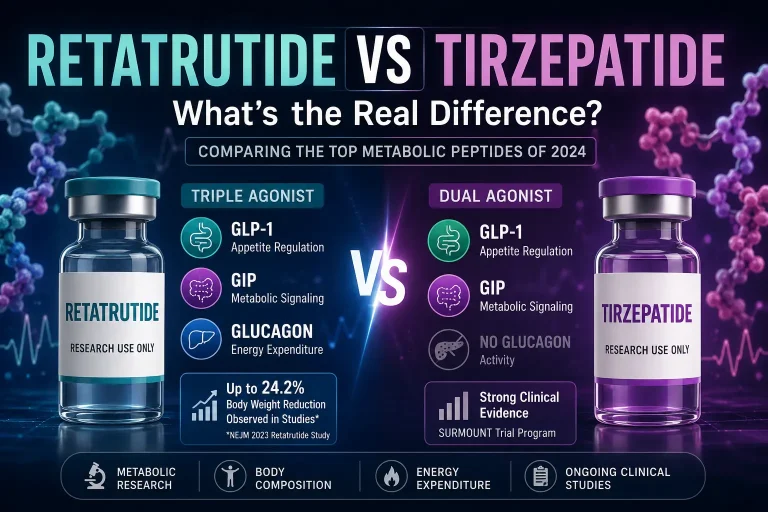

Retatrutide is one of the most closely watched compounds in modern metabolic peptide research. As a next-generation triple-agonist peptide, it has attracted significant scientific interest for interacting with three key metabolic pathways: GLP-1, GIP, and glucagon. This unique mechanism has led researchers to investigate how these pathways work together to influence appetite signaling, energy balance, and metabolic regulation.
Interest in retatrutide research has grown alongside the increasing global focus on obesity, metabolic health, and body composition. Researchers are particularly interested in understanding how Retatrutide differs from earlier compounds such as Tirzepatide and Semaglutide, which target fewer biological pathways.
In this Retatrutide peptide guide, we’ll explore how Retatrutide works, what researchers have observed in clinical studies, and why it has become a major focus within metabolic and appetite-related research.
For product specifications, available unit sizes and research-use information, view our Retatrutide peptide in Australia for research.
What Is Retatrutide?
Retatrutide is an investigational peptide compound being studied within the field of metabolic research. Researchers classify it as a triple hormone receptor agonist because it interacts with three important biological pathways involved in metabolism and energy regulation: GLP-1, GIP, and glucagon receptors.
Unlike earlier compounds that target one or two pathways, Retatrutide is being investigated for its ability to activate all three simultaneously. This broader mechanism has generated significant interest among researchers studying appetite regulation, metabolic signaling, body composition, and energy expenditure.
According to published information from Eli Lilly and Company, Retatrutide is an investigational once-weekly triple hormone receptor agonist that activates GLP-1, GIP, and glucagon receptors.
Source: Retatrutide is an investigational once-weekly triple hormone receptor agonist
Retatrutide Peptide Guide at a Glance
| Feature | Retatrutide |
| Category | Metabolic peptide research compound |
| Type | Triple agonist peptide |
| Pathways Studied | GLP-1 + GIP + Glucagon |
| Research Interest | Appetite, metabolism, energy balance |
| Development Status | Investigational/clinical research |
How Retatrutide Works
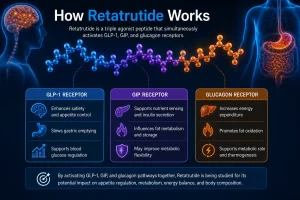
Retatrutide peptide guide: Mechanism of Action
Retatrutide is studied because it activates three metabolic pathways at the same time: GLP-1, GIP, and glucagon. This unique combination is why it is often described as a triple agonist peptide.
Researchers are interested in understanding how these pathways interact and whether targeting all three simultaneously may influence appetite regulation, metabolic communication, energy expenditure, and body composition differently from compounds that activate fewer pathways.
GLP-1 Pathway
The GLP-1 pathway plays an important role in appetite and satiety signaling. Researchers study this pathway because it helps regulate communication between the digestive system and the brain.
Areas commonly investigated include:
- Appetite signaling
- Satiety communication
- Digestive responses
- Glucose-related signaling
The GLP-1 pathway has become one of the most studied biological systems in modern metabolic research.
GIP Pathway
GIP is another naturally occurring hormone involved in nutrient-related signaling and metabolic communication. Researchers investigate how GIP receptors influence energy balance and how they may interact with GLP-1 signaling.
Research areas include:
- Nutrient sensing
- Metabolic communication
- Energy regulation
- Insulin-related pathways
Glucagon Pathway
The glucagon pathway is one of the key features that distinguishes Retatrutide from Tirzepatide. Researchers study glucagon because it is involved in energy utilization, liver metabolism, and fat oxidation pathways.
Scientific interest in this pathway includes:
- Energy expenditure
- Liver metabolism
- Fat oxidation research
- Metabolic flexibility
Because Retatrutide activates the glucagon receptor in addition to GLP-1 and GIP receptors, researchers are particularly interested in understanding how this third pathway may contribute to broader metabolic effects
Retatrutide Peptide Guide: Pathways Studied
| Pathway | What Researchers Study |
| GLP-1 | Appetite and satiety signaling |
| GIP | Nutrient response and metabolic communication |
| Glucagon | Energy expenditure and liver metabolism |
| Combined Activity | Multi-pathway metabolic regulation |
Why Retatrutide Is Called a Triple Agonist Peptide
The term “agonist” refers to a compound that activates a specific biological receptor. In peptide research, agonists are often categorized by the number of pathways they target.
A single agonist activates one receptor pathway, a dual agonist activates two pathways, and a triple agonist activates three. Retatrutide belongs to the third category because it targets GLP-1, GIP, and glucagon receptors simultaneously.
Researchers are increasingly interested in triple-pathway approaches because metabolism is regulated by multiple interconnected systems rather than a single biological signal. Studying several pathways together may provide additional insights into appetite regulation, energy balance, and metabolic communication.
Single vs Dual vs Triple Agonists
| Compound Type | Pathways Studied | Example |
| Single Agonist | GLP-1 | Semaglutide |
| Dual Agonist | GLP-1 + GIP | Tirzepatide |
| Triple Agonist | GLP-1 + GIP + Glucagon | Retatrutide |
Why Retatrutide Research Is Growing
When studying Retatrude peptide guide you notice that Retatrutide has emerged during a period of intense interest in metabolic health research. Rising obesity rates, increasing rates of metabolic disease, and growing scientific focus on appetite regulation have all contributed to the rapid expansion of this research field.
According to the World Health Organization (WHO), more than 1 billion people worldwide were living with obesity in 2022. At the same time, the International Diabetes Federation estimates that approximately 589 million adults were living with diabetes in 2024, with projections reaching 853 million by 2050. In the United States, the Centers for Disease Control and Prevention (CDC) reports that adult obesity prevalence is approximately 40.3%.
These trends have intensified interest in understanding the biological systems that regulate appetite, energy balance, body composition, and metabolic function. Because Retatrutide engages three major metabolic pathways simultaneously, it has become one of the most actively studied compounds in this area.
Retatrutide Clinical Research and Study Findings
Retatrutide is currently being evaluated through large-scale clinical research programs investigating its effects on metabolic pathways, appetite regulation, and body composition.
Researchers have focused particular attention on obesity-related studies because these trials provide valuable insights into how multiple metabolic pathways may interact over time.
Phase 2 Obesity Study
One of the most widely cited studies involving Retatrutide was published in the New England Journal of Medicine in 2023. The study evaluated adults living with obesity or overweight conditions over a 48-week period.
Researchers observed substantial differences between placebo and Retatrutide groups, with larger changes generally occurring in higher-dose study groups.
At 24 weeks, researchers reported mean body-weight reductions beginning at approximately 7.2% in lower-dose groups and increasing across higher-dose cohorts. At 48 weeks, researchers observed reductions reaching approximately 24.2% in the 12 mg group, compared with approximately 2.1% in the placebo group.
Researchers also observed that more than 90% of participants receiving 12 mg achieved at least 10% body-weight reduction, while nearly two-thirds achieved reductions of at least 20%.
Phase 2 Study Highlights
| Study | Population | Duration | Key Observation |
| Phase 2 Obesity Trial | Adults with obesity or overweight | 48 Weeks | Up to ~24.2% mean weight reduction observed in the 12 mg group |
| Placebo Group | Adults with obesity or overweight | 48 Weeks | ~2.1% mean reduction observed |
| Higher-Dose Group | 12 mg Retatrutide | 48 Weeks | High proportion achieved ≥10% and ≥20% weight reduction |
Phase 3 Research Updates
Retatrutide continues to be evaluated through Phase 3 clinical research programs. In 2026, Eli Lilly reported findings from the TRIUMPH-1 trial, stating that participants receiving 12 mg Retatrutide experienced an average weight reduction of approximately 28.3% over 80 weeks. Additional company-reported data suggested reductions of up to 30.3% at 104 weeks in a BMI ≥35 extension population.
These findings represent company-reported clinical trial results and continue to be evaluated within the broader scientific and regulatory process.
Retatrutide and Appetite Regulation
Appetite regulation is one of the primary reasons Retatrutide has become a major focus in metabolic research. Hunger and fullness are controlled by a complex network of hormones that communicate between the digestive system, brain, pancreas, and other metabolic tissues. Researchers are particularly interested in Retatrutide because it interacts with three pathways involved in these biological processes: GLP-1, GIP, and glucagon.
The GLP-1 pathway is known for its role in satiety signaling and appetite regulation. When activated, it helps communicate feelings of fullness and influences digestive responses after food intake. The GIP pathway is involved in nutrient sensing and metabolic communication, while the glucagon pathway is associated with energy expenditure and metabolic flexibility. Together, these pathways form the basis of Retatrutide’s triple-agonist mechanism.
Researchers continue to investigate how simultaneous activation of these pathways may influence hunger signaling, satiety communication, energy intake, and overall metabolic regulation. This multi-pathway approach is one reason Retatrutide is frequently discussed alongside other next-generation metabolic peptides.
Retatrutide and Body Composition Research
Body composition has become one of the most important areas of metabolic research because it provides a more complete picture than body weight alone. Researchers increasingly examine factors such as fat mass, lean mass, waist circumference, and metabolic health markers when evaluating metabolic compounds.
Retatrutide has attracted significant attention because studies have reported notable changes in body-weight outcomes while also generating interest in broader body composition measurements. Researchers are investigating how its triple-pathway mechanism may influence appetite regulation, nutrient utilization, energy expenditure, and fat metabolism.
The glucagon receptor pathway is particularly relevant in body composition research. Unlike Tirzepatide, which targets GLP-1 and GIP receptors, Retatrutide also activates glucagon receptors, a pathway associated with energy expenditure and fat oxidation. Researchers continue to study whether this additional mechanism contributes to some of the body composition observations reported in clinical trials.
As scientific understanding evolves, body composition research is increasingly shifting away from simple weight measurements and toward a broader evaluation of metabolic health, energy balance, and long-term physiological outcomes. This is one reason Retatrutide remains an important topic within modern metabolic peptide research.
Retatrutide Peptide vs Other Metabolic Research Peptides
Retatrutide vs Tirzepatide
Retatrutide and Tirzepatide are often compared because both belong to the metabolic peptide category and target incretin-related pathways. The key difference is that Retatrutide activates three receptor pathways while Tirzepatide activates two.
| Feature | Retatrutide | Tirzepatide |
| Type | Triple agonist | Dual agonist |
| Pathways | GLP-1 + GIP + Glucagon | GLP-1 + GIP |
| Research Focus | Appetite, metabolism, energy expenditure | Appetite and metabolic signaling |
| Key Difference | Includes glucagon pathway | No glucagon receptor activity |
Retatrutide vs Semaglutide
Semaglutide is classified as a GLP-1 receptor agonist and focuses on a single biological pathway. Retatrutide differs by activating GLP-1, GIP, and glucagon receptors simultaneously, creating broader research interest in multi-pathway metabolic regulation.
| Feature | Retatrutide | Semaglutide |
| Type | Triple agonist | GLP-1 receptor agonist |
| Pathways | GLP-1 + GIP + Glucagon | GLP-1 |
| Research Focus | Multi-pathway metabolic regulation | Appetite and glucose signaling |
| Scientific Interest | Broader receptor activity | Established GLP-1 biology |
Retatrutide vs Mazdutide
Mazdutide is another investigational metabolic peptide that combines GLP-1 and glucagon receptor activity. Retatrutide differs by incorporating GIP receptor activation in addition to GLP-1 and glucagon pathways.
| Feature | Retatrutide | Mazdutide |
| Type | Triple agonist | Dual agonist |
| Pathways | GLP-1 + GIP + Glucagon | GLP-1 + Glucagon |
| Research Interest | Multi-pathway appetite and metabolism | Appetite and energy regulation |
| Key Difference | Includes GIP pathway | Does not include GIP pathway |
Retatrutide vs MOTS-C
Although both compounds are discussed within metabolic health research, they belong to very different scientific categories. Retatrutide primarily focuses on appetite and metabolic signaling pathways, while MOTS-C is studied for its relationship with mitochondrial function and cellular energy regulation.
| Feature | Retatrutide | MOTS-C |
| Category | Incretin/Glucagon Metabolic Peptide | Mitochondrial Research Peptide |
| Main Focus | Appetite and metabolic signaling | Cellular energy and mitochondrial function |
| Pathway | GLP-1 + GIP + Glucagon | Mitochondrial signaling |
| Research Context | Body weight and metabolic outcomes | Energy metabolism and cellular resilience |
Retatrutide Peptide Forms Used in Research and Clinical Studies
Retatrutide has been evaluated through clinical research programs using standardized formulations designed for controlled study environments. Researchers carefully monitor preparation methods, storage conditions, administration schedules, and product stability throughout the research process.
Within laboratory settings, Retatrutide research compounds may also be supplied as lyophilised (freeze-dried) peptides. Lyophilisation is commonly used because it may help improve storage stability and preserve compound integrity over extended periods.
Researchers frequently discuss reconstituted peptide solutions when preparing compounds for laboratory investigation. Proper preparation, concentration calculations, storage conditions, and handling procedures are important considerations within research environments.
For research preparation education, peptide calculator tools may help researchers understand concentration and solution-preparation concepts. They should not be used as medical dosing tools.
Retatrutide Dosage in Published Research Studies
Published Retatrutide studies have used a variety of dosing strategies depending on the research objective, participant population, and trial design. Researchers commonly employ dose-escalation protocols that gradually increase exposure over time to evaluate safety, tolerability, and biological responses.
Because Retatrutide remains an investigational compound, there is no single standardized dosing approach across all studies. Different clinical programs have evaluated multiple dose levels and escalation schedules.
Dose Ranges Evaluated in Published Studies
| Research Context | Dose Range Studied |
| Phase 2 Obesity Study | Multiple weekly dose groups including 1 mg to 12 mg |
| Higher-Dose Clinical Research | Protocol-dependent escalation schedules |
| Phase 3 Programs | Dose levels vary according to trial design |
Retatrutide Safety and Tolerability in Studies
Safety and tolerability remain important areas of investigation throughout Retatrutide clinical development. Researchers have closely monitored adverse events, participant outcomes, and treatment discontinuation rates across multiple studies.
Clinical trials have reported gastrointestinal events among the most commonly observed side effects. Researchers have documented nausea, diarrhea, vomiting, constipation, and digestive discomfort at varying frequencies depending on dose level and study design.
Investigators have also examined the relationship between dose escalation and tolerability. Gradual dose increases are commonly used in clinical research to help evaluate how participants respond to higher exposure levels over time.
Researchers continue monitoring serious adverse events and long-term safety outcomes as larger clinical programs progress. While published studies provide valuable information, Retatrutide remains an active area of investigation and long-term safety continues to be evaluated.
Why Peptide Quality Matters for Retatrutide Research
Quality is a critical consideration when evaluating any research compound. Researchers commonly prioritize high-purity peptides because purity, consistency, and transparency may influence confidence in laboratory findings.
Several factors are frequently considered when assessing peptide quality:
- High purity standards
- Certificate of Analysis (COA) availability
- HPLC testing documentation
- Batch-to-batch consistency
- Storage transparency
- Product traceability
Certificates of Analysis provide researchers with information about purity testing, batch identification, and analytical results. HPLC testing is commonly used to evaluate peptide purity and verify compound identity, while batch testing helps support consistency between production runs.
As interest in Retatrutide research continues to grow, researchers increasingly prioritize suppliers that provide clear quality documentation, educational resources, and transparent product information.
Exploring Retatrutide peptide Research at Australia Peptide Sciences
At Australia Peptide Sciences, Retatrutide is supplied strictly as a research compound for laboratory and scientific investigation. Researchers can explore Retatrutide within the metabolic peptide category alongside related compounds such as Tirzepatide, Mazdutide, MOTS-C, and AOD-9604.
Australia Peptide Sciences focuses on high-purity compounds, transparent product information, educational resources, and research-focused quality standards. Researchers can also explore supporting resources covering peptide purity, certificate of analysis documentation, peptide reconstitution, and broader metabolic peptide research topics.
This commitment to transparency and scientific education helps researchers better understand compound categories, biological pathways, and quality considerations relevant to modern peptide research.
FAQs
What Is Retatrutide peptide?
Retatrutide peptide is an investigational metabolic peptide that is being studied for its interaction with three biological pathways involved in appetite regulation, energy balance, and metabolic function. Researchers classify Retatrutide as a triple agonist peptide because it activates GLP-1, GIP, and glucagon receptors simultaneously. This unique mechanism has made it one of the most closely studied compounds in metabolic research.
How Does Retatrutide Work?
Retatrutide works by activating three hormone receptor pathways: GLP-1, GIP, and glucagon. Researchers study these pathways because they play important roles in appetite signaling, satiety communication, nutrient sensing, energy expenditure, and metabolic regulation. By targeting all three pathways simultaneously, Retatrutide is being investigated for its potential effects on metabolic and body composition-related outcomes.
Why Is Retatrutide Called a Triple Agonist Peptide?
Retatrutide is called a triple agonist peptide because it activates three separate receptor systems: GLP-1, GIP, and glucagon. An agonist is a compound that activates a biological receptor. While some metabolic compounds target a single pathway and others target two, Retatrutide activates three pathways at once, which is why researchers refer to it as a triple agonist.
What Is the Difference Between Retatrutide Peptide and Tirzepatide?
The primary difference is the number of pathways they target. Tirzepatide activates GLP-1 and GIP receptors, making it a dual agonist peptide. Retatrutide activates GLP-1, GIP, and glucagon receptors, making it a triple agonist peptide. Researchers are particularly interested in the glucagon pathway because of its association with energy expenditure and metabolic flexibility.
What Pathways Does Retatrutide Target?
Retatrutide targets three key metabolic pathways:
- GLP-1 pathway – appetite and satiety signaling
- GIP pathway – nutrient sensing and metabolic communication
- Glucagon pathway – energy expenditure and liver metabolism
Researchers study how the interaction of these pathways may influence overall metabolic regulation and body composition outcomes.
What Have Researchers Observed in Retatrutide Studies?
Clinical studies have reported changes in appetite-related signaling, body-weight outcomes, metabolic markers, and body composition measurements. Researchers have observed significant reductions in body weight across several dose groups in clinical trials, along with changes in cardiometabolic markers. However, research remains ongoing, and investigators continue to evaluate long-term outcomes and safety.
Is Retatrutide a GLP-1 Peptide?
Retatrutide includes GLP-1 receptor activity, but it is not solely a GLP-1 peptide. Unlike traditional GLP-1 receptor agonists that target a single pathway, Retatrutide also activates GIP and glucagon receptors. This broader mechanism is one of the reasons it has attracted significant scientific interest.
Is Retatrutide Available in Australia?
Retatrutide remains an investigational compound and continues to be studied through clinical research programs. In Australia, research-grade Retatrutide may be available through suppliers that provide compounds strictly for laboratory and scientific investigation. Availability can vary depending on research requirements and supplier policies.
What Is Retatrutide Used for in Research?
Researchers study Retatrutide peptide guide in areas including appetite regulation, metabolic signaling, energy balance, body composition, obesity research, and cardiometabolic health. Scientific interest focuses on understanding how simultaneous activation of GLP-1, GIP, and glucagon pathways may influence metabolic processes and physiological outcomes.
Why Does Peptide Purity Matter for Retatrutide peptide guide Research?
Peptide purity is important because it helps researchers evaluate compound quality, consistency, and reliability. High-purity compounds supported by Certificate of Analysis (COA) documentation, HPLC testing, and batch verification provide greater transparency for laboratory research. Researchers often prioritize purity and quality assurance to help ensure consistency across studies and experimental conditions.