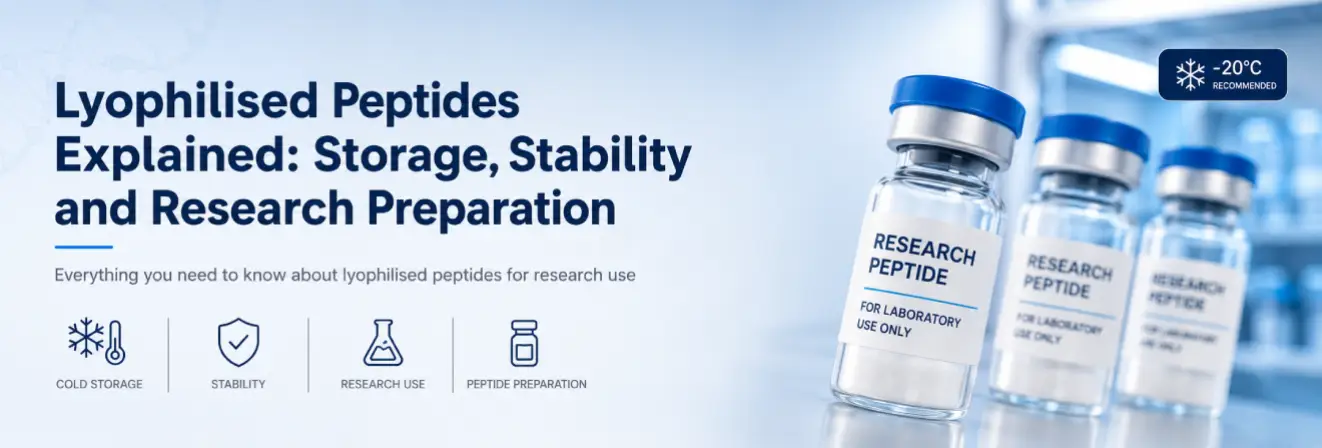
Lyophilised peptides are peptides that have been freeze-dried to remove most of their water content, creating a dry and comparatively stable peptide format that is easier to store, transport and prepare for research.
They are commonly supplied as a fine peptide powder, a compact cake or a thin layer at the bottom of a sealed vial. This appearance is normal and results from the way the material dries during manufacturing.
Removing water does not make a peptide permanently stable, but it can substantially reduce many degradation processes that occur more quickly in liquid solutions. Proper storage, controlled handling and suitable preparation remain essential because heat, moisture, oxygen, light and repeated temperature changes can still affect peptide quality.
This information applies to research materials only. It does not provide dosing, injection, administration or human-use instructions.
What Are Lyophilised Peptides?
Lyophilised peptides are peptide materials that have undergone lyophilisation, a controlled freeze-drying process used to remove water from a frozeow the Lyophilisation Process Worksn peptide solution.
A peptide is a short chain of amino acids joined by peptide bonds. These molecules can be sensitive to their surroundings, particularly when dissolved in water. Lyophilisation converts the peptide from a liquid formulation into a dry solid that is generally better suited to storage and transportation.
Researchers looking for additional structural background can review our Peptide Bond guide and Peptide Sequence guide.
Lyophilised peptide meaning
The term “lyophilised” means freeze-dried.
During lyophilisation, the peptide solution is frozen and placed under reduced pressure. The frozen water then changes directly from ice into vapour without first becoming liquid. This process is called sublimation.
After most of the ice has been removed, a secondary drying stage reduces the remaining moisture. The resulting material is sealed in a vial to limit exposure to the surrounding environment.
The process is intended to preserve the peptide in a dry state until it is required for an appropriate research procedure.
What does peptide powder look like?
Peptide powder does not always look like loose household powder. Depending on the peptide, formulation and manufacturing process, it may appear as:
- A fine white or off-white powder
- A compact disc or cake
- A thin coating on the bottom or wall of the vial
- Small flakes or a porous solid
- A coloured powder when the peptide or formulation has a naturally distinctive appearance, as may occur with research materials such as GHK-Cu peptide.
The visible volume may be extremely small. Milligram quantities of peptide can occupy very little space, especially when the material forms a thin layer inside a comparatively large vial.
A vial should not be assumed to be empty simply because the contents are difficult to see.
Does appearance indicate peptide quality?
Appearance alone cannot reliably confirm identity, purity or stability.
Two batches of the same peptide may look slightly different because of changes in vial size, drying conditions, residual moisture, excipients or how the dried material settled. A neat cake is not automatically more pure than a loose powder, and a small amount of visible material does not necessarily indicate an incorrect quantity.
Quality should be evaluated through appropriate documentation and analytical methods, such as batch-specific purity testing, identity testing and a Certificate of Analysis.
For guidance on interpreting these quality indicators, see our Peptide Purity Explained guide and Certificate of Analysis guide.
View Certificates of Analysis for Research Materials →
Why Are Peptides Freeze-Dried?
Freeze dried peptides are widely used because the dry format reduces several risks associated with storing peptides in solution.
Water supports many chemical and biological processes that can damage peptide material. Removing most of that water helps slow those processes and gives the peptide a more stable starting condition.
Reduced hydrolysis
Hydrolysis is a chemical reaction involving water. In peptide materials, it may contribute to the breakdown of chemical bonds or other forms of degradation, depending on the sequence and surrounding conditions.
Lyophilisation greatly reduces the amount of available water, which can slow hydrolytic degradation during storage.
It does not remove every possible source of moisture. Humid air, condensation and poorly sealed packaging can reintroduce water and reduce the benefit of the dry format.
Lower risk of microbial growth
Dry peptide material generally presents a much less favourable environment for bacteria and fungi than an aqueous solution.
This does not mean the contents should be treated as automatically sterile. Sterility depends on how the product was manufactured, packaged and handled.
Once a peptide is dissolved, microbial contamination becomes a more significant concern because water is present and the vial may be handled repeatedly.
Improved transport and storage
Liquid peptide solutions can be sensitive to temperature changes, leakage, agitation and prolonged transport.
A lyophilised peptide format is often easier to package and ship because:
- The material is dry
- The risk of leakage is lower
- Many degradation reactions proceed more slowly
- It usually tolerates transport conditions better than a prepared solution
- The peptide can remain sealed until needed
Freeze-drying does not make peptides resistant to excessive heat. Storage recommendations should still be followed before, during and after transport.
Greater flexibility before use
Supplying peptides in a dry format allows researchers to prepare material according to the requirements of a defined laboratory procedure rather than storing unnecessarily large volumes of prepared solution.
This can reduce unnecessary storage of prepared peptide solutions, which are generally less stable than the corresponding dry material.
It also allows concentration and solvent conditions to be selected according to peptide-specific technical data, solubility characteristics and the validated research method.
How the Lyophilisation Process Works
Lyophilisation involves more than placing a peptide in a freezer. It is a controlled manufacturing process that uses carefully managed temperature and pressure conditions.
For broader context on how synthetic peptide materials are produced before finishing and packaging, see How Are Peptides Made? and our Peptide Synthesis guide.
Freezing
The process begins with a peptide solution.
The solution is cooled until its water content freezes. The freezing rate and final temperature may influence the structure of the frozen material and the appearance of the final cake.
Manufacturers may optimise this stage to reduce physical stress and support efficient drying.
Primary drying
During primary drying, pressure inside the freeze-drying chamber is reduced.
Controlled heat is applied while the product remains frozen. Under these conditions, ice changes directly into vapour through sublimation.
Most of the water is removed during this stage.
Secondary drying
A small amount of water may remain associated with the dried product after primary drying.
Secondary drying uses controlled temperature and low pressure to remove more of this residual moisture. The target level depends on the peptide and formulation.
Residual moisture must be carefully managed. Excess moisture can reduce stability, while overly aggressive drying conditions may also affect certain formulations.
Sealing and packaging
After drying, the vial is normally sealed to protect the contents from humidity, oxygen and contamination.
Some peptide materials may be packaged under nitrogen, argon or another controlled atmosphere when oxidation is a concern.
The protective value of lyophilisation depends partly on the integrity of this packaging. A damaged stopper, loose cap or improperly sealed vial can allow air and moisture to enter.
Lyophilised Peptides vs Peptides in Solution
The main difference between lyophilised and liquid peptides is the presence of water.
| Factor | Lyophilised peptides | Peptides in solution |
| Physical form | Dry powder, cake or film | Liquid |
| Water content | Very low | High |
| General storage stability | Usually higher | Usually lower |
| Hydrolysis risk | Reduced | Higher |
| Microbial growth risk | Lower while dry | Higher |
| Preparation required | Yes | May be ready for use, depending on the formulation and validated method |
| Shipping practicality | Generally better | More temperature-sensitive |
| Freeze-thaw sensitivity | Relevant after preparation | Immediately relevant |
| Solubility considerations | Must be assessed during preparation | Already dissolved |
Neither peptide format is universally suitable for every application.
A prepared solution may be convenient when immediate use is required and its stability has been validated. A lyophilised format is generally preferred when transportation, longer storage or preparation flexibility is important.
For a more detailed comparison of dry and prepared material stability, see our Peptide Storage Stability guide.
What Affects Peptide Stability?
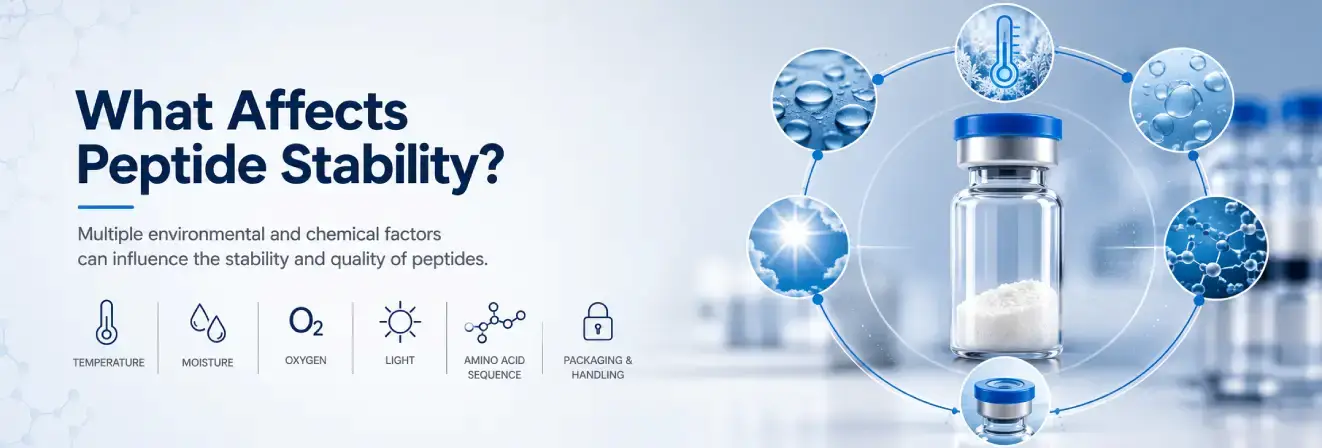
Peptide stability is influenced by the peptide sequence, physical form, formulation, packaging and surrounding environment.
No single storage period can be applied accurately to every peptide. Two peptides stored under identical conditions may degrade at different rates because their amino acid sequences and chemical properties are different.
Temperature
Higher temperatures generally increase the rate of chemical reactions.
For this reason, controlled cold storage is commonly used for many lyophilised research peptides when supported by product-specific stability information.
However, colder is not automatically better in every case. Product-specific guidance should determine whether refrigeration, standard freezer storage or another condition is appropriate.
Repeated movement between storage temperatures should be minimised because temperature cycling may increase condensation risk and introduce additional physical stress.
Moisture
Moisture is one of the most important threats to lyophilised peptide stability.
Dry material can absorb water from humid air, particularly when the vial remains open or is handled before warming to room temperature. Some peptides are more hygroscopic than others, meaning they absorb moisture readily.
Moisture can increase the likelihood of:
- Hydrolysis
- Aggregation
- Physical changes in the powder
- Reduced storage stability
- Microbial growth after preparation
Keeping the container sealed and dry is therefore a central part of lyophilised peptide storage.
Oxygen
Oxygen can react with susceptible amino acid residues.
Peptides containing residues such as cysteine, methionine or tryptophan may be more prone to oxidation, although susceptibility depends on the full peptide sequence and storage conditions.
Limiting unnecessary exposure to air and following any anaerobic storage recommendations can help reduce oxidation risk.
Light
Some peptides are light-sensitive.
Exposure to strong or prolonged light may contribute to chemical degradation. Vials should generally be protected from direct sunlight and intense artificial light unless the manufacturer confirms that light protection is unnecessary.
Amber containers, opaque secondary packaging or storage in a dark location may be used when appropriate.
Amino acid sequence
The sequence of a peptide strongly influences its behaviour.
Certain residues are associated with common degradation pathways:
| Amino acid residue | Potential concern |
| Cysteine | Oxidation and disulphide-related changes |
| Methionine | Oxidation |
| Tryptophan | Oxidation and light sensitivity |
| Asparagine | Deamidation |
| Glutamine | Deamidation |
| Aspartic acid | Sequence-dependent hydrolysis or rearrangement |
| N-terminal glutamic acid | Cyclisation in some conditions |
This table identifies general tendencies, not guaranteed outcomes. The position of the residue, neighbouring amino acids, pH, solvent and temperature can all affect the actual degradation pathway.
Because sequence strongly influences these degradation pathways, researchers can review our Peptide Sequence guide for additional structural context.
pH after reconstitution
Once a peptide has been dissolved, pH can significantly influence its solubility and chemical stability.
A strongly acidic or alkaline environment may accelerate certain degradation reactions. The most suitable pH depends on the peptide sequence and intended research method.
A solvent or buffer should not be selected solely because it works for another peptide.
Concentration
Very dilute peptide solutions may be more vulnerable to adsorption onto container surfaces, especially with hydrophobic peptides.
Highly concentrated solutions may have solubility or aggregation problems.
The appropriate experimental concentration should be determined from peptide-specific information, validated research methods and the requirements of the assay rather than from a universal preparation rule.
Container material
Some hydrophobic peptides can adsorb to certain plastic surfaces, reducing the amount of peptide available in solution.
Container selection may therefore affect recovery, particularly for low-concentration samples.
Glass or low-binding laboratory containers may be more suitable in some cases. Compatibility should be assessed for the individual peptide, solvent and research method.
Lyophilised Peptide Storage
Correct lyophilised peptide storage protects dry research material from temperature extremes, moisture, oxygen and light. For a detailed discussion of these variables, see our Peptide Storage Guide and Peptide Storage Stability guide. Product-specific storage information should always take priority over general guidance.
Short-term storage
For short periods, some lyophilised peptides may remain stable under controlled room-temperature or refrigerated conditions.
However, room-temperature stability should not be assumed for every product. Ambient conditions vary widely, especially in Australia, where indoor and transport temperatures may become high.
A “cool, dry place” should not be interpreted as a hot warehouse, vehicle, letterbox or room exposed to direct sunlight.
Long-term storage
For longer-term storage, controlled frozen conditions are commonly used for many lyophilised peptides when supported by product-specific stability information. A single freezer temperature should not be presented as universally appropriate for every peptide or formulation.
Some materials may require lower temperatures or additional protection from oxygen and moisture.
Long-term storage practices may include:
- Keeping the vial tightly sealed
- Using moisture-resistant secondary packaging
- Protecting the material from light
- Avoiding unnecessary opening
- Recording the receipt and storage dates
- Dividing material into separate vials when suitable
- Using a desiccator when recommended
- Limiting air exposure for oxidation-sensitive sequences
Specific shelf-life claims should be based on validated stability data rather than general assumptions.
Allow the vial to warm before opening
A cold vial should generally be allowed to reach room temperature while still sealed.
Opening a cold container can cause moisture from the surrounding air to condense inside the vial. This introduces water directly to the dry peptide and may reduce long-term stability.
The vial should remain closed until it has equilibrated to room temperature.
Avoid repeated opening
Repeatedly opening the same stock vial exposes the material to fresh air and humidity.
Where appropriate, the dry peptide may be divided into smaller sealed portions to reduce repeated handling. This should be performed using suitable laboratory procedures that minimise contamination and material loss.
Avoid unnecessary freeze-thaw cycles
Freeze-thaw cycles are especially relevant after the peptide has been reconstituted.
Repeated freezing and thawing can contribute to:
- Aggregation
- Precipitation
- Oxidation
- Physical stress
- Reduced consistency between samples
Where compatible with the validated experimental method, prepared solutions may be divided into suitable aliquots to reduce repeated freeze–thaw exposure and container access.
Dry lyophilised material should also be protected from repeated temperature changes because warming and cooling can increase condensation risk.
Reconstituting Lyophilised Peptides
Reconstituting lyophilised peptides involves adding a compatible solvent or buffer to prepare the dry material for a defined laboratory procedure.
Researchers can review our Peptide Reconstitution Guide for research-focused information on concentration planning, solvent compatibility and laboratory handling.
There is no universal solvent, volume or concentration suitable for every peptide.
The correct approach depends on:
- Peptide sequence
- Net charge
- Hydrophobicity
- Required concentration
- Intended assay
- Buffer compatibility
- Stability requirements
- Manufacturer instructions
General Research Preparation Principles
A laboratory preparation workflow should begin with the peptide’s technical data, validated solvent or buffer conditions, required experimental concentration and storage requirements.
Key principles include:
- Review peptide-specific technical and storage information.
- Confirm the required solvent or buffer, pH and experimental concentration.
- Keep handling conditions controlled and documented.
- Assess dissolution and visible physical changes.
- Label prepared material with identity, batch, concentration, preparation date and storage condition.
- Follow the validated experimental procedure for subsequent storage and use.
These are general laboratory principles and are not human-use preparation or administration instructions.
Choosing an appropriate solvent
Research solvents and buffers should be selected according to peptide-specific solubility, stability and assay requirements. There is no universal preparation medium suitable for every peptide.
Researchers comparing laboratory water formats can review Bacteriostatic Water for Peptides and Sterile Water vs Bacteriostatic Water.
Explore Bacteriostatic Water for Laboratory Research →
Water should not automatically be treated as the best solvent.
Some peptides dissolve readily in water, while others require a particular pH or a compatible co-solvent. Hydrophobic peptides may be especially difficult to dissolve.
The solvent must also be compatible with the intended assay. A solvent that dissolves the peptide successfully may still interfere with analytical equipment, cell-based testing or other experimental systems.
Solubility and peptide charge
Peptide solubility can sometimes be estimated from net charge and hydrophobicity, but prediction is not always reliable.
General patterns include:
- Acidic peptides may dissolve more readily under mildly basic conditions.
- Some basic peptides may require mildly acidic laboratory conditions for solubility, depending on sequence and validated technical guidance. An acidic preparation medium should not be assumed to be suitable for every peptide.
- Highly hydrophobic peptides may require a compatible organic co-solvent.
- Neutral peptides may require experimental optimisation.
Explore Acetic Acid Water 3ml for Laboratory Research →
Small-scale solubility testing can reduce the risk of losing an entire sample to an unsuitable solvent.
Laboratory preparation methods should minimise unnecessary mechanical stress, foaming and handling while following peptide-specific validated procedures.
Inspect the final solution
The expected appearance depends on the peptide and solvent.
A clear solution may be expected for many preparations, but clarity alone does not confirm identity, purity or concentration.
Unexpected signs may include:
- Persistent undissolved material
- New precipitation
- Cloudiness that is not expected
- Fibrous or particulate material
- Unusual colour change
- Container damage
- Visible contamination
Visual inspection can identify obvious physical changes, but clarity does not establish identity, concentration, purity or chemical stability. Analytical and preparation records remain necessary.
Handling Prepared Peptide Solutions
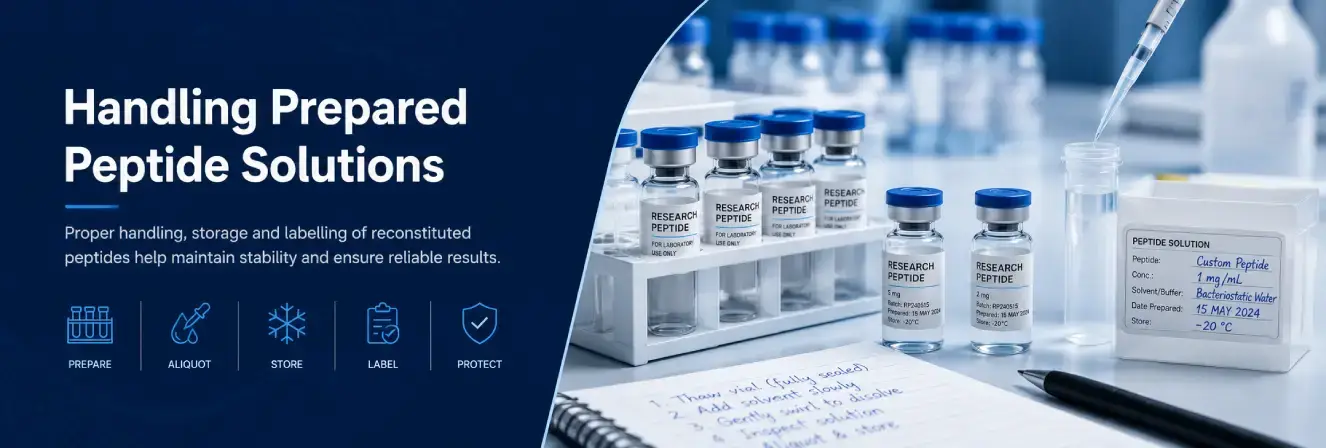
Prepared peptide solutions are usually less stable than lyophilised material because water enables additional degradation pathways.
Prepared solutions should be handled according to peptide- and method-specific stability information and prepared only for defined experimental requirements.
Use appropriate storage conditions
Storage temperature after reconstitution depends on the peptide, solvent and intended duration.
Storage conditions after preparation depend on peptide sequence, formulation, solvent, concentration and validated stability data. Refrigeration or freezing should not be applied as a universal rule.
Product-specific or method-specific stability information should be followed.
Limit storage duration
Prepared peptide solutions should not be assumed to remain stable for a fixed number of days.
A commonly cited storage window for a preservative-containing solvent does not automatically establish the chemical stability of every peptide dissolved in that solvent.
Microbial control and peptide stability are separate issues.
A preservative may help limit microbial growth under specified conditions, but it does not prevent oxidation, hydrolysis, deamidation, aggregation or adsorption.
Use aliquots where appropriate
Aliquoting can reduce repeated vial access and freeze-thaw exposure.
Each aliquot should be:
- Prepared using suitable laboratory technique
- Placed in a compatible container
- Labelled with identity and concentration
- Dated
- Stored under the required conditions
- Used according to the validated research procedure
Aliquoting should be planned carefully because very small volumes can increase losses from evaporation or surface adsorption.
Maintain accurate labels
Every prepared sample should be labelled clearly.
Useful information may include:
- Peptide name
- Batch or lot number
- Concentration
- Solvent or buffer
- Preparation date
- Storage condition
- Relevant expiry or use-by date
- Researcher or project identifier
Good labelling reduces mix-ups and supports traceability.
Common Mistakes to Avoid
Several handling errors can reduce peptide quality even when the original product was manufactured correctly.
Opening a cold vial
Opening the vial before it reaches room temperature can introduce condensation and moisture.
Assuming every peptide uses the same solvent
Solubility and stability vary considerably between peptides. A solvent suitable for one product may be unsuitable for another.
Judging quantity by appearance
A small cake or nearly invisible film may still contain the stated amount of peptide.
Shaking the vial aggressively
Vigorous mixing may cause foam or aggregation and is rarely necessary.
Storing all prepared solutions in the same way
Some peptide solutions tolerate freezing, while others may precipitate or become unstable. One storage rule cannot be applied to every peptide.
Reusing one stock vial repeatedly
Repeated opening increases exposure to air, moisture and contamination.
Making unsupported shelf-life assumptions
A peptide should not be considered stable for months or years unless that period is supported by product-specific data and suitable storage conditions.
Ignoring container compatibility
Adsorption to container surfaces can reduce recovery, particularly with hydrophobic peptides or dilute solutions.
Using damaged or poorly sealed vials
A compromised vial may no longer protect the material from moisture and oxygen.
Treating a Certificate of Analysis as the only quality check
A COA is important, but it should be reviewed carefully. Its value depends on whether it is batch-specific, complete, traceable and supported by appropriate analytical methods.
How to Assess the Quality of Lyophilised Peptides
High-quality research materials require more than an attractive label or purity claim.
Review the Certificate of Analysis
A suitable Certificate of Analysis may include:
- Product or peptide name
- Batch or lot number
- Stated purity
- Analytical method
- Identity confirmation
- Test date
- Quantity or net content
- Storage conditions
- Relevant chromatograms or spectra
The batch number on the document should match the product received.
Researchers can review our Certificate of Analysis guide for a more detailed explanation of batch identifiers, analytical methods and result interpretation.
Understand peptide purity
Purity usually describes the proportion of the intended peptide relative to detectable peptide-related impurities under a specified analytical method.
Purity does not necessarily confirm:
- Correct net peptide content
- Sterility
- Endotoxin status
- Absence of every contaminant
- Therapeutic suitability or clinical safety
- Stability after poor storage
Purity should therefore be considered alongside identity testing, handling history and the requirements of the research application.
For a dedicated explanation of chromatographic purity, identity and related analytical limitations, see Peptide Purity Explained.
Check identity testing
Mass spectrometry is commonly used to assess whether the molecular mass is consistent with the expected peptide.
Chromatography and mass spectrometry provide different information. A purity chromatogram alone does not fully confirm identity, and a mass result alone does not establish purity.
Examine packaging and labelling
Quality packaging should protect the peptide from physical damage, humidity and light.
The label should clearly identify the product and provide enough information for traceability.
Unlabelled, damaged or leaking containers should not be treated as reliable research materials.
Confirm research-use status
Products supplied for research use should be clearly identified as such.
Research-use-only materials are intended for laboratory or analytical investigation and should not be represented as approved medicines or as materials for human or veterinary administration.
Benefits and Limitations of the Lyophilised Peptide Format
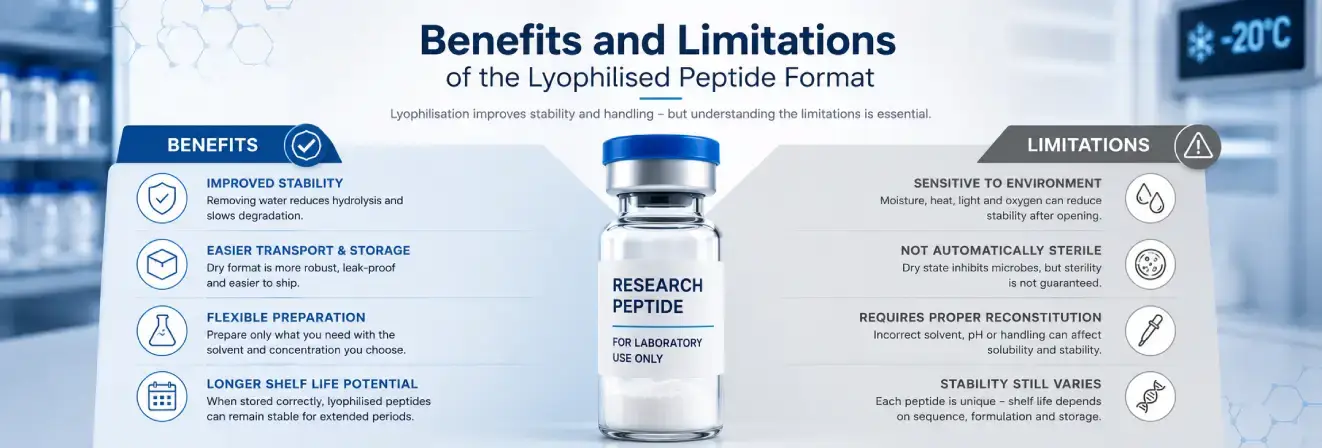
Lyophilisation offers important practical advantages, but it does not eliminate every risk.
| Benefit | Limitation |
| Improved dry-state stability | Stability still varies by sequence |
| Easier shipping than many liquid formats | Excessive heat can still cause damage |
| Reduced hydrolysis risk | Moisture can re-enter after opening |
| Lower microbial growth risk while dry | Dry material is not automatically sterile |
| Flexible preparation | Reconstitution introduces error risk |
| Longer potential storage | Shelf life requires supporting data |
| Reduced need to store solutions | Solubility may require optimisation |
Understanding both sides helps prevent unrealistic expectations.
A freeze-dried product is not automatically high quality, and a lyophilised peptide is not protected indefinitely. Manufacturing quality, residual moisture, packaging, transport and handling all remain important.
Lyophilised peptides are freeze-dried research materials in which most water has been removed to improve dry-state stability, transport practicality and storage before experimental preparation.
Their stability still depends on peptide sequence, residual moisture, packaging, temperature, oxygen, light and handling history. No single storage temperature, solvent or shelf-life estimate applies to every peptide.
Reliable laboratory use therefore depends on product-specific technical information, batch documentation, validated analytical methods and controlled preparation procedures.
For broader laboratory-focused information, browse our Research Peptide Guides.
FAQs about lyophilised peptides:
What do lyophilised peptides do?
Lyophilisation removes most of the water from peptide material, creating a dry format that can improve storage stability and transport before laboratory preparation. The process changes the physical format of the peptide rather than its underlying molecular identity.
How long can lyophilised peptides be stored at room temperature?
There is no universal room-temperature storage period for lyophilised peptides. Stability depends on the sequence, formulation, packaging, humidity, temperature history and validated product-specific stability data.
Are Lyophilised Research Peptides Ready for Direct Experimental Use?
Not necessarily. Lyophilised material is a dry research format that may require preparation according to peptide-specific technical data and the validated laboratory method. Research-use materials are not intended for human or veterinary administration.
What Types of Biological Materials Are Commonly Lyophilised?
Lyophilisation is used across pharmaceutical and laboratory sciences for materials that may benefit from dry-state stability, including certain peptides, proteins, vaccines, biological reagents and other sensitive formulations.
Sources: