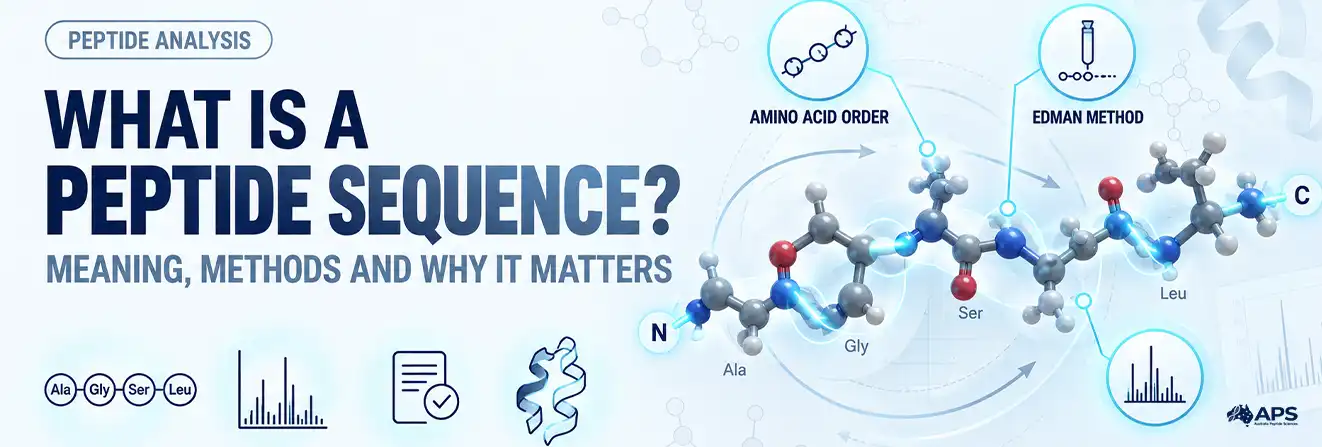
A peptide sequence is the ordered arrangement of amino acids joined within a peptide chain. This order defines the molecule’s primary structure and influences its charge, shape, stability, interactions, and experimental behaviour. Accurate sequence determination is therefore central to peptide identification, proteomics, quality assessment and structure-activity research.
Knowing the expected order, however, does not prove that a laboratory sample contains it. Researchers need supporting evidence, appropriate controls and a clear understanding of what each sequencing method can resolve.
Sequence notation, analytical method and validation criteria must be considered together when assessing a reported result.
What is a peptide sequence?
A peptide consists of amino acid residues connected by peptide bonds. Its sequence records those residues in their exact linear order, normally from the amino end, known as the N-terminus, to the carboxyl end, known as the C-terminus.
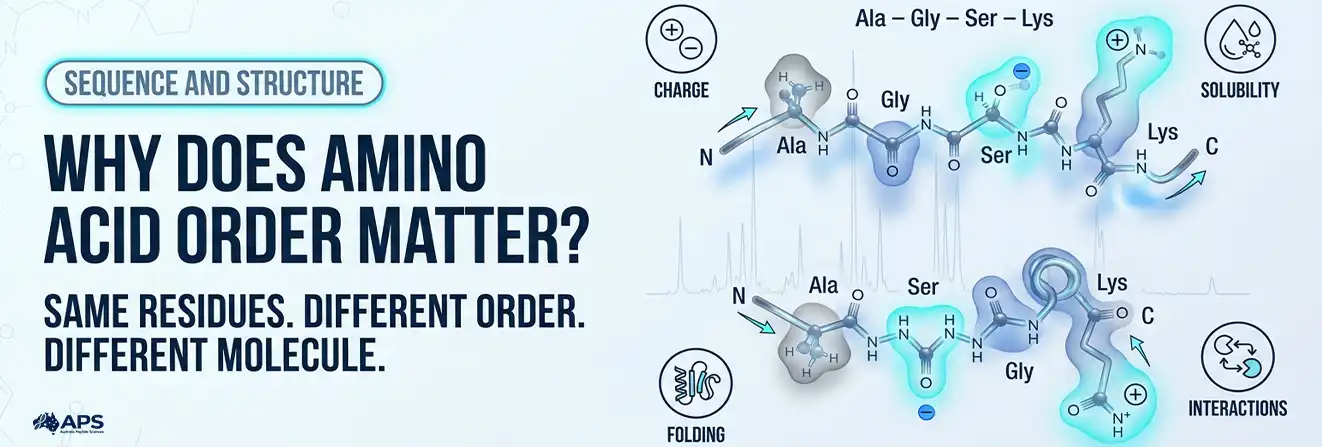
For example, Ala-Gly-Ser-Lys represents alanine followed by glycine, serine, and lysine. The same chain can be written as AGSK using standard one-letter amino acid codes. Both notations describe the same residue order and are read from left to right.
| Feature | What it means |
| Amino acid | A free molecular building block |
| Residue | An amino acid after its incorporation into a peptide chain |
| Peptide bond | The covalent bond connecting adjacent residues |
| N-terminus | The amino end, written first by convention |
| C-terminus | The carboxyl end, written last by convention |
This linear description is essential, but it may not capture every chemical feature. Terminal modifications, cyclisation, branching, disulfide connectivity, metal coordination in complexes such as GHK-Cu, and non-standard residues can all contribute to a peptide’s complete identity.
A sequence should therefore be interpreted alongside relevant structural and analytical information.
Why Does Amino Acid Order Matter?
A chain containing the right amino acids in the wrong order is a different molecule. The position of each residue determines which side chains are adjacent and how their chemical properties are distributed across the chain.
Sequence can influence:
- Net electrical charge at a given pH.
- Hydrophobic and hydrophilic regions.
- Solubility and aggregation tendency.
- Susceptibility to enzymes or chemical degradation.
- Secondary structure, including helices, turns and sheets.
- Recognition by antibodies, enzymes or receptors.
- Sites available for oxidation, phosphorylation or other modifications.
- The fragments produced during mass spectrometry.
A single substitution may have little effect or substantially alter molecular behaviour, depending on the residues involved, their location, the surrounding motif and experimental conditions.
Sequence also does not determine function in isolation. Understanding what peptides are provides the broader chemical and laboratory context, but conformation, chemical modifications, concentration and the biological model can still influence the observed response. Any biological effect must therefore be established experimentally under defined conditions.
How a peptide sequence differs from identity, purity and structure
These terms describe different properties and are not interchangeable.
| Property | Question answered | What it does not prove alone |
| Sequence | In what order are the residues arranged? | Sample purity or biological activity |
| Identity | Is the detected material consistent with the intended compound? | Complete absence of impurities |
| Purity | What proportion of the measured analytical signal is attributed to the main component under the stated method?
|
Correct residue order |
| Molecular mass | Does the observed mass match the expected mass? | Unique sequence or connectivity |
| Structure | How are the atoms and molecular features organised? | Performance in every research model |
Leucine and isoleucine have identical elemental compositions and masses, so conventional mass measurement—and many routine MS/MS workflows—cannot distinguish them unambiguously without specialised fragmentation or orthogonal evidence.
How Sequence Information Should Be Read on a Peptide COA
A peptide Certificate of Analysis (COA) may report several analytical results that answer different questions about a research sample. An observed molecular mass can support compound identity, while chromatographic purity indicates the proportion of the main detected component under the stated analytical method. MS/MS data may provide additional sequence-level evidence by comparing observed fragment ions with the expected amino acid order.
These results should be interpreted together rather than treating any single measurement as complete confirmation of peptide identity, purity, or structure. For example, a matching molecular mass does not by itself prove residue order, while a high chromatographic purity value does not independently confirm the peptide sequence.
When reviewing analytical documentation, researchers should therefore consider the reported sequence, molecular mass, purity method, batch information, and supporting spectra collectively. For further guidance, see our guide to peptide Certificates of Analysis (COAs).
How to determine peptide sequence
No method suits every sample. How to determine peptide sequence depends on what is already known, the available material, and the required level of confidence.
Method selection depends on several features of the sample and the analytical question:
- Is the expected sequence known, as it would be for a defined synthetic peptide such as BPC-157, or is the sample unknown
- Is the sample a purified peptide or a complex mixture?
- Is the N-terminus free and accessible?
- Are terminal or side-chain modifications expected?
- Is a complete sequence required, or only identity confirmation?
- How much sample is available?
- What level of uncertainty is acceptable for the intended research use?
These factors guide the choice between Edman degradation, tandem mass spectrometry, database searching, de novo analysis, and complementary structural methods.
Explore our research peptide shop
Peptide Sequencing Methods Compared
The principal peptide sequencing methods are not interchangeable. Each suits different samples and produces a distinct type of evidence.
| Method | Best suited to | Primary strength | Important limitation |
| Edman degradation | Purified peptides with a free N-terminus | Direct, sequential N-terminal readout | Blocked termini and declining cycle yield |
| Database-assisted MS/MS | Expected proteins or organisms represented in a reference database | Sensitive, scalable identification | Limited by database content and search assumptions |
| De novo MS/MS | Unknown or unexpected sequences | Does not require an exact database match | Requires informative, high-quality spectra |
| Peptide mass fingerprinting | Relatively simple samples containing known proteins | Rapid mass-pattern comparison | Usually insufficient for complete sequencing |
Edman Degradation Peptide Sequencing
Edman degradation peptide sequencing identifies residues sequentially from a peptide’s N-terminus using phenyl isothiocyanate. It provides a direct chemical readout for purified samples with an accessible N-terminus, while mass spectrometry uses fragmentation evidence, as discussed in this review of peptide and protein sequence identification.
Its main limitations include:
- The N-terminus must be free and chemically accessible.
- N-terminal acetylation or other blocking can prevent sequencing.
- Impure samples can produce overlapping signals.
- Repeated cycles require time.
- Each cycle reduces yield and confidence further along the chain.
- Long, modified, or heterogeneous samples are difficult to characterise completely.
Peptide Sequencing by Mass Spectrometry
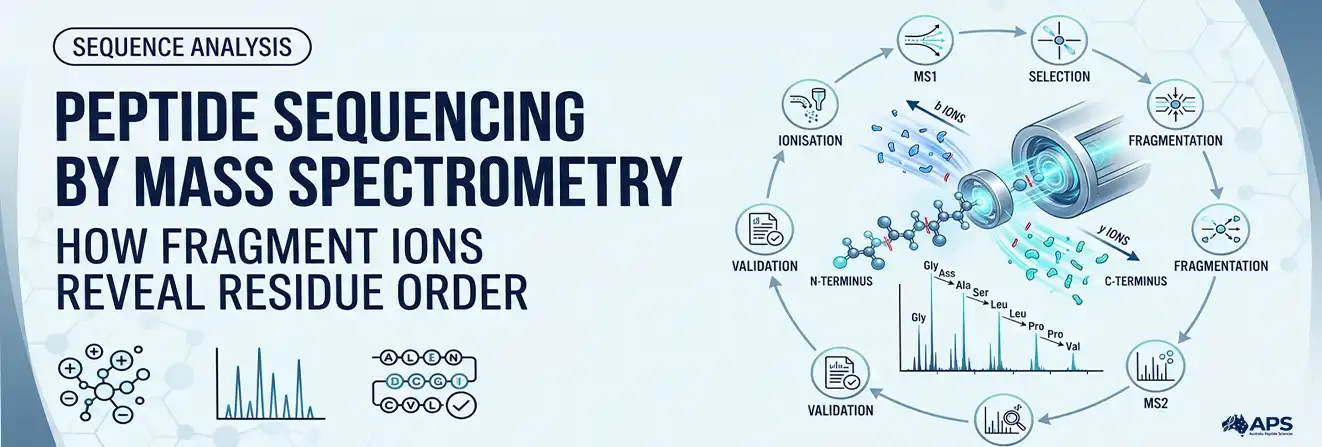
Peptide sequencing by mass spectrometry infers residue order from measured ions and fragmentation patterns. Liquid chromatography often separates sample components before mass analysis, producing an LC-MS/MS workflow.
The process generally follows these stages:
- Ionisation: Peptide molecules enter the gas phase as charged ions.
- MS1 measurement: The instrument records the mass-to-charge ratios, or m/z values, of precursor ions.
- Precursor selection: A selected ion is isolated for further analysis.
- Fragmentation: Energy breaks susceptible bonds along the peptide backbone.
- MS2 measurement: The resulting fragment ions are recorded.
- Interpretation: Software evaluates mass differences and candidate sequences.
- Validation: Mass error, fragment coverage, scores, and error controls are reviewed.
Backbone cleavage generates fragment series: b ions retain the N-terminal side, while y ions retain the C-terminal side. Differences between neighbouring ions can indicate residue masses, and tandem mass spectra research shows that continuous fragment coverage provides stronger evidence than a single matching peak.
Database Search or De Novo Peptide Sequencing?
MS/MS data still require an interpretation strategy. The two main approaches answer related but distinct questions.
1. Database-Assisted Identification
Search software compares observed spectra with theoretical database sequences. In proteomics, the distinction between peptides vs proteins matters because proteins are commonly identified through peptide fragments, with each match scored by mass accuracy, fragment agreement, and search settings.
Important settings include:
- Enzyme specificity and allowed missed cleavages.
- Precursor and fragment mass tolerances.
- Fixed and variable modifications.
- Permitted charge states.
- Organism or sequence database selection.
- Statistical acceptance thresholds.
For a defined synthetic peptide such as Semax, targeted MS/MS can compare the observed fragment pattern with the expected sequence.
However, it can miss novel peptides, unexpected variants, or modifications excluded from the search.
An excessively broad search space can also increase ambiguity.
Researchers can use resources such as UniProt to examine canonical sequences, isoforms, and annotated features. A database record, however, is a reference and does not prove that a particular sample contains that sequence.
2. De Novo Peptide Sequencing
De novo peptide sequencing derives a candidate order directly from mass differences and fragment relationships without requiring an exact database entry. It is useful when the source is unknown, a variant is suspected, or database searches cannot explain a high-quality spectrum.
The method works best with continuous fragment information and an accurate precursor mass. Missing peaks, noise, co-isolated ions, unexpected modifications, and isobaric residues can produce several plausible sequences. Software can rank candidates, but the highest-scoring result still requires evaluation against the underlying spectral evidence.
For a concise visual introduction, the following video explains the basic principles of peptide sequencing. It provides useful context before comparing the individual analytical methods discussed below.
How Amino Acid Sequence Analysis Is Validated
A software-generated peptide name does not make a result reliable. Amino acid sequence analysis requires supporting evidence at the spectrum, peptide, and dataset levels.
1. Fragment Coverage
Coverage shows how much of the proposed backbone is supported by observed fragments. A long, consecutive ion series is generally more informative than scattered matches, while complementary ion types and repeated observations strengthen confidence.
2. Mass Accuracy
High mass accuracy reduces the number of formulas or residue combinations consistent with a peak, but it cannot resolve every structural ambiguity. Calibration, charge assignment, and isotope selection must also be correct.
3. Statistical Error Control
Large datasets can produce convincing matches by chance. Proteomics workflows commonly estimate false discovery rates using target-decoy strategies and apply defined thresholds to peptide-spectrum matches. The original target-decoy search strategy study explains how decoy matches can help estimate incorrect identifications in large-scale MS/MS datasets. Novel or consequential findings may still require stricter thresholds and additional review.
4. Orthogonal Evidence
Confidence improves when a conclusion is supported by an independent measurement, such as:
- Expected intact molecular mass.
- Retention behaviour consistent with a reference standard under the same analytical conditions.
- Edman data for an accessible N-terminus.
- Alternative fragmentation data.
- Targeted MS/MS using a reference standard.
- Reanalysis using a different enzyme or cleavage strategy.
- Supporting chemical or structural characterisation.
No single metric provides universal proof. A reliable peptide sequence report separates measured evidence, software inference, and unresolved uncertainty, allowing independent evaluation of the conclusion.
Common Sequencing Challenges
Real samples rarely match ideal textbook conditions. Common complications include:
| Challenge | Why it matters | Possible response |
| Leucine and isoleucine | They have identical elemental compositions and masses | Explicit reporting of the ambiguity or the use of specialised supporting evidence |
| Blocked N-terminus | Prevents conventional Edman chemistry | Use MS-based methods or characterise the modification |
| Incomplete fragmentation | Leaves gaps in residue order | Acquire complementary spectra or optimise fragmentation |
| Mixed precursors | Produce fragments from multiple peptides | Improved chromatographic separation or precursor isolation |
| Unexpected modification | Changes precursor and fragment masses | Open or expanded searching followed by independent validation |
| Cyclic or branched structure | Makes linear sequence assumptions unreliable | Structure-aware methods supported by orthogonal analysis |
| Low signal | Produces weak peaks and reduces confidence | Optimisation of sample preparation, acquisition settings or sample amount |
Post-translational modifications can produce mass shifts, but locating them requires fragments that distinguish candidate sites. A review of common errors in modified-peptide analysis shows that incomplete fragmentation and overinterpretation can lead to unsupported assignments. Detection alone therefore does not confirm the modified residue.
Why Sequence Information Matters in Research
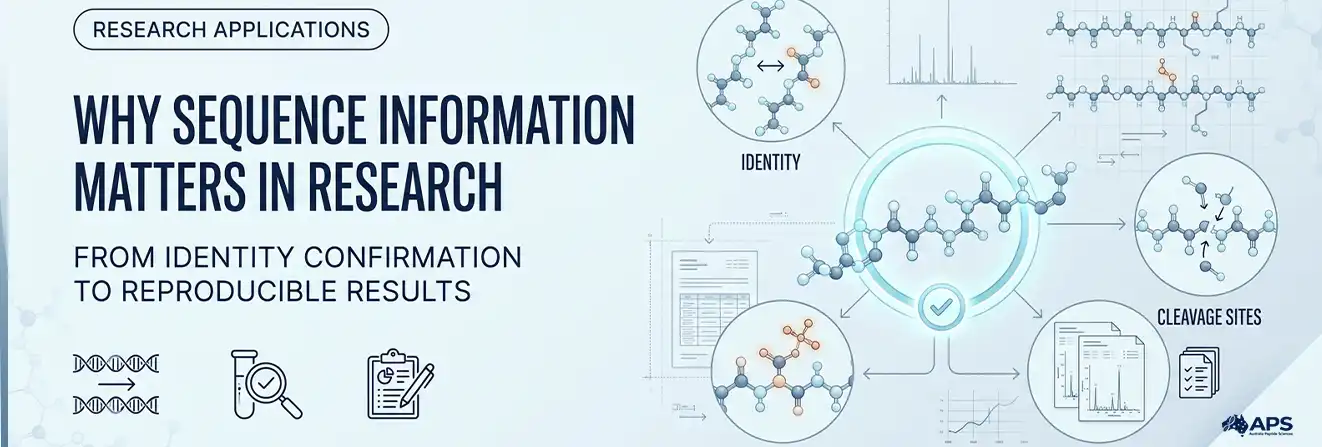
Researchers use sequence evidence to answer questions that intact mass or purity measurements alone cannot resolve.
Applications include:
- Confirming whether a synthetic product matches its intended order.
- Identifying proteins from enzymatically generated peptide fragments.
- Distinguishing isoforms, mutations, and processing products.
- Mapping selected post-translational modifications.
- Investigating degradation pathways and cleavage sites.
- Comparing analogues in structure-activity studies.
- Discovering previously unreported peptides.
- Selecting unique peptide targets for assays.
- Supporting reproducibility between batches and laboratories.
These applications across cellular research peptides and other research compounds do not establish clinical effectiveness, safety, or suitability for human use. Sequence identity is an analytical finding, and understanding what research use only means helps distinguish laboratory documentation from claims about personal or clinical use.
Biological effects require appropriate experiments, while therapeutic claims require relevant clinical and regulatory evidence.
Choosing the Right Sequencing Strategy
The research question should determine the analytical platform, rather than platform novelty alone.
| Research question | Useful starting approach |
| Does a known purified peptide match its expected identity? | Accurate intact mass plus targeted MS/MS |
| What is the accessible N-terminal order? | Edman degradation, potentially supported by MS. |
| Which proteins occur in a complex sample? | LC-MS/MS with controlled database searching |
| What is an unknown peptide’s likely order? | High-resolution MS/MS with de novo interpretation |
| Where is a modification located? | Fragmentation selected to preserve and localise it |
| Is a novel assignment defensible? | Multiple spectra, error control and orthogonal confirmation |
Sequence results should be interpreted alongside the batch number, analytical method, purity data and supporting documentation. Together, these records provide a more complete basis for research evaluation.
Explore Australia Peptide Sciences
What peptide sequence results can and cannot show
A peptide sequence defines residue order, but reliable characterisation requires more than a written sequence or matching molecular mass. Edman chemistry, MS/MS, database searches and de novo interpretation provide different forms of evidence, each with specific limitations.
Strong conclusions combine informative fragments, suitable error controls, transparent reporting, and complementary measurements. Distinguishing sequence, identity, purity, structure, and biological activity helps researchers design better analyses and avoid unsupported claims.
Frequently Asked Questions About Peptide Sequences
What is the peptide sequence?
A peptide sequence is the exact order of amino acid residues in a peptide chain, usually read from the N-terminus to the C-terminus.
How to determine a peptide sequence?
Researchers determine peptide order using methods such as Edman degradation, tandem mass spectrometry, database searching, and de novo sequencing.
How to write a peptide sequence?
A peptide sequence is written from the N-terminus to the C-terminus using standard one-letter or three-letter amino acid codes.
What is the sequence of BPC 157?
The reported 15-residue sequence of BPC-157 is Gly-Glu-Pro-Pro-Pro-Gly-Lys-Pro-Ala-Asp-Asp-Ala-Gly-Leu-Val, or GEPPPGKPADDAGLV.
What does a peptide sequence look like?
It may appear as three-letter codes such as Ala-Gly-Ser-Lys or as the equivalent one-letter sequence AGSK.
Can Molecular Mass Confirm a Peptide Sequence?
Matching molecular mass can support identity, but it cannot confirm residue order, distinguish every isobaric residue, or establish complete structural connectivity.
Can Mass Spectrometry Distinguish Leucine from Isoleucine?
Not by mass alone. Leucine and isoleucine have identical elemental compositions and masses. Conventional MS/MS may also leave this assignment ambiguous, although specialised fragmentation strategies or orthogonal methods can sometimes distinguish them.
What Is the Difference Between Database Searching and De Novo Peptide Sequencing?
Database searching compares spectra with known sequences, whereas de novo sequencing proposes residue order directly from fragment relationships without requiring an exact database match
Can Edman Degradation Sequence a Peptide with a Blocked N-Terminus?
Conventional Edman degradation requires an accessible N-terminus. A blocked terminus can prevent sequential residue identification and may require MS-based analysis.
Does a Confirmed Peptide Sequence Prove Purity or Biological Activity?
No. Sequence evidence addresses residue order, while purity and biological activity require separate analytical and experimental measurements.
Sources
- UniProt Sequence and Feature Guidance
- The Current State-of-the-Art Identification of Unknown Proteins Using Mass Spectrometry-Based Methods
- Quantification of the Compositional Information Provided by CID Mass Spectra of Peptides
- Target-Decoy Search Strategy for Increased Confidence in Large-Scale Protein Identifications
- Theoretical Assessment of Indistinguishable Peptides in Mass Spectrometry-Based Proteomics
- Common Errors in Mass Spectrometry-Based Analysis of Post-Translational Modifications