Peptide docking is a computational modelling technique used to predict how peptides may bind to proteins and form molecular complexes. By examining possible binding positions, molecular orientations and structural interactions, researchers can investigate protein–peptide recognition without relying exclusively on experimentally determined complex structures.
Unlike many small-molecule ligands, peptides contain flexible backbones and multiple interacting side chains. Their structures can change considerably when approaching a protein surface, making accurate docking predictions challenging.
Modern protein peptide docking combines molecular modelling, conformational sampling, scoring algorithms and structural refinement. Newer approaches also incorporate artificial intelligence and molecular dynamics to investigate complex formation and structural behaviour.
These methods support computational biology, structural biochemistry and peptide research by generating testable models of molecular interactions. However, docking predictions remain computational hypotheses rather than direct evidence of binding affinity or biological activity.
What Is Peptide Docking?
Peptide docking predicts possible three-dimensional arrangements of a peptide interacting with a protein or another molecular target. Its main objective is to identify plausible binding locations, orientations and conformations within a molecular complex.
The process typically involves two molecular components: a receptor and a peptide ligand. Computational algorithms explore possible arrangements between them, then evaluate the resulting structures using geometric, physical or statistical criteria. The output usually consists of several candidate binding poses rather than one definitively correct structure.
Explore peptide research at Australia Peptide Sciences.
What Is Protein Peptide Docking?
Protein peptide docking focuses specifically on interactions between a peptide and a larger protein structure.
Retatrutide is one example of a research peptide associated with multiple receptor targets, including GLP-1, GIP and glucagon receptors. The protein generally acts as the receptor, while the peptide is treated as the binding partner.
Depending on the method, the receptor may remain mostly rigid or undergo selected conformational adjustments during docking.
- The location of potential peptide-binding regions.
- The orientation of the peptide relative to the receptor.
- Contacts between peptide residues and protein residues.
- Possible hydrogen bonds, electrostatic interactions and hydrophobic contacts.
- Structural changes required to accommodate the peptide.
These features help researchers describe a possible protein peptide interaction at the molecular level.
Peptide Docking vs Conventional Molecular Docking
Conventional molecular docking is often designed around relatively small ligands. Peptides introduce additional structural complexity because rotation around specific backbone bonds and variations in amino acid side-chain conformations create a wide range of possible molecular structures. As peptide length increases, the number of accessible conformations can increase dramatically.
| Feature | Peptide Docking | Small-Molecule Docking |
| Ligand structure | Amino acid chain | Usually a smaller organic molecule |
| Flexibility | Often highly flexible | Variable, frequently more constrained |
| Backbone movement | Major consideration | Generally not applicable |
| Conformational sampling | Frequently extensive | Depends on ligand complexity |
| Receptor adjustments | May be important | May involve receptor side-chain or backbone flexibility |
| Main challenge | Exploring and ranking peptide conformations | Predicting ligand placement and interactions |
These differences explain why specialised peptide docking methods are often preferred over tools developed primarily for conventional small molecules.
Why Is Peptide Molecular Docking Challenging?
Peptide molecular docking must account for structural flexibility, receptor geometry and the possibility that molecular conformations change during binding. A peptide may have no single dominant structure in solution, yet adopt a more organised conformation when associated with a protein.
Peptide Conformational Flexibility
Peptides contain repeating backbone bonds that permit rotation around specific molecular axes. The amino acid order defined by a peptide sequence influences backbone flexibility and side-chain interactions, producing different conformations.
Certain peptide conformations may interact favourably with a receptor, while others may result in steric clashes or unfavourable molecular contacts. Flexible peptide docking requires sufficient structural sampling to identify plausible binding arrangements.
Binding-Site Uncertainty
A protein may contain several surface regions capable of accommodating a peptide. When the binding region is known, sampling can focus on a limited area. When the site is unknown, the algorithm must search a much larger portion of the receptor surface. This distinction affects computational cost and method selection.
Receptor Flexibility and Induced Fit
Proteins are not completely rigid. Side chains, loops and sometimes larger structural regions can move, altering the shape and chemistry of the peptide-binding interface. Docking methods may account for receptor flexibility through side-chain adjustments, multiple receptor conformations or a combination of both approaches. Rigid-receptor methods can miss arrangements requiring substantial rearrangement.
Peptide Length and Chemical Complexity
- Short linear peptides may suit extensive backbone sampling.
- Long flexible peptides present larger conformational search spaces.
- Cyclic peptides require preservation of ring geometry and constraints.
- Disordered peptides may occupy broad structural ensembles.
- Modified peptides can require non-standard residue parameters and compatible software.
How Does Peptide Docking Work?

A typical peptide docking workflow involves molecular preparation, conformational sampling, pose generation, scoring, refinement and structural validation. The exact sequence depends on the structural information available and the computational method selected.
1. Preparing the Protein Receptor
The starting point is usually a three-dimensional protein structure obtained experimentally or predicted computationally. The model is inspected for missing atoms, unresolved residues, protonation states, cofactors and alternative conformations. Water molecules and ions also require consideration because they can contribute to an interface. Consistent receptor preparation supports meaningful comparisons.
2. Preparing the Peptide Structure
Peptide preparation may start with an amino acid sequence or existing model. When the peptide conformation is unknown, algorithms can generate alternative structures including extended chains, turns and helices. The goal is to represent conformational diversity, not necessarily to nominate one isolated structure.
Chemically modified peptides require accurate residue definitions and molecular parameters. The retatrutide molecular structure provides an example of how amino acid modifications and attached chemical groups influence peptide structural modelling.
3. Identifying the Binding Region
Experimentally characterised complexes, interface residues, mutation studies or computational site predictors may offer prior information about binding.
For receptor-targeting peptides such as tirzepatide, structural information about GLP-1 and GIP receptor interactions can help define relevant modelling questions.
Such information can guide a local search. Otherwise, global docking methods explore possible sites across the receptor surface.
4. Generating Candidate Docking Poses
Docking software produces alternative positions, orientations and conformations. It may translate or rotate the peptide, sample backbone angles, adjust side chains and reject severe steric clashes. The collection of resulting models forms a docking pose ensemble.
5. Scoring and Ranking Docking Poses
Candidate poses are evaluated using geometric complementarity, contacts, electrostatics, hydrogen bonding, solvation approximations or other criteria. Scores prioritise models, but a favourable docking score is not necessarily an experimentally measured affinity.
6. Refining Selected Complexes
Simplified initial models may undergo higher-resolution refinement. This can adjust backbone geometry, optimise side chains, resolve clashes and minimise structural energy. Some protocols also permit local receptor flexibility.
7. Validating the Predicted Structures
Validation assesses geometric and chemical plausibility and consistency with available evidence. With an experimental reference complex, quantitative metrics can measure agreement between predicted and observed structures.
| Stage | Main Purpose | Typical Output |
| Receptor preparation | Establish a suitable protein model | Prepared receptor |
| Peptide preparation | Represent possible peptide structures | Peptide conformations |
| Site identification | Define interaction regions | Search region or site predictions |
| Docking | Generate candidate complexes | Binding poses |
| Scoring | Prioritise arrangements | Ranked ensemble |
| Refinement | Improve molecular geometry | Refined complexes |
| Validation | Assess structural credibility | Quality measures |
Main Types of Protein Peptide Docking
Template-Based Peptide Docking
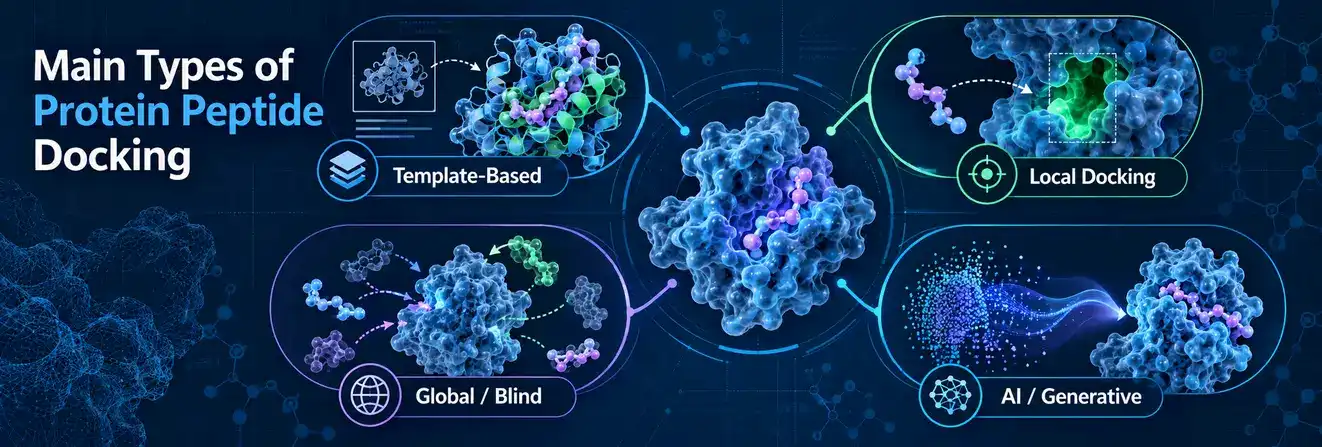
Template-based methods use structural information from previously characterised protein–peptide complexes. Related receptors or interaction motifs can guide modelling. This is efficient when comparable reference structures exist, but less dependable for completely novel arrangements.
Local Peptide Docking
Local docking focuses on a predefined receptor region, allowing more computational effort for peptide conformations and interface refinement. Its limitation is dependence on correct starting site information: an incorrect region can exclude the true binding site.
Global or Blind Peptide Docking
Global peptide docking can identify potential binding sites without predefined receptor locations. Hierarchical searches, simplified representations and conformational ensembles help manage cost. The wider search creates more competing predictions and increases the importance of careful ranking.
AI-Based and Generative Docking
Machine-learning methods predict sites, generate complexes or rank poses using learned patterns from structural data. Diffusion-based models offer generative sampling, but model reliability depends on dataset coverage, training and applicability to the system.
| Approach | Site Knowledge | Main Advantage | Main Limitation |
| Template-based | Related structures | Uses known interaction patterns | Suitable templates needed |
| Local | Usually required | Focused sampling | May miss unknown sites |
| Global/blind | Not required | Explores entire receptor | Large search space |
| AI/generative | Method-dependent | Learned sampling or ranking | Training coverage and assumptions |
Peptide Docking Software and Computational Tools

Different peptide docking software packages use different strategies. Selection should reflect peptide chemistry, receptor information, computational resources and the structural question being investigated.
Explore research peptides in our shop.
Flexible and Local Docking Tools
Rosetta FlexPepDock supports high-resolution protein–peptide refinement with peptide flexibility and receptor side-chain adjustments, particularly when approximate peptide placement is available. HADDOCK uses information-driven modelling; known or hypothesised interface restraints can guide sampling and refinement, including ensembles of peptide conformations.
Global and Blind Docking Tools
CABS-dock explores flexible peptides using coarse-grained representations followed by rebuilding and refinement. HPEPDOCK applies hierarchical docking using multiple peptide conformations. MDockPeP combines conformer generation, global searches and specialised scoring. PIPER-FlexPepDock combines global pose generation with high-resolution refinement.
Template-Based Docking Software
GalaxyPepDock uses interaction similarity and known structural patterns to model protein–peptide complexes. Its effectiveness depends on the availability and relevance of existing structural templates.
Peptide-Specific Docking Engines
AutoDock CrankPep uses peptide-oriented conformational sampling and can accommodate certain cyclic peptide structures. Researchers must confirm support for the precise chemical modifications and structural constraints present in their system.
AI and Diffusion-Based Docking Software
RAPiDock and DiffPepDock use diffusion modelling to generate possible protein–peptide arrangements. AlphaFold-based approaches can also predict protein–peptide complex structures, although their reliability varies with peptide characteristics, available structural information and the modelling protocol used.
| Software | Approach | Typical Application | Consideration |
| Rosetta FlexPepDock | Flexible local refinement | Approximate binding poses | Requires an approximate initial binding pose |
| HADDOCK | Information-driven | Known interface constraints | Reliability of the supplied interface restraints |
| CABS-dock | Coarse-grained flexible | Blind docking | May require additional all-atom refinement |
| HPEPDOCK | Hierarchical global | Unknown binding sites | Accuracy depends on peptide conformational sampling |
| MDockPeP | Global and scoring | Global protein–peptide docking | Long peptides challenging |
| GalaxyPepDock | Template-based | Related known complexes | Template availability |
| AutoDock CrankPep | Peptide-specific sampling | Flexible peptide docking | Chemistry support varies |
| RAPiDock | Diffusion | Candidate pose generation | Model applicability |
| DiffPepDock | Diffusion | Pose prediction | Generalisation |
No program is consistently best across every peptide length or receptor. Comparisons are most meaningful when assessed under equivalent input and benchmark conditions.
Understanding Protein Peptide Interactions in Docking Models
A predicted binding pose describes how a peptide may contact a receptor. Research compounds within the GLP-1 peptide category provide examples of peptides investigated for their interactions with specific protein receptors. Interpretation requires chemical plausibility rather than merely visual fit.
Shape Complementarity
Shape complementarity indicates whether molecular surfaces fit. Peptides may occupy grooves or interact with flatter interfaces. A good fit is useful but insufficient without favourable chemistry and an appropriate solvent environment.
Hydrogen Bonding and Electrostatic Interactions
Hydrogen bonds involve suitable donor and acceptor groups on side chains or backbones. Electrostatics reflect the distribution of molecular charges. Their effects depend on geometry, protonation and solvent; simply counting hydrogen bonds does not determine correctness.
Hydrophobic Contacts and Binding Interfaces
Nonpolar side chains may contribute through hydrophobic packing. Combined with charged interactions and hydrogen bonds, these contacts describe a predicted interface and which residues may participate in recognition.
Predicted Binding Does Not Prove Biological Activity
A plausible complex does not demonstrate experimental binding. Docking approximates interactions under modelling assumptions and cannot independently establish affinity, specificity, biological activity or function. Each pose remains a research hypothesis.
How Are Peptide Docking Results Scored?
Docking Scoring Functions
Scoring functions assign values to candidate complexes using steric contacts, molecular attraction and repulsion, hydrogen bonds, electrostatics, hydrophobicity, solvation or strain. Physics-based, empirical and knowledge-based strategies overlap in many tools. Scores use different conventions and are not directly comparable across programs.
Docking Scores vs Binding Affinity
Docking scores provide a computational basis for ranking predicted binding poses, but they cannot independently quantify experimental binding affinity. Their accuracy is limited by approximations involving entropy, solvent rearrangement, conformational changes and receptor flexibility.
Pose Clustering
Clustering groups structurally similar poses. Repeatedly sampled arrangements can help locate promising interfaces, but large clusters can also reflect sampling bias and do not guarantee a native-like pose.
Refinement and Re-Ranking
Fast initial scoring may be followed by expensive molecular refinement or learned re-ranking. A pose that ranks first initially may not remain highest after these later analyses.
How Is Peptide Docking Accuracy Evaluated?
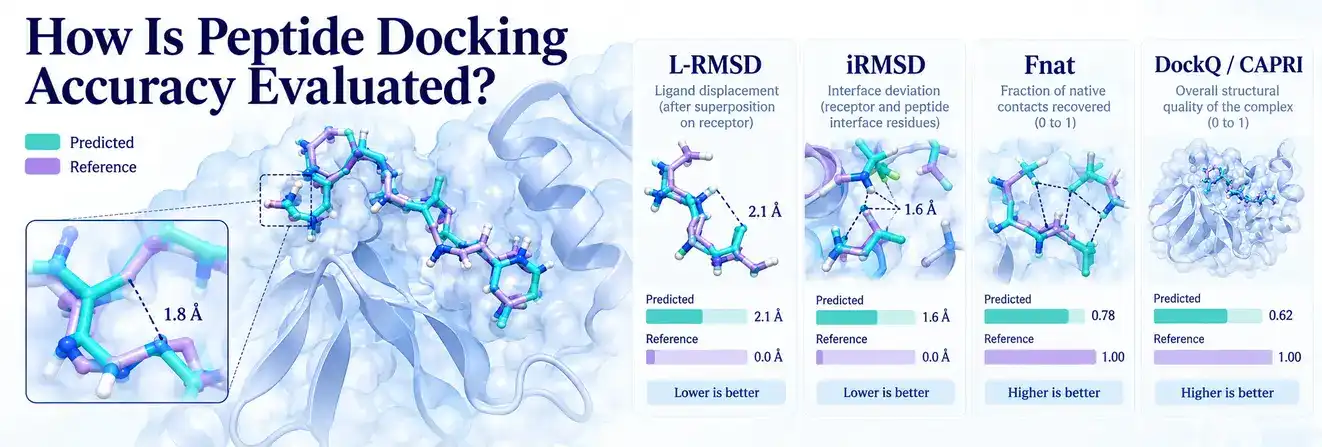
Accuracy can be quantified against a reliable experimentally determined reference complex. When no reference exists, plausibility and consistency can be assessed but actual native-pose accuracy cannot be established directly.
Ligand Root Mean Square Deviation
Ligand RMSD (L-RMSD) measures the difference between predicted and reference peptide positions after receptor alignment. Lower L-RMSD values generally indicate closer agreement with the reference structure, although peptide length, atom selection and structural alignment methods can influence the results.
Interface Root Mean Square Deviation
Interface RMSD (iRMSD) measures structural differences in the protein–peptide interface between a predicted complex and an experimentally determined reference structure. It can reveal local errors even where overall binding orientation appears similar.
Fraction of Native Contacts
Fnat measures the fraction of native protein–peptide interface contacts reproduced by a predicted docking model, with values ranging from zero to one. Higher values mean more reference contacts were recovered, although the definition of a contact matters.
DockQ and CAPRI Assessment
The DockQ quality measure combines ligand RMSD, interface RMSD and Fnat to assess docking accuracy. CAPRI uses structural criteria to group docking predictions into quality classes. These measures evaluate geometry relative to a reference, not biological activity.
| Metric | Measures | Interpretation |
| L-RMSD | Ligand position difference | Lower usually better |
| iRMSD | Interface structural deviation | Lower usually better |
| Fnat | Fraction of native contacts | Higher usually better |
| DockQ | Combined geometric quality | Higher usually better |
| CAPRI | Model quality class | Reference-relative assessment |
Peptide Docking and Molecular Dynamics Simulation
Peptide docking and molecular dynamics address related but distinct questions. Docking proposes candidate complexes; molecular dynamics examines time-dependent behaviour under a molecular force-field model.
How Molecular Dynamics Differs From Docking
Molecular dynamics calculates structural trajectories over simulation time. It can describe changing backbone conformations, side-chain orientation and interface contacts. Its results depend on starting models, parameterisation, solvent representation and finite sampling.
How Molecular Dynamics Complements Peptide Docking
Molecular dynamics can help assess the structural stability of predicted peptide–protein complexes by tracking changes in molecular conformations and interface contacts over simulated time. Research involving molecular dynamics simulations can therefore examine structural behaviour beyond static docking predictions.
A Combined Computational Research Workflow
- Prepare peptide and receptor structures.
- Generate candidate binding poses.
- Rank and inspect predicted complexes.
- Select representative structures.
- Refine selected models.
- Simulate molecular motion under defined conditions.
- Analyse contacts, dynamics and structural variability.
Longer simulations cannot necessarily resolve incorrect docking or insufficient sampling; controls and force-field assumptions remain important.
Peptide Docking vs Molecular Dynamics
| Feature | Docking | Molecular Dynamics |
| Purpose | Generate and rank poses | Examine motion |
| Output | Complex structures | Time-dependent trajectories |
| Flexibility | Algorithm-dependent | Simulated motions |
| Time | Usually no explicit physical time | Explicit simulation time |
| Limitation | Sampling and ranking | Force fields and sampling |
How to Choose Peptide Docking Software
When the Binding Site Is Known
Local or information-guided methods allow focused refinement. Rosetta FlexPepDock and HADDOCK may be relevant depending on approximate pose availability and restraint quality.
When the Binding Site Is Unknown
Global methods such as CABS-dock, HPEPDOCK and MDockPeP can explore the receptor surface. The diversity of resulting poses requires careful ranking and validation.
When Similar Complex Structures Exist
Templates may efficiently guide modelling, but structural resemblance does not guarantee the same interaction mode for a new peptide.
When Peptide Flexibility Is a Major Concern
Choose tools that adequately sample backbone and side-chain conformations. Performance on short constrained peptides may not transfer to long disordered chains.
When Comparing Multiple Peptide Sequences
Computational throughput matters for large sets of variants. Faster screening can precede higher-resolution analysis, provided preparation and ranking are consistent.
Research peptides such as Mazdutide can serve as examples for examining how sequence variations may influence receptor recognition and predicted binding interactions.
When Working With Cyclic or Modified Peptides
Confirm support for chemical bonds, non-standard residues, stereochemistry and conformational constraints.
These structural features are also important in peptide synthesis, where amino acid sequences and chemical modifications determine the resulting molecular structure. Unsupported chemistry can invalidate docking results.
Common Limitations of Peptide Docking
Incomplete Conformational Sampling
Even extensive conformational sampling may fail to identify the experimentally observed binding pose. This limits confidence in docking predictions, particularly when relevant peptide conformations are underrepresented.
Simplified Receptor Models
Rigid or partly flexible receptors may overlook loop or backbone changes needed for binding. Ensembles of receptor conformations can explore variability at greater computational cost.
Scoring Function Uncertainty
Simplified solvation, electrostatics or strain treatments may favour incorrect poses. Agreement between scoring approaches is useful but not definitive.
Limited Representation of Complex Peptides
Long, disordered or modified peptides are difficult to sample and may be poorly represented in machine-learning training data.
Confidence Does Not Equal Experimental Validation
Model confidence reflects algorithm-derived estimates, not direct experimental evidence. High-confidence predictions can still be wrong outside the model’s appropriate domain.
How Artificial Intelligence Is Changing Peptide Docking
Predicting Peptide-Binding Sites
Learned models can prioritise receptor regions before docking. Site prediction alone does not yield a validated three-dimensional complex.
Improving Docking Pose Ranking
Graph-based and other learning approaches analyse interfacial contact patterns to distinguish better structural candidates from docking decoys.
AlphaFold-Based Complex Modelling
Adapted structure-prediction systems can model protein–peptide complexes, but limited evolutionary signals, peptide flexibility and sequence length can affect accuracy. Their outputs still need structural assessment.
Harnessing Protein Folding Neural Networks for Protein-Peptide Docking: What Have We Learned?
Diffusion-Based Peptide Docking
Diffusion methods iteratively generate poses under learned geometric and physical constraints. RAPiDock and DiffPepDock demonstrate this class, with performance dependent on evaluation datasets and applicability to novel targets.
The Importance of Physical Modelling
Learned patterns cannot replace all molecular physical considerations. Electrostatics, solvation, entropy and geometry remain essential for interpreting interfaces and improving predictions.
Best Practices for Interpreting Peptide Docking Results
- Examine multiple poses rather than one top-ranked model.
- Inspect interface geometry and steric compatibility.
- Check whether conformational sampling represents peptide flexibility.
- Review receptor flexibility and structural assumptions.
- Avoid interpreting docking scores as measured binding affinities.
- Use reference-based quality metrics when experimental complexes exist.
- Compare independent modelling methods where useful.
- Consider molecular dynamics for studying structural motion.
- Record input structures, settings and software versions for reproducibility.
- Distinguish computational predictions from experimentally established findings.
Consistent preparation, transparent reporting and careful evaluation make docking conclusions easier to reproduce and compare.
The Role of Peptide Docking in Structural Research
Peptide docking provides a computational framework for investigating how peptides may interact with protein structures. By generating possible binding poses and evaluating molecular contacts, it helps researchers explore protein–peptide recognition at the structural level.
The reliability of these predictions depends on peptide flexibility, receptor preparation, conformational sampling, scoring methods and structural validation. Classical docking, molecular dynamics and newer AI-based approaches offer complementary ways to investigate these challenges.
No single computational method can fully describe every protein–peptide interaction. Combining appropriate modelling techniques with critical interpretation and independent validation provides a stronger foundation for research into peptide molecular structures and interactions.
FAQs About Peptide Docking
What Is the Docking Process?
Molecular docking begins with preparing the protein and peptide structures. Software then explores possible binding orientations and conformations, evaluates molecular contacts and ranks the resulting complexes. Selected models may undergo further refinement to assess their structural plausibility.
What Does Blind Docking Mean?
Blind docking predicts potential binding locations without specifying where a peptide should attach to a protein. The software examines different regions of the receptor surface, making this approach useful when existing structural information does not identify a binding site.
What Are the Different Types of Docking?
Peptide docking methods include local, global and template-based approaches. Local docking focuses on a known binding region, global docking explores the receptor surface, and template-based methods use previously characterised molecular structures. Each approach offers different advantages depending on the available structural information.
How to Prepare a Protein for Docking?
Protein preparation starts with obtaining a suitable three-dimensional structure and examining its completeness. Missing atoms, hydrogen placement, protonation states and relevant water molecules require careful consideration. The structure is then prepared according to the input requirements of the chosen docking program.
What Is Docking in Biology?
In computational biology, docking predicts how two molecular structures might associate in three-dimensional space. For peptide–protein systems, it helps identify possible interaction surfaces, examine residue contacts and investigate the structural arrangements involved in molecular recognition.