Glow Blend peptide is a multi-peptide research formulation combining BPC-157, TB-500 and GHK-Cu to investigate overlapping cellular, tissue-remodelling and skin-related pathways.
Each component has a distinct mechanism and evidence base, so findings on one peptide cannot be treated as evidence for the complete blend.
Australia Peptide Sciences lists its formulation as BPC-157 10 mg, TB-500 10 mg, and GHK-Cu 50 mg, supplied as a lyophilised 70 mg blend for laboratory research only.
Interpretation of the blend depends on its composition, experimental model, evidence level, and Australian regulatory context.
What Is Glow Blend peptide?
The term refers to a multi peptide blend research formulation built around BPC-157, TB-500, and GHK-Cu.
Rather than being a single molecule, Glow Blend peptide combines three distinct research compounds to study overlapping biological pathways, including those examined in broader peptides for skin research.
Key research areas include:
- fibroblast behaviour and extracellular matrix activity;
- cell migration and wound-response models;
- collagen-related signalling;
- angiogenesis and vascular-response pathways;
- inflammatory and oxidative-stress markers;
- skin and connective-tissue research;
- interactions between repair-related pathways.
- Browse the APS peptide shopto compare research-only compounds and product specifications.
For a concise overview of BPC-157 and TB-500, including the limitations of the current evidence for combining them, watch:
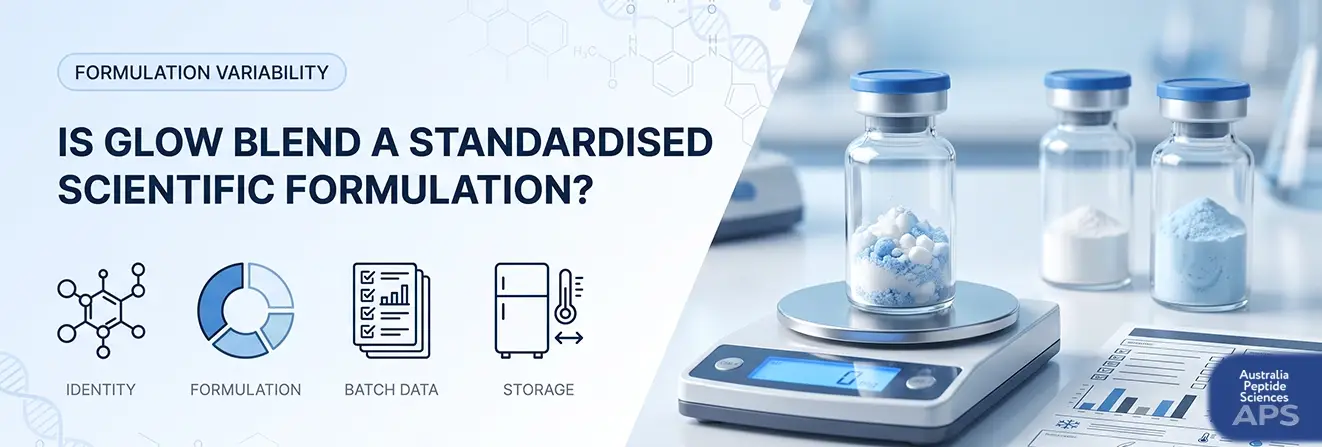
Is Glow Blend a Standardised Scientific Formulation?
No. Glow Blend is not a universally standardised scientific formulation, and its composition may vary between research products.
Differences in peptide amounts or ratios can affect experimental conditions, so findings from one formulation should not automatically be applied to another.
Investigators should document:
- peptide identity;
- amount of each component;
- total blend content;
- batch number;
- purity data;
- storage conditions;
- relevant reconstitution and experimental conditions.
What Is in the BPC-157 TB-500 GHK-Cu Blend?
The BPC-157 TB-500 GHK-Cu blend combines three research peptides with different but overlapping areas of study, including tissue repair, cell migration, and broader collagen research.
| Component | APS formulation | Main research themes | Evidence limitation |
| BPC-157 | 10 mg | Fibroblast migration, vascular responses, tendon and tissue models | Evidence is dominated by preclinical studies |
| TB-500 | 10 mg | Actin-related processes, cell migration, repair models | TB-500 should not be treated as identical to full-length thymosin β4 |
| GHK-Cu | 50 mg | Copper binding, collagen synthesis, fibroblast biology, matrix remodelling | Mechanistic and skin-related evidence does not establish blend-level outcomes. |
Research Profile of the Glow Blend Components
Each component has a different research profile and evidence base.
Evidence differs substantially across the three components, particularly between preclinical and human research.
1. BPC-157
BPC-157 research has focused on:
- tissue repair
- tendon response
- vascular signalling
- cell migration.
These areas also place BPC-157 within broader recovery peptide research, particularly in experimental models of tissue and cellular responses.
Most published BPC-157 findings come from animal or laboratory studies, while robust human clinical evidence remains limited.
2. TB-500 and Thymosin β4-Related Research
TB-500 requires careful terminology. It is often discussed alongside thymosin β4, but the two should not be treated as interchangeable.
Published analytical research has described TB-500 as containing a synthetic version of the LKKTETQ peptide sequence. This sequence corresponds to an active region within thymosin β4 associated with actin binding, cell migration, and wound-healing biology.
Full-length thymosin β4 is a 43-amino-acid peptide with broader biological functions. Research on thymosin β4 has investigated:
- actin sequestration and cytoskeletal dynamics;
- endothelial-cell migration;
- angiogenesis;
- stem and progenitor-cell mobilisation;
- wound-response processes;
- fibrosis and tissue remodelling.
Evidence from full-length thymosin β4 can support hypothesis generation, but it does not establish identical effects for TB-500.
3. GHK-Cu
GHK-Cu is the copper(II) complex of the tripeptide glycyl-L-histidyl-L-lysine.
Laboratory research has focused particularly on:
- fibroblast activity;
- collagen synthesis;
- extracellular matrix regulation;
- tissue-remodelling processes.
Early research linked GHK-Cu to increased collagen synthesis and other connective tissue mechanisms.
This makes it relevant to skin repair peptide blend research, although laboratory findings do not establish cosmetic or therapeutic outcomes in humans.
Learn more about Australia Peptide Sciences and our approach to sourcing peptides.
For an independent dermatologist’s overview of GHK-Cu, including its skin-related research and the limitations of current human evidence, watch this video:
Why Study a Peptide Blend for Research?
A single-peptide study is easier to interpret, while a peptide blend for research allows researchers to examine interactions between multiple biological pathways.
Because tissue repair can involve inflammatory signalling, cell migration, vascular responses, and extracellular matrix remodelling, a blend may help researchers investigate:
- whether components affect different stages of the same process;
- whether combined effects are additive, neutral or antagonistic;
- whether changing the peptide ratio alters the measured response.
Testing these variables can distinguish additive effects from neutral or antagonistic interactions.
In multi peptide blend research, appropriate controls are needed to determine whether observed effects come from individual components or from the combination itself.
How Could the Components Intersect in Tissue Repair Research?
The rationale behind tissue repair blend research comes from the fact that the three components are associated with overlapping processes involved in tissue repair and remodelling.
1. Inflammatory Signalling
Researchers may examine cytokines, chemokines, and oxidative-stress markers to determine whether the components influence inflammatory responses during repair.
The significance of these changes depends on the experimental model, timing, and biological context.
2. Cell Migration and Vascular Responses
BPC-157 has been studied in fibroblast migration and angiogenesis-related models, while thymosin β4 research has examined endothelial-cell migration and vascular processes.
These pathways may provide a basis for studying how multiple components interact during tissue repair.
3. Fibroblasts and Extracellular-Matrix Remodelling
Fibroblasts produce and organise collagen, elastin and other extracellular matrix components.
GHK-Cu has been studied for effects on collagen synthesis and matrix-associated signalling, making this pathway particularly relevant to tissue-remodelling research.
4. Re-Epithelialisation and Wound Models
Skin models may measure:
- keratinocyte migration;
- fibroblast response;
- barrier restoration;
- extracellular matrix organisation;
- wound closure.
These endpoints can be studied using cell cultures, co-cultures, 3D skin models, or animal models.
For additional context on age-related changes in skin biology, see the research on peptides for aging skin
5. Skin and Collagen Research Applications
GHK-Cu is particularly relevant to skin-focused research because of its established mechanistic literature involving dermal fibroblasts and extracellular matrix biology.
Common laboratory endpoints include:
- fibroblast viability and proliferation;
- collagen expression;
- elastin-related markers;
- glycosaminoglycan production;
- matrix metalloproteinase activity;
- oxidative stress and inflammatory markers.
GHK-Cu has been reported to stimulate collagen synthesis in cultured fibroblasts. However, these laboratory findings do not by themselves establish cosmetic or therapeutic outcomes in humans.
Conclusions about a skin repair peptide blend depend on the endpoint measured, and these laboratory findings do not establish human skin benefits.
What does research on Glow Blend peptides show?
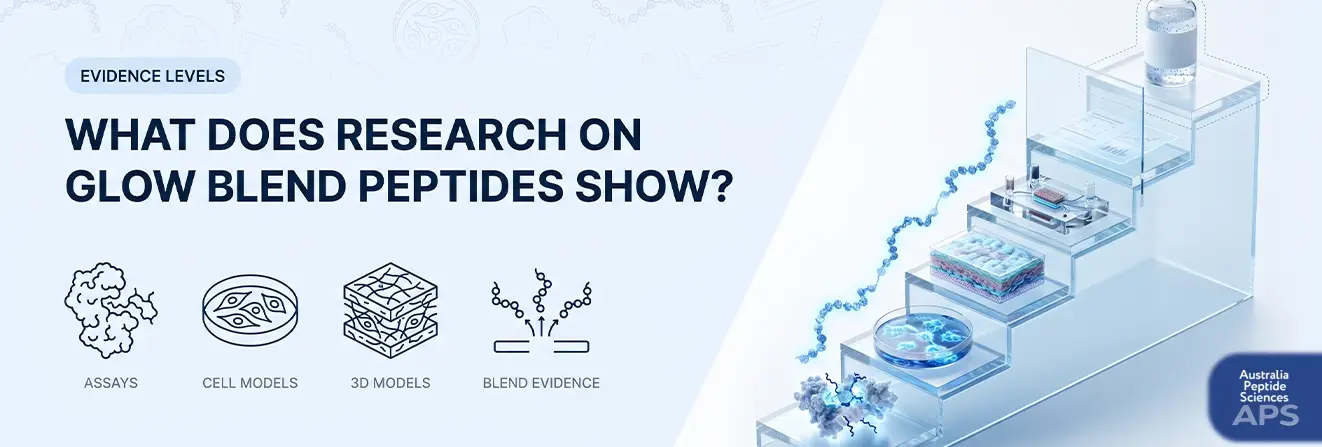
The evidence is uneven because the three components have different research histories, while direct studies of the complete blend remain limited.
The strongest way to interpret Glow Blend peptide research is to separate the evidence by level:
| Evidence level | What it can show | Main limitation |
| Biochemical assays | Binding, stability and molecular interactions | Cannot establish tissue outcomes |
| Cell culture | Viability, migration and signalling | Does not reproduce whole-tissue biology |
| 3D or co-culture models | Cell interactions and tissue architecture | Lacks full systemic physiology |
| Animal studies | Integrated tissue responses | Findings may not translate to humans |
| Human studies of individual compounds | Human-specific observations | Evidence remains limited or uneven |
| Controlled studies of the complete blend | Blend-specific effects | Direct evidence remains insufficient |
Component Evidence Is Not Blend Evidence
If BPC-157 affects tendon models, GHK-Cu increases collagen synthesis in fibroblasts, and thymosin β4 influences endothelial migration, this does not prove that combining BPC-157, TB-500, and GHK-Cu will produce the same effects together.
A combination study may show:
- one component dominating the response;
- additive or neutral effects;
- interference between components;
- changes depending on concentration or timing.
Blend-specific effects therefore require controlled studies of the complete formulation.
How Are Multi-Peptide Blend Effects Evaluated?
Controlled blend studies typically compare each component with the complete formulation.
| Comparison group | Purpose |
| Untreated control | Establishes the baseline response |
| Vehicle control | Identifies any effect caused by the experimental vehicle |
| BPC-157 alone | Measures BPC-157-specific effects |
| TB-500 alone | Measures TB-500-specific effects |
| GHK-Cu alone | Measures GHK-Cu-specific effects |
| Complete blend | Evaluates the combined response |
Pairwise combinations may also be included when researchers need to determine whether two components interact before evaluating the full three-peptide formulation.
Glow Blend Australia: Research and Regulatory Context
The term Glow Blend Australia may be used by researchers looking for locally available research materials, but product availability does not mean therapeutic approval.
For Glow Blend peptide in Australia, materials supplied for laboratory research should not be interpreted as approved medicines. The TGA has identified unapproved products containing BPC-157, GHK-Cu and TB-500 among peptide products of regulatory concern.
Clear separation between laboratory research and human or veterinary use remains essential for suppliers and laboratories.
Explore Glow Blend for Research
Researchers looking for a documented Glow Blend research compound can review the current Australia Peptide Sciences formulation, including its BPC-157, TB-500 and GHK-Cu composition, batch details and available Certificate of Analysis.
The product is supplied strictly for laboratory research and analytical purposes, with clear specifications to support informed material selection and experimental planning.
View Glow Blend Peptide for Research
Research Perspective on Glow Blend Peptide
Glow Blend peptide brings together three research compounds with distinct but potentially overlapping biological pathways. Current evidence is strongest at the individual-component and preclinical levels, while direct evidence for the complete blend remains limited.
Reliable interpretation requires separate assessment of each component and controlled testing of the complete blend.
FAQs About Glow Blend peptide
What does Glow Blend peptide do?
It combines BPC-157, TB-500, and GHK-Cu for research into tissue repair, cell migration, collagen signalling, and extracellular matrix pathways, but blend-specific human effects are not established.
Do glow peptides really work?
There is not enough controlled human evidence to establish the effectiveness of the complete Glow blend, as most evidence relates to individual components or preclinical models.
Is GHK-Cu worth the hype?
GHK-Cu has credible research involving collagen, fibroblasts, and tissue remodelling, but this evidence does not validate every cosmetic or therapeutic claim made about it.
Is there any downside to GHK-Cu?
A major limitation is that evidence varies by formulation and route of exposure, while unapproved GHK-Cu therapeutic products have not been evaluated by the TGA for safety, quality, or effectiveness.
Is there a downside to using peptides?
Research peptides can have limited human safety and efficacy data, and findings from laboratory or animal studies may not translate directly to humans.
What are the differences between GHK-Cu and glow peptide?
GHK-Cu is a single copper-binding tripeptide, while Glow is a multi-peptide blend that typically combines GHK-Cu with BPC-157 and TB-500.
Is Glow the best peptide for skin?
No research currently establishes Glow as the best peptide for skin, although GHK-Cu has been studied extensively for fibroblast, collagen, and extracellular matrix activity.
Is Glow peptide for hair growth?
The complete Glow blend is not established for hair growth. Copper peptides have been investigated in hair-follicle models, but evidence specific to GHK-Cu and especially to the complete Glow formulation remains limited.
What is Glow 70 mg peptide?
In the current Australia Peptide Sciences formulation, Glow 70 mg contains 10 mg BPC-157, 10 mg TB-500 and 50 mg GHK-Cu, for a total labelled content of 70 mg.
Why do people take glow peptides?
Glow peptides are promoted for skin, collagen, and tissue-repair purposes, but these claimed human benefits go beyond what controlled research on the complete blend has established.
Reference
OECD guidance on in vitro research materials
BPC-157 tendon fibroblast study