
GLP-1 peptide research examines how glucagon-like peptide-1 and related compounds behave in receptor assays, cell systems, isolated tissues and whole-organism models. It covers native GLP-1, modified analogues, receptor agonists, antagonists, labelled probes and multi-receptor compounds.
These materials are not interchangeable. A response produced by native GLP-1 in a short cell assay may differ substantially from the response to a stabilised analogue during prolonged exposure.
Multi-receptor compounds require additional controls because activity at GIPR or GCGR can contribute to the observed response. Mazdutide, for example, activates GLP-1R and GCGR, so receptor-selective controls are needed to separate the two pathways.
Reliable GLP-1 studies depend on a defined research question, a well-characterised compound, an appropriate model, measurable endpoints, suitable controls, and conclusions that remain within the experiment’s limits.
What Is GLP-1 peptide research?
GLP-1, or glucagon-like peptide-1, is a peptide hormone released mainly by intestinal L-cells after nutrient intake. GLP-1-producing neurons in the brainstem also contribute to feeding and metabolic regulation. Multi-receptor studies require additional controls because compounds such as tirzepatide peptide research activate both GLP-1R and GIPR; our tirzepatide research guide examines this design in more detail.
The main active forms are GLP-1(7-36) amide and GLP-1(7-37). Native GLP-1 has a short circulating life because dipeptidyl peptidase-4, commonly called DPP-4, rapidly cleaves it. This instability is relevant when selecting incubation times, sampling intervals, and handling conditions.
A GLP-1 research peptide may be a native sequence, metabolite, fragment, or engineered analogue used to study receptor pharmacology, stability, delivery, or biological response. A sound GLP-1 peptide research programme begins by identifying the exact material because sequence, formulation, and exposure can change the outcome.
| Research term | Practical laboratory meaning |
| Native GLP-1 | An active natural sequence, usually GLP-1(7-36) amide or GLP-1(7-37) |
| GLP-1 metabolite | A product of enzymatic processing, such as GLP-1(9-36) amide |
| GLP-1 analogue | A modified molecule designed to alter stability, exposure, or receptor activity |
| GLP-1R agonist | A compound that activates the GLP-1 receptor |
| GLP-1R antagonist | A compound used to test whether a response depends on GLP-1R |
| Multi-receptor agonist | A compound designed to activate GLP-1R alongside receptors such as GIPR or GCGR |
| Labelled probe | A fluorescent or radiolabelled ligand used to examine binding, localisation or trafficking |
Visit our Shop to browse the complete range of research peptides.
Framing a Laboratory Research Question
A broad question such as “What does GLP-1 do?” is not specific enough to guide an experiment. The study should define the compound, receptor or pathway, biological system, exposure window, and primary endpoint before data collection begins.
| Research question | Suitable starting model | Primary measurement | Essential control |
| Does the compound bind GLP-1R? | Membrane preparation or receptor-expressing cells | Binding affinity or occupancy | Unlabelled competitor and non-receptor control |
| Does binding activate the receptor? | GLP-1R-expressing cell line | cAMP concentration-response curve | Reference agonist and vehicle |
| Is the response GLP-1R-dependent? | Receptor-null cells or relevant tissue | Loss or blockade of response | Antagonist or genetic control |
| Does the ligand alter receptor trafficking? | Tagged-receptor cell system | Internalisation and recycling over time | Unlabelled ligand and reference agonist |
| Does the compound affect islet secretion? | Primary islets | Glucose-stimulated insulin or glucagon release | Matched glucose and vehicle conditions |
| Does exposure align with an in vivo effect? | Validated animal model | Pharmacokinetics linked to a predefined endpoint | Time-matched vehicle group |
This framework prevents a common error: using a convenient assay to answer a question that the assay cannot resolve. A cAMP result can establish pathway activation in that system, but it cannot determine tissue distribution, appetite response, or clinical effectiveness.
How GLP-1 Receptor Research Explains Peptide Signalling
GLP-1 receptor research focuses on GLP-1R, a class B G protein-coupled receptor. Ligand binding primarily activates Gαs, adenylyl cyclase, and cyclic adenosine monophosphate, or cAMP. In pancreatic beta cells, cAMP can engage protein kinase A and EPAC2, interacting with glucose-dependent electrical activity and intracellular calcium.
1. Binding, Potency and Efficacy Are Different Measures
Binding assays measure whether and how strongly a compound associates with a receptor. Functional assays evaluate what happens after binding. EC50 represents the concentration producing half-maximal activity in a selected assay, while Emax describes the largest response observed.
These values depend on receptor density, cell background, incubation time, detection method, and compound stability. A lower EC50 in an engineered cell line does not establish stronger activity in native tissue or a whole organism.
2. Signal Bias and Receptor Trafficking
Researchers may also measure β-arrestin recruitment, receptor phosphorylation, internalisation, recycling and degradation. Biased signalling is assessed by comparing pathways against a suitable reference ligand within the same experimental system.
Studies of GLP-1 receptor trafficking show that internalised receptors may continue signalling, return to the cell surface, or move towards degradation. Short cAMP assays therefore cannot fully predict responses during repeated or prolonged exposure.
3. Receptor Expression and Assay Background
Receptor-overexpressing cells offer sensitivity and consistency, but high receptor density can exaggerate weak agonism or alter apparent bias. Key findings should be repeated in a physiologically relevant cell type, primary preparation, or receptor-expression range that reflects the research question.
Receptor detection also requires validated tools. Antibody specificity, transcript abundance, and reporter expression should be confirmed rather than assumed, particularly in tissues where GLP-1R expression is low.
Major GLP-1 Pathways Studied in Research

GLP-1 pathways connect receptor activation with pancreatic, gastrointestinal, and neural responses. This page treats those pathways as experimental endpoints; a broader explanation of their metabolic roles is available in our guide to how GLP-1 peptides work in metabolic.
1. Pancreatic Islet Endpoints
Islet studies commonly measure glucose-stimulated insulin secretion, glucagon release, intracellular calcium, and beta-cell signalling. Glucose concentration must be controlled because GLP-1R activity interacts with the metabolic state of the preparation.
Human and animal islets may not respond identically. Donor age, metabolic status, isolation quality, culture time, and islet size should be recorded, while secretion results should be normalised using a justified measure such as islet number, DNA content, or total hormone content.
2. Gastric and Intestinal Endpoints
Intestinal cell lines and organoids can be used to measure nutrient-triggered GLP-1 secretion, epithelial responses, and transporter-related effects. Glucose, fatty acids, amino acids, bile acids, and neural mediators can be tested separately or in defined combinations.
Gastric-emptying studies require different methods, including tracer techniques, imaging, or validated meal protocols. The measurement window matters because short- and long-acting compounds may produce different response patterns during repeated exposure.
3. Neural and Autonomic Endpoints
Brain slices, electrophysiology, neural activity markers, and region-specific genetic approaches can connect receptor activity with defined circuits. Food intake alone is not sufficient to identify the responsible pathway because satiety, reward, locomotion, stress, and visceral discomfort can influence the same outcome.
Species differences and low receptor abundance complicate neural mapping. Strong studies combine validated receptor detection with pharmacological blockade, genetic manipulation, or functional confirmation.
GLP-1 and Appetite Research
GLP-1 and appetite research examines satiety, meal size, food-seeking behaviour and food reward as distinct laboratory outcomes. Dual GIP/GLP-1 agonists and selective GLP-1R agonists require different receptor controls; our GLP-1 vs GIP vs glucagon explains the relevant distinctions.
Animal studies may measure meal frequency, meal duration, preference, progressive-ratio responding, and neural activation. Reduced food intake should be interpreted alongside locomotor activity, conditioned taste aversion, or other measures that help distinguish altered appetite from non-specific behavioural suppression.
Human research may use fixed meals, ad libitum meals, appetite-rating scales, gastric-emptying measurements and functional imaging. Endogenous GLP-1 exposure should not be treated as equivalent to prolonged pharmacological receptor activation because the concentration profile, tissue access and duration differ.
GLP-1 and Metabolic Research
GLP-1 and metabolic research can measure glucose tolerance, insulin and glucagon secretion, hepatic glucose production, lipid handling, energy intake and body composition. To attribute a metabolic response to GLP-1R, pair these endpoints with receptor-specific controls and matched exposure data.
The endpoint must support the claim. Increased cAMP confirms signalling within a particular cell system, but it does not establish improved glucose tolerance, reduced food intake, or organ protection.
| Evidence level | What it can show | What it cannot establish alone |
| Receptor or cell assay | Binding, potency, efficacy and intracellular signalling | Whole-body exposure or clinical benefit |
| Isolated islet, tissue or organoid | Responses within a multicellular preparation | Integrated appetite or long-term metabolic effects |
| Animal model | Pharmacokinetics, tissue exposure and whole-body responses | An identical human response |
| Controlled human study | Effects in a defined population | Universal effectiveness or long-term safety |
| Clinical outcome trial | Longer-term outcomes under a specified protocol | Effects of a different, untested compound |
Cardiovascular, renal or liver markers need particular care. An organ-level change may arise indirectly through lower energy intake, altered glucose exposure, body-mass change or inflammation. Direct activity within the organ should be demonstrated before it is included in a mechanistic conclusion.
How GLP-1 Research Compounds Differ
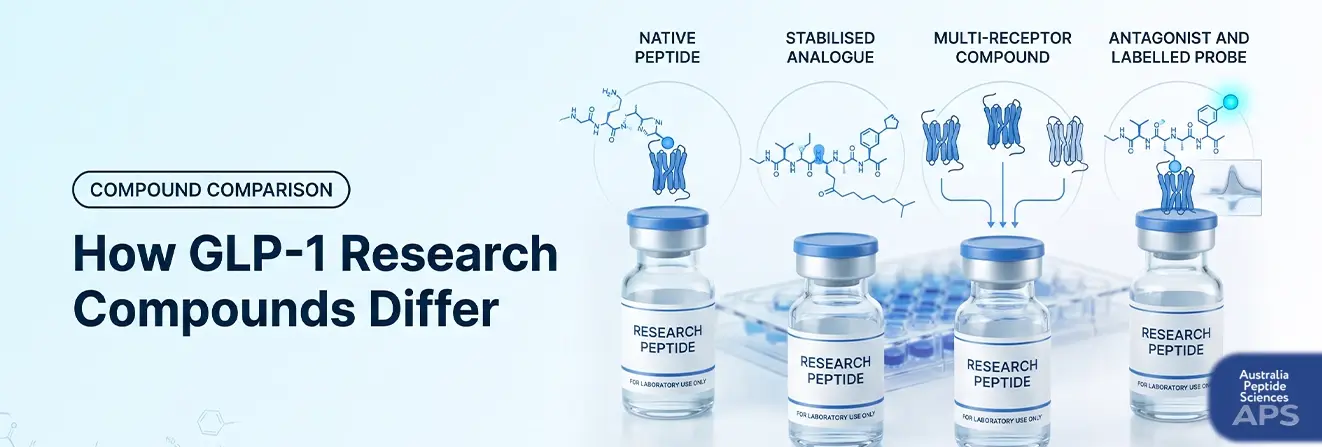
GLP-1 research compounds include native peptides, metabolites, stabilised analogues, receptor agonists, antagonists and labelled probes. Their structural and pharmacological differences determine which questions they can answer. They should also be distinguished from peptides investigated through other metabolic mechanisms; for example, the AOD-9604 research peptide covers a growth hormone-derived fragment rather than an incretin receptor agonist.
1. Native Peptides, Fragments and Metabolites
Native GLP-1 supports short-duration studies of receptor activation and enzymatic degradation. Metabolites such as GLP-1(9-36) amide and sequence fragments should be assessed separately because they may not reproduce the activity of the full peptide.
2. Stabilised Analogues and Single-Receptor Agonists
Amino-acid substitutions, fatty-acid chains and albumin-binding strategies can extend exposure while affecting stability, receptor kinetics and tissue distribution. In GLP-1 receptor agonist pharmacology, semaglutide and liraglutide are classified as modified GLP-1 analogues, whereas exenatide is derived from exendin-4, giving each compound a distinct pharmacological profile.
3. Dual- and Triple-Receptor Compounds
Tirzepatide activates GIPR and GLP-1R, while investigational retatrutide targets GIPR, GLP-1R, and the glucagon receptor. Research into dual GIP and GLP-1 receptor activity shows why multi-receptor compounds require selective agonists, antagonists, receptor-null cells, or genetically modified models.
4. Antagonists, Tracers and Labelled Probes
Exendin (9-39) is commonly used to test GLP-1R dependence. Fluorescent and radiolabelled ligands support binding, localisation and internalisation studies, but labelling may change affinity, kinetics or trafficking. The modified probe should be compared with the unlabelled compound before mechanistic conclusions are drawn.
Visit Australia Peptide Science for Research Peptides
What Methods and Experimental Models Are Used in GLP-1 peptide research?
GLP-1 laboratory research combines biochemical assays, cell models, isolated tissues, and whole-organism studies. Each method addresses a different part of receptor pharmacology, compound exposure, or biological response.
1. In Vitro Receptor and Signalling Assays
Common measurements include:
- Competitive or saturation binding assays for receptor affinity.
- Concentration-response experiments for potency and maximum response.
- cAMP assays for canonical G protein signalling.
- Calcium-flux assays where calcium-linked responses are relevant.
- β-arrestin recruitment assays, including BRET- or enzyme-based systems.
- Microscopy or tagged-receptor methods for internalisation and recycling.
- Reporter-gene assays for downstream transcriptional activity.
- Cell-viability and cytotoxicity tests to separate signalling from cellular damage.
A single concentration should not replace a full response curve when potency or efficacy is the question. Assay windows should also be tested so that transient signals are not compared directly with accumulated endpoints without suitable interpretation.
2. Islets, Tissues and Organoids
Isolated pancreatic islets preserve multicellular communication relevant to insulin and glucagon secretion. Intestinal organoids can model hormone release and local epithelial responses, while brain slices and tissue explants can connect receptor activity with local function.
These models retain more biological context than a single cell line but lack complete circulation, metabolism, and communication between distant organs. Tissue quality, donor characteristics, species, culture conditions, and time ex vivo should be documented.
3. Animal and Translational Models
Animal studies may assess food intake, glucose tolerance, gastric emptying, body composition, energy expenditure, and tissue biomarkers. Pharmacokinetic sampling should establish whether measurable exposure aligns with the timing of the biological endpoint.
Receptor-knockout animals, tissue-specific deletions, and antagonist controls can test receptor dependence, but compensation may complicate interpretation. A lifelong knockout is not equivalent to short-term pharmacological blockade.
Human studies offer stronger translational evidence, yet participant selection, comparators, treatment duration, missing data, and predefined outcomes still affect reliability. Evidence for one characterised medicine cannot be transferred automatically to an unapproved compound with a similar name.
How Can Researchers Build a Reproducible GLP-1 Laboratory Workflow?
Documenting these elements creates a traceable link between the hypothesis, experimental conditions, and conclusion, making failed replication easier to investigate.
- Define the mechanism being tested.State the receptor, pathway, cell type, and expected direction of response.
- Confirm the material.Record sequence, salt or counter-ion, batch, formulation, reconstitution conditions, and available analytical documentation.
- Select the model.Match receptor expression and biological complexity to the question rather than defaulting to the most convenient system.
- Set the exposure design.Justify concentration range, incubation time, vehicle, and sampling schedule.
- Choose primary and secondary endpoints.Identify the main outcome before the experiment and separate it from exploratory measurements.
- Build receptor-specific controls.Include a reference agonist, antagonist, or genetic control where receptor dependence is central.
- Plan replication and analysis.Define biological replicates, technical repeats, exclusions, normalisation, and statistical methods in advance.
This sequence creates a traceable link between the original hypothesis and the conclusion. It also makes failed replication easier to investigate because compound, model, and assay variables have been documented.
Essential Controls for GLP-1 Receptor and Signalling Assays
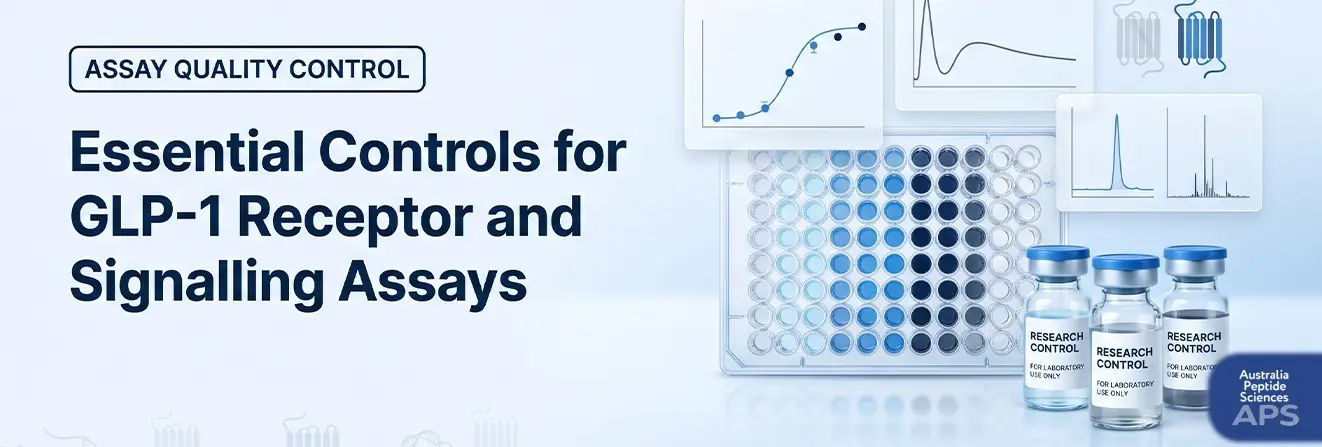
Reliable GLP-1 experiments require controls that distinguish receptor activity from artefacts. Depending on the question, designs should include:
- A vehicle or untreated control.
- An appropriate reference agonist.
- An antagonist, receptor-null cell or genetic control.
- A full concentration-response curve.
- Time-course measurements for transient and sustained responses.
- Independent biological replicates.
- Randomisation and blinded assessment for animal studies.
- Prespecified exclusions and statistical methods.
Batch-specific documentation should distinguish compound identity from chromatographic purity and identify any additional quality attributes relevant to the experiment.
Researchers can review the available GLP-1 research collection when comparing compounds against the analytical and documentation requirements of their study.
Confirming GLP-1R Activity with Positive, Negative and Orthogonal Controls
A positive control confirms that the assay can detect a known response. A negative control estimates background or non-specific activity, while an orthogonal method tests the same biological claim through a different measurement principle.
For example, receptor activation measured by cAMP may be supported by a second functional assay or receptor-dependence experiment. Agreement across methods is more informative than repeating the same assay under identical conditions.
Testing GLP-1 Peptide Identity, Purity and Stability
Purity and identity answer different questions. Chromatographic purity estimates the proportion of detected material associated with the main peak under selected conditions, while mass spectrometry supports molecular identity. Neither measurement confirms biological potency without a functional assay.
Peptides may undergo oxidation, deamidation, aggregation, adsorption to surfaces, or repeated freeze-thaw damage. Storage temperature, light exposure, container material, solvent, concentration, and time after preparation can therefore affect reproducibility.
Sample handling should be standardised across groups. Researchers should use validated stability information where available, prepare aliquots when appropriate, and record deviations that could affect exposure.
Improving Data Quality and Reproducibility in GLP-1 Assays
Technical repeats estimate measurement precision within an experiment; biological replicates test whether the finding persists across independent samples or experimental runs. Treating technical wells as independent biological observations can overstate certainty.
Normalisation should be selected before analysis and justified for the model. Possible denominators include cell number, viable-cell count, protein content, DNA content, tissue mass or total hormone content. A denominator affected by the compound can introduce a new bias.
Plate position, reagent lot, operator, instrument settings and culture passage may also create batch effects. Randomised layouts, consistent calibration and inclusion of reference controls across batches make these effects easier to detect.
Minimum reporting should include:
- Compound identity, batch and preparation method.
- Model source, receptor background and culture conditions.
- Concentration range and exposure duration.
- Number and type of replicates.
- Raw or appropriately normalised response data.
- Statistical model, exclusions and missing observations.
- Both positive and negative results relevant to the stated hypothesis.
How Should GLP-1 Binding, Signalling and Metabolic Data Be Interpreted?
Interpretation should begin with the model and finish with the narrowest conclusion supported by the data. Check:
- Whether the material was native GLP-1, an analogue, or a multi-receptor compound.
- Whether the model used engineered cells, primary tissue, animals, or humans.
- Whether identity, purity, concentration, and stability were adequately characterised.
- Whether receptor involvement was demonstrated rather than inferred.
- Whether potency and maximum response were reported separately.
- Whether exposure matched the concentration and duration used in the assay.
- Whether relevant biological variables and negative findings were reported.
- Whether the result was independently replicated.
Rodent findings cannot be transferred directly to humans because receptor distribution, metabolism and neural organisation may differ. Reduced food intake should not be interpreted as increased energy expenditure because these are separate outcomes requiring separate measurements.
What Are the Current and Emerging Directions in GLP-1 Research?

1. More Precise Receptor Signalling
Researchers are testing whether signalling bias, binding kinetics, and receptor trafficking can be tuned to produce more consistent responses. This requires several pathway measurements across time rather than a single cAMP endpoint.
2. Multi-Receptor Biology
Retatrutide is an investigational triple-receptor compound designed to activate GIPR, GLP-1R, and GCGR. Research involving this compound should use receptor-specific controls to separate individual pathway contributions from responses produced by combined receptor activity.
3. Targeted Molecular Delivery
Peptide conjugates may help direct another molecular activity towards GLP-1R-expressing cells. Preclinical work on GLP-1-directed molecular delivery has investigated an NMDA receptor antagonist in rodent metabolic models, but the approach remains experimental.
4. Oral and Long-Acting Delivery
Research includes absorption enhancers, protective formulations, nanoparticles, prodrugs, sustained-release systems, and chemical modifications. Each strategy requires measurement of stability, exposure variability, and retained receptor activity.
5. Better Human Models
Human islets, organoids, induced pluripotent stem-cell systems, and validated tissue mapping may reduce the gap between simplified assays and clinical research. Their value depends on transparent reporting of donor variation, receptor expression, and reproducibility.
Laboratory Sourcing in Australia
For teams evaluating GLP-1 peptides Australia-wide, product selection should begin with the intended experiment rather than a general compound label. Researchers should compare sequence identity, batch documentation, formulation, storage requirements, and suitability for the selected assay.
Commercial availability does not establish biological performance. Product information should be assessed alongside independent controls and in-house validation appropriate to the model.
Explore GLP-1 Research Compounds in Australia
Australia Peptide Sciences supplies GLP-1 research compounds for laboratory and analytical studies, supported by clear product information and Australia-based service.
Compare formulation, batch documentation, and available analytical information across our GLP-1 research compounds before selecting material for a laboratory model.
What Matters Most in GLP-1 Studies
GLP-1 peptide research is most informative when molecular identity, receptor activity, exposure, and biological endpoints are connected through a planned experimental sequence. Native peptides, long-acting analogues, and multi-receptor compounds answer different questions and should not be treated as interchangeable.
The value of GLP-1 peptide research depends on suitable controls, transparent reporting and conclusions that remain within the limits of the model. Laboratory evidence can define mechanisms and guide further study, but it cannot by itself establish human safety, effectiveness or regulatory approval.
FAQs About GLP-1 Peptide Research
Where can I buy GLP-1 research peptides?
GLP-1 research peptides can be sourced from specialist laboratory suppliers such as Australia Peptide Sciences and are intended only for controlled research use.
Do GLP-1 peptides really work?
Characterised GLP-1 compounds produce measurable receptor and metabolic responses, but outcomes depend on the compound, model, exposure, and endpoint.
Which peptide is a GLP-1 peptide?
Native GLP-1 is a natural peptide, while semaglutide and liraglutide are modified analogues, and tirzepatide is a dual GIP/GLP-1 agonist.
Are GLP-1 peptides the same as Ozempic?
No, Ozempic is a brand of semaglutide and represents one modified GLP-1 receptor agonist rather than the entire peptide class.
What is the biggest side effect of GLP-1?
Nausea is among the most common side effects of approved GLP-1 medicines, alongside vomiting, diarrhoea and constipation.
Are there natural GLP-1 peptides?
Yes, GLP-1(7-36) amide and GLP-1(7-37) are naturally occurring active forms produced by the body.
What GLP-1 drugs are available in Australia?
Marketed options include Ozempic, Wegovy, Trulicity, Saxenda and Mounjaro, although their approved uses differ.
How are GLP-1 research compounds supplied in Australia?
Research compounds may be sold online for laboratory use, while approved GLP-1 medicines require a prescription and legitimate pharmacy supply.
Is GLP-1 peptide safe?
Safety cannot be generalised because approved medicines have product-specific safety data, while research-only compounds are not established as safe for human use.
What naturally stimulates GLP-1 release?
Meals containing protein, carbohydrates, and fats naturally stimulate intestinal GLP-1 release, but the response is temporary and differs from long-acting medicines.
References