Retatrutide half life is approximately six days according to published pharmacokinetic research. This extended half-life is an important pharmacokinetic parameter in studies examining systemic exposure, elimination and repeated-exposure patterns.
Also known by the research code LY3437943, retatrutide is an investigational peptide studied for activity at the GLP-1, GIP and glucagon receptors. Researchers interested in its development history and pharmacological profile can also review our LY3437943 retatrutide research guide. Half-life should be interpreted alongside receptor pharmacology, exposure and pharmacodynamic research.
A six-day half-life means the measured plasma concentration is expected to decline by approximately 50% over one half-life under the studied pharmacokinetic conditions; it does not indicate complete elimination. Repeated exposure may also produce accumulation over time. Retatrutide remains an investigational compound and is not approved as a therapeutic medicine in Australia.
What Is the Retatrutide Half Life?
The estimated retatrutide half life is approximately six days. This is a population-level pharmacokinetic estimate derived from controlled research and should not be interpreted as an exact elimination constant for every study subject, biological system or experimental condition.
What Retatrutide Half-Life Means
In pharmacokinetics, half-life is the estimated amount of time required for the concentration of a compound in plasma to decrease by half.
If the starting concentration is treated as 100%, the theoretical pattern would be:
- Approximately 50% remaining after one half-life
- Approximately 25% remaining after two half-lives
- Approximately 12.5% remaining after three half-lives
- Approximately 6.25% remaining after four half-lives
- Approximately 3.13% remaining after five half-lives
The concentration does not fall by 50 percentage points during every interval. Instead, each interval removes approximately half of the amount remaining at that time.
Half-life is primarily a pharmacokinetic measure of elimination. It helps researchers examine systemic exposure, accumulation and concentration changes over time. It does not independently establish pharmacodynamic potency, biological response or an appropriate experimental protocol.
Why the six-day figure is approximate
The frequently cited six-day estimate should not be interpreted as a precise countdown. Pharmacokinetic values are calculated from observations across study participants, and individual concentrations may vary.
Factors that can contribute to variability include:
- Individual physiological differences
- The number and timing of previous administrations
- Absorption from the administration site
- Distribution throughout the body
- Metabolic and elimination processes
- The study population and sampling schedule
- The analytical method used to measure concentration
Pharmacokinetic half-life cannot be established from subjective or observational outcomes alone. Accurate assessment requires controlled sampling, validated analytical methods and appropriately designed pharmacokinetic studies.
Retatrutide Half-Life Chart
A Retatrutide half-life chart can illustrate how exponential elimination works. The following table uses an assumed six-day half-life and a starting value of 100%.
| Time after a single exposure | Completed half-lives | Theoretical amount remaining |
| Day 0 | 0 | 100% |
| Day 6 | 1 | 50% |
| Day 12 | 2 | 25% |
| Day 18 | 3 | 12.5% |
| Day 24 | 4 | 6.25% |
| Day 30 | 5 | 3.13% |
| Day 36 | 6 | 1.56% |
These percentages are theoretical mathematical estimates rather than measured concentrations from a specific study sample. They assume a constant six-day half-life and a single exposure without subsequent exposure.
How to interpret the chart
The chart demonstrates why a compound with a six-day half-life may remain present for several weeks. After 30 days, the theoretical remaining amount is slightly above 3%, rather than zero.
Pharmacologists often use approximately five half-lives as a practical estimate for when most of a compound has been eliminated. For retatrutide, five six-day intervals equal about 30 days. However, “mostly eliminated” and “completely absent” do not mean the same thing.
The table does not predict the duration or magnitude of downstream biological responses. Pharmacokinetic concentration and pharmacodynamic response do not necessarily decline at the same rate.
Single and repeated exposure are different
The chart applies to one theoretical exposure. It does not describe what happens when administrations are repeated weekly in a clinical trial.
When a new administration occurs before the previous amount has been fully eliminated, some residual compound remains in circulation. The new exposure is added to that residual amount, producing accumulation over time.
This is why a simple single-dose chart cannot accurately represent concentration during a repeated-dose clinical protocol.
How long does retatrutide stay in the body?
Under a simplified pharmacokinetic model using an approximately six-day half-life, most of a single exposure would be expected to decline over roughly five half-lives, or about 30 days. Actual measured concentrations depend on study conditions, sampling methods and whether exposure is repeated.
Half-life versus complete clearance
Complete clearance does not occur at the end of one half-life. After every six-day interval, the remaining concentration is reduced by approximately half.
Under a simplified model, approximately 96.9% would be eliminated after five half-lives, leaving about 3.1%. After six half-lives, about 1.6% would remain. Elimination continues progressively rather than ending on a fixed day.
The five-half-life rule is therefore a practical convention, not proof that no detectable compound remains.
Half-life versus duration of action
Half-life measures the decline in concentration, while duration of action describes how long a biological effect continues.
The duration of action may be influenced by:
- The concentration required to activate a receptor
- The relationship between exposure and response
- Receptor sensitivity
- Downstream cellular signalling
- Accumulation from repeated exposure
- Individual physiological differences
A low remaining concentration may still be associated with measurable receptor or downstream activity, while a higher concentration does not by itself predict the magnitude of a biological response. Half-life should therefore be interpreted alongside pharmacodynamic and receptor-level data.
Why Does Retatrutide Have a Long Half-Life?
Naturally occurring metabolic peptide hormones usually have short lifespans in circulation because enzymes break them down rapidly and the kidneys help remove them from the body. Retatrutide was structurally engineered to remain in circulation for substantially longer.
The structure of the retatrutide peptide
To understand what retatrutide peptide is , consider its activity at the GLP-1, GIP and glucagon receptors. These pathways participate in appetite regulation, insulin response, glucose metabolism and energy balance.
For further research into the compound’s simultaneous activity at GLP-1, GIP and glucagon receptors, see our retatrutide triple agonist research overview.
Chemical modifications help protect the molecule from rapid enzymatic degradation. This allows systemic exposure to continue for days rather than the very short periods associated with some native peptide hormones.
Its structure also supports reversible binding to serum albumin, an abundant protein in the blood. Albumin association can reduce rapid filtration and slow the rate at which a peptide is cleared.
For a closer look at the molecular features associated with this pharmacokinetic profile, see our retatrutide molecular structure guide.
The role of albumin binding
When part of a circulating peptide associates reversibly with albumin, it is less readily removed through the kidneys and may be less exposed to immediate enzymatic breakdown.
The bound and unbound portions remain in a dynamic balance. As free compound is distributed or eliminated, some albumin-associated compound can become available. This contributes to a gradual concentration decline.
Albumin binding is not unique to retatrutide. Related long-acting metabolic peptides also use structural strategies that extend circulation and support less frequent administration compared with short-acting peptides.
Why molecular design matters
A native hormone and an engineered analogue such as mazdutide can act on related receptors while having very different pharmacokinetic properties.
Researchers can modify a peptide to influence:
- Resistance to enzymatic cleavage
- Albumin association
- Solubility
- Receptor selectivity
- Absorption
- Distribution
- Renal clearance
- Overall systemic exposure
These properties must be studied together. A long half-life alone does not establish potency, receptor balance, safety or clinical usefulness.
Why Was Retatrutide Studied Once Weekly?

Major clinical studies of retatrutide have used once-weekly administration as part of predefined research protocols. Its approximately six-day half-life helps explain why prolonged systemic exposure can be maintained across the study interval. These schedules describe controlled clinical research and should not be translated into laboratory-use instructions.
Residual concentration between study administrations
With a six-day half-life, slightly less than half of a single exposure would theoretically remain seven days later. Under repeated weekly administration, every new exposure occurs while part of the previous one is still present.
That overlap helps maintain systemic exposure throughout the study interval. It also means that the concentration pattern after several weeks differs from the pattern following the first administration.
Researchers account for this accumulation when designing dose groups, escalation procedures, monitoring plans and safety assessments.
Why Clinical-Trial Schedules Should Not Be Used as Laboratory Protocols
Clinical-trial schedules are designed around a specific investigational formulation, predefined study populations, pharmacokinetic objectives and controlled monitoring. They cannot be directly transferred to research materials, laboratory preparations or unrelated experimental protocols.
Laboratory researchers should instead use protocols developed specifically for their experimental system, analytical objectives and validated methodology.
Retatrutide Accumulation and Steady State
Repeated administration of a long-acting compound may produce accumulation because each new exposure occurs before the previous one has been fully cleared.
Over time, the amount eliminated during an interval approaches the amount added. This recurring concentration pattern is called steady state.
How long might steady state take?
A general pharmacokinetic principle is that many compounds approach steady state after approximately four to five half-lives.
If retatrutide has an approximate six-day half-life, this simplified principle suggests:
- Four half-lives: approximately 24 days
- Five half-lives: approximately 30 days
Under a simplified repeated-exposure pharmacokinetic model, steady-state concentrations may be approached after approximately four to five half-lives. This is a general pharmacokinetic principle rather than a laboratory protocol or prediction for a specific experimental system.
Dose escalation further complicates the pattern. When the administered amount changes, the body begins moving towards a new exposure level rather than remaining at the previous steady state.
Peak and trough concentrations
The highest concentration during a dosing interval is commonly described as the peak, while the concentration immediately before the next scheduled administration is the trough.
A long half-life generally reduces the difference between peak and trough compared with a rapidly cleared compound given at the same interval. However, the precise concentration curve depends on absorption, distribution, clearance and the administered amount.
Neither peak nor trough values can be determined accurately from the half-life alone.
| Pharmacokinetic feature | Single exposure | Repeated weekly exposure |
| Starting condition | No previous amount assumed | Residual compound may be present |
| Accumulation | Does not occur | Develops over successive intervals |
| Steady state | Not reached | May be approached after several half-lives |
| Concentration pattern | Gradual decline | Repeating peaks and troughs |
| Elimination after stopping | Based on the amount present | Influenced by accumulated exposure |
Retatrutide vs Tirzepatide and Semaglutide: Half-Life Comparison
A Retatrutide half life vs tirzepatide comparison is useful because both compounds have been studied with once-weekly administration, although they target different receptor combinations.
Retatrutide has an estimated half-life of approximately six days. Tirzepatide has a half-life of approximately five days, while semaglutide has a half-life of roughly seven days.
| Compound | Receptor activity | Approximate half-life | Administration frequency studied or authorised | General status |
| Retatrutide | GLP-1, GIP and glucagon | About 6 days | Once weekly in clinical trials | Investigational |
| Tirzepatide | GLP-1 and GIP | About 5 days | Once weekly | Approved for specified indications in some markets |
| Semaglutide | GLP-1 | About 7 days | Once weekly for injectable formulations | Approved for specified indications in some markets |
Researchers comparing these compounds can also review our Retatrutide vs Tirzepatide research comparison and Tirzepatide vs Semaglutide research comparison for a broader analysis of receptor activity and pharmacokinetic differences.
Retatrutide compared with tirzepatide
The estimated difference between the half-lives of retatrutide and tirzepatide is relatively modest. Retatrutide’s distinguishing feature is its activity at three receptors rather than two.
Tirzepatide activates GLP-1 and GIP receptors. Retatrutide also activates those receptors but adds glucagon receptor agonism.
This receptor difference may influence pharmacodynamic outcomes, but receptor count alone does not establish superiority between compounds. Reliable comparisons require appropriately designed research rather than conclusions drawn from separate trials or headline results.
Retatrutide compared with semaglutide
Semaglutide’s approximate seven-day half-life is slightly longer than the commonly reported six-day estimate for retatrutide. Both pharmacokinetic profiles support prolonged exposure, but their receptor activity differs.
Semaglutide targets the GLP-1 receptor. Retatrutide targets GLP-1, GIP and glucagon receptors.
A longer half-life does not necessarily indicate stronger pharmacodynamic activity. Observed outcomes depend on receptor pharmacology, exposure, study design, experimental conditions and the population or model being investigated.
Retatrutide Half-Life Calculator
A Retatrutide half-life calculator estimates the theoretical percentage of a starting amount remaining after a specified interval. It does not measure the concentration in a biological sample and should not be used to design dosing or administration protocols.
A retatrutide half-life calculator estimates the theoretical amount remaining by reducing the starting amount by half approximately every six days.
Example calculation
Based on an approximate six-day half-life, about 35.4% of a single theoretical starting amount would remain after nine days.
The result is not a laboratory measurement. It assumes a constant six-day half-life and does not account for repeated exposure, absorption differences or individual variability.
Limitations of half-life calculators
An online half-life calculator cannot determine:
- Actual concentration in a biological sample
- Compound identity or purity
- Experimental recovery or degradation
- Absorption and distribution parameters
- Concentration following repeated exposure
- Receptor occupancy or biological response
- An appropriate laboratory protocol
Researchers performing concentration and reconstitution calculations can also use the Retatrutide Reconstitution Calculator, which is designed for mathematical research calculations rather than human-use guidance.
How Does Half-Life Relate to Pharmacodynamic Research?
Half-life influences how long systemic exposure may be maintained, but it represents only one component of the relationship between concentration and biological response. A longer half-life can support sustained receptor exposure and reduce rapid concentration changes, but it does not independently establish pharmacodynamic magnitude, receptor activity or experimental outcomes.
Concentration and response do not always match
Pharmacokinetics describes the absorption, distribution and elimination of a compound, while pharmacodynamics examines the biological responses associated with exposure to that compound.
The two are connected, but the relationship may not be immediate or proportional. Biological responses can depend on:
- Receptor occupancy and sensitivity
- Downstream signalling
- Duration of exposure
- The administered amount
- Accumulation
- Adaptation over time
- Participant characteristics
- Other health and behavioural factors
Study subjects or experimental systems with similar measured exposure may not produce identical biological responses. Observed phenotypic changes therefore cannot be used to infer an exact plasma or sample concentration.
Why Pharmacodynamic Responses May Outlast Measured Exposure
Because concentration and downstream signalling do not necessarily decline at identical rates, measurable biological responses may persist or change after plasma concentrations begin to fall. Researchers should therefore distinguish pharmacokinetic measurements from pharmacodynamic endpoints when interpreting experimental findings.
Does retatrutide half-life determine research study duration?
No. Half-life describes pharmacokinetic elimination and does not determine how long an experimental study should run. Study duration should be defined by the research question, experimental model, endpoints and protocol design.
Does Retatrutide Half-Life Determine Research Study Duration?
No. Half-life describes the rate at which concentration declines and does not determine the appropriate duration of a research study.
Study duration depends on the research question, experimental model, pharmacokinetic endpoints, sampling strategy and protocol design. Published clinical-trial durations describe those specific investigations and should not be interpreted as laboratory-use instructions.
Retatrutide Research and Regulatory Status in Australia
Retatrutide remains an investigational compound rather than an approved medicine for general human use. Its status should not be confused with that of authorised GLP-1 or GIP/GLP-1 medicines.
Investigational compound versus approved medicine
An investigational compound is being evaluated to determine its quality, safety and efficacy for proposed uses. An approved medicine has undergone regulatory assessment for particular indications, formulations, manufacturing standards and prescribing conditions.
Promising clinical findings do not replace regulatory approval. Approval decisions consider the total evidence package, not one pharmacokinetic value or a single trial result.
Researchers should verify current Australian regulatory information through the Therapeutic Goods Administration because regulatory status may change as new evidence is submitted and assessed.
Research-Use Materials and Regulatory Status
A retatrutide material supplied for laboratory research should be evaluated within its stated research-use context. Research-use materials are not approved therapeutic medicines and should not be represented or used as products for human or veterinary administration.
Labels such as “research use only” do not establish that a product is safe, effective or legally supplied for human administration.
Laboratory research documentation may instead include:
- Batch identification
- Analytical testing information
- Certificate of Analysis data
- Purity and identity testing
- Research handling and storage information
Researchers evaluating peptide documentation can review our peptide purity guide for more information on analytical documentation and research material quality.
View Australia Peptide Sciences Certificates of Analysis.
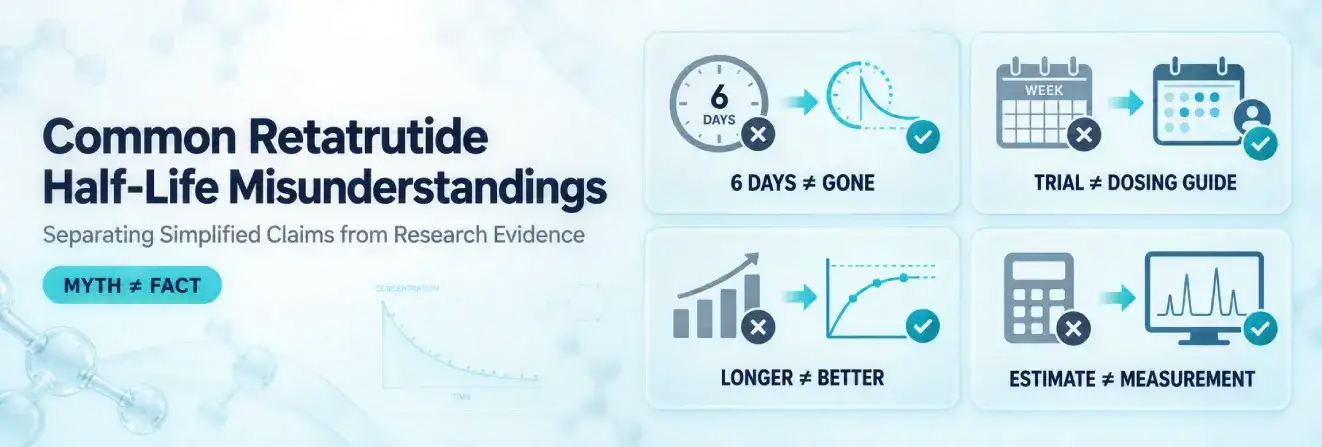
Common Retatrutide Half-Life Misunderstandings
“Retatrutide disappears after six days”
A six-day half-life means that approximately half the concentration remains after six days. It does not mean complete elimination has occurred.
Under a simplified model, several half-lives are required for most of the compound to be eliminated.
“A Weekly Clinical-Trial Schedule Can Be Used as a General Research Protocol”
Clinical-trial schedules are specific to the investigational formulation, study population, endpoints and monitoring framework. They should not be transferred directly to unrelated laboratory research protocols.
“A Longer Half-Life Guarantees Stronger Biological Effects”
Half-life describes elimination kinetics rather than the magnitude of a biological response. Receptor pharmacology, exposure, experimental design and model-specific variables must also be considered.
“A Calculator Shows Exactly How Much Remains in a Biological Sample”
A calculator produces a theoretical estimate. Actual concentration requires validated analytical measurement under controlled conditions.
The retatrutide half life is approximately six days according to published pharmacokinetic research. Under a simplified single-exposure model, most of the starting amount would be eliminated over approximately five half-lives, while repeated exposure may produce accumulation.
Half-life is useful for modelling elimination and systemic exposure but does not independently determine pharmacodynamic activity or experimental study design. Retatrutide remains an investigational compound.
Explore Reta Peptide for Laboratory Research Only
FAQs about retatrutide half life
What is the half-life of retatrutide?
Research indicates that the retatrutide half life is around six days, meaning its plasma concentration decreases by approximately half during this period.
What does retatrutide half life mean?
The term refers to the estimated time needed for retatrutide’s plasma concentration to fall to 50% of its previous level. It does not mean the compound is fully cleared from the body within six days.
How long does retatrutide stay in the body?
With an estimated six-day half-life, most of a single exposure may be eliminated within approximately 30 days. Clearance can differ between individuals and may take longer following repeated exposure.
Why was retatrutide administered once weekly in trials?
Its extended half-life supports prolonged systemic exposure across the study interval. The once-weekly schedule reflects protocols used in controlled clinical research and should not be transferred directly to laboratory research protocols.
How long does it take retatrutide to reach steady state?
Under consistent repeated exposure, steady state may be approached within four to five half-lives, or approximately 24–30 days. Individual pharmacokinetics and study protocols can affect the exact timeframe.
What is the retatrutide half life vs tirzepatide?
Retatrutide’s estimated half-life is about six days, while tirzepatide’s is approximately five days. Retatrutide targets GLP-1, GIP and glucagon receptors, whereas tirzepatide targets GLP-1 and GIP receptors.
Does retatrutide have a longer half-life than semaglutide?
No. Semaglutide has a reported half-life of approximately seven days, making it slightly longer than the estimated six-day retatrutide half life. However, this difference alone does not determine clinical effectiveness.
Is a retatrutide half-life calculator accurate?
A calculator can illustrate theoretical exponential decline when a fixed half-life is assumed. It cannot measure an actual biological sample, account for all pharmacokinetic variables or determine an experimental protocol.
Is retatrutide approved in Australia?
No. Retatrutide remains an investigational compound and is not approved by the Therapeutic Goods Administration as a therapeutic medicine in Australia.
How long can you take retatrutide for?
An approved treatment duration has not been established because retatrutide remains under investigation. The duration of a clinical trial should not be used as guidance for personal treatment.
Sources
https://pubmed.ncbi.nlm.nih.gov/35985340/
https://pubmed.ncbi.nlm.nih.gov/37366315/
https://clinicaltrials.gov/study/NCT04881760
https://clinicaltrials.gov/study/NCT06662383