
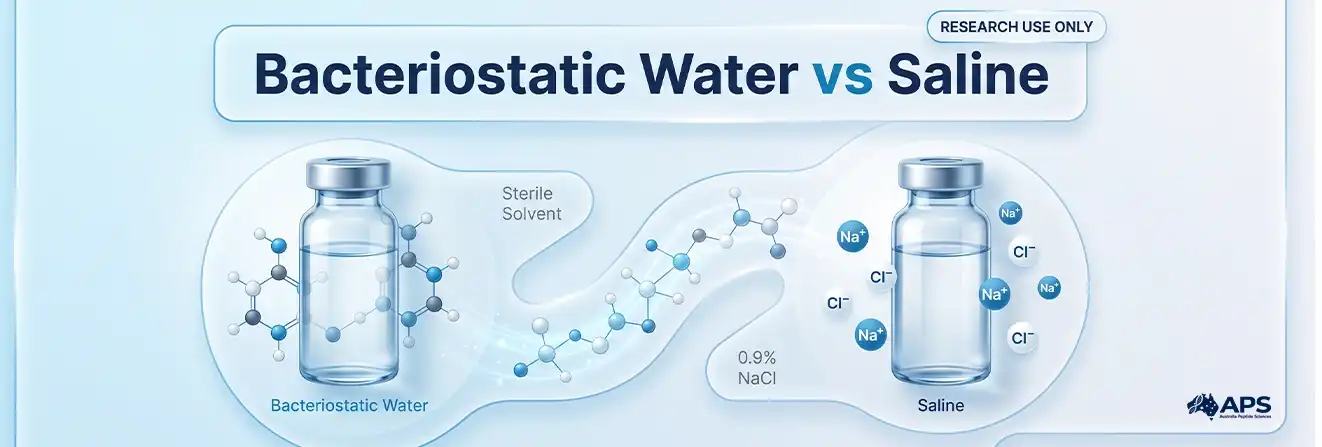
Bacteriostatic water vs saline is primarily a comparison of preservative content, sodium chloride content, and compatibility with a specific laboratory protocol. Bacteriostatic water is sterile water containing a preservative, commonly benzyl alcohol, while normal saline is a sterile 0.9% sodium chloride solution that may be preserved or preservative-free.
Salt and preservatives can influence a peptide’s chemical environment, including tonicity, ionic strength, solubility, and microbial control. Neither solution is suitable for every peptide or research protocol.
In laboratory research, differences in diluent composition can affect solvent compatibility, peptide stability and experimental conditions. Diluent selection should follow compound-specific documentation, validated research methods and established laboratory protocols.
Bacteriostatic water vs saline: What Is the Key Difference?
Bacteriostatic water contains an antimicrobial preservative, commonly benzyl alcohol, but no sodium chloride. Normal saline contains 0.9% sodium chloride and may be preservative-free or preserved. Bacteriostatic saline combines sodium chloride with an antimicrobial preservative.
Laboratory diluent selection should follow compound-specific documentation and validated research protocols, as differences in salt and preservative content may affect experimental compatibility.
| Question | Bacteriostatic water | Normal saline |
| Contains sodium chloride? | No | Yes, normally 0.9% |
| Contains a preservative? | Yes | Usually no, but check the label |
| Relative tonicity before adding a compound | Hypotonic solution | Approximately isotonic solution |
| Typical vial format | May be supplied in a multi-dose vial, as labelled | Single-dose or other labelled container formats |
| Suitable for every peptide? | No | No |
| Main selection rule | Confirm preservative compatibility | Confirm salt and formulation compatibility |
Four Common Sterile Diluent Formulations
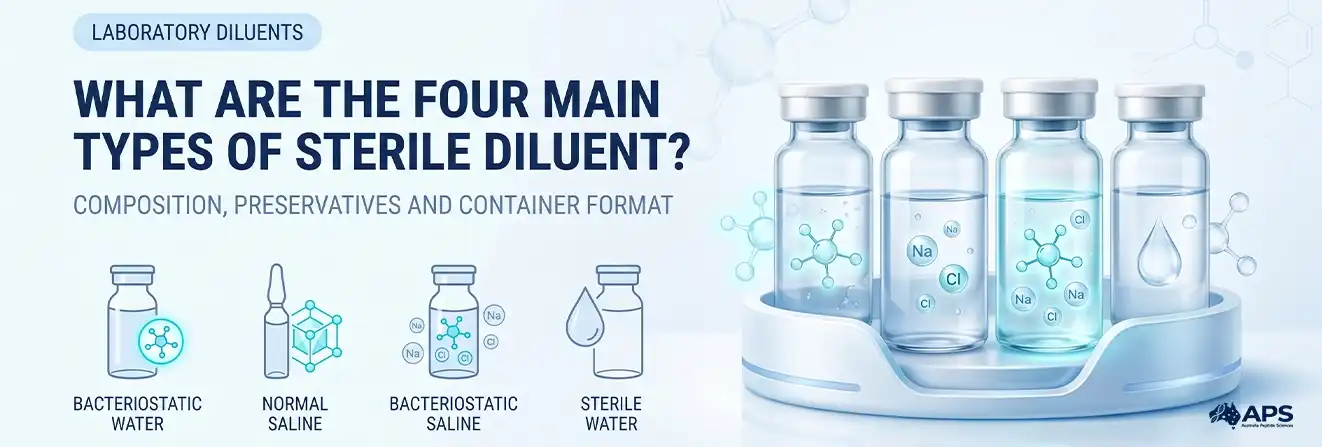
Sterile laboratory diluents differ in sodium chloride content, antimicrobial preservatives and container designation. Four commonly compared formulations illustrate why these properties must be evaluated separately.
1. Bacteriostatic Water
Bacteriostatic water is sterile water containing an antimicrobial preservative, commonly benzyl alcohol. The preservative inhibits the growth of susceptible bacteria, while the product label determines whether the container permits multiple withdrawals.
2. Preservative-Free Normal Saline
Normal saline contains 0.9% sodium chloride, equivalent to 9 mg/mL. Preservative-free saline contains no benzyl alcohol and commonly comes in single-dose containers, although researchers must check the label.
3. Bacteriostatic Saline
Bacteriostatic saline is not bacteriostatic water. It contains sodium chloride and a bacteriostatic preservative.
4. Preservative-Free Sterile Water
The bacteriostatic water vs sterile water comparison examines how preservative content influences laboratory handling and compound compatibility.
What Is the Composition of Bacteriostatic Water and Saline?
Understanding bacteriostatic water vs saline requires separating composition from packaging. “Sterile” describes the product’s microbiological condition, “bacteriostatic” indicates bacterial-growth inhibition, “saline” indicates sodium chloride content, and “multi-dose” describes the container’s intended use.
| Diluent | Water | Sodium chloride | Preservative | Common presentation |
| Bacteriostatic water | Yes | No | Usually benzyl alcohol | Multiple-dose |
| Preservative-free saline | Yes | 0.9% | No | Often single-dose |
| Bacteriostatic saline | Yes | 0.9% | Usually benzyl alcohol | Multiple-dose |
| Preservative-free sterile water | Yes | No | No | Single-dose or pharmacy bulk package, as labelled |
One official product label lists either 0.9% or 1.1% benzyl alcohol, depending on presentation. Researchers should therefore verify each product’s complete composition rather than assume that all formulations are identical.
Normal Saline vs Bacteriostatic Water
Normal saline contributes sodium and chloride ions to a solution, whereas bacteriostatic water contains an antimicrobial preservative without added sodium chloride. These differences may influence ionic strength, tonicity and preservative compatibility in laboratory experiments.
1. Sodium Chloride and Ionic Strength
Sodium chloride dissociates into charged ions and increases the ionic strength of a solution. Depending on peptide sequence, concentration, pH, and formulation conditions, this change may alter electrostatic interactions, solubility, and aggregation behaviour.
Research on peptide aggregation and physical stability shows that formulation effects are compound-specific. Visual clarity alone cannot establish peptide compatibility or long-term stability.
2. Tonicity
Normal saline is approximately isotonic. Water-based diluents without sufficient solute remain hypotonic before another compound is added.
Tonicity does not establish peptide compatibility. An isotonic solution may still be chemically unsuitable for a particular peptide, assay or research design.
3. Preservative Function
Benzyl alcohol inhibits susceptible bacterial growth. It does not sterilise contaminated material, remove endotoxins, or replace proper aseptic technique. Repeated withdrawals and compound compatibility remain dependent on the product label and research protocol.
What Is Bacteriostatic Saline?
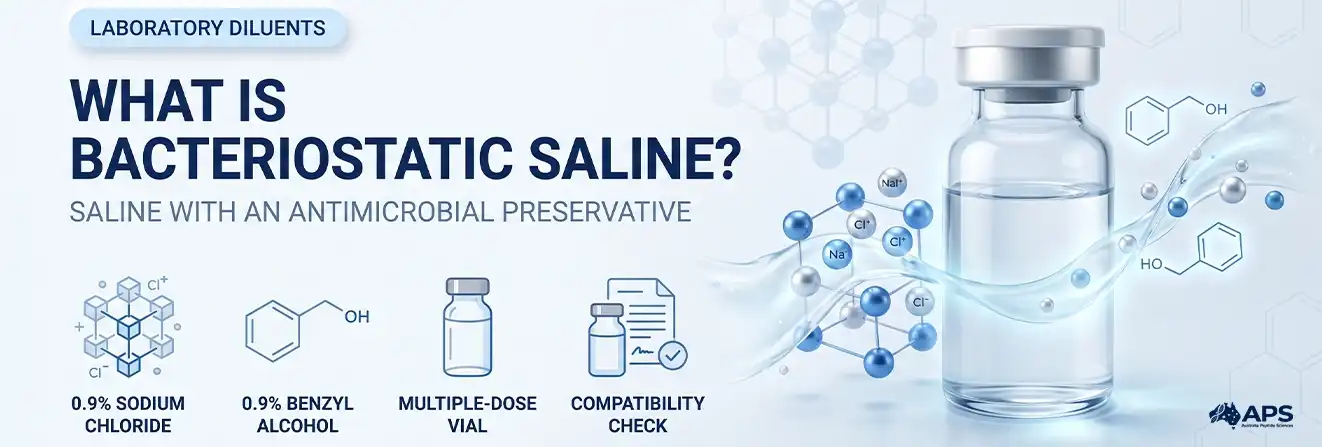
Bacteriostatic saline is sterile saline containing an antimicrobial preservative. One labelled formulation contains 0.9% sodium chloride and 0.9% benzyl alcohol in multiple-dose vials.
It combines saline’s ionic content with preservative activity but should not automatically replace plain saline or bacteriostatic water.
The bacteriostatic sodium chloride label advises checking for potential incompatibilities with sodium chloride or benzyl alcohol. It also cautions against substituting the preserved formulation when a specific sodium chloride solvent is required.
Because sterile saline may be preserved or unpreserved, researchers should check its ingredients and container designation.
Saline Compatibility in Peptide Reconstitution Research
Normal saline is not a universally suitable peptide diluent. Its use in laboratory reconstitution should be supported by compound-specific compatibility data or a validated research protocol. When an acidic solvent is required, Acetic Acid Water 3ml represents a separate formulation option that also requires documented compatibility.
Before selecting a sterile diluent, researchers should review:
- The manufacturer’s preparation instructions.
- A validated laboratory method or published protocol.
- Peptide solubility and concentration requirements.
- Required buffer, pH, and ionic-strength conditions.
- Sensitivity to sodium chloride or benzyl alcohol.
- The intended analytical method.
- Container and storage compatibility.
Substituting one diluent for another can alter experimental results, even when both solutions are sterile. Compatibility should therefore be confirmed before changing a validated laboratory method.
Researchers should document the precise diluent formulation and use matched vehicle controls where appropriate to distinguish peptide-related effects from those associated with sodium chloride, preservatives or other solvent components.
Reconstitution creates a liquid preparation, while later dilution may change its concentration and stability.
How Diluent Compatibility Affects Peptide Solubility and Stability
Comparing saline with bacteriostatic water for peptides requires evaluating more than visible dissolution. Differences in sodium chloride and preservative content may influence peptide solubility, physical stability and analytical results.
1. Solubility and Precipitation
Peptide charge and solubility vary with sequence, concentration, pH, and the surrounding formulation. A metal-binding compound such as GHK-Cu Peptide illustrates why compatibility must be assessed individually, while a physicochemical characterisation of GHK and GHK-Cu demonstrates how their properties can vary across solution conditions. Salt-specific effects should not be assumed without compound-specific stability data.
2. Aggregation
Peptides may aggregate without producing immediately visible cloudiness. Ionic strength, concentration, pH, temperature, agitation, and interactions with container surfaces can influence physical stability, as detailed in research on factors affecting peptide aggregation. Visual inspection therefore cannot replace stability-indicating analysis.
3. Chemical Degradation
Peptides may undergo hydrolysis, oxidation or deamidation depending on their amino acid sequence and formulation. Degradation rates can be influenced by pH, temperature, dissolved oxygen, light exposure and storage conditions.
4. Surface Adsorption
Low-concentration peptides may adsorb to glass, plastic, tips, or filters, affecting measured recovery.
5. Assay Performance
A diluent can affect chromatography, binding assays, and cell systems. Controls should use the same vehicle as experimental samples to avoid false attribution.
This video explains the differences between bacteriostatic water, sterile water, and normal saline for peptide research.
Peptide Stability After Reconstitution: Why the Diluent Is Not the Only Factor
Peptide stability after reconstitution depends on the formulation, concentration, container, temperature, and handling conditions. No diluent provides a universal stability period.
Two separate timelines must be tracked:
- The labelled period for the opened diluent container
- The validated stability period for the prepared peptide solution
A multiple-withdrawal diluent may remain usable longer than the prepared peptide. Reconstituted peptide storage must therefore follow a validated peptide storage guide, compound-specific evidence, and product documentation rather than a general 28-day assumption.
What to Check on Bacteriostatic Water and Saline Labels
Product labels help distinguish bacteriostatic water from normal saline and bacteriostatic saline. For bacteriostatic water, the preservative identity and concentration should be verified. For saline formulations, researchers should confirm the sodium chloride concentration, commonly 0.9%, and whether an antimicrobial preservative is present. Container designation, storage requirements and formulation restrictions must also be assessed against the laboratory protocol.
Common Misconceptions About Bacteriostatic Water vs Saline
| Misconception | Accurate interpretation |
| Isotonic saline is compatible with every peptide. | Isotonicity does not establish peptide compatibility. Sodium chloride may influence ionic strength, solubility and aggregation. |
| A clear peptide solution is stable in either diluent. | Visual clarity does not rule out chemical degradation or peptide aggregation. |
Research Materials and Diluent Documentation
Reliable comparisons between bacteriostatic water and saline require documented peptide identity, batch information and diluent composition. The research-use-only laboratory materials guide provides additional information about laboratory research documentation.
Available laboratory diluent formulations are listed in the BAC Water category. Product selection should account for sodium chloride concentration, preservative content and documented compatibility with the intended research method.
Bacteriostatic Water vs Saline: Final Research Considerations
The main distinction between bacteriostatic water and normal saline lies in their preservative and sodium chloride content. These formulation differences can influence ionic strength, peptide solubility, chemical stability and analytical conditions in laboratory research.
Neither formulation is universally suitable for peptide research. Diluent selection depends on compound-specific compatibility data, validated experimental methods and the precise composition of each solution, including any sodium chloride or antimicrobial preservatives.
Researchers should confirm sodium chloride and preservative content, follow validated protocols, and document the selected vehicle to support consistent and interpretable results.
Frequently Asked Questions About Bacteriostatic Water vs Saline
Is bacteriostatic saline the same as bacteriostatic water?
No. Bacteriostatic saline contains sodium chloride and an antimicrobial preservative, commonly benzyl alcohol. Bacteriostatic water contains a preservative without added sodium chloride. This difference affects ionic strength and formulation compatibility in laboratory research.
Can normal saline replace bacteriostatic water in a laboratory protocol?
Not automatically. Normal saline introduces sodium and chloride ions, while bacteriostatic water contains an antimicrobial preservative without added salt. Substitution requires compound-specific compatibility data and validation against the intended research method.
Is there a universal substitute for bacteriostatic water in peptide research?
No. Sterile water, normal saline or another laboratory diluent may be appropriate only when compatibility has been established for the specific material and protocol.
What is the sodium chloride concentration in normal saline?
Normal saline contains 0.9% sodium chloride, equivalent to 9 mg/mL. Laboratory formulations must meet their specified quality requirements, and preservative content should be verified using the product label.
How does sodium chloride in saline affect peptide research?
Sodium chloride increases ionic strength and can influence electrostatic interactions, peptide solubility and aggregation behaviour. These effects depend on the peptide sequence, concentration, pH and experimental conditions.
Can sterile water replace bacteriostatic water in laboratory research?
Only where validated documentation establishes compatibility. Sterile water contains no antimicrobial preservative and therefore represents a different formulation environment.
Is bacteriostatic saline the same as normal saline?
Bacteriostatic saline specifically contains an antimicrobial preservative alongside sodium chloride. Normal saline refers to a 0.9% sodium chloride solution and is commonly preservative-free, although preserved formulations also exist. Product labelling determines the exact composition.
How does sterile water differ from bacteriostatic water in peptide research?
Sterile water contains no antimicrobial preservative, whereas bacteriostatic water contains a labelled preservative. Their suitability depends on the specific research material, formulation requirements and validated protocol.
Is deionized water the same as bacteriostatic water?
No; deionized water lacks the preservative, sterility assurance, and formulation controls associated with bacteriostatic water.
What is bacteriostatic saline?
Bacteriostatic saline is a sterile sodium chloride solution containing an antimicrobial preservative that helps inhibit bacterial growth.
Sources
- Bacteriostatic Water for Injection - DailyMed
- Factors Affecting the Physical Stability (Aggregation) of Peptide Therapeutics
- Bacteriostatic Sodium Chloride - DailyMed
- Physicochemical Characterization of Native GHK and Its Copper Complexes
- Preventing Unsafe Injection Practices - CDC
- What Is Bacteriostatic Water? - YouTube Video