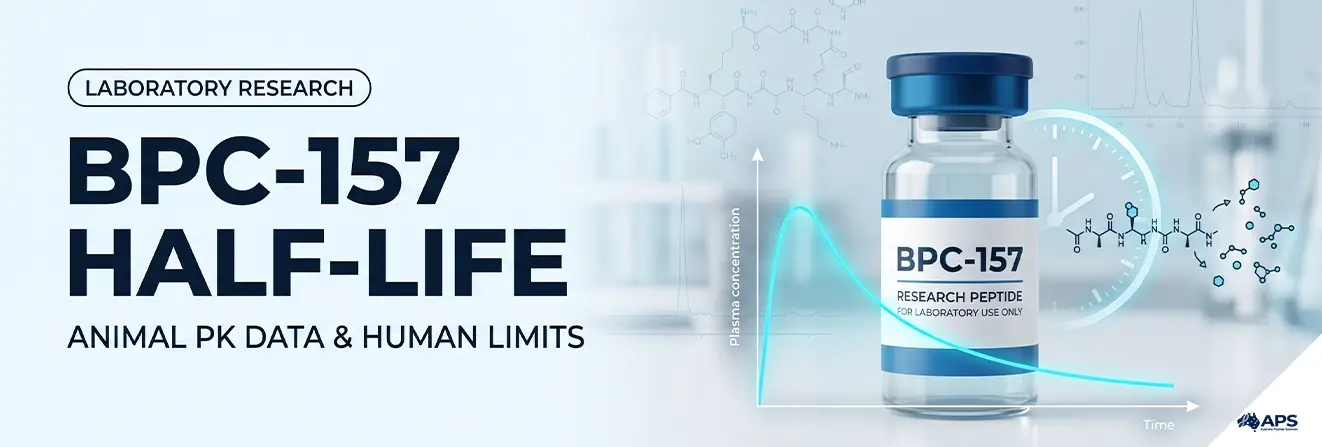
BPC-157 half life data come mainly from animal studies, with no reliable human elimination value established.
Research in rats and beagle dogs found that intact BPC-157 had a short plasma half-life. Longer estimates measured total radioactivity, including metabolites and breakdown products, rather than the parent peptide alone. Plasma half-life, detectability, and biological response duration therefore describe different processes.
Research-use note: This article discusses published pharmacokinetic evidence for scientific and educational purposes only. BPC-157 materials supplied for research are intended for laboratory use only and are not intended for human or veterinary administration, diagnosis, treatment or personal use. For more information, see our Research Use Only Peptides guide.
What Does the Research Show?
The strongest published BPC-157 half life evidence comes from a 2022 study in rats and beagle dogs. Intact BPC-157 had an elimination half-life below 30 minutes and was undetectable after four hours under the study conditions. However, metabolites and radiolabelled breakdown products followed different elimination profiles.
| Research question | Evidence-based answer |
| Is an animal half-life available? | Yes. Intact BPC157 was measured in rats and beagle dogs. |
| What was the reported range? | Approximately 5.27 to 29.7 minutes across the tested IV and IM conditions. |
| Is a human half-life established? | No reliable peer-reviewed human value is publicly established. |
| Does half-life equal detection time? | No. Detection depends on the analyte, sample, method, and reporting threshold. |
| Does half-life define effect duration? | No. A pharmacodynamic endpoint may follow a different timeline from plasma concentration. |
For a broader overview of the compound, including its structure, experimental terminology and wider preclinical evidence, see our BPC-157 Peptide Research Guide.
What Half-Life Means in BPC-157 Pharmacokinetics
BPC-157 pharmacokinetic results can vary according to species, experimental exposure, administration route, formulation, sampling schedule and analytical method. Each dataset should therefore be interpreted within its original study conditions rather than transferred directly to another biological model or research protocol.
1. BPC-157 Elimination Half-Life and Plasma Clearance
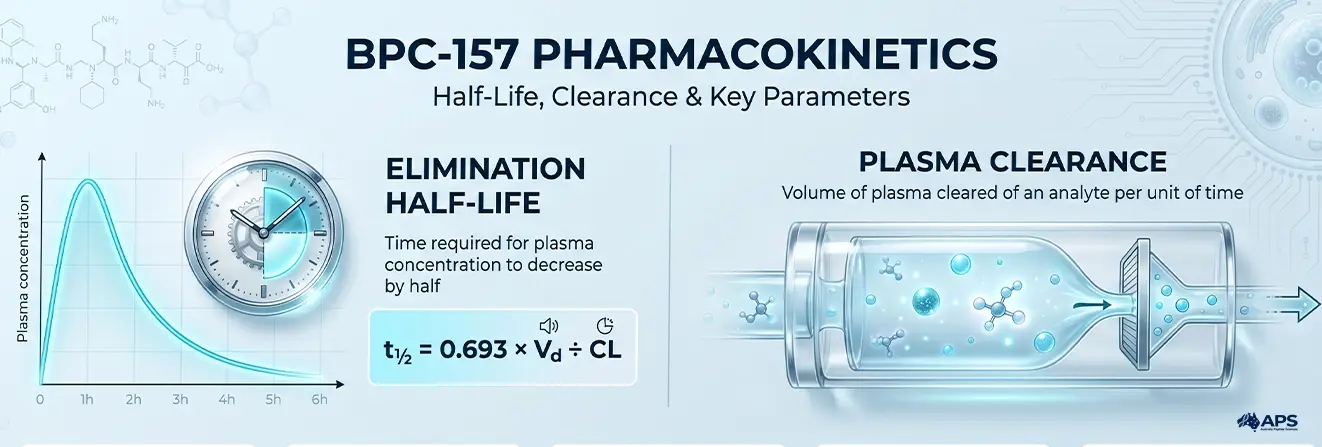
BPC-157 elimination half life and clearance measure different processes. Half-life represents time, while clearance measures the volume of plasma cleared of an analyte per unit of time:
t½ = 0.693 × Vd ÷ CL
A larger distribution volume may extend half-life, whereas faster clearance may shorten it.
2. Key BPC-157 Pharmacokinetic Parameters
- Cmax: Highest measured plasma concentration.
- Tmax: Time required to reach Cmax.
- AUC: Total systemic exposure over time.
- Vss: Apparent distribution volume at steady state.
- CL: Plasma clearance per unit of time and body weight.
- Absolute bioavailability: Fraction reaching circulation compared with intravenous administration.
Researchers unfamiliar with peptide structure and analytical identity can also review our peptide sequence guide for background on how amino acid sequence defines a peptide.
BPC-157 Half-Life in Animal Models: The Main Pharmacokinetic Study
A 2022 study used mass spectrometry and radiolabelling to examine BPC157 in rats and beagle dogs. The intact peptide had a minute-scale elimination half-life, while labelled metabolites remained detectable longer.
1. BPC-157 half life in rats
Rat results varied by route and dose:
| Administration | Tmax | Half-life | IM bioavailability |
| IV, 20 µg/kg | N/A | 15.2 min | Reference |
| IM, 20 µg/kg | 3 min | 7.87 min | 18.82% |
| IM, 100 µg/kg | 3 min | 17.1 min | 14.49% |
| IM, 500 µg/kg | 3 min | 29.7 min | 19.35% |
| IM, 100 µg/kg for 7 days | 3 min | 18.5 min | Not reported |
2. BPC-157 Half-Life in Beagle Dogs
| Administration | Tmax | Half-life | IM bioavailability |
| IV, 6 µg/kg | N/A | 5.27 ± 2.25 min | Reference |
| IM, 6 µg/kg | 6.33 ± 3.14 min | 20.0 ± 5.53 min | 45.27% |
| IM, 30 µg/kg | 8.67 ± 5.54 min | 25.5 ± 7.08 min | 47.64% |
| IM, 150 µg/kg | 8.17 ± 2.99 min | 29.3 ± 5.06 min | 50.56% |
| IM, 30 µg/kg for 7 days | 10.5 ± 10.5 min | 19.6 ± 3.72 min | Not reported |
Intramuscular bioavailability was approximately 14–19% in rats and 45–51% in dogs under the reported study conditions. These values describe specific preclinical protocols and cannot establish human pharmacokinetics or be converted into human-use instructions.
How Route and Testing Method Affect BPC-157 Results
In the published animal study, intravenous administration provided direct systemic exposure, while intramuscular administration included an absorption phase. The study reported IV and IM pharmacokinetic data in rats and dogs but did not establish equivalent route-specific values for subcutaneous administration or a reliable human oral pharmacokinetic profile.
| Route | Evidence available | Not established |
| Intravenous | Rat and dog plasma measurements | Oral or subcutaneous behaviour |
| Intramuscular | Tmax, Cmax, AUC, half-life and bioavailability | A value covering all injection routes |
| Subcutaneous | No route-specific result | The commonly cited four-to-six-hour estimate |
| Oral | Separate absorption data required | A reliable human oral half-life |
Route-specific findings should therefore remain tied to the experimental model and analytical method used in the original study. They should not be interpreted as instructions for preparing or administering research materials.
Distribution, Metabolism and BPC-157 Plasma Clearance
Radiolabelled BPC157-derived material appeared across several rat tissues, with the highest early concentration in the kidneys and lower levels in the brain. However, radioactivity may represent the intact peptide, metabolites, or labelled breakdown products. Researchers identified proline and five peptide fragments, indicating progressive proteolytic breakdown.
BPC-157 plasma clearance was 50.1 mL/min/kg in rats and 90.8 ± 40.1 mL/min/kg in dogs after intravenous administration. Labelled material continued to leave through urinary and biliary pathways after the intact peptide was no longer detectable.
Why Longer BPC-157 Half-Life Estimates Appear
Different values often reflect different measured substances rather than conflicting results.
1. Intact BPC157 Versus Total Radioactivity
The 2022 study reported a half-life below 30 minutes for intact BPC157. In contrast, total plasma radioactivity in rats had a terminal half-life of 102 ± 32 hours because it included metabolites and other labelled material.
2. The Older 66–69 Hour Rat Figure
Later publications cite an oral rat study from 1996 reporting 66 hours in males and 69 hours in females. However, the original report and its analytical details are not readily available for assessment.
| Reported value | Measurement context | Interpretation |
| 5.27–29.7 minutes | Intact BPC157 in rat and dog IV/IM studies | Strongest parent-peptide evidence |
| 102 ± 32 hours | Total plasma radioactivity in rats | Includes labelled metabolites and breakdown products |
| 66–69 hours | Older oral rat report | Historical evidence with limited methodological detail |
| 4–6 hours | Common online estimate | Lacks clear route-matched primary evidence |
This distinction is also relevant when evaluating research material quality. See our Peptide Purity Explained guide for more information on identity, purity and analytical interpretation.
For additional context, the following video provides a visual overview of BPC-157 research and related pharmacokinetic considerations:
Does Repeated Administration Cause Accumulation?
The seven-day intramuscular component of the animal study compared repeated experimental exposure with the corresponding single-exposure condition. In both rats and dogs, concentration-time profiles and major PK parameters remained broadly similar. Under those specific study conditions, the researchers did not identify a clear signal of substantial accumulation of the intact parent peptide.
This finding is limited to the studied animal models, formulations, routes, analytical methods and exposure periods. It should not be generalised to other experimental systems.
BPC-157 Duration of Action Versus Plasma Half-Life
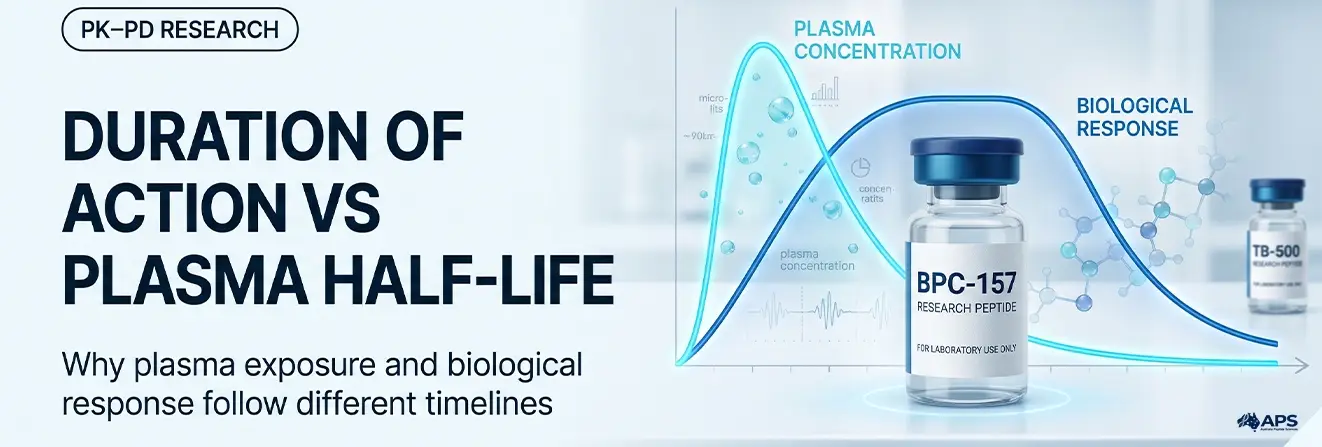
Duration must be evaluated for each:
- Biological model and control group
- Administration route and schedule
- Measurement period
- Molecular, histological, biomechanical or behavioural endpoint
- Relationship between peptide concentration and response
A PK-PD relationship requires pharmacokinetic exposure and pharmacodynamic effects to be measured within a compatible study design.
View Certificates of Analysis for Research Materials
How Long Does BPC-157 Stay in the System?
There is no validated human answer to how long BPC-157 remains detectable. In the main animal pharmacokinetic study, intact BPC-157 was no longer detectable in plasma four hours after experimental administration under the assay conditions used. This does not establish its absence from every tissue, metabolite pool or biological sample.
Detection time depends on:
- Whether the assay targets intact BPC157 or its metabolites
- Sample type and assay sensitivity
- Route, dose, and exposure frequency
- Sampling time, stability, and laboratory thresholds
As a general pharmacokinetic model, five elapsed half-lives correspond to approximately 3.1% of the starting amount remaining. However, this mathematical principle cannot establish a human BPC-157 detection window without validated human pharmacokinetic measurements.
What Is Known About BPC-157 Human Half-Life?
Reliable peer-reviewed human pharmacokinetic data establishing a validated BPC-157 half-life remain unavailable. A registered Phase I study, NCT02637284, does not provide a sufficiently robust published pharmacokinetic dataset from which a dependable human elimination half-life can be established.
Animal pharmacokinetic values cannot be directly extrapolated to humans because protease activity, clearance mechanisms, tissue distribution, body size and route-dependent absorption may differ substantially between species.
The Therapeutic Goods Administration identifies BPC-157 within its information on unapproved peptide products. Preclinical pharmacokinetic findings should therefore remain within their research context and should not be used to derive human dosing, therapeutic efficacy or personal-use recommendations.
For a broader explanation of how research materials should be distinguished from approved therapeutic products, see our Research Use Only Peptides guide.
How to Interpret BPC157 Pharmacokinetic Evidence
Before comparing study results, researchers should confirm:
- Analyte: Intact BPC157, metabolites or total radiolabel.
- Model: Species, strain, sex, and experimental condition.
- Route: IV, IM, oral, and subcutaneous data must remain separate.
- Sampling: Early samples are essential for detecting a minute-scale terminal phase.
- Assay: Sensitivity, specificity, recovery, and sample stability.
- PK parameters: Tmax, Cmax, AUC, clearance, distribution volume, and half-life measure different outcomes.
- Exposure: Single- and repeated-dose results require separate interpretation.
- PK versus PD: A biological response does not prove that intact peptide remains in circulation.
When comparing BPC-157 with other research peptides, each material should be evaluated independently for identity, purity, concentration and analytical quality rather than assuming that results from one compound apply to another.
For guidance on interpreting batch-specific analytical documentation, see our peptide Certificate of Analysis and the [Australia Peptide Sciences Certificates of Analysis](https://australiapeptidesciences.com/certificates-of-analysis-coa/).
A Brief History of BPC-157 Research
BPC-157 research began in the 1990s, with preclinical investigations examining gastrointestinal, tissue-response and other biological models. Later research explored vascular signalling, tissue repair pathways and systemic distribution. Because different peptides have distinct structures and experimental evidence bases, findings should not be transferred from one compound to another. Researchers comparing related areas can review our BPC-157 Peptide Research Guide and TB-500 Peptide Research Guide.
What Research Shows About BPC-157 Half-Life
Current BPC-157 half-life evidence comes primarily from animal pharmacokinetic research. The strongest published study found that intact BPC-157 had a minute-scale plasma half-life in rats and beagle dogs, while radiolabelled metabolites and breakdown products remained detectable for longer periods.
These measurements describe specific preclinical study conditions and do not establish a validated human half-life. Accurate interpretation therefore requires each value to remain linked to its species, experimental route, measured analyte, analytical method and sampling conditions.
For broader laboratory-focused information on BPC-157 and other research compounds, browse our Research Peptide Guides.
Explore BPC-157 Peptide for Laboratory Research Only
Frequently Asked Questions About BPC-157 half life
How long does BPC last in the system?
No validated human duration has been established. In the main animal pharmacokinetic study, intact BPC-157 was no longer detectable in plasma four hours after experimental administration under the assay conditions used.
How long does it take for BPC-157 to leave your system?
This is not established in humans. Animal plasma measurements and theoretical half-life calculations cannot be converted into a reliable human elimination or detection window.
How long does BPC-157 last?
Published animal pharmacokinetic data report an elimination half-life below 30 minutes for intact BPC-157 under the studied IV and IM conditions. Biological-response duration must be investigated separately and cannot be inferred from plasma half-life alone.
Does BPC-157 Half-Life Show When a Biological Response Begins?
No. Plasma half-life is a pharmacokinetic measurement, while the onset and duration of a biological response are pharmacodynamic questions. These require compatible experimental endpoints and study designs.
Does a Short Plasma Half-Life Mean BPC-157 Has a Short Biological Response?
Not necessarily. Plasma concentration and downstream biological responses may follow different timelines. BPC-157 pharmacokinetic and pharmacodynamic findings should therefore be evaluated separately.
How long does 5mg of BPC-157 last?
The amount alone cannot determine duration because this depends on the route, formulation, measured analyte, and validated pharmacokinetic data.
Can Published Animal Study Doses Be Used as a Laboratory Protocol?
Not automatically. Published doses belong to specific animal models, formulations, routes and study objectives. Laboratory protocols should be independently designed and validated for the experimental system being investigated.
Does the BPC-157 Half-Life Study Establish a Complete Safety Profile?
No. A pharmacokinetic study primarily describes absorption, distribution, metabolism and elimination. It does not by itself establish a complete safety profile, and animal findings cannot establish safety for human use.
References