
A peptide library is a collection of peptide sequences used to compare sequence variants, study molecular interactions and identify peptides with defined experimental properties.
Libraries may contain a small number of systematic variants or much larger, highly diverse sequence sets. Their design depends on the research question, assay format and desired sequence coverage.
Common formats include overlapping, alanine scanning, truncation, random, combinatorial and display-based libraries. After generation, peptide library screening helps identify sequences that produce measurable experimental signals. Reliable results depend on thoughtful design, appropriate controls, suitable screening methods and independent validation of candidate sequences in research settings only.
Peptide Library Definition and Purpose
A peptide library is an organised collection of peptides in which each peptide sequence varies according to a predefined design strategy. The sequences may differ at a single position, across several positions or throughout the entire peptide.
The main purpose is to study how sequence changes influence a measurable property. That property may involve molecular binding, sequence recognition, structural preference, biochemical behaviour or another defined experimental endpoint.
A library can therefore answer questions that are difficult to address with a single peptide. Instead of asking whether one sequence interacts with a target, researchers can compare many related sequences and determine which amino acids, motifs or sequence patterns appear most important.
How a Peptide Library Differs From a Single Peptide
An individual research peptide can be examined as a defined sequence, while a peptide library expands that comparison across multiple sequence variants.
For example, a researcher investigating a short binding motif may prepare a reference peptide and then construct a library in which individual residues are systematically changed. Differences in experimental signal can then help reveal which positions contribute most strongly to the observed interaction.
The scale of a library depends on the design. Some contain only a few dozen carefully selected peptides, while other formats are designed to represent much larger sequence populations.
Peptide Library vs Peptide Pool
A peptide library and a peptide pool are related concepts, but they do not always mean the same thing.
A peptide library is usually designed to explore sequence diversity in a systematic or randomised way. Each sequence contributes information to a broader research question.
A peptide pool refers more generally to multiple peptides combined into one mixture. Pooling can be useful for efficient testing, but it may reduce the ability to attribute a result to one specific sequence unless the pool is later deconvoluted.
| Format | Sequence Diversity | Main Research Purpose | Typical Approach |
| Single peptide | One defined sequence | Characterise a specific peptide | Individual testing |
| Peptide library | Multiple systematically or randomly varied sequences | Explore sequence-property relationships | Parallel or staged screening |
| Peptide pool | Multiple peptides combined in one mixture | Evaluate groups of peptides efficiently | Pool testing followed by deconvolution when needed |
Australia Peptide Sciences provides research-focused information and resources covering peptides, peptide science and laboratory research.
How Does a Peptide Library Work?
A peptide library works by creating controlled sequence diversity and then comparing how individual sequences or groups of sequences behave under the same experimental conditions.
The exact workflow varies, but most library-based studies follow the same general logic: define the question, design the sequence set, generate the library, perform a screen, identify candidate hits and validate the strongest candidates.
Creating Sequence Diversity
Sequence diversity is the central feature of a peptide library. Researchers may vary:
- one amino acid position at a time;
- several selected positions;
- peptide length;
- residue order;
- motif boundaries;
- defined amino acid classes;
- the entire sequence through randomisation.
The design should reflect the question being asked. A library intended to map an interaction region will look very different from one intended to explore a broad range of possible binding sequences.
Exposing the Library to a Research Target or Assay
Once generated, the library is tested using an assay that can produce a measurable readout.
Depending on the research objective, that readout may relate to:
- molecular binding;
- affinity differences;
- recognition by another molecule;
- biochemical activity within a controlled assay;
- changes in fluorescence or another analytical signal;
- enrichment during a selection process.
The assay must be able to distinguish meaningful responses from background noise.
Identifying Candidate Peptide Sequences
Sequences producing a predefined experimental response are often referred to as hits or candidate hits.
A strong hit does not automatically prove that the sequence has the desired property. It indicates that the sequence has met the initial screening criterion and deserves further evaluation.
Validating Screening Hits
Validation is essential because initial screening can generate false positives, assay-specific artefacts or signals caused by non-specific interactions.
Candidate peptides may therefore be retested individually, compared with controls and assessed using an independent analytical method.
In practice, peptide library research moves from sequence design and library generation to screening, candidate selection and independent validation. Each stage should be matched to the experimental objective and assay format.
This video provides a visual overview of how peptide libraries can be displayed, screened and selected in research.
Main Types of Peptide Libraries
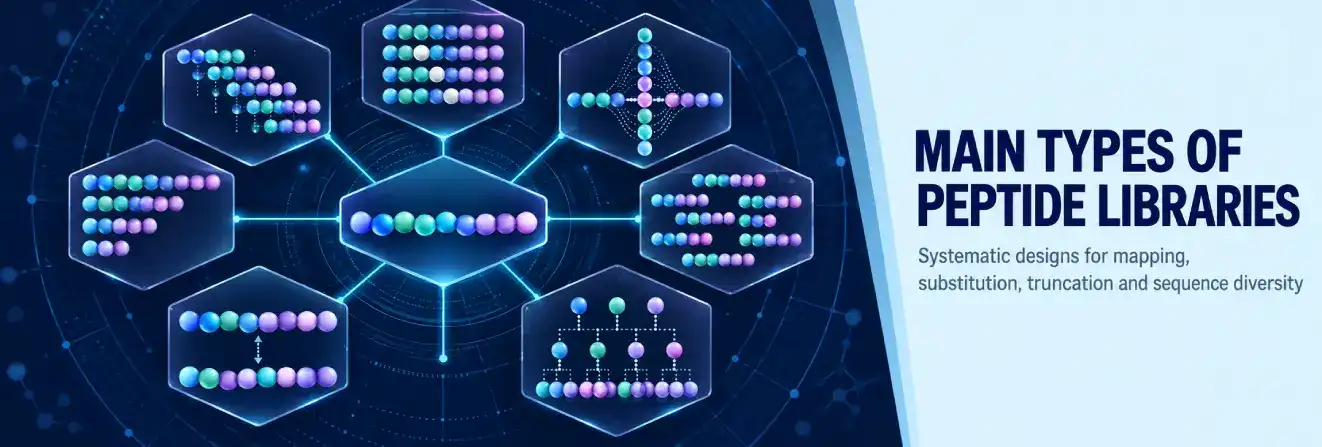
Different peptide library formats answer different types of research questions. There is no single design that is ideal for every application.
Overlapping Peptide Libraries
An overlapping library divides a larger parent sequence into shorter peptide fragments that overlap with one another.
For example, if a longer protein region is being investigated, a series of partially overlapping peptides can provide systematic coverage across that sequence.
Overlapping libraries are useful for:
- locating interaction regions;
- mapping linear recognition sites;
- identifying short sequence segments associated with an experimental signal;
- comparing neighbouring sequence regions.
The amount of overlap affects the resolution of the analysis. Greater overlap provides finer mapping but also increases the number of peptides required.
Alanine Scanning Libraries
Alanine scanning is used to investigate the importance of individual amino acid positions.
A reference sequence is retained, while selected residues are replaced one at a time with alanine. Researchers then compare the behaviour of each variant with the original peptide.
If replacing one residue causes a large reduction in the measured signal, that position may contribute strongly to the interaction or property being studied.
Alanine scanning is most useful when a candidate sequence has already been identified and the goal is to understand which residues are functionally important.
Positional Scanning Libraries
A positional scanning library explores how different amino acids behave at defined positions within a peptide.
Instead of changing one residue only to alanine, a position may be tested against multiple possible substitutions.
This approach can help reveal:
- preferred residues at a given position;
- tolerated substitutions;
- sequence constraints;
- position-specific patterns associated with stronger or weaker responses.
Truncation Peptide Libraries
Truncation libraries systematically shorten a peptide from one or both ends.
They are useful for determining whether the full sequence is required or whether a shorter region retains the experimental property of interest.
A truncation series can help identify:
- minimal binding regions;
- non-essential terminal residues;
- sequence boundaries;
- short motifs responsible for measurable interactions.
Random Peptide Libraries
Random peptide libraries introduce broad sequence variation without restricting the design to one known parent sequence.
Randomisation allows researchers to explore a wider portion of peptide sequence space, making this format useful when the most relevant sequence motif is not already known.
Scrambled Peptide Libraries
Scrambled libraries contain peptides with the same or similar amino acid composition as a reference sequence but with a different residue order.
Scrambled peptides can serve as useful controls because they help distinguish effects associated with sequence order from effects associated mainly with overall composition.
They can also reveal whether a specific motif arrangement is necessary for an observed experimental signal.
Combinatorial Peptide Libraries
A combinatorial peptide library is created by systematically combining multiple amino acid possibilities across selected positions.
Combinatorial designs allow broad exploration of sequence relationships, and synthetic combinatorial peptide libraries can be used to examine how variations across selected positions influence experimental responses. Increasing theoretical diversity beyond what can realistically be synthesised or screened may reduce the practical value of the library.
| Library Type | Main Variable | Typical Research Question | Key Strength | Main Limitation |
| Overlapping | Sequence window | Where is the relevant region? | Systematic coverage | Requires many peptides for high resolution |
| Alanine scanning | Individual residues | Which positions are important? | Clear residue-by-residue comparison | Limited substitution diversity |
| Positional scanning | Residue identity at selected positions | Which substitutions are preferred? | Detailed position-specific information | Library size can grow quickly |
| Truncation | Peptide length | What is the minimal sequence region? | Defines sequence boundaries | May not capture internal substitutions |
| Random | Entire sequence | Which sequences show the desired property? | Broad exploration | Complete sequence-space coverage is impossible |
| Scrambled | Residue order | Does sequence order matter? | Useful control strategy | Does not systematically test every position |
| Combinatorial | Multiple positions | Which residue combinations perform best? | High diversity | Complexity rises rapidly |
Synthetic and Display-Based Peptide Libraries
Peptide libraries can also be classified according to how their sequences are physically generated and represented.
Two major categories are synthetic peptide libraries and genetically encoded display libraries.
Synthetic Peptide Libraries
Synthetic libraries contain physically synthesised peptides with defined sequences. In experiments that require a defined reference, the original parent peptide is typically included alongside its variants for controlled comparison.
This format provides strong control over sequence identity and can support designs such as:
- overlapping libraries;
- alanine scanning;
- truncation libraries;
- scrambled libraries;
- selected combinatorial designs.
Synthetic libraries are particularly useful when individual peptides need to be tested separately or arranged systematically across plates, arrays or other assay formats.
Phage Display Peptide Library
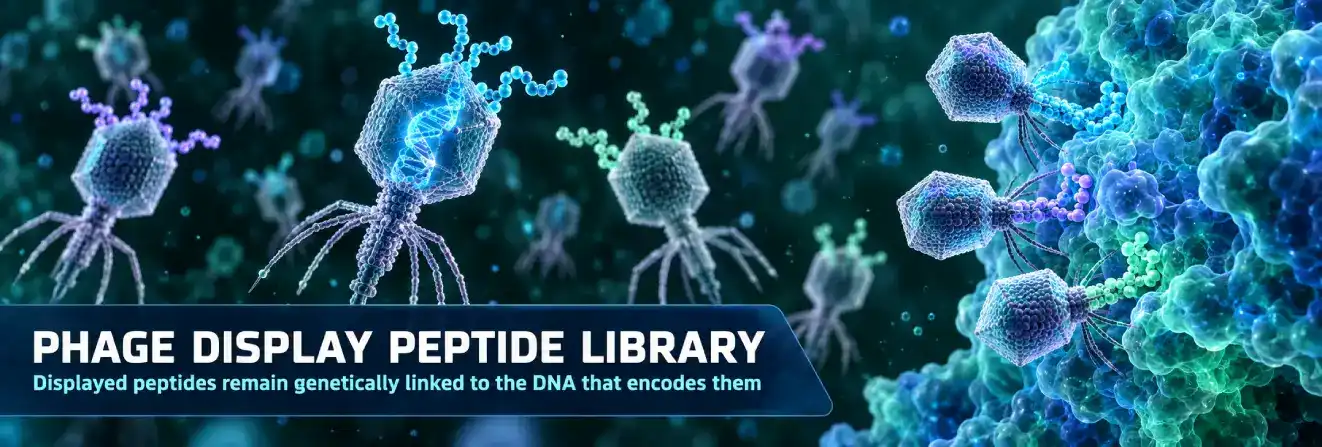
A phage display peptide library uses bacteriophages as carriers for diverse peptide sequences.
Each displayed peptide is genetically linked to the DNA sequence encoding it. This genotype-to-phenotype connection makes it possible to perform repeated selection and enrichment steps while retaining information about the peptide sequence.
During screening, phage displaying peptides that interact with a selected research target can be enriched relative to less strongly retained variants, making phage-displayed peptide libraries useful for identifying candidate binding sequences. The corresponding genetic material can then be analysed to identify enriched peptide sequences.
A major advantage of phage display is the ability to work with large encoded sequence populations. However, the system also introduces biological constraints that differ from those found in chemically synthesised libraries.
Other Encoded Display Approaches
Other encoded systems can also be used to explore peptide or protein sequence diversity, including:
- mRNA display;
- ribosome display;
- yeast display;
- bacterial display.
These approaches differ in how sequences are presented, linked to their encoding information and selected. They may be useful when very large sequence populations are required, but each method has its own technical limitations and sources of bias.
| Feature | Synthetic Peptide Library | Phage Display Peptide Library |
| Physical format | Chemically synthesised peptides | Peptides displayed on phage particles |
| Sequence identification | Known from synthesis design | Recovered through associated genetic information |
| Diversity | Moderate to high, depending on synthesis scale | Can support very large encoded libraries |
| Sequence control | High for predefined libraries | Influenced by encoding and biological propagation |
| Typical use | Systematic sequence comparison | Selection and enrichment from diverse populations |
| Main challenge | Synthesis complexity and library scale | Display, amplification and selection bias |
Peptide Library Design
Effective peptide library design begins with a clear research question. Diversity alone does not make a library useful. The sequence set must be structured so that the resulting data can answer a specific experimental question.
Start With the Research Question
The first decision is what the library needs to reveal. For example, the study may aim to:
- locate a relevant region within a longer sequence;
- identify which residues contribute most to a measured signal;
- compare tolerated substitutions at selected positions;
- define the minimal sequence that retains the property of interest;
- select candidate sequences from a broad, unknown sequence space.
Choosing a library format before defining the question often adds unnecessary complexity.
Peptide Length
Peptide length influences both experimental relevance and technical practicality.
Longer sequences can provide more structural context but may be more difficult to synthesise consistently. When additional positions are allowed to vary, they can also greatly increase the theoretical sequence space that a library is designed to explore.
Shorter peptides are often easier to compare systematically but may not reproduce interactions that depend on a larger sequence context.
The appropriate length therefore depends on the experimental objective rather than a universal standard.
Library Diversity
Library diversity describes how many unique sequences are represented.
Greater diversity can increase the chance of discovering unexpected sequence patterns, but only if the screening system can meaningfully evaluate that diversity.
A theoretical library containing millions of possible sequences is not automatically more informative than a smaller, carefully designed library. Coverage, assay sensitivity and validation capacity must all be considered.
Fixed and Variable Positions
Many peptide library designs contain a mixture of fixed and variable residues.
Fixed positions may preserve a known motif or structural feature, while variable positions allow sequence exploration around that core.
This approach can reduce unnecessary diversity while preserving the parts of the peptide most relevant to the research question.
Amino Acid Composition
Sequence composition affects how peptides behave during synthesis, handling and experimental testing.
Factors such as hydrophobicity, charge and residue distribution can influence:
- solubility;
- aggregation;
- synthesis efficiency;
- chromatographic behaviour;
- assay background;
- non-specific interactions.
These properties should be considered during library design rather than only after problems appear during screening.
Controls in Peptide Library Design
Controls allow researchers to interpret whether a signal is specific and reproducible.
Useful controls may include:
- the original reference peptide;
- known non-binding or low-signal sequences;
- scrambled peptides;
- positive controls where appropriate;
- blank or assay-only controls.
Controls should be planned at the same stage as the library rather than added after screening begins.
Peptide Library Synthesis
Understanding how peptides are made helps explain how a digital sequence design is converted into a physical peptide library for experimental analysis.
The required synthesis strategy depends on the number of peptides, sequence length, chemical complexity and intended assay format.
From Sequence Design to Physical Peptides
A peptide library typically begins as a sequence list that defines every peptide to be synthesised.
Before synthesis, sequences may be reviewed for potential issues such as:
- extreme hydrophobicity;
- repeated residues;
- aggregation-prone patterns;
- difficult terminal sequences;
- modifications that may affect production or analysis.
Large libraries require consistent naming, plate mapping and sample tracking to avoid sequence assignment errors.
Solid-Phase Peptide Synthesis
Peptide synthesis, particularly solid-phase peptide synthesis (SPPS), is widely used for producing defined peptide sequences.
The peptide is assembled stepwise while attached to a solid support. After chain assembly and any required processing, the peptide is released, prepared and analysed.
For library production, SPPS is well suited to parallel workflows and defined sequence designs.
Individual Peptides, Plates and Arrays
Synthetic libraries may be supplied or organised in different formats depending on how they will be tested.
Common formats include:
- individual containers;
- multi-well plates;
- peptide arrays;
- defined pools.
Individual wells offer clear sequence identification, while arrays allow large numbers of sequences to be examined in parallel. Pools can reduce the number of initial assays but may require later deconvolution.
Synthesised library peptides are commonly supplied in lyophilised (freeze-dried) form to support stability during storage and handling.
Purity and Analytical Characterisation
Peptide identity and quality affect the interpretation of screening results.
Common analytical considerations include:
- peptide identity;
- expected molecular mass;
- chromatographic profile;
- estimated purity;
- sample consistency.
Not every exploratory library requires the same peptide purity level. The appropriate specification depends on the assay and the purpose of the experiment. Analytical results for individual peptides are typically summarised in a certificate of analysis (COA).
Why Some Library Sequences Are Harder to Synthesise
Some peptides are more challenging to produce than others because sequence composition can influence coupling efficiency, aggregation and purification.
Difficult sequences may include strongly hydrophobic peptides, highly repetitive sequences or longer peptides with complex chemical behaviour.
This means that a designed library and a successfully recovered library may not always be identical in practical representation. Quality assessment is therefore important when interpreting screening data.
Browse the available research peptides for laboratory and analytical research.
What Is Peptide Library Screening?
Peptide library screening is the process of testing many peptide sequences to identify variants that meet a predefined experimental criterion.
Screening reduces a large collection of candidates to a smaller set that can be studied in greater detail.
What Researchers Screen For
A peptide screen should be built around a clearly defined readout.
Possible readouts include:
- relative binding signal;
- affinity-related measurements;
- fluorescence changes;
- enrichment across selection rounds;
- biochemical assay response;
- sequence-dependent molecular recognition.
A screen is only useful if its readout is closely connected to the property being investigated.
Primary Screening
Primary screening is the first stage of testing.
Its purpose is usually to identify a manageable number of candidate sequences from the full library. It may favour sensitivity so that potentially useful hits are not missed.
Primary screening is not normally sufficient to establish a definitive result.
Secondary Screening
Secondary screening retests selected candidates under more focused conditions.
This stage may use:
- additional replicates;
- narrower concentration ranges;
- individual rather than pooled peptides;
- more specific controls;
- alternative assay formats.
The goal is to determine which initial signals remain reproducible.
High-Throughput Peptide Screening
High-throughput peptide screening allows many sequences to be tested efficiently using parallelised assays, automation or highly organised plate and array formats.
The approach is especially useful when library size would make sequential individual testing impractical.
Why High-Throughput Approaches Are Useful
High-throughput systems can improve:
- testing capacity;
- consistency between samples;
- data organisation;
- comparison across large sequence sets;
- speed of candidate prioritisation.
They can also make it easier to run technical replicates and controls across large experimental designs.
What High Throughput Does Not Solve
Higher throughput does not compensate for poor experimental design.
A large automated screen can still produce misleading results if:
- the library does not represent the intended sequence space;
- controls are inadequate;
- the assay has a weak signal-to-background ratio;
- candidate thresholds are poorly defined;
- sequence-dependent artefacts are ignored.
High throughput improves scale, not necessarily experimental validity.
How Researchers Choose the Right Peptide Library
The most suitable peptide library is determined by the research question rather than by the largest available diversity.
| Research Goal | Suitable Library Strategy |
| Map a region within a longer sequence | Overlapping peptide library |
| Identify important amino acid positions | Alanine scanning |
| Determine minimal sequence length | Truncation library |
| Compare substitutions at selected positions | Positional scanning |
| Explore broad unknown sequence diversity | Random or combinatorial library |
| Select binders from a large encoded population | Display-based library |
| Test whether sequence order matters | Scrambled peptide controls |
A useful decision process is to ask three questions:
- Is there already a known sequence or motif to build from?
- Does the study need systematic comparison or broad discovery?
- Can the available screening method realistically handle the planned library size?
A smaller library with a strong experimental rationale is often more informative than a very large library with poorly defined coverage.
Peptide Library Screening Workflow
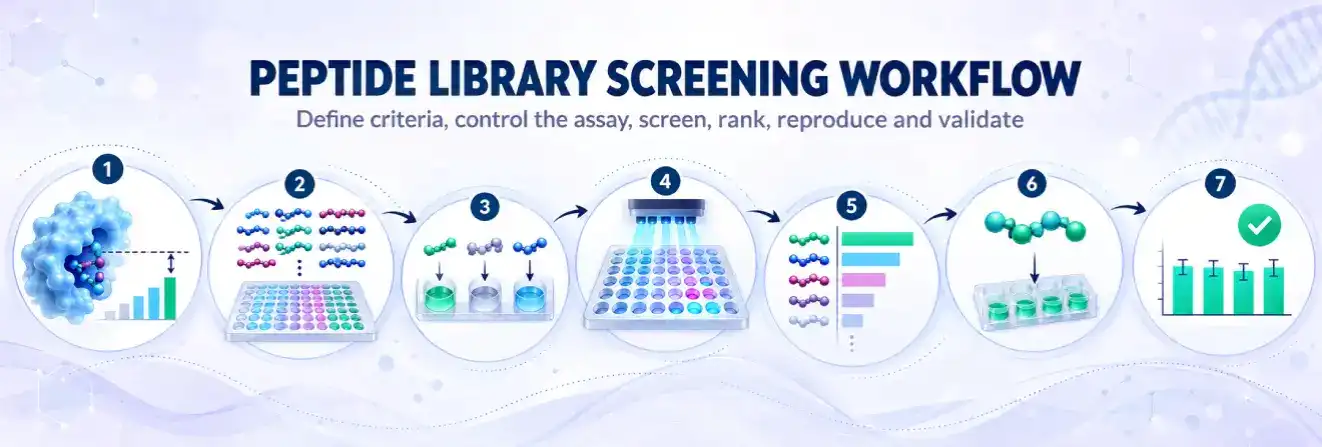
A structured screening workflow improves the likelihood that candidate hits can be interpreted and reproduced.
Step 1: Define the Selection Criterion
The experimental criterion should be established before screening begins.
Researchers need to define what constitutes a meaningful response and how that response differs from assay background.
Step 2: Match Library Diversity to the Assay
The number of sequences should be compatible with the capacity and sensitivity of the screening platform.
If library diversity is far larger than the assay can evaluate reliably, important sequences may be under-represented or missed.
Step 3: Establish Controls
Controls help distinguish meaningful sequence-dependent effects from technical noise.
Positive, negative, scrambled or reference controls may be used depending on the experimental design.
Step 4: Perform the Initial Screen
The full library is tested under standardised conditions.
Consistency is particularly important because sequence comparisons become unreliable when assay conditions vary substantially across plates or batches.
Step 5: Rank Candidate Hits
Sequences can be prioritised according to predefined criteria such as signal strength, enrichment, reproducibility or performance relative to controls.
Ranking should not rely only on the strongest raw signal. Data quality and sequence-specific artefacts should also be considered.
Step 6: Isolate or Reproduce Selected Candidates
Selected peptides may be resynthesised or otherwise generated independently before validation.
This helps separate true sequence-dependent behaviour from potential sample-specific issues in the original library.
Step 7: Validate the Results
Final candidate sequences should be examined with appropriate replicates and, where possible, independent analytical methods.
Validation is the stage that turns an initial screening observation into a more reliable research finding.
What Makes a Peptide Library Screen Reliable?
Reliable peptide screening depends on more than library size or assay throughput. The strongest studies combine appropriate sequence coverage with well-controlled experimental measurements.
Library Coverage
The library must represent the sequence differences required to answer the research question.
For systematic mapping, missing peptides can create gaps that make interpretation difficult. For random libraries, limited sampling may leave large regions of theoretical sequence space unexplored.
Assay Quality
The assay should provide a reproducible signal that can be distinguished clearly from background.
Important considerations include:
- dynamic range;
- signal-to-background ratio;
- replicate consistency;
- sensitivity;
- technical variability.
Reproducibility
A candidate sequence should perform consistently across repeated measurements.
Replicates can help distinguish genuine sequence-dependent behaviour from isolated experimental variation.
Common Challenges in Peptide Library Research
Peptide libraries provide extensive comparative information, but their interpretation requires an understanding of practical limitations.
Library Size Can Increase Rapidly
The theoretical number of sequences increases exponentially when multiple positions are varied.
If five amino acids are allowed at each of six variable positions, the number of possible combinations is already 15,625. Expanding either the number of variable positions or the amino acid choices can increase diversity dramatically.
For this reason, rational restrictions are often necessary.
Complete Sequence-Space Coverage Is Rare
For longer random peptides, the number of theoretical sequences becomes far larger than any practical library can contain.
A random library therefore represents a sample of possible sequence space rather than every possible peptide.
Difficult Peptide Sequences
Not every designed sequence can necessarily be produced with the same efficiency or analytical quality.
Uneven synthesis success may influence how well the physical library reflects the original digital design.
Solubility and Aggregation
Low solubility or aggregation can affect apparent assay performance.
A low signal may reflect poor availability of the peptide rather than weak molecular interaction, while aggregation can sometimes create misleading high signals.
False Positives
False positives can arise from:
- non-specific binding;
- assay interference;
- surface interactions;
- aggregation;
- technical errors;
- threshold selection.
Secondary screening is therefore essential.
Screening Bias
Different screening systems can favour some sequence properties over others.
Display-based libraries, synthetic arrays and solution-based assays do not necessarily sample or present peptides in the same way. A candidate selected in one system may therefore need additional evaluation in another format.
Research Applications of Peptide Libraries
Peptide libraries are widely used in peptide research because they allow systematic relationships between sequence variation and experimental behaviour to be studied.
Protein-Peptide Interaction Research
Libraries can help identify sequences that interact with proteins or other molecular targets.
After candidate binders are identified, related sequence variants can be studied to determine which residues contribute most strongly to the interaction.
Epitope Mapping
Overlapping peptide libraries can provide systematic coverage of a larger protein sequence.
This approach can help locate short linear regions associated with molecular recognition in controlled research assays.
Binding Motif Identification
Random, combinatorial and positional scanning libraries can reveal sequence patterns that are repeatedly associated with stronger binding or recognition.
The resulting data may help define a consensus motif or preferred residue pattern.
Structure-Activity Relationship Research
Sequence variants can be compared to examine how residue changes affect a measurable experimental response.
Alanine scanning, substitution libraries and truncation series are particularly useful for this type of investigation.
Proteomics Research
Peptide libraries can support studies of protein recognition, binding specificity and sequence-dependent molecular interactions within proteomics workflows.
Defined peptide arrays can also provide an organised way to compare many sequence motifs in parallel.
Molecular Recognition Studies
Libraries make it possible to examine how changes in charge, hydrophobicity, residue order and side-chain chemistry affect recognition between molecules.
These studies can provide broader information about the sequence features that influence interaction specificity.
Screening Method Development
Peptide libraries can also be used to evaluate and optimise research assays.
A library containing peptides with a range of known or expected responses can help determine whether a screening method has sufficient sensitivity, specificity and dynamic range.
Peptide Library Design vs Peptide Library Screening
Peptide library design and peptide library screening are closely connected but represent different stages of the research process.
| Peptide Library Design | Peptide Library Screening |
| Determines which sequences will be included | Tests the resulting sequence collection |
| Defines fixed and variable positions | Measures experimental responses |
| Establishes expected diversity | Identifies candidate hits |
| Includes control planning | Compares hits with controls |
| Occurs before library generation | Occurs after the library is available |
| Focuses on the research question | Focuses on experimental measurement |
Strong screening results depend heavily on decisions made during design. A well-designed library makes it easier to interpret why one sequence behaves differently from another.
Peptide Library Research: Design, Screening and Validation
A peptide library provides a structured way to examine how sequence variation affects molecular and biochemical behaviour.
Different formats support different research goals, from mapping sequence regions and identifying key residues to exploring broader sequence diversity through random, combinatorial or display-based approaches. Reliable results depend on thoughtful peptide library design, appropriate controls, suitable synthesis strategies and screening methods that match the study objective.
Peptide library screening should also be followed by secondary testing and independent validation to confirm meaningful hits. Treating design, synthesis, screening and validation as connected stages improves the overall reliability and interpretation of peptide library research.
To understand how research-use-only products are defined and handled, see our guide to research use only peptides.
For questions about peptide research, laboratory applications or available research products, contact Australia Peptide Sciences.
FAQs About Peptide Libraries
What Is a Peptide Library Used For?
A peptide library is used to compare multiple peptide sequences and study how sequence variation affects measurable experimental properties. Researchers may use peptide libraries to investigate molecular binding, sequence recognition, interaction regions, residue importance and other sequence-dependent behaviours.
How Is a Peptide Library Screened?
Peptide library screening involves testing many peptide sequences against a defined experimental criterion. Researchers identify candidate hits based on measurable signals such as binding, fluorescence, biochemical activity or enrichment, then confirm promising sequences through secondary testing and independent validation.
What Is the Difference Between a Peptide Library and a Peptide Pool?
A peptide library is designed to explore sequence diversity systematically or randomly, while a peptide pool refers more generally to several peptides combined in one mixture. Pooling can simplify initial testing, but additional deconvolution may be required to identify which individual peptide produced a measured response.
What Is a Phage Display Peptide Library?
A phage display peptide library uses bacteriophages to present diverse peptide sequences. Each displayed peptide is genetically linked to the DNA that encodes it, allowing selected sequences to be enriched during screening and subsequently identified through their associated genetic information.
What Is the Difference Between Synthetic and Display-Based Peptide Libraries?
Synthetic peptide libraries contain physically synthesised peptides with defined sequences and provide direct control over peptide identity. Display-based libraries use genetically encoded systems to present large sequence populations and are particularly useful for selection and enrichment from highly diverse libraries.
How Do Researchers Choose the Right Peptide Library?
The most appropriate peptide library depends on the research objective. Overlapping libraries are useful for mapping sequence regions, alanine scanning can identify important residues, truncation libraries help define minimal sequence boundaries, and random or combinatorial libraries support broader sequence exploration.
References
- Merrifield RB. Solid Phase Peptide Synthesis. I. The Synthesis of a Tetrapeptide. Journal of the American Chemical Society. 1963;85(14):2149–2154.
- Geysen HM, Meloen RH, Barteling SJ. Use of peptide synthesis to probe viral antigens for epitopes to a resolution of a single amino acid. Proceedings of the National Academy of Sciences USA. 1984;81(13):3998–4002.
- Smith GP. Filamentous fusion phage: novel expression vectors that display cloned antigens on the virion surface. Science. 1985;228(4705):1315–1317.
- Lam KS, Salmon SE, Hersh EM, et al. A new type of synthetic peptide library for identifying ligand-binding activity. Nature. 1991;354(6348):82–84.
- Houghten RA, Pinilla C, Blondelle SE, et al. Generation and use of synthetic peptide combinatorial libraries for basic research and drug discovery. Nature. 1991;354(6348):84–86.