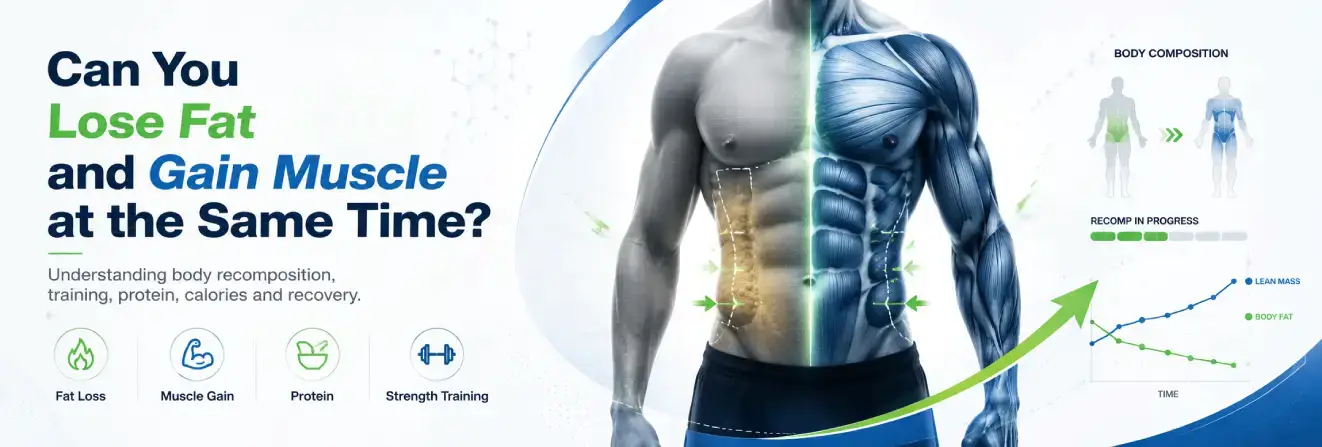
Can you lose fat and gain muscle at the same time? Yes. This process, known as body recomposition, involves reducing body fat while maintaining or increasing muscle mass.
Results vary depending on training experience, calorie and protein intake, resistance training, sleep and recovery. Because fat loss and muscle gain can occur together, body weight may change only slightly even when body composition improves.
Can You Lose Fat and Gain Muscle at the Same Time?
Losing fat while building muscle may sound contradictory because fat loss is usually associated with a calorie deficit, while muscle growth is often associated with adequate energy and nutrients. In practice, the body is capable of using stored energy while responding to a muscle-building training stimulus.
Research has documented increases in fat-free mass alongside reductions in fat mass in several populations, including some people who already had resistance-training experience. The magnitude of the change varies considerably between individuals.
Fat and muscle are separate tissues, so changes in one do not automatically produce the same change in the other.
What Body Recomposition Actually Means
Body recomposition refers to improving the ratio between fat mass and lean mass rather than focusing only on reducing total body weight.
A successful recomposition phase might involve:
- Decreasing body fat.
- Maintaining or increasing muscle mass.
- Improving strength or training performance.
- Reducing waist circumference.
- Seeing changes in body shape without a dramatic change in scale weight.
For this reason, body recomposition is different from a conventional weight-loss plan in which the main objective is simply to make body weight decrease.
Fat Loss Is Not the Same as Weight Loss
Understanding the difference between fat loss and weight loss is important because body weight includes far more than body fat. It also reflects muscle, bone, organs, water, glycogen and other tissues.
If someone loses 2 kg of fat but gains 1 kg of lean mass, the scale may show only a 1 kg reduction even though body composition has changed substantially.
| Goal | Fat Mass | Muscle Mass | Scale Weight | Main Objective |
| Weight loss | Usually decreases | May decrease or remain stable | Decreases | Lower total body weight |
| Fat loss | Decreases | Ideally maintained | Usually decreases | Reduce body fat |
| Muscle gain | May remain stable or increase | Increases | Usually increases | Build muscle |
| Body recomposition | Decreases | Maintained or increases | May change slowly | Improve fat-to-muscle ratio |
This is why relying only on scale weight can make genuine progress difficult to recognise.
How Does Body Recomposition Work?
Body recomposition depends on the interaction between energy balance, resistance training, protein intake and recovery.
Fat loss requires the body to use more stored energy over time. Muscle growth, meanwhile, requires an appropriate training stimulus and sufficient nutritional support.
These processes can overlap.
Energy Balance and Stored Body Fat
A calorie deficit occurs when energy expenditure exceeds energy intake. When this continues over time, the body must draw on stored energy.
Body fat is one of those energy stores. Tesamorelin has also been studied in research examining growth hormone signalling and related metabolic processes.
However, the size of the deficit matters. A very aggressive reduction in calories may make training harder, reduce recovery capacity and increase the risk of losing lean mass.
A smaller, more controlled deficit can be more compatible with maintaining training quality and supporting muscle retention.
Some individuals may also experience favourable body-composition changes around maintenance intake, particularly when beginning an effective resistance-training programme or returning after a period away from training.
Muscle Protein Synthesis and Resistance Training
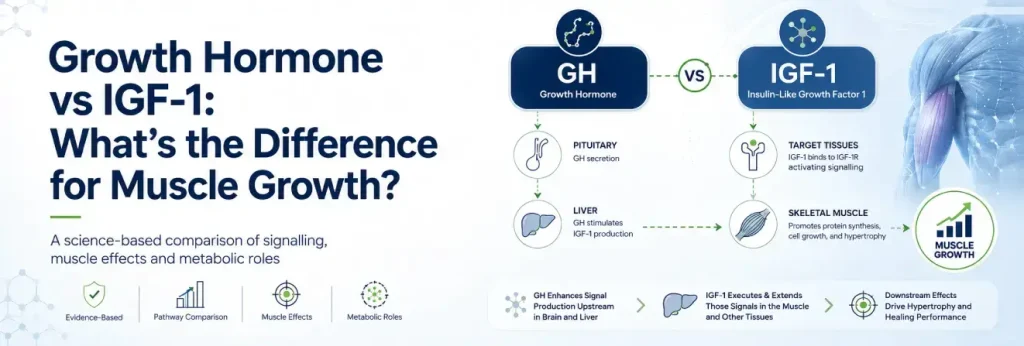
Muscle tissue constantly undergoes processes of breakdown and rebuilding, influenced by training, nutrition and hormonal signals such as growth hormone and IGF-1.
Resistance exercise provides a stimulus that encourages the body to adapt by repairing and strengthening trained muscle tissue.
For muscle growth to occur effectively, that stimulus needs to be repeated over time and supported by:
- Sufficient protein.
- Adequate overall nutrition.
- Progressive training.
- Recovery between sessions.
- Consistent sleep.
Simply eating more protein without providing a meaningful resistance-training stimulus will not reproduce the adaptations expected from structured strength training.
Why Fat and Muscle Can Change in Opposite Directions
Muscle and fat are different tissues with different functions.
Research into growth-related signalling also includes IGF-1 LR3, which has been studied for its interaction with IGF-1 receptors and related cellular pathways.
The balance is not identical for everyone. A beginner with relatively high body fat may respond differently from a highly trained, very lean athlete.
Recomposition potential therefore depends heavily on the individual’s training status, body composition, nutrition and recovery.
Who Is Most Likely to Lose Fat and Gain Muscle at the Same Time?
Body recomposition can occur across different training levels, but some people are generally in a better position to experience noticeable changes.
Beginners to Resistance Training
People who are new to structured resistance training often have substantial potential for adaptation.
Because the training stimulus is new, increases in strength and lean mass may occur relatively quickly compared with someone who has trained consistently for many years.
This makes beginners one of the groups most commonly associated with successful body recomposition.
People With Higher Starting Body-Fat Levels
People with higher body-fat levels have larger stored energy reserves, although starting body-fat level alone does not determine whether body recomposition will occur.
This does not guarantee muscle gain. Training quality, protein intake, total energy intake and recovery still matter.
People Returning After a Training Break
Someone who previously trained consistently and then stopped for several months may regain lost performance and muscle relatively quickly after returning.
This is often described as muscle memory.
During this period, an individual may regain lean mass while simultaneously reducing accumulated body fat, particularly if nutrition and training are well controlled.
Can Experienced Lifters Recomp?
Yes. Body recomposition is not limited to beginners, although it is often more difficult for experienced lifters.
Research has reported increases in fat-free mass alongside reductions in fat mass in several resistance-trained populations.
However, advanced trainees generally have less room for rapid muscle growth because much of their initial adaptation has already occurred.
For them, body recomposition may be:
- Slower.
- Smaller in magnitude.
- More sensitive to nutrition and recovery.
- Harder to detect over short periods.
When Body Recomposition Becomes More Difficult
Recomposition may become more difficult when someone is:
- Already very lean.
- Highly advanced in resistance training.
- Using an excessive calorie deficit.
- Recovering poorly.
- Sleeping inadequately.
- Training without progressive overload.
- Attempting to maintain a very high exercise workload while eating too little.
| Situation | Recomposition Potential | Main Challenge | Practical Priority |
| Beginner | Generally favourable | Learning technique and consistency | Build training habits |
| Higher body-fat level | Potentially favourable | Maintaining muscle during fat loss | Moderate deficit and resistance training |
| Returning lifter | Often favourable | Rebuilding consistency | Progressive retraining |
| Intermediate lifter | Possible | Slower muscle growth | Precise nutrition and progression |
| Advanced lean lifter | More difficult | Limited remaining adaptation | Consider dedicated phases |
| Aggressive dieting phase | Less favourable | Recovery and lean-mass loss | Reduce unnecessary restriction |
How to Lose Fat and Gain Muscle at the Same Time
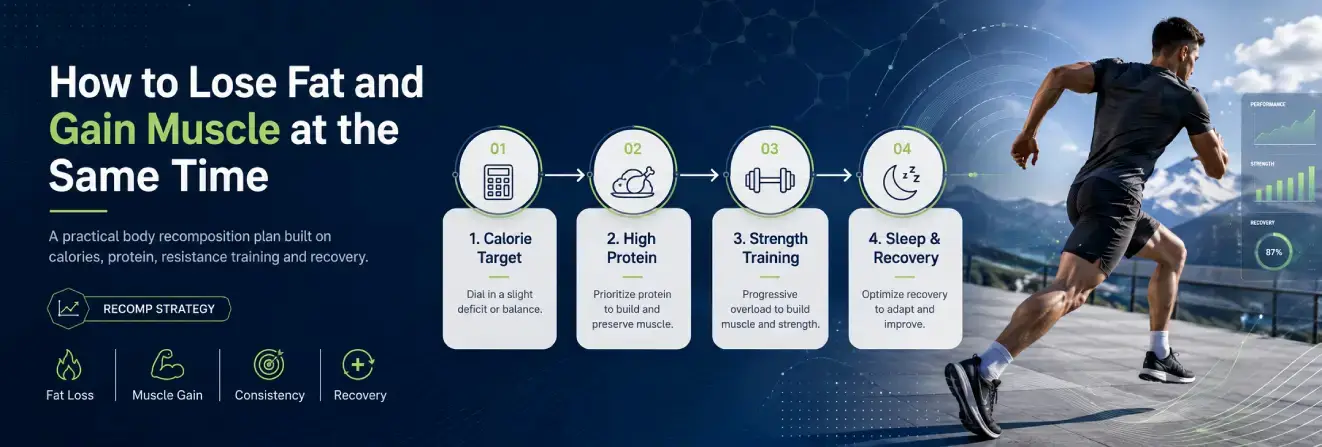
Successful body recomposition depends on combining appropriate nutrition, progressive resistance training and adequate recovery.
The following seven steps cover the main elements of an effective body recomposition approach.
1. Set an Appropriate Calorie Target
A large calorie deficit is not necessary simply because fat loss is a goal.
A moderate reduction in energy intake is often easier to combine with resistance training because it allows more energy for performance and recovery.
The appropriate calorie target depends on factors such as:
- Current body size.
- Starting body-fat level.
- Activity level.
- Training experience.
- Rate of weight change.
- Performance in the gym.
If body weight is falling rapidly while strength and recovery are deteriorating, the deficit may be more aggressive than necessary.
2. Eat Enough Protein
Protein provides amino acids required for muscle repair and remodelling.
Adequate dietary protein becomes particularly important during fat loss because the goal is not merely to reduce body weight but to preserve as much lean tissue as possible.
Useful food sources can include:
- Lean meat.
- Fish.
- Eggs.
- Dairy products.
- Soy foods.
- Legumes.
- Other protein-rich whole foods.
Protein supplements can be convenient, but they are not required if daily protein needs can be met through food.
3. Prioritise Progressive Resistance Training
Resistance training is one of the central components of body recomposition.
The aim is to provide a sufficient training stimulus to maintain or build muscle mass.
Useful training methods include:
- Free weights.
- Machines.
- Cable exercises.
- Body-weight resistance.
- Other forms of progressively loaded exercise.
Progress can come from gradually improving:
- Load.
- Repetitions.
- Sets
- Exercise execution.
- Range of motion.
- Total training volume.
Progressive overload does not mean adding weight at every workout. It means that training becomes appropriately more challenging over time.
4. Use Cardio Without Letting It Replace Resistance Training
Cardiovascular exercise can support energy expenditure, fitness and general health.
It can be useful during a fat-loss phase, but adding more cardio does not automatically improve body recomposition.
High volumes of cardio may make recovery more difficult when combined with demanding resistance training and insufficient energy intake.
A balanced programme generally treats resistance training as the main muscle-preserving stimulus and cardio as a complementary tool.
5. Prioritise Sleep and Recovery
Training creates the stimulus for adaptation, but recovery determines whether the body can respond effectively.
Insufficient sleep can affect:
- Exercise performance.
- Perceived effort.
- Appetite.
- Recovery.
- Lean-mass preservation.
Research has also associated sleep restriction with less favourable body-composition outcomes during calorie restriction.
6. Stay Consistent Long Enough to Measure a Trend
Body recomposition is rarely obvious after a few days.
Water retention, glycogen changes, digestion, menstrual-cycle changes and training-induced inflammation can all influence short-term body weight.
Progress should be assessed over a meaningful period using several measures rather than reacting to individual weigh-ins.
7. Review the Plan Using Actual Results
Review progress using body weight, measurements and training performance, and make adjustments only after a consistent trend becomes clear.
Can You Build Muscle and Lose Fat at Same Time in a Calorie Deficit?
One of the most common questions about body recomposition is whether muscle can still be gained during a calorie deficit.
Yes, muscle gain can occur during a calorie deficit in some circumstances. It is more likely when the person has substantial capacity for muscular adaptation and when the deficit is not so severe that training and recovery suffer.
Why a Smaller Deficit May Be More Compatible With Muscle Retention
The larger the calorie deficit becomes, the greater the challenge of supporting demanding training and recovery.
A moderate deficit gives the body a better opportunity to maintain exercise quality while still drawing on stored energy.
This is particularly relevant when the goal is body composition rather than the fastest possible reduction in scale weight.
Why an Aggressive Deficit Can Make Muscle Gain Harder
Rapid weight loss may sound attractive, but it can come with trade-offs.
Possible warning signs of excessive restriction include:
- Falling training performance.
- Persistent fatigue.
- Poor recovery.
- Increased hunger.
- Difficulty maintaining exercise intensity.
- Loss of strength.
- Faster loss of lean tissue.
The goal of recomposition is not simply to make the scale fall as quickly as possible.
Do You Always Need a Calorie Deficit?
Not necessarily.
Some studies have reported improvements in body composition under different energy-intake conditions, including maintenance or higher-energy diets combined with resistance training and relatively high protein intake.
Calories still matter, but body composition is also influenced by training, protein intake and recovery.
There is no single protein target that is ideal for every individual.
For someone whose main priority is reducing body fat, an appropriate deficit remains a practical approach. Someone primarily focused on maximising muscle growth may eventually benefit from a controlled energy surplus instead.
How Much Protein Do You Need for Body Recomposition?
Protein is one of the most important nutritional variables for maintaining and building lean tissue.
Research involving resistance training has reported favourable changes in lean and fat mass across a range of moderate to high protein intakes.
Ideal protein intake varies between individuals.
Why Protein Matters During Fat Loss
When calorie intake decreases, the body has less dietary energy available.
Adequate protein helps support muscle tissue while resistance training continues to provide the stimulus for preservation or growth.
Protein also contributes to satiety, which may make a calorie-controlled diet easier to maintain.
Protein Intake and Resistance Training
Protein works best as part of a complete training and nutrition strategy.
The main priorities are:
- Meeting an appropriate total daily protein intake.
- Consuming protein consistently.
- Maintaining sufficient overall nutrition.
- Continuing progressive resistance training.
Muscle growth cannot be reduced to protein intake alone.
Whole Foods vs Protein Supplements
Whole foods can provide protein together with vitamins, minerals and other nutrients.
Protein supplements may offer convenience when dietary intake falls short, but they are not required for body recomposition and should not replace a generally balanced diet.
What Is the Best Training Approach for Body Recomposition?
There is no single workout programme that guarantees simultaneous fat loss and muscle gain.
The most important requirement is a progressive resistance-training programme that can be performed consistently.
Resistance Training Is the Primary Muscle-Building Stimulus
If preserving or gaining muscle is part of the goal, the body needs repeated resistance-training exposure.
A programme should train the major muscle groups and include sufficient volume to create adaptation without creating more fatigue than the person can recover from.
Progressive Overload Matters More Than Constantly Changing Exercises
Frequently changing exercises can make progress difficult to measure.
Keeping important movements in the programme long enough to improve them allows changes in strength, repetitions and execution to be tracked.
Progressive overload can involve:
- Adding resistance.
- Performing more repetitions.
- Improving technique.
- Increasing productive training volume.
- Improving control through the movement.
Training Volume and Frequency
The ideal number of sessions depends on training experience, available time and recovery.
Research has reported successful recomposition outcomes across different resistance-training frequencies and programme designs.
Consistency and progressive training matter more than finding a supposedly perfect workout split.
Where Cardio Fits In
Cardio can help increase total activity and improve cardiovascular capacity.
Appropriate options may include:
- Walking.
- Cycling.
- Swimming.
- Running.
- Interval training.
The amount should complement resistance training rather than consistently leaving the individual too fatigued to perform it effectively.
Why Recovery Between Sessions Matters
Muscles do not need endless training to grow.
They need enough stimulus followed by enough recovery.
If strength, motivation and performance are continually declining, increasing training volume is unlikely to solve the problem.
For laboratory research products, explore our research peptide range.
Signs of Muscle Gain and Fat Loss
The clearest signs of muscle gain and fat loss often appear across several measurements rather than one single metric.
Your Waist Measurement Is Decreasing
A gradual reduction in waist circumference can indicate fat loss, particularly when measured under consistent conditions.
It is often more useful than watching scale weight alone.
Your Strength Is Increasing or Being Maintained
Improving strength while losing body fat can be a positive sign that muscle tissue and training performance are being supported.
Strength is not a perfect measurement of muscle mass because technique and neurological adaptation also influence performance, but it remains a useful indicator.
Your Clothes Fit Differently
A smaller waist combined with more developed shoulders, legs or arms may change how clothing fits even if scale weight remains similar.
Progress Photos Show Changes
Photos taken under similar lighting, posture, distance and conditions can show changes that are difficult to notice day by day.
Body-Fat Measurements Trend Downward
Body-fat measurements may help, but they should not be interpreted as perfectly precise.
What matters most is whether measurements taken under similar conditions show a consistent trend.
Your Weight Is Stable but Your Body Shape Is Changing
This pattern can occur during body recomposition.
Possible signs include:
- Waist measurements decreasing.
- Muscle definition increasing.
- Strength improving.
- Clothes becoming looser around the waist.
- Scale weight remaining relatively stable.
- Progress photos showing a leaner appearance.
Why Am I Building Muscle but Not Losing Fat?
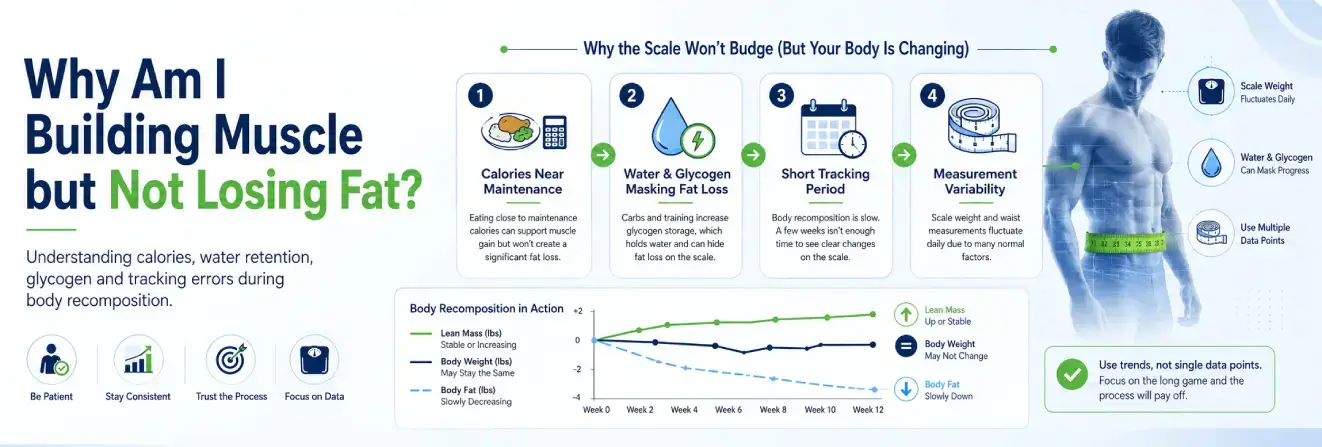
Building muscle without a noticeable reduction in body fat often comes down to energy intake, measurement accuracy and how long the plan has been followed.
Your Calorie Intake May Be Higher Than You Think
Muscle gain does not guarantee fat loss.
If average calorie intake is high enough to meet or exceed energy expenditure, muscle may increase without a meaningful reduction in fat mass.
Small additions such as drinks, snacks, sauces or larger weekend meals can significantly affect weekly intake.
Fat Loss May Be Hidden by Muscle, Water or Glycogen Changes
Scale weight can increase when muscles store more glycogen and water.
Resistance training can also temporarily increase water retention, particularly after demanding sessions.
Someone may therefore be losing fat even though short-term body weight does not change.
You May Not Have Been Tracking Long Enough
A few days or one week is rarely enough to determine whether a recomposition strategy is working.
Short-term fluctuations can easily mask gradual fat loss.
Your Training May Be Improving Faster Than Your Diet
Someone may train consistently and build strength but still consume too much energy to reduce fat stores.
In that case, the solution may not be more exercise. A modest adjustment to average calorie intake may be more appropriate.
Poor Sleep and Recovery May Be Affecting Progress
Poor recovery can reduce training quality and make dietary adherence harder.
If someone is constantly fatigued, hungry and under-recovered, the programme may need to be adjusted before adding more exercise.
Your Measurement Method May Be Misleading You
Home body-fat scales can fluctuate substantially based on hydration and other factors.
One reading should never be treated as proof that fat has been gained or lost.
| What You Notice | Possible Explanation | What to Check |
| Strength increasing but waist unchanged | Muscle gain may be occurring without meaningful fat loss | Average energy intake |
| Weight unchanged but waist smaller | Recomposition may be occurring | Continue tracking |
| Weight dropping quickly and strength falling | Deficit may be too aggressive | Calories and recovery |
| Body-fat readings change sharply day to day | Measurement variability | Hydration and longer-term trends |
| No change in weight, measurements or performance | Current plan may be insufficient | Training, calories and adherence |
How to Measure Body Recomposition Properly
No single method provides a perfect picture of body composition.
Using several measurements together is usually more useful than relying on one number.
Scale Weight
Daily or regular weigh-ins can help identify trends, provided they are interpreted over time.
Body weight is influenced by:
- Food intake.
- Hydration.
- Sodium.
- Glycogen.
- Digestive contents.
- Hormonal changes.
For that reason, averages and trends are more useful than isolated readings.
Waist and Body Measurements
Waist circumference is inexpensive and easy to track.
Measurements should be taken consistently using the same anatomical location and similar conditions.
Progress Photos
Photos can provide a visual record of changes in muscle definition, waist size and overall shape.
Consistency in lighting and positioning makes comparison more useful.
Strength and Training Performance
Training records can show whether strength and work capacity are improving, remaining stable or declining.
This provides context for changes in body weight and measurements.
DEXA and Other Body-Composition Tests
Several methods can estimate fat mass and fat-free mass, including:
- DEXA.
- Bioelectrical impedance.
- BodPod.
- Skinfold measurements.
- Ultrasound-based techniques.
Each has limitations.
Hydration, nutrition status, body size and the assessment method itself can influence reported body-composition changes.
Why You Should Use More Than One Measurement
A combination of methods provides a more useful picture.
| Measurement | What It Shows | Main Advantage | Main Limitation |
| Scale weight | Total mass | Simple and inexpensive | Cannot distinguish fat from muscle |
| Waist measurement | Central size change | Easy to repeat | Technique must be consistent |
| Progress photos | Visual body changes | Shows shape and definition | Lighting and posture affect comparison |
| Strength records | Training performance | Useful for monitoring adaptation | Strength is not identical to muscle mass |
| DEXA | Estimated fat, lean mass and bone | Detailed body-composition data | Cost and measurement variability |
| BIA scale | Estimated body fat and lean mass | Convenient | Strongly influenced by hydration |
How Long Does Body Recomposition Take?
There is no universal timeline for body recomposition.
The rate of progress depends heavily on the individual’s starting point.
Why There Is No Universal Timeline
Important variables include:
- Training experience.
- Starting body-fat level.
- Calorie intake.
- Protein intake.
- Training programme.
- Sleep.
- Recovery.
- Genetics.
- Consistency.
- Measurement method.
A beginner returning to exercise after a long period of inactivity may notice measurable changes faster than an advanced lifter who is already lean.
Focus on Trends, Not Daily Changes
Muscle gain and fat loss are gradual processes.
Daily changes mostly reflect water, food intake and other short-term variables.
A consistent multi-week trend in:
- Waist size.
- Average body weight.
- Strength.
- Photos.
- Body-composition measurements.
is more informative than any single day’s result.
When to Reassess Your Strategy
A plan should be reviewed when there has been enough time to establish a reliable trend and there is still no meaningful change.
Possible adjustments may include:
- Reviewing calorie intake.
- Improving protein consistency.
- Modifying training volume.
- Improving exercise progression.
- Increasing general activity.
- Addressing poor sleep.
- Reducing unnecessary fatigue.
Should You Recomp, Cut or Build Muscle First?
Body recomposition is not automatically the best strategy for every goal.
Sometimes concentrating on fat loss or muscle gain separately may be more efficient.
When Body Recomposition Makes Sense
Body recomposition may be a reasonable approach for:
- Beginners.
- People returning to training.
- Individuals with higher body-fat levels.
- People who want gradual body-composition improvement without aggressive dieting.
- Intermediate trainees who are still making reliable progress.
When a Dedicated Fat-Loss Phase May Be Better
A dedicated fat-loss phase may be more appropriate when reducing body fat is clearly the main priority.
Resistance training and adequate protein should still be maintained to help preserve lean mass.
When a Dedicated Muscle-Gain Phase May Be Better
Someone who is already lean and highly trained may struggle to maximise muscle growth while restricting calories.
A controlled muscle-gain phase can provide more energy to support training performance and tissue growth.
| Strategy | Primary Goal | Calorie Approach | Best Suited To | Main Trade-Off |
| Recomposition | Lose fat while gaining or maintaining muscle | Maintenance or modest deficit depending on the individual | Beginners, returning lifters, some intermediate trainees | Progress may be slower |
| Fat-loss phase | Reduce body fat | Calorie deficit | Those prioritising fat reduction | Muscle gain may be limited |
| Muscle-gain phase | Maximise muscle growth | Controlled surplus | Leaner, more advanced trainees | Some fat gain may occur |
Common Body Recomposition Mistakes
Many unsuccessful recomposition attempts fail because several parts of the plan work against each other.
Common mistakes include:
- Cutting calories too aggressively.
- Training without progressive overload.
- Relying almost entirely on cardio.
- Eating too little protein.
- Changing exercises and diets constantly.
- Judging progress only by scale weight.
- Ignoring sleep and recovery.
- Expecting dramatic results within a few weeks.
- Copying another person’s calorie intake without adjustment.
- Treating supplements as substitutes for diet and training.
- Adding more exercise whenever progress slows without first checking recovery or food intake.
A good recomposition plan should be sustainable enough to follow consistently.
Does Sleep Affect Muscle Gain and Fat Loss?
Sleep can influence several factors relevant to body recomposition.
Sleep and Lean-Mass Preservation
During calorie restriction, preserving muscle becomes particularly important.
Research has linked sleep restriction during weight loss with less favourable changes in the proportion of fat and lean tissue lost.
Sleep and Training Performance
Insufficient sleep can reduce strength-endurance performance and increase perceived effort during training.
Lower training quality may make it harder to maintain the progressive stimulus required for muscle development.
Sleep, Hunger and Recovery
Poor sleep may also affect appetite control and dietary consistency, making recovery and nutrition harder to manage over time.
For this reason, recovery should be treated as a fundamental part of body recomposition rather than an optional extra.
For laboratory research into growth hormone-related signalling, GHRP peptides represent a distinct area of study.
What Does the Research Say About Body Recomposition?
Scientific evidence supports the possibility of losing fat while increasing or maintaining lean mass, but the results vary considerably between studies and individuals.
Evidence in Beginners and People With Higher Body-Fat Levels
These populations are often considered favourable candidates because beginners have greater potential for initial adaptation, while higher fat stores may contribute additional endogenous energy. However, starting body-fat level alone does not determine whether recomposition will occur.
Nutrition, training quality and recovery still need to support the desired adaptation.
Evidence in Resistance-Trained Individuals
Body recomposition has also been reported in resistance-trained men and women.
Research has documented increases in fat-free mass alongside decreases in fat mass under various resistance-training and nutritional conditions.
The results are not identical across all participants, which highlights the importance of individual response.
What Research Still Cannot Tell Us
Current evidence does not support a single body recomposition protocol that works equally well for everyone.
Studies differ in:
- Participant training status.
- Starting body composition.
- Training frequency.
- Exercise volume.
- Protein intake.
- Total calorie intake.
- Study duration.
- Body-composition measurement method.
Results from a single study may not apply equally to every individual.
| Research Supports | Research Does Not Establish |
| Losing fat and gaining lean mass can occur during the same period | One universal recomposition diet |
| Resistance training is a major component | One perfect workout split |
| Adequate protein supports lean tissue | Protein supplements are mandatory |
| Trained people can sometimes recomp | Every trained person will achieve the same result |
| Sleep and recovery can influence outcomes | A guaranteed timeline for results |
| Measurement methods have limitations | One perfectly accurate body-fat measurement method |
Australia Peptide Sciences provides research peptides for laboratory and analytical applications, supported by product information, quality documentation and research-use standards.
Conclusion – Can You Lose Fat and Gain Muscle at the Same Time?
Can you lose fat and gain muscle at the same time? Yes. Body recomposition can occur when resistance training, adequate protein, appropriate calorie intake and recovery are combined consistently.
Beginners, returning lifters and some people with higher body-fat levels may find recomposition more achievable, while leaner or more advanced trainees may benefit from separate fat-loss and muscle-gain phases. Progress should be judged using several measures, including waist size, strength, photos and longer-term body-weight trends.
FAQs About Can You Lose Fat and Gain Muscle at the Same Time
What kills muscle gains the most?
Muscle growth can slow when several key factors are consistently missing. These include effective resistance training, enough dietary protein, sufficient calorie intake, quality sleep and adequate recovery. During a fat-loss phase, an overly aggressive calorie deficit can also make it harder to maintain or build muscle.
Is it better to lose fat first then build muscle?
The best approach depends on your current body composition and training experience. People with higher body-fat levels may benefit from prioritising fat loss while continuing resistance training and eating enough protein. Beginners and returning lifters may be able to lose fat and gain muscle at the same time through body recomposition, while leaner and more advanced trainees may achieve better results by separating fat-loss and muscle-building phases.
What are signs your body is burning fat?
Fat loss cannot be confirmed by a particular feeling or sensation. More reliable signs include a gradual reduction in waist circumference, a downward trend in body weight when a calorie deficit is present, looser-fitting clothes and consistent decreases in body-fat measurements. Changes in hunger, energy or fat texture alone do not reliably show that body fat is being lost.
What are signs of muscle gain and fat loss?
Common signs include a smaller waist, greater muscle definition, stable or improving strength and noticeable changes in progress photos or how clothes fit. Your scale weight may change very little because fat mass can decrease while lean mass is maintained or increased.
Why am I building muscle but not losing fat?
If muscle is increasing but body fat is not decreasing, your average calorie intake may be close to maintenance or above your energy needs. Water retention and increased muscle glycogen can also temporarily hide fat loss on the scale. Tracking waist measurements, body-weight trends, food intake and training performance can give a clearer picture of whether body recomposition is actually occurring.
How do I get my body to lose fat while preserving muscle?
A sustainable calorie deficit is generally needed to reduce body fat. To help protect muscle during the process, combine the deficit with progressive resistance training and adequate protein intake.
Laboratory studies of tirzepatide focus on its dual activity at GIP and GLP-1 receptors and their roles in metabolic and appetite-related pathways.
Avoiding unnecessarily aggressive calorie restriction can also make it easier to maintain training performance and lean mass.
What exercises are best for building muscle while losing fat?
There is no single exercise that produces the fastest muscle growth for everyone. A well-structured resistance-training programme should train the major muscle groups and gradually become more challenging over time. Exercises such as presses, rows, squats, leg presses, hinges and pull-downs can all be effective when performed with appropriate resistance, volume and progression.
Sources:
- PubMed – High Protein Diet and Body Composition in Resistance-Trained Individuals
https://pubmed.ncbi.nlm.nih.gov/26500462/ - CDC – Physical Activity and Healthy Weight
https://www.cdc.gov/healthy-weight-growth/physical-activity/ - PubMed – Energy Deficiency and Lean Mass Gains During Resistance Training
https://pubmed.ncbi.nlm.nih.gov/34623696/ - Australian Institute of Sport – Isolated Protein Supplement
https://www.ausport.gov.au/ais/nutrition/supplements/group_a/sports-foods2/isolated-protein-supplement2 - PubMed – Resistance Exercise During Dietary Weight Loss
https://pubmed.ncbi.nlm.nih.gov/40909191/ - PubMed – Sleep Restriction and Body Composition During Calorie Restriction
https://pubmed.ncbi.nlm.nih.gov/29438540/ - PubMed – Hydration and Bioelectrical Impedance Body Composition Measurements
https://pubmed.ncbi.nlm.nih.gov/37335581/ - FDA – Tirzepatide and GIP/GLP-1 Receptor Activity
https://www.fda.gov/news-events/press-announcements/fda-approves-new-medication-chronic-weight-management - DailyMed – Tesamorelin Prescribing Information
https://dailymed.nlm.nih.gov/dailymed/drugInfo.cfm?setid=839334d3-8c1d-4c26-9036-2ab524a6ea75 - PubMed – GHRP-6 and Growth Hormone Release
https://pubmed.ncbi.nlm.nih.gov/9543138/ - PubMed – Long R3 IGF-1 and IGF-1 Receptor Signalling
https://pubmed.ncbi.nlm.nih.gov/16166219/ - Australian Government – 24-Hour Movement Guidelines for Adults
https://www.health.gov.au/topics/physical-activity/24-hour-movement-guidelines-for-all-australians/recommendations-for-adults-18-to-64-years