
Glutathione is a tripeptide widely studied in redox biology, oxidative-stress research, glutathione-dependent enzyme systems and cellular metabolism. Laboratory studies examine its reduced and oxidised forms, interactions with reactive species and relationship with mitochondrial and intracellular redox processes under defined experimental conditions.
What Is Glutathione?
Glutathione is a tripeptide composed of glutamate, cysteine and glycine. In biological systems it participates in redox reactions and enzyme-mediated pathways, including glutathione peroxidase and glutathione transferase systems. Laboratory research commonly examines glutathione through its reduced form (GSH), oxidised form (GSSG) and the relationship between these states under defined experimental conditions.
Glutathione for Research is available as a laboratory research material for controlled investigation of redox chemistry and related cellular processes.
Glutathione at a Glance
| Feature | Glutathione |
| Type | Tripeptide |
| Found In | Nearly all cells |
| Primary research context | Redox chemistry and glutathione-dependent pathways |
| Common measurements | GSH, GSSG, GSH:GSSG relationship and oxidative-stress markers |
| Produced By | The body |
Glutathione in Redox Biology
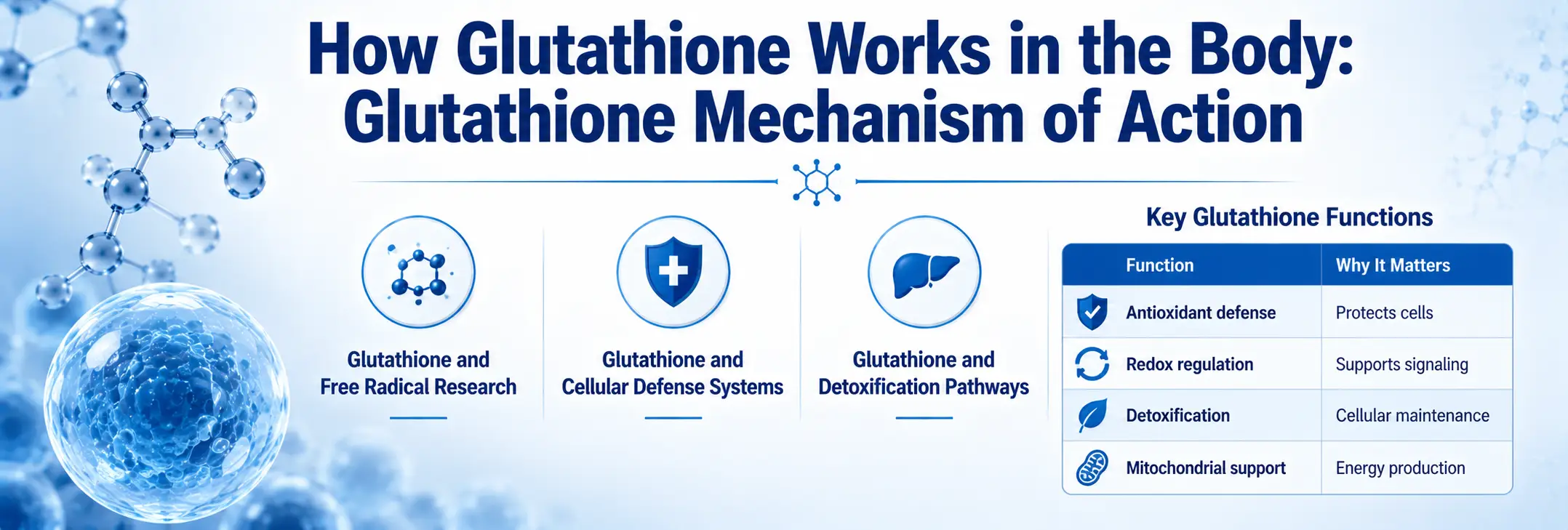
Glutathione participates in electron-transfer reactions that help regulate cellular redox state. Research commonly examines glutathione alongside reactive oxygen species, glutathione-dependent enzymes and other antioxidant systems. Its role should be interpreted through measurable biochemical endpoints rather than broad claims about health, ageing or disease prevention.
Glutathione Mechanisms in Laboratory Research
Glutathione can act as an electron donor in redox reactions and participates in enzymatic systems involved in peroxide reduction and conjugation reactions. Experimental studies may examine glutathione redox state, glutathione-dependent enzyme activity, reactive-species balance and changes in molecular oxidation under controlled conditions.
Factors That Influence Glutathione Status in Experimental Models
Measured glutathione status can vary with oxidative challenge, precursor availability, enzyme activity, mitochondrial function, inflammatory signalling and experimental conditions. Interpretation depends on tissue or cell type, measurement method and study design.
Understanding Oxidative Stress: What Is Oxidative Stress?How glutathione functions in the body
Oxidative stress reflects an imbalance between reactive species and cellular redox-regulatory systems. Its mechanisms and measurement are discussed further in Oxidative Stress: Cellular Damage & Redox Mechanisms.
Oxidative stress occurs when free radical production exceeds the body’s antioxidant defenses. This imbalance can affect cellular structures, proteins, lipids, and DNA.
What Are Free Radicals?
Free radicals are unstable molecules generated during normal metabolism and environmental exposures. While they play some beneficial roles in biology, excessive amounts may contribute to cellular damage.
Why Researchers Study Oxidative Stress
Researchers study oxidative stress because it has been linked to aging, metabolic health, inflammation, cardiovascular health, neurodegenerative conditions, and skin aging. Understanding how antioxidant systems respond to oxidative stress remains a major focus of modern biomedical research.
Sources of Oxidative Stress
| Source | Research Interest |
| Aging | Cellular decline |
| Pollution | Oxidative damage |
| UV Exposure | Skin stress |
| Inflammation | Cellular signaling |
| Metabolic Dysfunction | Redox imbalance |
Glutathione Pathways Researchers Study
Laboratory studies may examine glutathione-dependent antioxidant reactions, redox-sensitive signalling, glutathione conjugation, mitochondrial redox regulation and responses to experimentally induced oxidative challenge.
Experimental Approaches in Glutathione Research
Glutathione research spans biochemical assays, cell-based models, tissue analysis and controlled studies measuring redox-related biomarkers. Relevant endpoints can include GSH and GSSG concentrations, glutathione-dependent enzyme activity, oxidative-damage markers and mitochondrial measurements. Results should be interpreted according to the specific model, exposure conditions and analytical methods used.
Glutathione in Skin-Related Laboratory Research
Skin-related experimental models may examine glutathione in relation to oxidative stress, melanogenesis-associated pathways, redox signalling and cellular responses to environmental stressors. These research contexts do not establish cosmetic whitening, pigmentation treatment or personal-use outcomes.
Glutathione in Cellular Aging Research
Age-associated models may examine changes in glutathione redox state alongside mitochondrial function, oxidative stress and other cellular processes. Related mechanisms are discussed further in Cellular Aging. Experimental findings should remain distinct from claims about anti-ageing or longevity outcomes.
Glutathione in Immune-Cell Research
Glutathione can be investigated in immune-cell models involving reactive-species production, redox-sensitive signalling and glutathione-dependent enzymatic pathways. The presence of these mechanisms does not by itself establish immune enhancement or therapeutic effectiveness.
Glutathione in Hepatic and Conjugation Research
Laboratory studies may examine glutathione-dependent conjugation reactions, oxidative-stress markers and enzyme systems in hepatic models. These experiments investigate biochemical mechanisms rather than liver-health benefits or detoxification outcomes for individuals.
Glutathione Forms in Laboratory Research
Glutathione research materials may differ by redox state, formulation and physical form. Laboratory evaluation should focus on compound identity, formulation, analytical documentation, stability and compatibility with the intended experimental model. Australia Peptide Sciences supplies lyophilised glutathione strictly for laboratory research.
Glutathione Compared with Other Research Compounds
Glutathione differs from compounds such as NAD+, MOTS-C, SS-31 and GHK-Cu in molecular structure and the experimental pathways commonly investigated. Comparisons should focus on defined biochemical or cellular mechanisms rather than claims about energy, anti-ageing, skin outcomes or personal benefits. Compound-specific comparisons are available in the Peptide Comparison Guides.
Analytical Quality in Glutathione Research
Laboratories evaluating glutathione materials should review compound identity, reported purity, batch traceability and analytical methodology. Purity results should be interpreted alongside the relevant testing method rather than as a standalone measure of experimental suitability.
Further analytical context is available in Peptide Purity Explained.
Batch-specific analytical documentation is available through the Peptide Certificates of Analysis (COAs).
Glutathione Research at Australia Peptide Sciences
Glutathione for Research is supplied as a laboratory research material. Evaluation should be based on compound specifications, analytical documentation, batch information and compatibility with the intended experimental model.
Glutathione supplied by Australia Peptide Sciences is intended for laboratory research only and is not represented for human or veterinary consumption, supplementation, cosmetic use or clinical administration. Further context is available in the Research Use Only Peptides guide.
For preparation and analytical context beyond redox biology, see the Research Peptide Guides.
FAQs About Glutathione Research
What is glutathione?
Glutathione is a tripeptide composed of glutamate, cysteine and glycine. It participates in redox reactions and glutathione-dependent enzymatic pathways in biological systems.
What are GSH and GSSG?
GSH is the reduced form of glutathione, while GSSG is its oxidised form. Their relationship can provide information about cellular redox conditions under defined experimental settings.
Why is glutathione studied in oxidative-stress research?
Glutathione participates in reactions involving reactive species and glutathione-dependent enzymes, making it relevant to experimental studies of redox balance and molecular oxidation.
How is glutathione measured in laboratory research?
Methods may assess GSH, GSSG, total glutathione, glutathione-dependent enzyme activity or related oxidative-stress markers. Interpretation depends on sample type and analytical method.
Is glutathione research limited to antioxidant activity?
No. Research may also examine glutathione-dependent conjugation, redox-sensitive signalling, mitochondrial processes and enzyme systems.
Do glutathione research findings guarantee cosmetic or anti-ageing outcomes?
No. Findings apply to the material, model and endpoints studied and do not guarantee outcomes from personal use.
Why does glutathione purity matter in research?
Purity and identity can affect interpretation and reproducibility. They should be evaluated using batch-specific analytical documentation and the methods stated on the COA.
Is APS glutathione intended for human use?
No. Australia Peptide Sciences supplies glutathione strictly as a laboratory research material and not for human or veterinary consumption or personal use.
Sources: