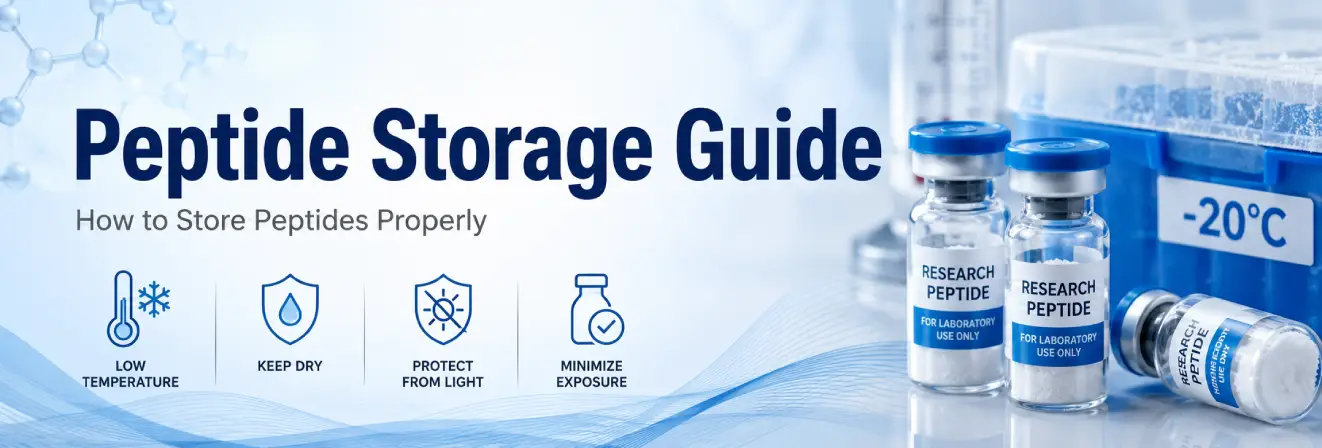
Peptide storage is one of the most important factors affecting peptide stability, handling consistency, and long-term research reliability.
Whether peptides are stored in dry form, lyophilised form, or after reconstitution, storage conditions may influence their integrity and overall laboratory performance. Temperature, moisture, light exposure, oxygen contact, and handling procedures can all affect peptide stability over time.
Peptide storage in laboratory research involves controlling environmental and handling variables that can influence material stability. Relevant factors may include temperature, moisture, oxygen exposure, light, formulation, container compatibility and handling frequency. Storage conditions should be evaluated according to compound-specific documentation and the intended experimental workflow.
Storage conditions can affect the interpretation of analytical quality data, which is discussed further in the Peptide Purity Explained guide.
Understanding Peptide Storage and Peptide Stability
Peptides are biologically active compounds composed of amino acid sequences that may respond differently to environmental conditions. Because peptide chemistry varies significantly between sequences, peptide stability is not universal.
Some peptides may remain relatively stable under controlled conditions, while others may be more sensitive to:
- Moisture
- Heat
- Oxidation
- Light exposure
- pH variation
- Contamination
- Repeated handling
Peptide stability refers to a peptide’s ability to maintain structural and chemical integrity during storage and use.
When storage conditions are poorly controlled, several degradation pathways may occur.
Common degradation mechanisms include:
- Hydrolysis
- Oxidation
- Aggregation
- Deamidation
- Surface adsorption
- Microbial contamination in solution
Because of these factors, peptide storage is often considered an essential part of peptide preparation and laboratory workflow planning rather than a simple storage step.
As interest in Research Peptides Australia continues to grow, understanding proper peptide storage and handling has become increasingly relevant in laboratory research settings.
Factors That Influence Peptide Storage
Several environmental and chemical factors may influence how peptides behave during storage.
1. Peptide Storage Temperature in Laboratory Research
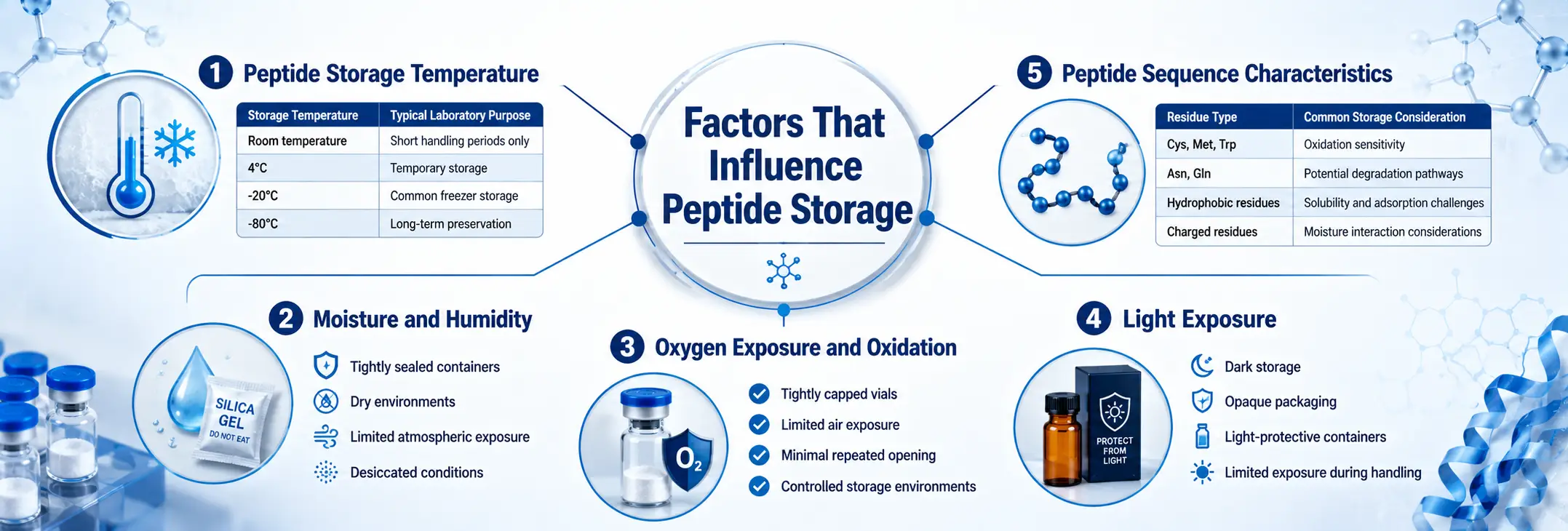
Temperature requirements must be established for the material’s physical state and formulation. Evaluate the full storage history, including excursions and repeated handling, against the applicable stability information. A single temperature label does not describe every aspect of sample integrity.
2. Moisture, Oxygen and Light
Moisture, oxygen and light can influence peptide stability through hydrolysis, oxidation, photochemical reactions or other degradation pathways. Their significance varies by sequence, formulation and experimental conditions, so environmental controls should be defined according to material-specific stability information.
Oxidation-sensitive or metal-associated peptide systems may require additional stability evaluation under the conditions used in the laboratory model.
3. Peptide Sequence Characteristics
Not all peptides behave identically during storage.
Peptide sequence characteristics may influence:
- Solubility
- Oxidation risk
- Aggregation tendency
- Moisture sensitivity
- Overall peptide shelf life
Some residues are commonly associated with particular storage concerns.
| Residue Type | Common Storage Consideration |
| Cys, Met, Trp | Oxidation sensitivity |
| Asn, Gln | Potential degradation pathways |
| Hydrophobic residues | Solubility and adsorption challenges |
| Charged residues | Moisture interaction considerations |
Because peptide chemistry varies, storage recommendations often benefit from being evaluated alongside sequence-specific characteristics.
Storage Considerations for Lyophilised Peptide Materials
Researchers frequently ask how to store peptides before reconstitution.
In many laboratory settings, peptides are supplied in dry or lyophilised form prior to preparation.
Before reconstitution, maintaining controlled storage conditions may help support peptide stability and preserve sample integrity.
Dried peptides can absorb moisture during handling or storage. Container integrity and exposure to humid air therefore matter even before reconstitution; reduced water content should not be treated as immunity to degradation.
Repeated handling may increase exposure to:
- Air
- Humidity
- Contamination
- Temperature variation
For this reason, unnecessary opening of storage containers is often avoided.
Storage Duration and Stability
Define a storage period using evidence for the specified material and conditions. Where stability is evaluated analytically, compare the relevant identity, impurity or other validated endpoints with the baseline specification. Temporary handling tolerance does not establish a shelf life.
Lyophilised Peptide Storage
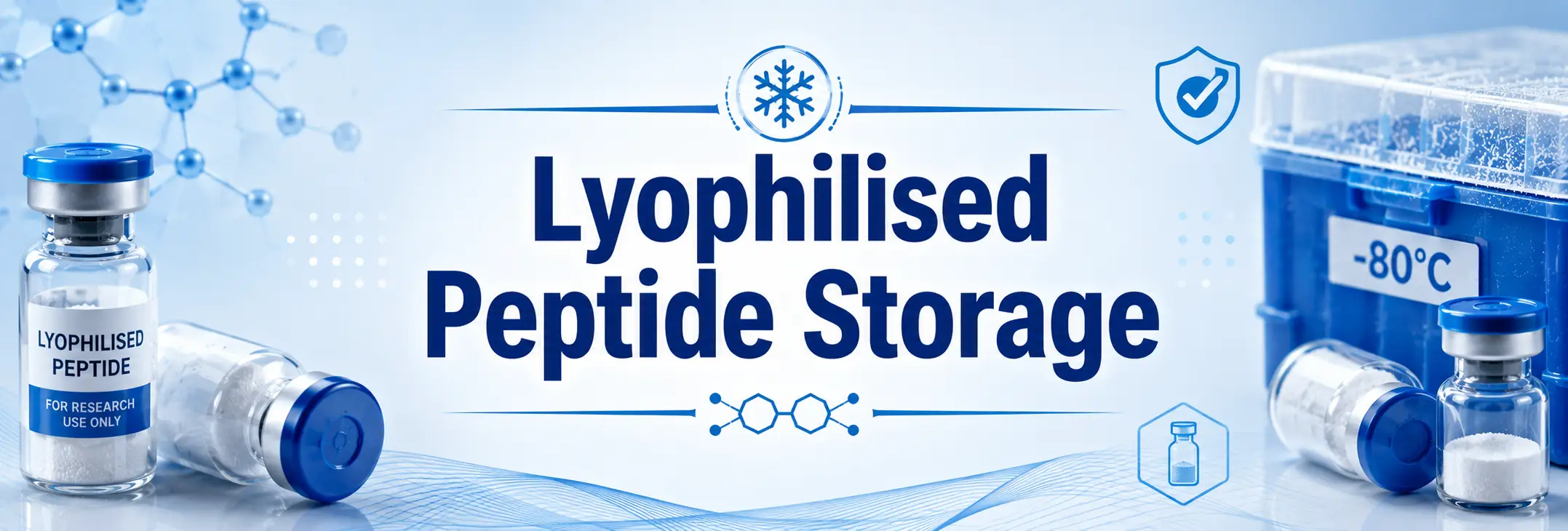
Lyophilised peptide storage is widely used because removal of water may help improve peptide stability.
Lyophilisation, often called freeze-drying, removes water from peptide preparations under controlled conditions and produces a dry material that may be more suitable for extended storage.
Many research peptides are supplied in this form.
What Is Lyophilised Peptide Storage?
Lyophilised peptide storage refers to storing peptides after freeze-drying.
This process helps reduce water-driven degradation pathways that may occur in solution.
Potential benefits of lyophilised peptide storage may include:
- Reduced hydrolysis risk
- Improved handling flexibility
- Extended peptide shelf life
- Lower microbial risk compared with solutions
Despite improved stability, lyophilised peptides still require controlled storage.
Stability of Lyophilised Peptides
Lyophilisation reduces water content but does not remove sequence-dependent degradation risks. Bachem’s peptide-handling guidance discusses moisture sensitivity and other factors relevant to dried peptide materials.
How Long Can Lyophilised Peptides Last?
Peptide shelf life for lyophilised products varies considerably.
Factors influencing stability may include:
- Sequence composition
- Storage temperature
- Moisture exposure
- Oxidation sensitivity
- Handling frequency
Certain residues may demonstrate increased sensitivity during storage.
These may include:
- Cys
- Met
- Trp
- Asn
- Gln
For this reason, peptide shelf life should be viewed as condition dependent rather than fixed.
Stability Considerations for Peptides in Solution
Solution storage introduces variables absent from the dried state, including solvent or buffer composition, pH and concentration. Degradation and aggregation can alter material quality without an obvious visible change. Storage evidence should therefore address the prepared solution used in the experiment, not only the original dry material.
Preparation-related variables are discussed further in the Peptide Reconstitution Guide.
Laboratory Handling Variables That Affect Peptide Stability

Handling variables that may influence peptide stability include container composition, surface adsorption, contamination control, repeated environmental exposure and compatibility between the peptide formulation and laboratory materials. Their relevance should be assessed within the specific experimental system.
Peptide Solubility and Storage
Solubility can influence peptide stability and handling, particularly for charged or hydrophobic sequences. Relevant variables may include peptide charge, hydrophobicity, concentration, buffer composition and surface interactions. Solvent selection should follow compound-specific solubility and stability information.
Laboratory diluent characteristics are compared in Sterile Water vs Bacteriostatic Water.
Common Sources of Variability in Peptide Storage

Storage variability may arise from repeated environmental exposure, uncontrolled temperature changes, moisture, unsuitable containers, extended storage under unvalidated conditions or failure to consider sequence-specific stability. These factors should be evaluated as experimental variables rather than treated as universal rules.
Shipping and Transport Considerations
Transport conditions may influence peptide stability before laboratory use. Relevant variables can include transit duration, temperature exposure, moisture protection, packaging integrity and compound-specific stability requirements. Materials should be transferred to the documented storage conditions after receipt.
Batch-specific analytical information can be reviewed through the Peptide Certificates of Analysis (COAs), where available.
Laboratory storage information should remain separate from personal-use or clinical handling instructions. Further context is available in the Research Use Only Peptides guide.
A useful storage specification identifies the material, physical state, conditions, permitted duration and supporting stability evidence. Record the sample’s handling history so that later analytical or experimental findings can be interpreted in context.
The Research Peptide Guides cover the analytical and preparation considerations that accompany storage decisions.
FAQs About Peptide Storage in Laboratory Research
Is there one storage temperature for all peptides?
No. Appropriate storage conditions depend on peptide sequence, formulation, physical state, storage duration and available stability data.
Why are some peptides supplied lyophilised?
Lyophilisation removes water from a formulation and may improve stability for some peptide materials by reducing water-dependent degradation pathways.
Are peptides in solution always less stable than lyophilised peptides?
Not universally, but aqueous conditions can introduce additional degradation pathways such as hydrolysis, oxidation, aggregation and contamination. Stability remains compound- and formulation-specific.
What factors can affect peptide stability during storage?
Relevant variables may include temperature, moisture, oxygen exposure, light, pH, formulation, concentration, container compatibility and handling frequency.
Can visible appearance confirm peptide stability?
No. A material may undergo chemical degradation without obvious visible changes. Analytical assessment is required when stability needs to be established.
Why does peptide sequence matter for storage?
Different amino-acid residues and sequence characteristics can influence oxidation, deamidation, aggregation, solubility and surface adsorption.
Does a lower storage temperature always mean better stability?
Not necessarily. Storage requirements depend on the compound and formulation, and lower temperatures can introduce other variables such as freeze–thaw stress or precipitation in some systems.
Why is batch documentation relevant to storage?
Batch-specific product information and analytical documentation help laboratories link storage requirements and quality data to the material actually being used.
Sources:
Factors affecting peptide aggregation
Sample preparation and handling recommendations