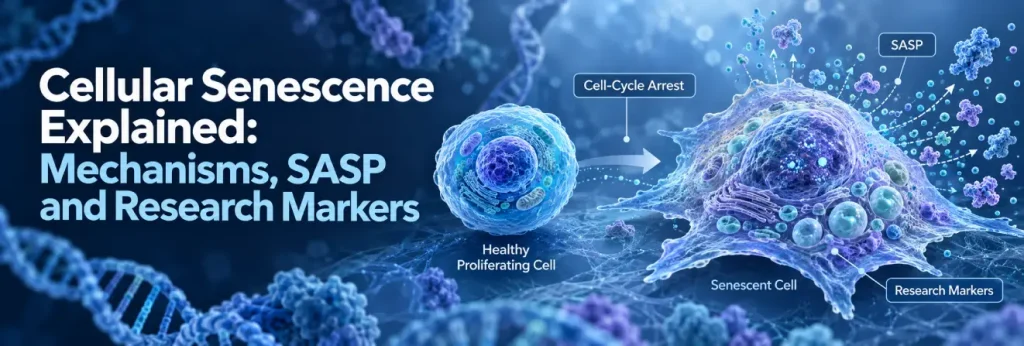
Cellular aging is the gradual change in cellular structure, function and regulatory capacity that occurs over time. Research examines these changes through processes such as DNA damage, telomere dynamics, mitochondrial function, oxidative stress, cellular senescence, autophagy and altered intercellular signalling.
Cellular Aging Definition: What Does It Mean?
Cellular aging, also called cellular ageing, refers to age-associated changes in cellular structure, function and stress responses. These changes can reflect accumulated molecular damage, altered gene regulation and declining maintenance capacity, although their patterns differ across cell types and experimental models.
The cell aging process is not a fixed sequence of growth, replication and senescence. Some cells divide repeatedly, whereas others remain non-dividing for extended periods. An aging cell may show changes in DNA maintenance, mitochondrial activity or stress signalling without entering a senescent state.
These age-associated changes may alter specialised cellular functions, replication capacity and responses to environmental stress. Their effects depend on cell type, division history and experimental conditions.
Cellular Aging vs. Cellular Senescence
Cell aging and cellular senescence are related but distinct biological concepts:
- Cellular aging: A gradual decline in cellular function over time.
- Cellular senescence: A state of stable cell-cycle arrest in which cells remain metabolically active and develop characteristic molecular changes.
Senescent cells can accumulate in tissues and influence surrounding cells, often contributing to inflammation and reduced tissue function.
What Is Cellular Age?
Cell age may describe the time since a cell was formed, its replication history or an estimated molecular ageing state, depending on the research context. In single-cell research, cellular age can be inferred from gene-expression patterns, epigenetic signatures and other molecular measurements calibrated to specific cell populations.
These estimates are model-dependent and do not provide a universal measurement of chronological time. Cells from the same tissue may exhibit different molecular ageing profiles, reflecting differences in cellular identity, stress exposure and regulatory activity.
Cellular Theory of Aging
No single cellular theory of aging fully explains how different cell types change over time. Research in cellular aging theory investigates several interconnected biological mechanisms:
- Accumulated genomic damage: DNA damage that builds up over time and may affect cellular function.
- Telomere attrition: Progressive shortening of telomeres associated with repeated cell division and cellular ageing.
- Mitochondrial dysfunction: Age-associated changes in mitochondrial activity and cellular energy metabolism.
- Epigenetic alterations: Changes in gene regulation that occur without modifying the underlying DNA sequence.
- Loss of proteostasis: Reduced capacity to maintain proper protein folding, quality control and turnover.
- Altered intercellular signalling: Changes in communication between cells that influence age-associated biological processes.
- Tissue environments: Local biological conditions that affect how cells respond to ageing-related changes.
The updated hallmarks of aging framework identifies twelve interconnected biological processes. This broader perspective supports research within cellular ageing theory and explains why cellular ageing cannot be attributed to one isolated mechanism.
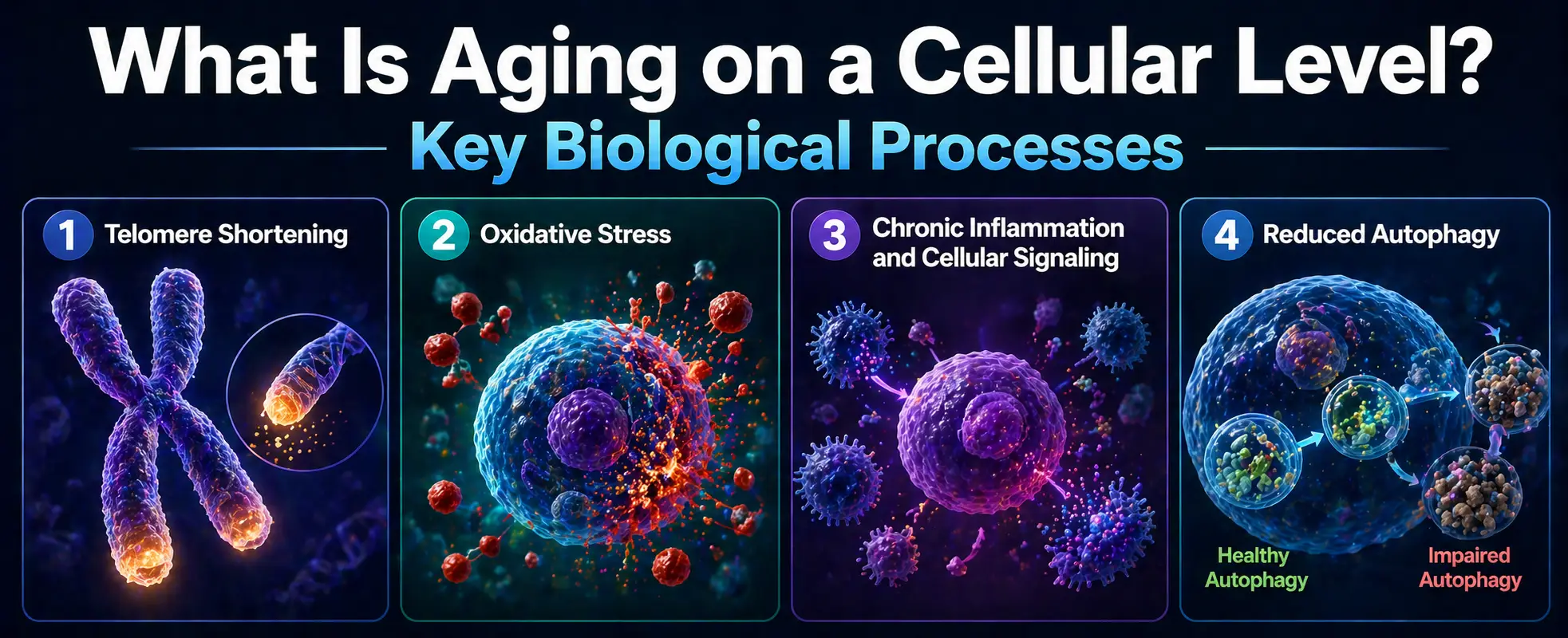
What Happens to Cells as We Age? Key Biological Processes
Cellular aging mechanisms involve overlapping changes in DNA maintenance, energy metabolism, protein quality control, cell division and communication between cells. No single cellular aging mechanism explains the aging of cells across every tissue. Studies of cells and aging therefore compare multiple biological pathways and evaluate their effects in defined experimental models.
-
DNA Damage and Telomere Shortening
DNA is continually exposed to damage from normal metabolic activity and environmental factors such as ultraviolet radiation and pollutants. Although cells have repair systems, some damage may remain and accumulate over time, potentially disrupting normal cellular function.
Telomeres, the protective structures at the ends of chromosomes, also tend to shorten when many types of cells divide. Critically short or damaged telomeres can trigger cellular senescence or cell death, although telomere behaviour differs among tissues and cell types.
-
Mitochondrial Changes and Oxidative Stress
Mitochondria generate much of the energy required for cellular activity. Age-related changes in mitochondrial function can affect cellular energy systems and redox regulation. Related mechanisms are examined further in research on mitochondrial dysfunction.
Oxidative stress occurs when reactive species exceed cellular antioxidant, repair and removal capacity. Under experimental conditions, this imbalance can alter proteins, lipids, DNA and redox-sensitive signalling pathways.
NAD+ is a coenzyme involved in cellular energy metabolism and signalling pathways. In laboratory ageing research, NAD+ research material can be examined in experimental models involving mitochondrial activity, redox metabolism and related cellular processes.
-
Changes in Cell Division and Repair
In tissues that rely on dividing cells, replication capacity and stem-cell function may decline with age. This can reduce the efficiency of tissue maintenance and repair. However, not all cells divide regularly, and the effects of ageing differ depending on the cell type and its role in the body.
-
Cellular Senescence and Chronic Inflammation
Some damaged or stressed cells enter a state called cellular senescence, in which they stop dividing but remain metabolically active. Senescent cells can release cytokines, growth factors and enzymes known collectively as the senescence-associated secretory phenotype, or SASP.
When these signals persist, they may contribute to chronic, low-grade inflammation, disrupt communication between cells and interfere with normal tissue repair.
-
Reduced Autophagy and Waste Accumulation
Autophagy supports cellular quality control by breaking down and recycling damaged proteins and organelles. Its efficiency may decline with age, allowing defective components to accumulate inside cells.
This buildup can interfere with energy production and other cellular processes, contributing to a gradual loss of cellular function.
Main Causes of Cellular Aging
Internal molecular processes and external stressors both contribute to cellular aging, although their effects vary by cell type, tissue context and experimental conditions.
Internal Causes
- Metabolic by-products and oxidative reactions
- Genomic instability and variation in DNA-repair pathways
- Changes in growth-factor and nutrient-sensing signalling
- Replicative limits and telomere attrition
Environmental and Cellular Stressors Studied in Ageing Research
Cellular ageing research also examines external and physiological stressors that can influence oxidative damage, inflammatory signalling and repair capacity. Experimental variables may include ultraviolet exposure, tobacco-smoke components, nutrient conditions, persistent stress signalling, altered activity states and environmental pollutants. Their effects depend on exposure, cell type and experimental model.
Cellular Aging Pathology: Research Context
Cellular aging pathology examines relationships between age-associated cellular changes and pathological tissue states. Persistent senescence-associated signalling, altered inflammatory pathways and impaired cellular maintenance may contribute to tissue dysfunction under certain biological conditions.
However, cellular ageing is not itself a pathological diagnosis. The significance of these changes depends on the cell type, tissue environment and experimental model. Associations observed in cultured cells do not establish clinical outcomes or therapeutic effects.
Cellular Aging Markers and Research Findings
The molecular features of aging cells are assessed through measurable laboratory endpoints rather than visible appearance alone.
Relevant endpoints include senescence-associated proteins, DNA-damage responses, telomere-related measurements, mitochondrial respiration, oxidative-stress markers, autophagy, proteostasis and cell signalling. Skin-related experimental models may also assess extracellular-matrix changes, as discussed in What Causes Skin Aging?.
GHK-Cu is investigated in laboratory models involving collagen signalling, extracellular-matrix biology, oxidative-stress pathways and other cellular processes relevant to skin research.
How Cellular Aging Is Studied Experimentally
Research on cell ageing investigates whether defined experimental conditions alter selected molecular and functional markers. Changes in individual endpoints do not establish that cellular ageing has been stopped or reversed.
Experimental approaches to cellular ageing commonly combine multiple endpoints rather than relying on one marker. Research may examine senescence-associated proteins, DNA-damage signalling, telomere-related measures, mitochondrial respiration, reactive-oxygen-species balance, autophagy and proteostasis, gene-expression changes and cell viability. Interpretation depends on the cell type, model, exposure conditions and analytical methods used.
Cellular Aging and Investigational Research Models
Epitalon has been examined in cell-based ageing research.
Khavinson et al.’s fibroblast study reported telomerase activity and telomere elongation in cultured human fetal fibroblasts. Those cellular observations do not establish human anti-ageing or longevity effects.
Research endpoints may include cellular stress responses, inflammatory signalling, energy metabolism, senescence, repair pathways and other age-associated cellular processes. These models are used to investigate mechanisms rather than establish personal anti-ageing outcomes.
Peptide Certificates of Analysis (COAs) provide batch-specific information on the reported identity, purity and composition of research materials.
Experimental controls address a separate question: whether the measured cellular response can be attributed to the tested material under the stated conditions.
Conclusion: Why Cellular Aging Matters
Cellular aging describes interconnected changes in DNA maintenance, mitochondrial function, redox balance, senescence, autophagy and other cellular systems. No single marker defines the entire process, so ageing research generally relies on multiple complementary measurements and well-controlled experimental models. Findings from cellular research should remain distinct from claims about personal anti-ageing, clinical effectiveness or human use.
FAQs About Cellular Aging
Can cellular aging be fully reversed in experimental models?
No universal reversal of cellular aging has been established. Research instead examines whether specific age-associated cellular phenotypes can be modified under defined experimental conditions.
What Is Cell Aging?
Cell aging refers to age-associated changes in cellular function, molecular maintenance and stress responses. These changes may affect dividing and non-dividing cells and do not necessarily involve cellular senescence.
What Is Cellular Ageing at the Molecular Level?
Cellular ageing involves interconnected changes in DNA maintenance, epigenetic regulation, mitochondrial activity, proteostasis and intercellular signalling. The timing and measurable effects of these changes vary across cell types, tissues and experimental models.
How Can Cellular Aging Mechanisms Be Understood Experimentally?
Experimental research combines molecular and functional measurements to examine DNA repair, mitochondrial activity, redox balance, proteostasis and senescence-associated signalling. Comparing these endpoints across defined conditions helps distinguish individual cellular responses from broader ageing-related changes.
What markers are used to study cellular aging?
Researchers may assess senescence markers, DNA damage, telomere-related changes, mitochondrial function, oxidative stress, autophagy and alterations in cellular signalling.
Can a single nutrient or compound establish cellular regeneration?
No. Cellular regeneration and ageing involve multiple pathways, and evidence requires appropriate molecular, structural or functional measurements rather than one nutrient or compound alone.
Which stressors are commonly examined in cellular aging research?
Experimental studies may examine oxidative stress, DNA damage, inflammatory signalling, mitochondrial impairment, environmental exposures and disruptions in cellular quality-control pathways.
How is cellular aging assessed experimentally?
Cellular aging is assessed using combinations of molecular, biochemical and functional measurements. No single test provides a complete measure of cellular ageing across all tissues or models.
Sources:
- The Hallmarks of Aging
- Telomere Dysfunction in Ageing and Age-Related Diseases
- Mitochondrial Dysfunction and Oxidative Stress in Aging and Disease
- NAD+ Metabolism and Its Roles in Cellular Processes During Ageing
- Role of Cellular Senescence in Inflammation and Regeneration
- Molecular Mechanisms of Autophagy Decline During Aging
- GHK Peptide as a Natural Modulator of Multiple Cellular Pathways in Skin Regeneration