
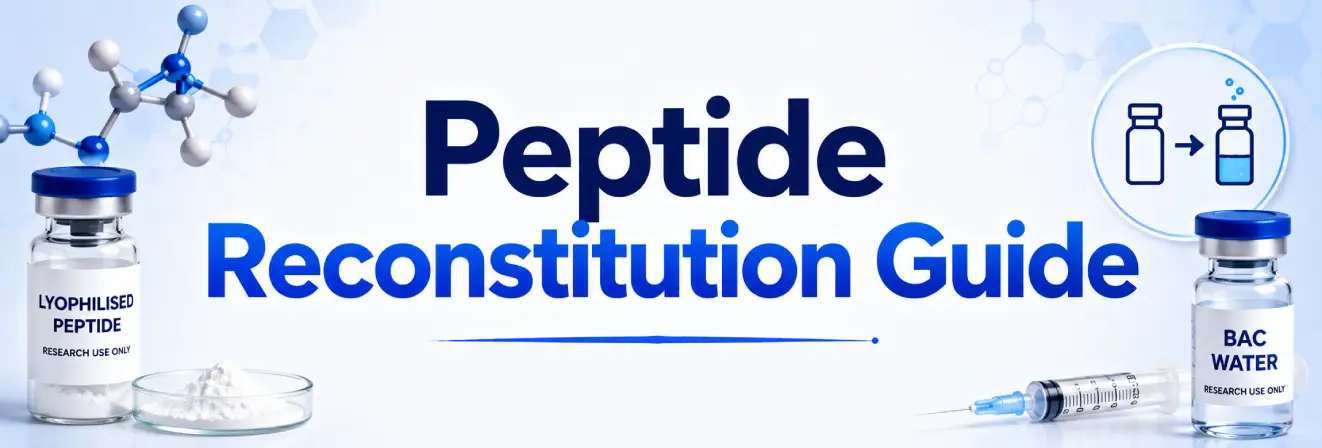
Peptide reconstitution is a laboratory preparation process involving lyophilised peptides, where solvent selection can influence compound solubility, stability and experimental compatibility.
Understanding peptide reconstitution is relevant to laboratory workflows involving lyophilised materials, solvent compatibility, solution preparation, stability and controlled experimental handling.
Many research peptides are supplied in a lyophilised (freeze-dried) form, meaning they arrive as a dry powder rather than a liquid solution. In laboratory research, reconstitution describes preparing a lyophilised peptide with a compatible solvent for a defined experimental workflow. The appropriate solvent and preparation conditions depend on compound-specific documentation and protocol requirements.
Laboratory reconstitution requires an understanding of lyophilised peptide properties, suitable diluent formulations and compound-specific preparation requirements. Bacteriostatic water is one possible research diluent, but its compatibility must be established for the peptide and experimental method.
What Is Peptide Reconstitution?
Peptide reconstitution is the process of dissolving a lyophilised (freeze-dried) peptide in a compatible solvent to produce a solution for laboratory research. The selected solvent and preparation conditions depend on the peptide’s properties and the requirements of the experimental method.
Peptides are often supplied as lyophilised powders because removing water can reduce certain degradation processes and improve stability during storage and transportation. However, the benefits of freeze-drying depend on the peptide’s molecular properties and formulation.
Once reconstituted, peptide solutions may be evaluated for solubility, concentration, chemical stability and compatibility with the intended analytical method. Successful dissolution alone does not establish long-term stability or experimental suitability.
Broader information about peptide materials and laboratory research categories is available in the Research Peptides Australia guide.
What Are Lyophilised Peptides?
Lyophilised peptides are freeze-dried peptide preparations in which most of the water has been removed through a controlled drying process.
Lyophilisation involves freezing a peptide formulation and removing water primarily through sublimation under reduced pressure. This process can improve storage stability for certain peptides, depending on their molecular properties and formulation.
Potential benefits of lyophilisation under suitable formulation and storage conditions include:
- Improved storage stability for compatible peptide formulations
- Reduced risk of certain moisture-related degradation processes
- Better preservation of selected formulation characteristics
- More convenient transport and handling of appropriately packaged dry materials
These potential benefits are not universal. The suitability of lyophilisation depends on peptide structure, formulation components, manufacturing conditions and storage requirements. Reconstitution conditions must therefore be established for each compound rather than assumed to be identical across different peptides.
Laboratory evaluation should consider peptide identity, available analytical documentation, formulation specifications and the requirements of the intended research protocol.
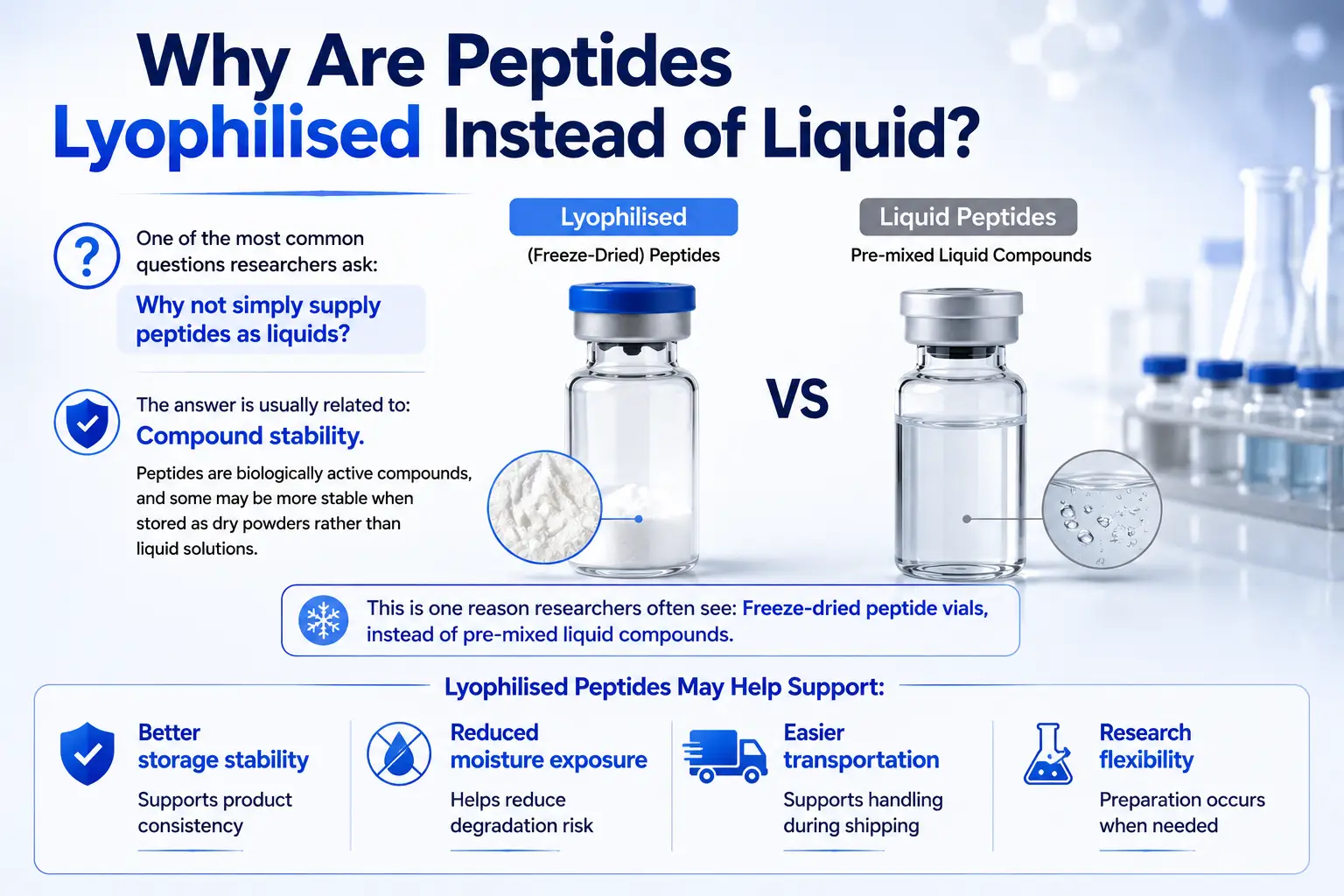
Why Are Peptides Lyophilised Instead of Liquid?
Peptide formulations may be supplied as lyophilised powders when reducing water content helps limit degradation during storage. Whether a dry or liquid formulation provides greater stability depends on the peptide’s molecular properties, formulation and storage conditions.
In aqueous solutions, certain peptides may undergo chemical degradation or physical changes such as aggregation. Freeze-drying can reduce some stability risks, although its effectiveness depends on the formulation and manufacturing process. Potential advantages include:
| Potential Benefit | Research Significance |
| Potentially improved storage stability | May help preserve peptide characteristics under validated storage conditions |
| Lower residual moisture | May reduce certain moisture-dependent degradation reactions |
| Dry-state transportation | Can simplify transport when appropriate packaging and temperature controls are maintained |
| Preparation for defined laboratory assays | Allows compatible peptide solutions to be prepared according to experimental requirements |
Lyophilised peptides require a compatible solvent when solution preparation is necessary for laboratory analysis. Diluent selection, peptide solubility and stability must be evaluated according to compound-specific documentation and validated research methods.
Why Peptide Reconstitution Matters in Laboratory Research
Peptide reconstitution influences solution composition, sample stability and the reproducibility of laboratory measurements. Several factors must be considered when evaluating a prepared peptide solution:
- Peptide identity and physicochemical properties
- Diluent composition and solvent compatibility
- Storage conditions and solution stability
- Sample integrity and analytical compatibility
Reliable experimental results depend on controlling solution conditions and accounting for changes that may occur after a lyophilised peptide is dissolved.
Reconstitution converts a lyophilised peptide into a solution, but successful dissolution alone does not confirm chemical stability or suitability for the intended assay. These properties require compound-specific evidence and appropriate analytical evaluation.
The Role of Bacteriostatic Water in Peptide Reconstitution
Bacteriostatic water is one of the aqueous diluents considered in laboratory peptide reconstitution. Its antimicrobial preservative may support certain research workflows, provided the formulation is compatible with the peptide and experimental method.
Bacteriostatic Water and Diluent Compatibility
Bacteriostatic water is a sterile aqueous diluent containing an antimicrobial preservative, commonly benzyl alcohol. Its suitability for peptide reconstitution depends on compound solubility, preservative sensitivity, solution stability and the requirements of the validated laboratory protocol.
The Sterile Water vs Bacteriostatic Water comparison examines how antimicrobial preservatives influence laboratory handling and compound compatibility.
The Bacteriostatic Water for Peptide Research guide provides additional information about preservative composition, formulation characteristics and laboratory research requirements.
Available laboratory diluent formulations and product specifications are listed in the BAC Water category.
Why Aseptic Handling Matters During Peptide Reconstitution
Aseptic handling is an important consideration during laboratory peptide reconstitution because microbial contamination can compromise sample integrity and affect experimental results.
Laboratory preparation conditions should account for:
- Contamination control
- Container and closure integrity
- Diluent quality and compatibility
- Documented preparation and storage conditions
Aseptic handling helps reduce contamination risks but does not independently establish peptide stability or solvent compatibility. Preparation requirements depend on product specifications, compound-specific documentation and validated laboratory protocols.
Variables That Can Affect Peptide Reconstitution Research
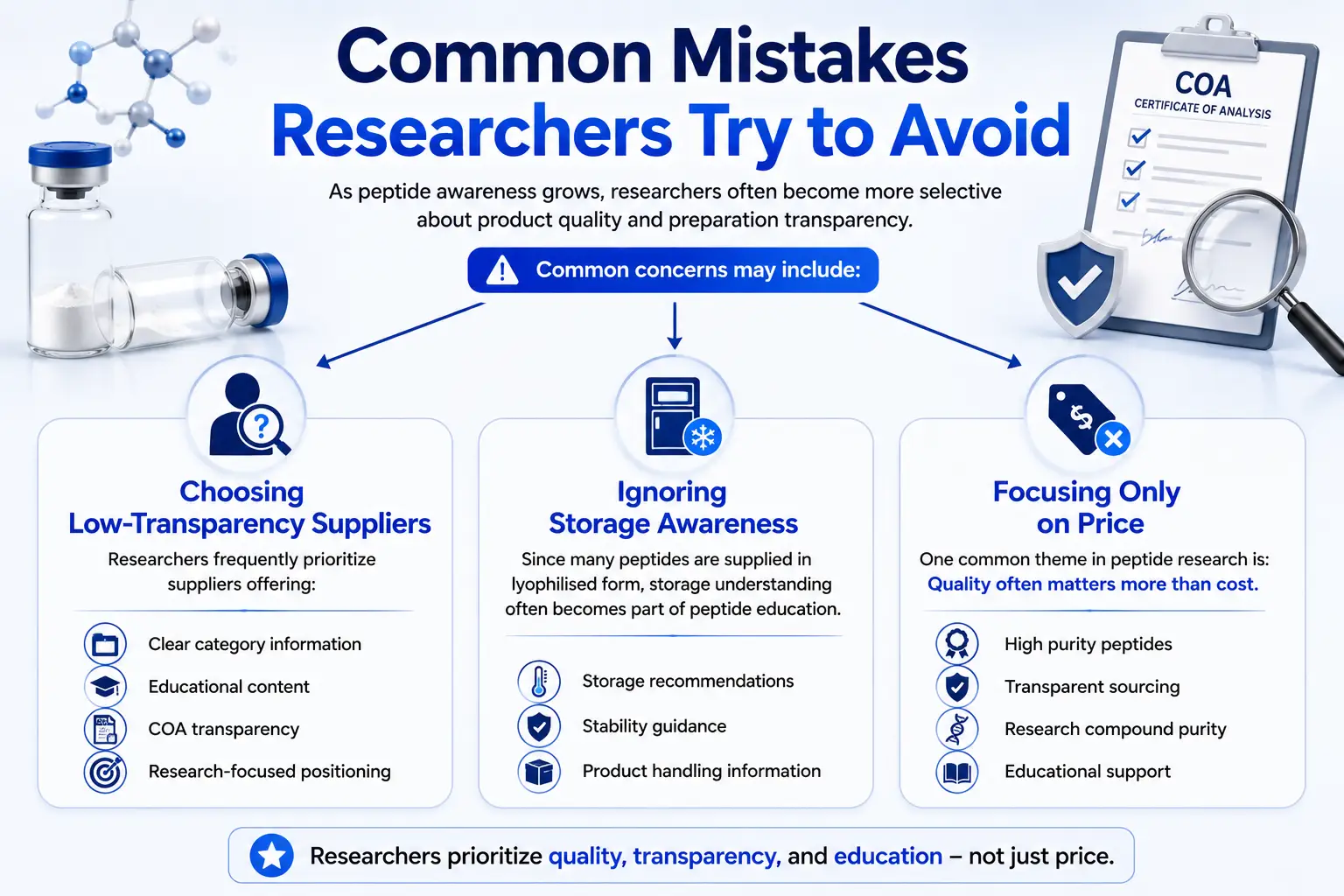
Peptide solubility and reconstitution behaviour depend on amino acid sequence, chemical modifications, solvent composition, pH and concentration. These factors can influence peptide charge, dissolution and aggregation. The resulting solution must also be compatible with the intended analytical method, as complete dissolution does not establish chemical stability or experimental suitability.
Analytical Documentation for Peptide Reconstitution
Analytical documentation provides information about peptide identity, batch characteristics and reported quality attributes. These details help laboratories assess research materials before selecting preparation conditions.
- Compound identity and batch identification
- Available analytical testing methods
- Reported peptide purity and composition
- Formulation characteristics and known limitations
- Relevant product specifications and storage requirements
Laboratory reconstitution also requires evaluating:
- Compound-specific solubility
- Diluent and preservative compatibility
- Solution stability and analytical requirements
Available Peptide Certificates of Analysis (COAs) may provide batch-specific information about compound identity, reported purity and analytical testing methods. However, a peptide COA does not independently establish compatibility with a particular diluent or stability after reconstitution.
Documented material characteristics and compound-specific compatibility data provide a more reliable basis for evaluating laboratory reconstitution conditions than general product descriptions alone.
Why Compound-Specific Documentation Matters
Peptide reconstitution requirements vary according to molecular structure, formulation characteristics and the intended laboratory analysis. Compound-specific documentation helps establish suitable preparation conditions.
Incomplete dissolution, aggregation and chemical degradation are distinct outcomes that require different analytical evaluations. Bachem’s peptide-handling guidance describes how peptide composition, solubility and solvent properties influence laboratory preparation.
Research material documentation should clearly identify compound specifications, intended laboratory applications and relevant handling limitations. The Research Use Only Peptides guide provides additional information about research-use classification and laboratory requirements.
FAQs about Peptide Reconstitution
What is peptide reconstitution in laboratory research?
Peptide reconstitution is the preparation of a lyophilised peptide with a compatible solvent for a defined laboratory workflow. Conditions depend on the specific compound, formulation and experimental protocol.
Why are peptides supplied as powder?
Many peptides are supplied in lyophilised form because freeze-drying may help support greater stability, easier transport, and reduced degradation risk.
What are lyophilised peptides?
Lyophilised peptides are freeze-dried peptide compounds commonly supplied in powder form before research preparation.
What role can bacteriostatic water have in peptide research?
Bacteriostatic water is a preserved sterile aqueous preparation that may be used where compound documentation and the laboratory protocol establish compatibility.
Why does reconstitution require compound-specific evaluation?
Peptides can differ in solubility, stability and formulation requirements, so solvent selection and preparation conditions should not be assumed to be identical across compounds.
What information should be reviewed before laboratory reconstitution?
Relevant information may include compound identity, purity, storage requirements, solvent compatibility, stability information and batch-specific analytical documentation.
Are all peptides reconstituted the same way?
No. Peptide reconstitution requirements vary according to amino acid sequence, molecular modifications, solubility, formulation and stability. Diluent selection and preparation conditions should follow compound-specific documentation and validated laboratory protocols.
Why is analytical documentation relevant to peptide preparation?
Analytical documentation helps laboratories confirm the identity and reported characteristics of the specific material being prepared and supports traceability between the compound and its experimental use.
The Research Peptide Guides cover related questions about purity, storage and analytical documentation before experimental preparation.