
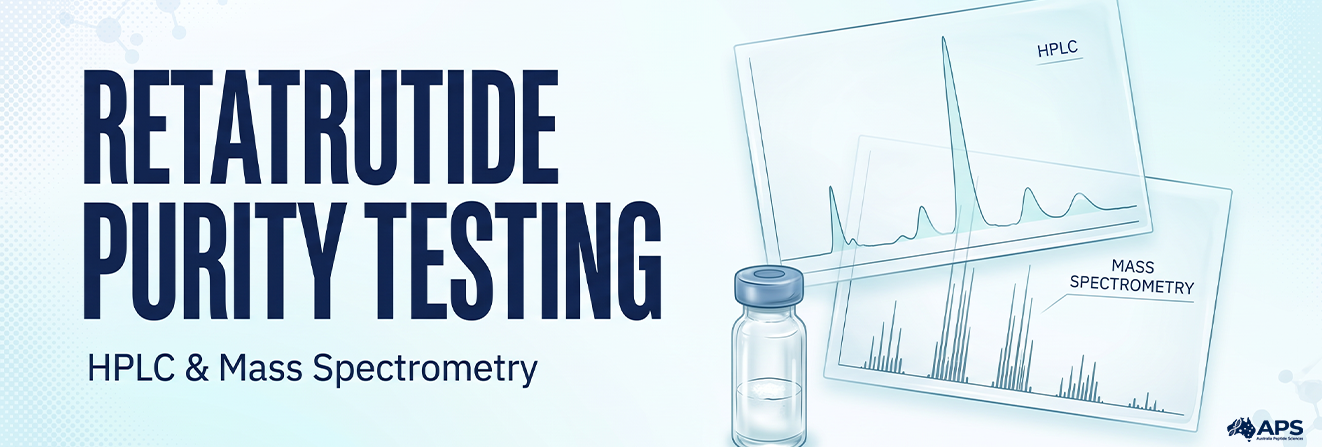
Retatrutide ingredient testing results help researchers evaluate a sample’s reported identity, chromatographic purity and connection to a specific batch. Reading them correctly requires more than checking whether a percentage exceeds a preferred threshold.
A chromatogram, mass spectrum and certificate of analysis answer different questions. Their value depends on the method and sample examined. This guide explains how to interpret those findings for laboratory research; analytical results do not establish therapeutic suitability.
Quick Answer
HPLC commonly reports the proportion of integrated chromatographic signal assigned to the target peptide. Mass spectrometry provides mass-related evidence supporting identity. A batch-specific COA records the reported findings. These results should be assessed together, but they do not automatically establish peptide quantity, sterility, biological activity or suitability for human use.
What Do Retatrutide Ingredient Testing Results Actually Measure?
Separate four questions before interpreting the numbers:
| Question | Relevant evidence | Important limitation |
| Is the expected molecule present? | Mass data and complementary identity tests | Intact mass cannot resolve every structural alternative |
| What proportion of detected signal is assigned to the target? | HPLC separation and peak integration | Area percentage depends on the analytical method |
| How much target peptide is present? | A suitable quantitative assay | Area purity alone does not establish quantity |
| Does the report match the supplied material? | Linked batch, sample and report identifiers | A result for another lot cannot characterise this one |
“Ingredient testing” does not necessarily provide a complete inventory of the sample. Its scope follows the analytical procedures performed.
For materials in the GLP-1 research category, assess each compound against its own analytical specification; shared catalogue placement does not imply equivalent composition or testing requirements.
What Should a Retatrutide COA Include?
A retatrutide COA should identify the tested material and clearly report its analytical findings.

Material Identification and Traceability
Check the compound name, supplier lot number, laboratory sample identifier and report reference. Supplier and laboratory identifiers may differ, provided records connect them.
When evaluating Retatrutide research material, match these details to the supplied material before interpreting the results. It is intended for laboratory research only, not human or veterinary use.
Analytical Methods and Results
The report should provide:
- Methods: named procedures or method references.
- Results: measured values, units and reporting basis.
- Specifications: acceptance criteria, where applied.
- Laboratory details: testing dates, authorisation and available verification information.
A specification and a result are different: “Not less than 98%” is an acceptance criterion; “98.7% by HPLC area” is a measurement. An unexplained “pass” does not show the measured value.
Report Verification
The peptide COA guide explains document checks that support this review. Use the issuing laboratory’s official verification process where available.
An authentic report still requires traceability records linking the tested sample to the supplied material.
How Is Retatrutide HPLC Purity Reported?
High-performance liquid chromatography separates sample components according to their interactions with the column and mobile phase. In a typical UV chromatogram, the horizontal axis shows retention time and the vertical axis shows detector response.
1. Reading Peak Area and Retention Time
The integrated area beneath a peak represents its recorded response over the selected interval. Peak height alone is not interchangeable with integrated area.
For an area-normalised result, the calculation is:
Target peak area (%) = target integrated peak area ÷ total included integrated peak area × 100.
If the assigned target peak contributes 9,920 area units and included peaks total 10,000 units, the area percentage is 99.2%. This describes detector signal, not total sample mass. Waters’ peptide purity workflow uses the target peak’s share of integrated signal for area-based reporting.
Integration rules determine which peaks enter the calculation. Solvent signals, system peaks and signals below reporting thresholds may be excluded according to the method.
2. Checking Whether the Main Peak Is Properly Assigned
The largest peak should not simply be assumed to be retatrutide. Assignment needs supporting evidence, such as comparison with a suitable reference and compatible mass data.
Retention time is method-dependent. Changing the column, mobile phase, temperature or gradient can change when a compound elutes. Comparing retention times from unrelated methods is therefore unreliable.
3. Recognising Co-Elution and Method Differences
Two compounds can elute closely enough to appear as one peak. In a Waters synthetic-peptide impurity study, added mass detection revealed impurities unresolved from the main UV peak. The experiment involved another peptide and illustrates co-elution, rather than a finding about retatrutide batches.
When comparing retatrutide HPLC reports, check detector wavelength, separation conditions, integration rules and supporting method performance. A small numerical difference between laboratories may reflect method differences rather than a meaningful difference in material quality.
As Peptide Purity Explained discusses, chromatographic signal and sample composition are different reporting concepts, so results should be compared on the same analytical basis.
What Does Retatrutide Mass Spectrometry Confirm?
Mass spectrometry measures ions according to their mass-to-charge ratio, written as m/z. Interpreting retatrutide mass spectrometry results means checking whether those measurements are consistent with the expected molecule and the stated analytical approach.

1. Charge States and Reported Molecular Mass
Electrospray ionisation can generate several charge states from one peptide. Multiple spectral peaks may therefore represent the same molecule carrying different charges, rather than different ingredients.
Software may convert these signals into an estimated neutral molecular mass through deconvolution. The report should distinguish the measured m/z values from the deconvoluted mass.
The Waters mass-directed purification primer distinguishes monoisotopic mass from average mass, which use different isotope conventions. Mixing these values can create an apparent discrepancy without demonstrating an identity failure.
2. Why the Complete Retatrutide Structure Matters
Retatrutide is a modified peptide. Its original discovery paper describes a 39-residue backbone conjugated through a linker to a C20 fatty diacid. Expected mass calculations must represent the intended conjugate rather than an unmodified amino-acid chain.
The Retatrutide Molecular Structure guide explains the molecular features that must be represented in structural descriptions. An identity assessment should also specify the mass convention, ion assignment and method-appropriate acceptance tolerance.
For background on retatrutide’s triple-receptor pharmacology and its clinical research status, see our retatrutide research guide.
3. What Intact Mass Leaves Unresolved
A compatible intact mass supports the identity assignment, but does not independently establish every residue, modification location or stereochemical feature. Different structures can share the same mass.
Tandem mass spectrometry, or MS/MS, examines fragment ions to provide additional sequence information. Zeng and colleagues’ LC-HRMS study demonstrates how accurate mass and fragmentation data support peptide characterisation. Particular isomeric or stereochemical questions may still require other methods.
Worked Example: Reading Purity and Identity Together
Consider the following hypothetical report. These figures illustrate interpretation only and do not represent an APS batch or actual laboratory certificate.
| Report entry | Reasonable interpretation | What remains unresolved |
| Target peak: 99.2% area | The assigned peak contributes 99.2% of included integrated signal | Total sample composition and possible co-elution |
| Other included peaks: 0.8% area | Additional chromatographic signals were integrated | Their identities and individual response factors |
| Observed mass matches within the stated tolerance | Mass data support the target assignment | Complete structural and stereochemical confirmation |
| Sample identifier linked to a supplier lot | Documentation connects the report to that lot | Representativeness of sampling and subsequent handling |
If an apparent identity discrepancy accompanies a high purity result, first check molecular form, charge assignment, mass convention and report transcription. An unresolved discrepancy requires clarification rather than being dismissed because the purity percentage looks favourable.
Why Do Batch Numbers and Sampling Details Matter?
A laboratory report describes the sample analysed. Its relevance to a production lot depends on documented sampling and the connection between that sample and the supplied material.
Check whether testing concerned bulk material, a finished container or several independently selected containers. A result from one submitted container does not demonstrate that every container was individually analysed.
The same traceability checks apply to other research peptides; our guide to BPC-157 purity and COA testing shows how batch identifiers and analytical results are matched for a different compound.
The testing date also needs context. It records when analysis occurred; it does not establish an expiry date or prove that later storage preserved the original characteristics. Retest periods require relevant stability evidence.
In comparative work involving Tirzepatide research material, keep separate lot records for each compound. Similar percentages do not establish comparable quality when methods or reporting conditions differ.
Does High Retatrutide Purity Confirm Peptide Quantity?
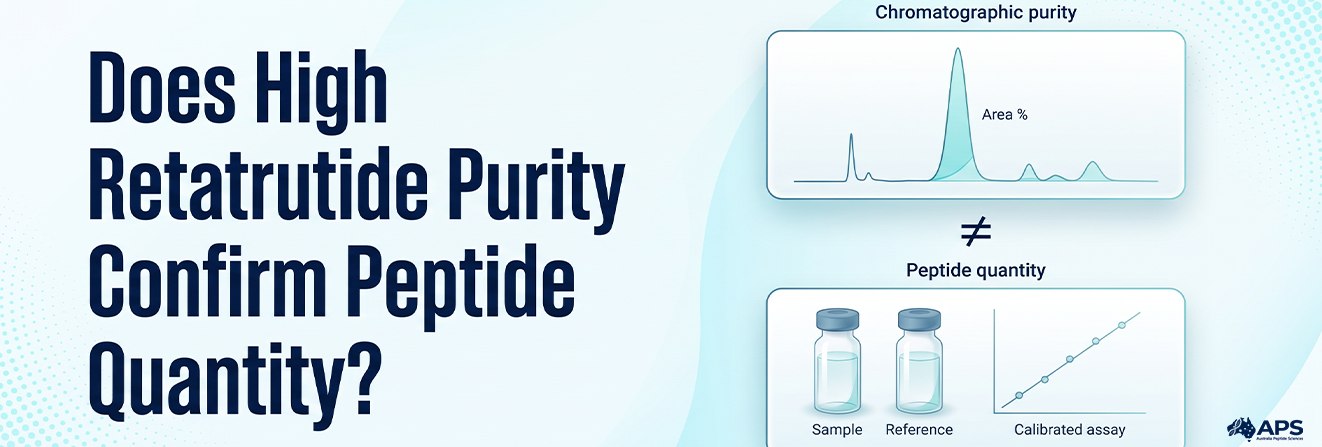
Chromatographic purity and peptide quantity are different measurements. A high area percentage does not establish the amount of target peptide in a container.
An HPLC method can quantify peptide content when it is appropriately calibrated and validated for that purpose. This is different from calculating relative peak areas without an external quantity reference.
Mass spectrometry can also support calibrated quantitative methods; an identity spectrum alone is not a quantitative assay.
The distinction matters when reviewing Mazdutide research material: an HPLC purity claim and a stated quantity per container describe separate attributes and require different supporting measurements.
A multi-laboratory oxytocin study compared HPLC assay, quantitative nuclear magnetic resonance and amino acid analysis. Its findings concern that model peptide, while illustrating why quantitative results require a defined method and reference basis.
Water, counter-ions and residual solvents may contribute to sample mass without being represented by an HPLC area percentage. Ask whether a reported quantity is expressed per container, per unit mass, on an as-received basis or using specified corrections. Do not calculate verified peptide content by multiplying a nominal label amount by an area-purity percentage.
Which Quality Questions Require Additional Tests?
HPLC and identity-focused MS do not provide a universal screen for all contaminants or material properties. Additional testing depends on the intended experiment and identified risks.
| Attribute | Evidence that may be relevant |
| Water content | A suitable water-determination procedure |
| Counter-ion content or residual solvents | Dedicated chemical analysis |
| Elemental impurities | Appropriate elemental testing |
| Endotoxin or microbial contamination | Separate, relevant microbiological tests |
| Biological activity | A suitable functional assay with controls |
| Stability during storage | Compound-specific stability studies |
The EMA’s synthetic-peptide guideline treats identity, purity, assay/content, water, counter-ions and microbiological attributes separately. It provides analytical context, rather than universal acceptance criteria for RUO materials.
“Not tested” does not mean absent. “Not detected” must be interpreted against the method’s detection capability. Neither statement should be converted into an unrestricted “contaminant-free” claim.
How Should Researchers Review Conflicting or Incomplete Reports?
Prioritise unanswered questions according to the experiment. Receptor-response studies may require functional evidence, while quantitative analysis may require a well-characterised content reference.
Before accepting a report:
- Match the sample and lot identifiers.
- Separate measured results from specifications and label claims.
- Check methods, units, reporting limits and mass conventions.
- Request supporting chromatograms or spectra where needed.
- Resolve discrepancies and document the decision against laboratory requirements.
ICH’s analytical validation guidance describes specificity and complementary procedures where one method cannot sufficiently distinguish the analyte from other components. These principles help assess whether the evidence supports the analytical claim.
Key Takeaways for Interpreting Retatrutide Ingredient Testing Results
Retatrutide ingredient testing results are most informative when identity, chromatographic purity, quantity and traceability are reviewed separately, then considered together. The practical question is whether the documented evidence meets the laboratory’s defined requirements. A favourable percentage alone cannot establish complete composition, biological performance or suitability beyond research use.
Frequently Asked Questions
How does diluent volume affect concentration in a 10 mg vial?
For a fixed 10 mg amount, increasing the final solution volume lowers the concentration; doubling the volume halves it.
What is the concentration of 10 mg in 1 mL, 2 mL and 3 mL?
Assuming complete dissolution and a final volume of 1, 2 or 3 mL, the calculated concentrations are 10 mg/mL, 5 mg/mL and approximately 3.33 mg/mL, respectively.
Why is bacteriostatic water used for lyophilised peptides?
Its benzyl alcohol preservative inhibits bacterial growth. However, suitability depends on the peptide and analytical method; it does not establish peptide stability or sterilise contaminated material.
How should reconstituted retatrutide be stored in the laboratory?
Follow documented storage conditions supported by stability data for the specific formulation, diluent and container. A universal storage temperature or shelf life should not be assumed.
How long will it take to see results from retatrutide?
No individual timeline is guaranteed; clinical trials measured changes over months, and their findings cannot establish the performance of separately supplied research materials.
Can retatrutide cause arrhythmia?
Arrhythmias and increased heart rate were reported in clinical trials, but these observations alone do not establish causation or predict an individual’s risk.
What are the potential side effects of taking retatrutide?
Reported adverse effects include nausea, diarrhoea, vomiting, constipation and increased heart rate; chemical purity testing cannot establish clinical safety.
How many people have taken retatrutide?
Published trials report study-specific enrolment, including 338 participants in the 2023 phase 2 obesity trial, but these figures do not establish total worldwide exposure.
What is the latest news on retatrutide?
On 14 November 2026, Lilly announced additional phase 3 data concerning sleep apnoea and knee osteoarthritis; retatrutide remained investigational.
Can retatrutide help with anti-aging?
An anti-ageing benefit has not been established by the clinical evidence discussed here, and analytical purity results cannot demonstrate longevity effects.
Sources
- Waters. Streamlined LC-MS Analysis of Stress Induced Impurities of a Synthetic Peptide.
- Waters. Using Empower 3 Software for Monitoring Synthetic Peptide Impurities with an ACQUITY QDa Detector.
- Waters. Peptide Isolation: Considerations for Mass-Directed Purification.
- Coskun T, et al. LY3437943, a novel triple glucagon, GIP, and GLP-1 receptor agonist: From discovery to clinical proof of concept. Cell Metabolism. 2022.
- Zeng K, et al. Liquid Chromatography-High Resolution Mass Spectrometry for Peptide Drug Quality Control. The AAPS Journal. 2015.
- Li C, et al. Survey of peptide quantification methods and their reproducibility comparison: A case study using oxytocin. Journal of Pharmaceutical and Biomedical Analysis. 2019.
- European Medicines Agency. Guideline on the Development and Manufacture of Synthetic Peptides.
- ICH/FDA. Q2(R2): Validation of Analytical Procedures. 2024.