
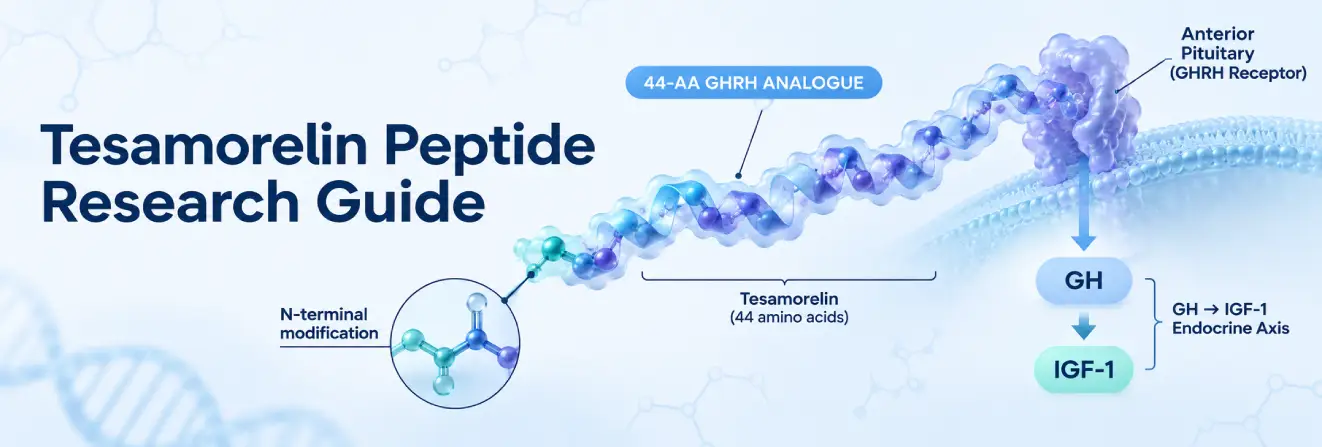
Tesamorelin is a synthetic growth hormone-releasing hormone (GHRH) analogue studied for its effects on growth hormone signalling, visceral fat and liver fat. Unlike many research peptides, it has undergone randomised clinical trials and holds a narrowly defined US regulatory approval.
Based on the 44-amino-acid human GHRH sequence, tesamorelin contains an N-terminal modification that improves its stability. It activates pituitary GHRH receptors, stimulating growth hormone (GH) release and downstream IGF-1 signalling.
Clinical evidence primarily concerns people with HIV-associated lipodystrophy. These findings provide insight into metabolic regulation but do not establish benefits for general weight loss or anti-ageing.
Researchers comparing GHRH-derived compounds can review the APS CJC-1295 (No DAC) research product.
For laboratory investigations of ghrelin receptor signalling, APS also lists Ipamorelin as a distinct growth hormone secretagogue.
Researchers studying growth hormone fragments and lipid-related pathways can examine AOD-9604, which differs mechanistically from GHRH analogues.
What Is Tesamorelin?
Tesamorelin is a synthetic peptide analogue of human growth hormone-releasing hormone, also called growth hormone-releasing factor (GRF). It was developed by Theratechnologies, a Canadian biotechnology company, and investigated principally for its effects on excess visceral fat in people living with HIV.
Natural GHRH is produced in the hypothalamus and signals to the anterior pituitary to regulate growth hormone secretion. Tesamorelin retains the complete 44-amino-acid sequence of the native hormone while incorporating a modification at its N-terminus.
This modification is intended to improve resistance to enzymatic degradation compared with unmodified GHRH. However, tesamorelin should not be confused with long-acting, albumin-binding GHRH analogues such as CJC-1295 with DAC, which have different pharmacokinetic characteristics.
The distinction is important because peptides acting on the same receptor can differ substantially in molecular stability, circulation time, receptor exposure and the strength of their supporting clinical evidence.
For a broader overview of research peptide classes and pathways, see the APS peptide list and what they do.
Tesamorelin at a Glance
| Property | Scientific Detail
|
| Compound | Tesamorelin
|
| Peptide class | Growth hormone-releasing hormone analogue |
| Base structure | Human GHRH(1-44) |
| Molecular modification | N-terminal trans-3-hexenoyl group |
| Molecular target | Growth hormone-releasing hormone receptor (GHRHR) |
| Primary signalling pathway | GH-IGF-1 axis |
| Original developer | Theratechnologies |
| US regulatory history | Initial FDA approval in 2010 for a specific HIV-associated indication |
| Australian regulatory context | Subject to relevant TGA requirements and Australian scheduling controls |
| WADA classification | Prohibited at all times under S2.2.4 |
Tesamorelin Structure and N-Terminal Modification
The tesamorelin peptide contains 44 amino-acid residues corresponding to the natural human GHRH(1-44) sequence. Its defining difference is the addition of a hexenoyl group to the N-terminal tyrosine residue.
Three features are especially relevant to molecular research:
- Modified N-terminus: The trans-3-hexenoyl group is a six-carbon chain with a double bond at position three. Its addition contributes to resistance against enzymatic degradation.
- Preserved receptor activity: The modified peptide remains a GHRH receptor agonist rather than becoming a different class of secretagogue.
- Analytical complexity: The free-base molecular mass is approximately 5,135.9 daltons. Sequence identity, the terminal modification and related impurities all require appropriate characterisation.
Native peptide hormones are vulnerable to proteolytic cleavage, particularly at exposed terminal regions. Chemical modification can alter degradation susceptibility while preserving the molecular features needed for receptor recognition.
Stabilisation does not necessarily mean prolonged circulation. Tesamorelin has a comparatively short circulating half-life, so its pharmacokinetics must be considered separately from downstream endocrine effects.
Researchers exploring the broader landscape of peptide-related evidence can consult Australia Peptide Sciences for research-focused resources.
How Tesamorelin Works
Tesamorelin works by activating GHRH receptors in the anterior pituitary, stimulating the release of endogenous growth hormone. This produces downstream changes in IGF-1 signalling and several metabolic pathways regulated by the GH axis.
Its principal mechanism is receptor-mediated endocrine stimulation rather than direct replacement of growth hormone.
This video provides a visual introduction to tesamorelin and its effects on growth hormone signalling.
GHRH Receptor Signalling and the GH-IGF-1 Axis
Growth hormone-releasing hormone receptors are expressed predominantly on somatotroph cells in the anterior pituitary.
When tesamorelin binds to these receptors, it activates intracellular signalling pathways associated with G-protein-coupled receptor activity.

The principal signalling sequence involves several connected processes:
- GHRH receptor activation: Tesamorelin interacts with GHRHR on pituitary somatotroph cells.
- Intracellular signalling: Receptor activation stimulates adenylyl cyclase and increases cyclic adenosine monophosphate (cAMP).
- Growth hormone secretion: Downstream signalling, including protein kinase A-associated pathways, supports GH synthesis and release.
- IGF-1 response: Circulating GH stimulates IGF-1 production, particularly in the liver, while other tissues also contribute to IGF-1 signalling.
- Metabolic effects: GH and IGF-1 participate in lipid metabolism, glucose regulation, protein turnover and broader endocrine communication.
These steps help explain why tesamorelin produces measurable changes in circulating IGF-1 during clinical studies.
IGF-1 is frequently used as a pharmacodynamic marker of GH-axis activation. Nevertheless, an increase in IGF-1 does not independently demonstrate a favourable clinical outcome.
Researchers must distinguish receptor activation, hormonal changes and physiological endpoints rather than treating them as interchangeable measures of effectiveness.
Endocrine Feedback and Metabolic Signalling
Growth hormone secretion is regulated by several interacting signals. They do not all act in the same direction:
- Hypothalamic GHRH promotes pituitary GH release.
- Somatostatin inhibits GH secretion.
- GH and IGF-1 contribute to feedback regulation of the endocrine axis.
Tesamorelin acts through the GHRH receptor, unlike direct GH administration, which bypasses this receptor. However, retaining feedback pathways does not mean that externally stimulated hormone secretion reproduces normal endogenous activity. Repeated receptor stimulation can change hormone exposure and downstream signalling.
GH can promote lipolysis in adipose tissue and increase the availability of circulating fatty acids. This provides a biological rationale for research into changes in fat distribution.
Distinct endpoints require separate interpretation: lipid mobilisation, visceral fat, hepatic fat, glucose regulation and circulating IGF-1 do not necessarily change together. APS discusses related research measurements in its overview of metabolic health.
What the Clinical Trials Found
Tesamorelin has a stronger human clinical evidence base than many peptides commonly discussed in experimental research.
Its principal studies include randomised, placebo-controlled trials examining visceral fat accumulation in people with HIV, followed by investigations of hepatic fat and metabolic parameters.
The results are scientifically meaningful within those populations, but their interpretation depends on the study design, duration, measured outcomes and participant characteristics.
Visceral Fat Research in HIV: Falutz et al., 2007
In a pivotal 2007 randomised trial published in the New England Journal of Medicine, Falutz and colleagues studied 412 people living with HIV and abdominal fat accumulation. Participants were assigned to tesamorelin or placebo for 26 weeks.
The primary outcome was percentage change in visceral adipose tissue, measured by computed tomography. Unlike subcutaneous fat, this compartment surrounds internal abdominal organs.
Key findings included:
- Visceral fat: A decrease of approximately 15.2% in the tesamorelin group, compared with a 5.0% increase in the placebo group.
- Lipid measurements: Improvements in selected measures, including triglycerides and the total cholesterol-to-HDL cholesterol ratio.
- Endocrine response: Increased circulating IGF-1, consistent with activation of the GH-IGF-1 axis.
The change was concentrated in the visceral fat compartment rather than being uniform across body-fat stores. The trial therefore supports an effect on a defined body-composition endpoint in a specific population, not a general weight-loss indication.
Liver Fat Research in HIV: Stanley et al., 2019
Stanley and colleagues published a 2019 double-blind, placebo-controlled trial in The Lancet HIV. It enrolled 61 people with HIV and non-alcoholic fatty liver disease (NAFLD) and followed outcomes for 12 months.
The primary efficacy endpoint was hepatic fat fraction, assessed by proton magnetic resonance spectroscopy. Glucose was the primary safety endpoint.
The reported results were:
- Between-group difference: Hepatic fat fraction fell by approximately 4.1 percentage points more than with placebo.
- Relative change: The difference corresponded to a relative reduction of around 37% from baseline.
- Fat threshold: More participants in the tesamorelin group had hepatic fat fractions below 5% at 12 months.
These findings provide controlled evidence of reduced liver fat in the population studied. They do not establish long-term reversal of fibrosis or prevention of clinical liver disease.
The publication used the historical term NAFLD. Contemporary literature increasingly uses metabolic dysfunction-associated steatotic liver disease (MASLD), but the diagnostic frameworks are not entirely interchangeable.
Subsequent Studies and Evidence Reviews
Russo and colleagues (2024) analysed a subgroup from the Stanley et al. trial who were receiving integrase inhibitor-based regimens. The analysis found reductions in visceral and hepatic fat compared with placebo, but it was not an independent replication of the original trial.
Two 2026 systematic reviews brought together additional randomised evidence:
- Badran and colleagues: Five randomised controlled trials, with pooled reductions in visceral adipose tissue, hepatic fat and selected body-composition measures.
- Ditta and colleagues: Four randomised controlled trials involving 909 participants, reporting reduced visceral fat, waist circumference and trunk fat, alongside increased lean body mass.
The reviews used different inclusion criteria and may draw on overlapping participants. Their findings cannot be treated as independent replications involving entirely separate clinical populations.
Earlier extension studies also suggested that visceral fat reductions could diminish after discontinuation. Neither the pooled analyses nor the individual trials establish reduced cardiovascular events, improved survival or durable long-term effects.
Summary of Major Tesamorelin Clinical Evidence
| Study | Population and duration | Main outcome | Main limitation |
| Falutz et al., 2007 | 412 people with HIV; 26 weeks | Reduced visceral fat; improved selected lipid measurements | Specific population; limited long-term outcomes |
| Stanley et al., 2019 | 61 enrolled participants with HIV and NAFLD; 12 months | Reduced hepatic fat fraction versus placebo | Small study; long-term liver outcomes uncertain |
| Russo et al., 2024 | Integrase inhibitor-treated subgroup; 12 months | Reduced visceral and hepatic fat | Subgroup analysis of an earlier trial |
| Badran et al., 2026 | Meta-analysis of five randomised trials | Pooled improvements in visceral fat and related outcomes | Different studies and endpoint measures |
| Ditta et al., 2026 | Four randomised trials; 909 participants | Reduced visceral/trunk fat; increased lean mass | Heterogeneity; limited long-term safety data |
Together, these investigations support a consistent effect on visceral adipose tissue in the studied HIV populations.
The hepatic fat findings are promising within the same research context, but the available evidence does not justify extending the conclusions to unrelated populations or conditions.
Tesamorelin vs Other GH-Axis Peptides
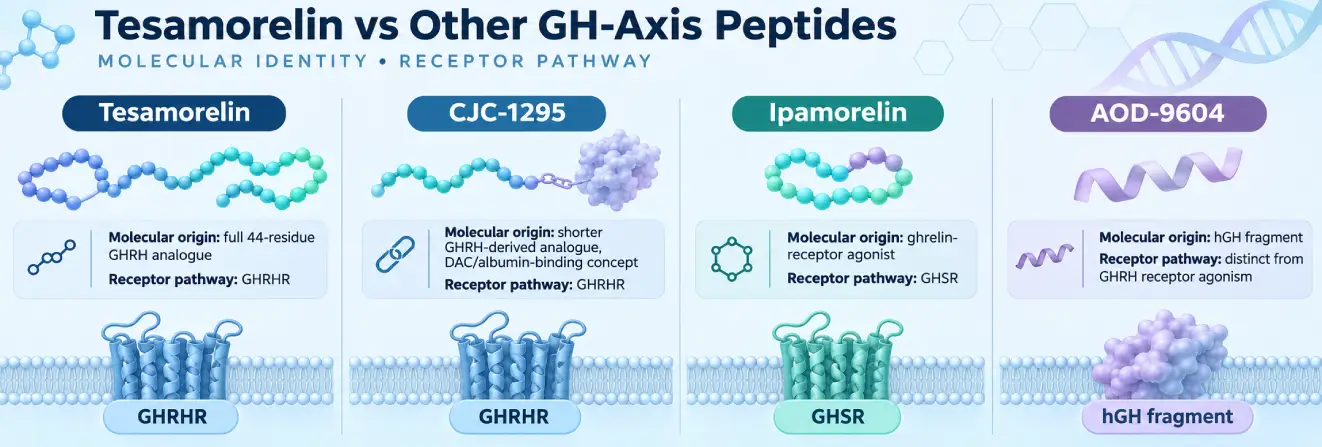
Tesamorelin is one of several research compounds associated with growth hormone signalling. However, compounds grouped under the term GH-axis peptides may act through different receptors and have substantially different molecular structures.
These differences affect how their experimental findings should be interpreted.
| Compound | Structure and target | Principal mechanism | Human evidence |
| Tesamorelin | Modified GHRH(1-44); GHRH receptor | Stimulates endogenous GH release | Multiple randomised trials in HIV-associated conditions |
| CJC-1295 with DAC | Modified GHRH(1-29) with albumin-binding DAC; GHRH receptor | Prolonged receptor stimulation | Small human pharmacology studies |
| Ipamorelin | Synthetic pentapeptide; ghrelin receptor (GHS-R1a) | GH secretagogue activity | Limited human investigations |
| AOD-9604 | Modified hGH 177-191 fragment; molecular mechanism incompletely established | Studied for metabolic effects distinct from GHRH receptor activation | Limited trials without established weight-loss efficacy |
The compounds should not be grouped as though they have equivalent evidence. Three distinctions are particularly important:
- Tesamorelin versus CJC-1295: Both activate GHRH receptors, but tesamorelin retains the full 44-residue GHRH sequence. Original CJC-1295 is derived from a shorter sequence and incorporates a DAC group intended to prolong exposure through albumin binding. Small studies, including Teichman and colleagues’ 2006 pharmacology work, found prolonged GH and IGF-1 elevations with CJC-1295; these findings cannot substitute for tesamorelin trial outcomes.
- Naming without DAC: The expression CJC-1295 without DAC is also used commercially for modified GRF(1-29). The label does not establish chemical identity with original albumin-binding CJC-1295.
- Different receptor pathways: Ipamorelin acts at the ghrelin receptor rather than reproducing GHRH structure. AOD-9604 derives from an hGH fragment, not GHRH, and its proposed effects do not establish GHRH receptor agonism. For more on this distinction, see the AOD-9604 research guide.
Meaningful comparisons therefore require attention to molecular identity, receptor pharmacology, pharmacokinetics and outcome measures. Additional research topics are collected in the APS peptide comparison guides.
Researchers investigating GH-axis signalling can explore related laboratory compounds in the APS Growth Hormone Research Peptides category.
Tesamorelin Approval and Regulatory Status
Tesamorelin’s clinical approval, laboratory research availability and anti-doping classification concern different regulatory questions. The jurisdictions and frameworks should not be conflated.
| Framework | What is established | What it does not mean |
| United States (FDA) | Initial approval in 2010 for excess abdominal fat in adults with HIV-associated lipodystrophy | Approval for general weight loss or anti-ageing |
| Australia (TGA/ARTG) | Therapeutic status depends on Australian regulation and any applicable ARTG entry | Automatic approval because of a US authorisation |
| WADA | Listed in 2026 under S2.2.4; prohibited at all times | A statement about Australian therapeutic registration |
FDA Approval and Its Limitations
US approval covers a defined HIV-related indication. The compound has been marketed under the EGRIFTA name, including later formulations EGRIFTA SV and EGRIFTA WR.
The prescribing information does not establish it as a medicine for general obesity or routine weight management. It also identifies important uncertainties, including the absence of established long-term cardiovascular safety.
Approval of a finished medicine does not validate independently supplied research peptides. Such materials may differ in formulation, sterility, quality controls or regulatory status.
Tesamorelin Australia: TGA and ARTG Considerations
The Therapeutic Goods Administration (TGA) regulates therapeutic goods under Australian law. The Australian Register of Therapeutic Goods (ARTG) records products included for supply, subject to relevant exemptions and authorised pathways.
The Australian Poisons Standard includes growth hormone-releasing hormones as a class within Schedule 4, with additional controls referenced in Appendix D. This scheduling classification is distinct from product registration.
For the Australian research context, three points matter:
- Overseas approval is not transferable. FDA authorisation does not automatically provide Australian marketing approval.
- Research-use labelling is not a blanket exemption. A research use only label does not itself remove relevant importation, advertising or supply obligations.
- Registration requires product-specific evidence. Claims about therapeutic supply require confirmation from an applicable ARTG entry or other authoritative TGA documentation.
The legal position may depend on the particular material, its intended activity and Commonwealth, state or territory requirements.
WADA Classification in Sport
The World Anti-Doping Agency (WADA) lists tesamorelin in category S2.2.4 of its 2026 Prohibited List as a growth hormone-releasing factor. Substances in this category are prohibited both in and out of competition.
Anti-doping classification is separate from pharmaceutical approval, research authorisation and clinical efficacy.
Limits of the Evidence and Safety Considerations
The tesamorelin clinical literature provides a substantial basis for investigating GHRH receptor pharmacology, but several uncertainties remain.
These limitations are particularly important when findings are discussed outside the original trial populations.
Limits of Generalising Clinical Findings
Most pivotal tesamorelin trials involved adults living with HIV who experienced abnormal abdominal fat accumulation.
HIV-associated lipodystrophy can involve multiple interacting factors, including antiretroviral treatment history, altered adipose tissue distribution, inflammation and metabolic dysfunction.
Findings from these populations cannot automatically be generalised to people without HIV or to individuals with different metabolic characteristics.
Several distinctions remain essential:
- Visceral fat reduction is not equivalent to general weight loss. A measurable change in one fat compartment does not establish a corresponding change in total body weight.
- Reduced hepatic fat is not proof of liver disease resolution. Imaging measurements, histological changes and clinical outcomes represent different endpoints.
- Hormonal responses are not clinical outcomes. Higher circulating IGF-1 demonstrates endocrine activity but does not independently establish clinical benefit.
- Short-term effects do not establish long-term safety. Trials lasting several months cannot fully assess outcomes that develop over many years.
- Findings cannot be transferred between peptides. Similar receptor targets do not guarantee equivalent pharmacological or physiological effects.
Research involving tesamorelin should therefore be interpreted according to the specific endpoints and populations investigated.
IGF-1, Glucose Regulation and Long-Term Uncertainties
Increased circulating IGF-1 is an expected pharmacodynamic consequence of GHRH receptor activation. It supports the mechanism but is not itself a measure of clinical benefit or long-term safety.
Several safety domains have been investigated:
- IGF-1 exposure: The effects of prolonged growth-factor signalling remain incompletely characterised.
- Glucose regulation: GH affects insulin sensitivity. Some trial endpoints did not show statistically significant between-group differences, but this does not rule out glycaemic risk.
- Adverse events: Clinical reports include fluid retention, joint or muscle discomfort, peripheral oedema, hypersensitivity and local reactions associated with administration.
- Long-term outcomes: Cardiovascular effects and the durability of changes in fat distribution require further investigation.
US prescribing information identifies glucose intolerance and diabetes mellitus among recognised safety concerns. Safety conclusions must therefore draw on the broader clinical programme, not a single study result or short-term measurement.
Tesamorelin Quality Considerations for Researchers
Tesamorelin presents analytical challenges associated with its peptide length, modified N-terminus and potential degradation pathways.
For laboratory research, the identity and quality of the material are essential to interpreting experimental findings.
Peptide Identity and Analytical Verification
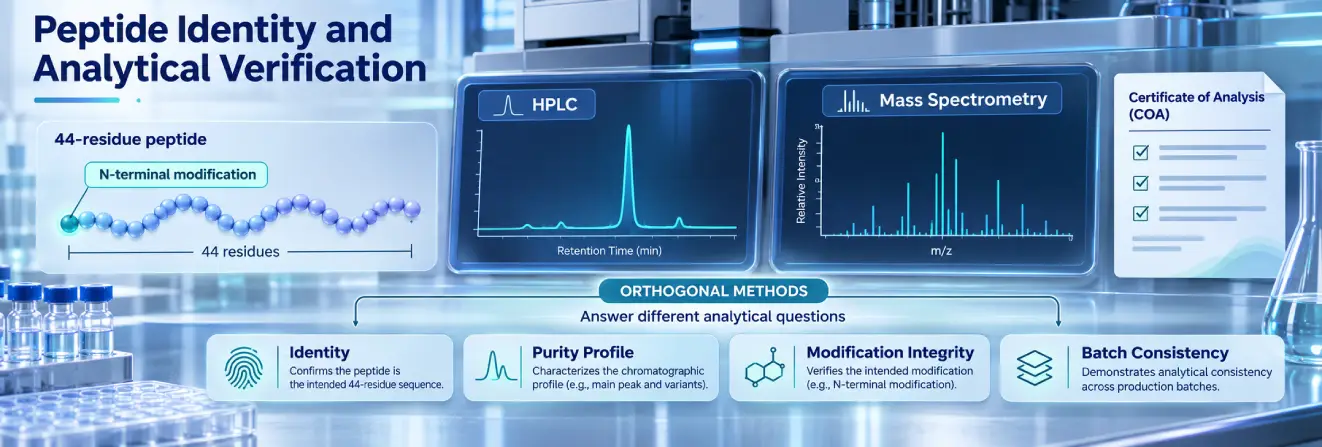
The 44-residue structure and modified N-terminus make tesamorelin more demanding to characterise than many shorter peptides. Identity, modification integrity, impurities and batch consistency are separate analytical considerations.
| Analytical method or record | What it can support | What it does not establish alone |
| Mass spectrometry (MS) | Expected molecular mass and molecular species | Complete sequence or absence of all related impurities |
| High-resolution or tandem MS | More detailed mass or sequence-related evidence | Full identity without appropriate method validation |
| HPLC | Chromatographic separation and peptide-related purity | Sterility or total mass purity |
| Batch Certificate of Analysis | Documented results, methods, batch identity and acceptance criteria | Suitability for every experimental use |
Orthogonal methods are valuable because each analytical technique has limitations. Measurements should be interpreted according to the method’s validation and the types of impurities it can detect.
An APS guide to reading a Certificate of Analysis explains how batch identifiers and analytical results are assessed.
Purity, Stability and Certificate of Analysis
An HPLC purity percentage usually describes the share of detected chromatographic signal assigned to the main component under specified conditions. It is not automatically the mass percentage of chemically pure peptide; detection conditions, separation performance and unmeasured impurities matter.
A batch-specific COA may include the batch identifier, method details, test results and acceptance criteria. Purity claims on a research product page should agree with the supporting batch documentation. The principles behind interpreting such results are covered in peptide purity explained.
Potential stability risks include:
- Oxidation of susceptible amino-acid residues.
- Deamidation and peptide-bond hydrolysis, depending on sequence and environmental conditions.
- Changes to terminal modifications or related molecular species, potentially requiring additional analytical separation.
Moisture, temperature variation, oxygen and solution conditions can affect integrity, although susceptibility depends on the specific formulation. These factors are discussed in the APS resource on peptide storage stability.
Importantly, high HPLC purity does not establish sterility, endotoxin status or biological safety. Those are separate attributes requiring appropriate tests when relevant.
What Tesamorelin Research Establishes
Tesamorelin illustrates how modifying a naturally occurring peptide hormone can preserve GHRH receptor activity while changing molecular stability. Its activation of the GH-IGF-1 axis provides a characterised model for endocrine and metabolic research.
Randomised trials in people with HIV-associated lipodystrophy demonstrate reductions in visceral adipose tissue. Other studies report reductions in hepatic fat, with 2026 evidence reviews supporting the principal body-composition findings. These results remain limited by the trial populations, measured endpoints and unanswered long-term questions.
US regulatory approval is narrowly defined and does not establish general clinical applications or an equivalent Australian registration. For laboratory research, the central value of tesamorelin is the connection between peptide structure, receptor pharmacology and interpretable experimental evidence.
For Research Use Only. Not for human or veterinary use.
FAQs About Tesamorelin
What is tesamorelin?
Tesamorelin is a synthetic analogue of human growth hormone-releasing hormone (GHRH). It contains the 44-amino-acid GHRH sequence with an N-terminal trans-3-hexenoyl modification that improves resistance to enzymatic degradation.
How does tesamorelin work?
Tesamorelin activates GHRH receptors in the anterior pituitary, stimulating endogenous growth hormone (GH) secretion and increasing insulin-like growth factor 1 (IGF-1). This signalling pathway influences endocrine regulation, lipid metabolism and other physiological processes.
Does tesamorelin reduce visceral belly fat?
Randomised clinical trials demonstrated reductions in visceral abdominal fat among adults with HIV-associated lipodystrophy. These findings concern a specific clinical population and do not establish equivalent effects in people without HIV.
What have tesamorelin studies found about liver fat?
A 2019 randomised trial involving people with HIV and non-alcoholic fatty liver disease (NAFLD) found that tesamorelin reduced hepatic fat compared with placebo over 12 months. Its effects on long-term liver disease outcomes remain uncertain.
Does visceral fat return after tesamorelin is discontinued?
Clinical extension studies found that visceral fat reductions were not consistently maintained after tesamorelin was discontinued. Visceral adipose tissue tended to reaccumulate, suggesting that the observed changes were not permanent.
What safety concerns have been identified in tesamorelin research?
Reported concerns include elevated IGF-1, glucose intolerance, fluid retention, joint discomfort and hypersensitivity reactions. The consequences of prolonged IGF-1 elevation and long-term cardiovascular safety remain incompletely understood.
What is the difference between tesamorelin and CJC-1295?
Both activate GHRH receptors, but their structures and pharmacokinetics differ. Tesamorelin is based on GHRH(1-44), whereas the original CJC-1295 is derived from GHRH(1-29) and contains an albumin-binding drug affinity complex (DAC). Tesamorelin also has substantially more extensive clinical trial evidence.
Is tesamorelin FDA approved?
Yes. Tesamorelin received initial FDA approval in 2010 to reduce excess abdominal fat in adults with HIV-associated lipodystrophy. This approval is limited to that indication and does not establish broader therapeutic applications.
Is tesamorelin approved in Australia?
US approval does not automatically apply in Australia. The regulatory status of any tesamorelin medicine must be verified through the Therapeutic Goods Administration (TGA) and Australian Register of Therapeutic Goods (ARTG). GHRH analogues are also subject to Australian scheduling controls.
Is tesamorelin approved for general weight loss?
No. The FDA-approved indication concerns excess abdominal fat associated with HIV-related lipodystrophy. Tesamorelin is not approved for general weight-loss management, and reductions in visceral fat should not be confused with overall body-weight reduction.
Is tesamorelin banned in sport?
Yes. Tesamorelin is explicitly listed under category S2.2.4 of the World Anti-Doping Agency’s (WADA) 2026 Prohibited List as a growth hormone-releasing factor. It is prohibited both in competition and out of competition.
Sources:
The NIH PubChem database provides information on tesamorelin’s molecular structure, composition and chemical identity.
The NIH PubMed record of Falutz et al. (2007) documents the randomised clinical trial investigating visceral fat in people with HIV.
The NIH PubMed record of Stanley et al. (2019) presents clinical findings on hepatic fat reduction in participants with HIV and NAFLD.
The US FDA Purple Book documents tesamorelin’s original approval and its licensed formulations.
The Australian Therapeutic Goods Administration (TGA) explains the regulatory requirements for therapeutic peptide products in Australia.