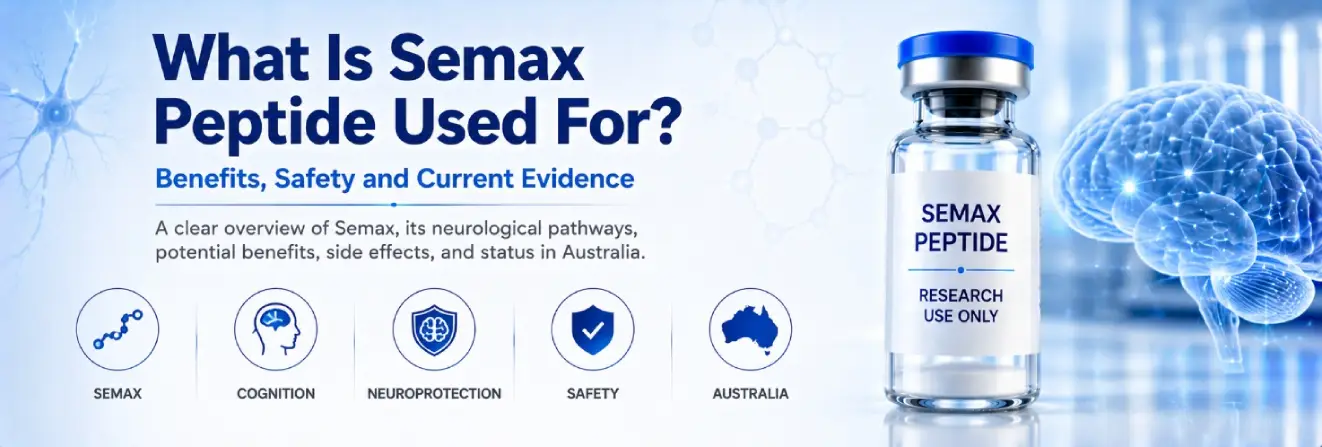
What is Semax peptide used for? Semax is a synthetic heptapeptide primarily investigated in neuroprotection, neurotrophic signalling, attention, memory, neuroplasticity and cerebral-ischaemia research.
Semax was developed from an ACTH-related peptide sequence but does not reproduce the conventional corticotropic activity of full ACTH.
Research has examined its effects on pathways involving BDNF, NGF, dopamine, serotonin, oxidative stress and inflammatory signalling. However, much of the evidence comes from animal models, molecular studies and relatively small human trials.
These findings support continued scientific investigation but do not establish Semax as an approved cognitive enhancer or neurological treatment.
Research-use note: Australia Peptide Sciences materials are supplied strictly for laboratory and scientific research and are not intended for human or veterinary administration.
What Is Semax Peptide Used For?
Semax is most commonly associated with research into neurological protection and cognitive function. Its main areas of investigation include cerebral ischemia, stroke recovery markers, attention, memory formation, learning behaviour and neurotrophic signalling.
Semax is commonly discussed within neuropeptide research because of its links to neurotrophic signalling, neurotransmitter pathways and CNS-focused experimental models.
Additional research has examined stress-response, neuroimmune, oxidative-stress and inflammatory pathways, although evidence in these areas remains predominantly preclinical.
Neuroprotection and Cerebral Ischemia Research
One of the most established areas of Semax research involves cerebral ischemia, which occurs when blood flow and oxygen delivery to brain tissue are reduced.
Animal studies have investigated whether Semax can influence:
- Neuronal survival after ischemic injury
- The volume of damaged brain tissue
- Neurotrophin expression
- Vascular-system gene activity
- Inflammatory and immune responses
- Oxidative-stress pathways
- Functional recovery markers
Research in rat models found that Semax affected genes involved in vascular formation, immune responses and neuronal protection following focal brain ischemia. These results help explain why the compound continues to attract interest in neuroprotection research.
Some small human studies have also examined Semax in patients recovering from ischemic stroke.
A 1997 study included 30 Semax-treated patients, while later rehabilitation research reported changes in plasma BDNF and functional recovery measures. These results are preliminary and do not provide the level of evidence normally expected from large, independently replicated clinical trials.
Researchers examining related cellular-stress pathways can also review our What Is Oxidative Stress? guide for broader mechanistic context.
Attention, Learning and Memory Research
Semax is sometimes discussed in nootropic contexts because it has been investigated in attention, memory and learning-related research. That label should not be interpreted as evidence of reliable cognitive enhancement in humans.
Studied cognitive processes include:
- Selective attention
- Short-term memory
- Learning
- Mental performance
- Information processing
- Cognitive function during fatigue
The proposed cognitive effects are partly connected to changes in neurotrophic factors and monoamine neurotransmitters. However, improvements observed in animal learning tests cannot automatically be assumed to occur in healthy people.
Human research remains limited. One functional brain-imaging study involved only 24 healthy participants and measured short-term changes in resting-state brain connectivity after Semax exposure. Although such studies may identify neurological activity, they do not prove meaningful or lasting improvements in memory, intelligence or everyday performance.
Neuroplasticity and Brain-Signalling Research
Neuroplasticity is the brain’s ability to change its connections and activity in response to learning, experience or injury.
Semax has been investigated for its possible influence on several pathways involved in this process, including:
- Brain-derived neurotrophic factor, or BDNF
- Tropomyosin receptor kinase B, or TrkB
- Nerve growth factor, or NGF
- Synaptic signalling
- Neuronal survival
- Gene expression following neurological stress
Animal research has shown changes in BDNF, NGF and TrkB expression after Semax administration. These findings provide a plausible biological basis for continued research but are not equivalent to proving a clinical cognitive benefit.
Mood and Stress-Response Research
Semax has also been studied in relation to stress, anxiety-like behaviour and depression-like behaviour, particularly in animal models.
This research focuses on potential changes in:
- Dopamine signalling
- Serotonin signalling
- BDNF expression
- Behavioural responses to stress
- Neuroendocrine regulation
- Inflammatory cytokines
Current findings are insufficient to establish Semax as an anxiety, depression or mood-disorder treatment. These pathways remain experimental research areas.
Other Early Research Areas
Additional exploratory areas include:
- Pain-response pathways
- Immune-system signalling
- Oxidative-stress regulation
- Neuroinflammation
- Cardiovascular tissue models
- Amyloid aggregation
- Mitochondrial stability
Most evidence in these areas comes from cells or animals. It should therefore be described as early mechanistic research rather than confirmation of a health benefit.
| Research Area | Why Semax Is Studied | Main Evidence Type | Current Interpretation |
| Cerebral ischemia | Neuronal protection and recovery markers | Animal studies and small human trials | Promising but not clinically established |
| Attention and memory | Cognitive signalling and performance | Animal and limited human research | Evidence remains preliminary |
| BDNF and neuroplasticity | Neuronal growth, survival and adaptation | Mainly molecular and animal studies | Biological activity has been observed |
| Mood and stress | Monoamine and stress-response pathways | Primarily animal models | Human benefit is unconfirmed |
| Immune and inflammatory pathways | Gene expression and cytokine signalling | Preclinical research | Exploratory evidence |
| Oxidative stress | Protection against cellular damage | Cell and animal models | Requires further validation |
What Is Semax?
Semax is a synthetic heptapeptide, meaning that it contains seven amino acids. Its sequence is: Met-Glu-His-Phe-Pro-Gly-Pro. This sequence may also be abbreviated as MEHFPGP.
For broader context on why amino-acid order matters, see our Peptide Sequence guide.
The first part of the molecule corresponds to amino acids 4–7 of ACTH, while the final Pro-Gly-Pro sequence is attached at the C-terminus. The added sequence contributes to the compound’s chemical and biological characteristics.
The Relationship Between Semax and ACTH
ACTH is a naturally occurring pituitary hormone best known for stimulating the adrenal glands to produce cortisol and other hormones.
Semax is not full ACTH. It contains only a small fragment related to the ACTH molecule and is modified with a Pro-Gly-Pro sequence.
For this reason, Semax may be described in several ways:
- An ACTH-fragment analogue
- An ACTH 4–10 analogue
- A synthetic regulatory peptide
- A melanocortin-related peptide
- Synthetic peptide investigated in neurobiological research
The terminology can be confusing. Chemically, Semax contains the ACTH 4–7 sequence followed by Pro-Gly-Pro. It is commonly discussed as an analogue of ACTH 4–10 because the resulting seven-amino-acid structure corresponds to that broader region.
Does Semax Have the Hormonal Effects of ACTH?
Semax is generally described as lacking the conventional corticotropic activity of full ACTH. It is therefore not expected to act like ACTH by directly stimulating normal adrenal cortisol production.
This does not mean that every possible endocrine or neuroendocrine effect has been excluded. Human studies remain too limited to conclude that Semax has no indirect hormonal influence under every condition.
How Does Semax Peptide Work?
The complete mechanism of Semax has not been definitively established. Current research suggests that its activity may involve several connected pathways rather than one receptor or biological target.
BDNF and TrkB Signalling
BDNF is a protein involved in:
- Neuronal survival
- Synaptic plasticity
- Learning
- Memory formation
- Adaptation following neurological injury
BDNF interacts with TrkB receptors on nerve cells. This signalling system helps regulate the maintenance and modification of neural connections.
Semax has increased BDNF-related activity in multiple preclinical experiments. Changes have been observed in the hippocampus, basal forebrain and other brain areas in rodents.
A higher BDNF measurement does not automatically mean that a compound improves cognition or prevents neurological disease. BDNF changes are biological markers that must be connected to meaningful, repeatable human outcomes before clinical conclusions can be made.
A change in BDNF or TrkB signalling is a mechanistic observation and should not be interpreted as proof of improved cognition or neurological recovery.
NGF and Other Neurotrophic Pathways
NGF supports the development, maintenance and survival of certain nerve-cell populations.
Research suggests that Semax can temporarily modify NGF expression alongside BDNF and related receptors. The timing and location of these changes may vary, making the mechanism more complex than a general increase in all neurotrophic factors.
Dopamine and Serotonin Signalling
Dopamine and serotonin are neurotransmitters involved in motivation, attention, reward, mood, movement and stress responses.
Rodent research indicates that Semax may influence dopaminergic and serotonergic activity. These effects are frequently used to explain why Semax is studied for attention, alertness and mood-related pathways.
The evidence does not establish Semax as equivalent to antidepressants, ADHD medicines or conventional stimulants. Those products have different structures, targets, pharmacological effects and levels of clinical evidence.
Immune and Inflammatory Signalling
Neurological injury can activate inflammatory and immune pathways that may contribute to additional tissue damage.
Semax has affected the expression of genes associated with:
- Immune responses
- Antigen presentation
- Vascular function
- Inflammatory signalling
- Cellular survival
These findings are especially relevant to cerebral ischemia models, where inflammation can influence the extent and progression of tissue injury.
Oxidative Stress and Cellular Protection
Oxidative stress occurs when reactive molecules exceed the ability of cellular defence systems to control them.
Preclinical Semax research has examined whether the peptide can reduce oxidative damage, support mitochondrial stability or modify protective cellular pathways after neurological stress.
These mechanisms remain under investigation. It has not been established that Semax provides general antioxidant protection in humans.
Semax Research Outcomes: What Does the Evidence Suggest?
The phrase “Semax peptide benefits” appears frequently in search and discussion, but scientifically these should be framed as research outcomes or hypotheses rather than established personal benefits.
Current evidence supports continued investigation into neurotrophic, cognitive and neuroprotective pathways but does not establish reliable therapeutic effects in humans.
Cognitive Research Outcomes
Research has explored possible effects on:
- Attention
- Learning performance
- Memory formation
- Mental fatigue
- Executive-function networks
- Cognitive activity following neurological injury
The strongest cognitive claims found online often extend beyond the evidence. Small studies may identify changes in test performance or brain activity, but they cannot predict how most people would respond.
Neuroprotective Research Outcomes
Semax is most scientifically associated with neuroprotection.
Potential neuroprotective effects investigated in experimental models include:
- Reduced neuronal damage
- Changes in infarct size
- Increased neurotrophic-factor expression
- Support for vascular and immune pathways
- Changes in neurological recovery measures
- Protection against ischemic cellular stress
Human stroke studies provide early signals, but sample sizes and study designs limit the conclusions that can be drawn. Larger controlled trials would be required to determine whether the observed effects are clinically meaningful and reproducible.
Mental-Fatigue and Attention Research
Some research has investigated attention and cognitive performance under mentally demanding conditions.
This does not establish Semax as a proven treatment for “brain fog,” chronic fatigue or reduced productivity. These symptoms can have many causes, including sleep problems, stress, medication effects, nutritional deficiencies and medical conditions.
Mood and Stress-Response Research
Preclinical studies have produced findings involving anxiety-like behaviour, depression-like behaviour and stress responses.
Possible mechanisms include BDNF, dopamine, serotonin and inflammatory signalling. However, Semax has not been established as a substitute for evidence-based treatment of depression, anxiety or other psychiatric conditions.
What Has Semax Not Been Proven to Do?
Available evidence does not establish that Semax:
- Prevents dementia
- Treats Alzheimer’s disease
- Reliably improves cognition in healthy people
- Treats ADHD
- Reverses age-related cognitive decline
- Provides guaranteed neuroprotection
- Treats anxiety or depression
- Is safe for long-term unsupervised human use
- Produces the same effects in humans as in animal models
Laboratory activity and preliminary human findings should not be presented as proven clinical results.
How Strong Is the Scientific Evidence for Semax?
The quality of Semax evidence varies significantly by research area.
Human Research
Human research includes small studies involving:
- Ischemic stroke
- Neurological rehabilitation
- Healthy volunteers
- Attention and cognitive testing
- Resting-state functional brain imaging
- BDNF measurements
These studies are useful for identifying possible effects and generating research questions. Their major limitations include small participant numbers, limited geographic diversity and insufficient independent replication.
For example, one early stroke study evaluated 30 treated patients, while a brain-imaging experiment included 24 healthy volunteers divided between Semax and placebo groups.
These numbers are too small to determine how reliably Semax works across different ages, health conditions, backgrounds and concurrent treatments.
Animal Research
A large proportion of Semax evidence comes from animal models involving:
- Focal cerebral ischemia
- Learning and memory tests
- Dopamine and serotonin measurements
- BDNF and NGF expression
- Stress-related behaviour
- Inflammatory responses
- Neurological tissue analysis
Animal research is important for understanding mechanisms, but animal outcomes frequently fail to translate into effective human treatments.
Cellular and Molecular Research
In-vitro and molecular studies examine:
– Peptide interactions
– Receptor activity
– Enzyme behaviour
– Amyloid aggregation
– Gene expression
– Neurotrophin production
– Oxidative-stress markers
These experiments can show that Semax has biological activity. They cannot establish whether a research finding produces a safe or useful effect in the human body.
| Evidence Level | What Is Studied | What It Can Demonstrate | What It Cannot Establish |
| In-vitro research | Cells, proteins, receptors and molecular reactions | Possible mechanisms and biological interactions | Human efficacy or whole-body safety |
| Animal research | Ischemia, cognition, stress and neurological models | Activity in a living biological system | Reliable human outcomes |
| Small human studies | Brain imaging, attention and stroke recovery | Preliminary human signals | Broad effectiveness or long-term safety |
| Large controlled trials | Diverse participants and defined outcomes | Reproducible clinical efficacy and adverse-event patterns | Currently unavailable for most Semax claims |
Main Evidence Limitations
The current research base is limited by:
- Small human study populations
- Limited independent replication
- Heavy reliance on animal models
- Few large randomised controlled trials
- Limited long-term follow-up
- Inconsistent study methods and outcome measures
- Differences between Semax formulations
- Limited data on medicine interactions
- Geographic concentration of clinical research
- Incomplete safety data for vulnerable populations
These limitations explain why a biologically interesting peptide can remain clinically uncertain.
Is Semax a Stimulant?
Semax is not generally classified as a conventional central nervous system stimulant.
Traditional stimulants, such as amphetamine or methylphenidate, act through recognised pharmacological pathways that produce measurable changes in wakefulness, attention and sympathetic nervous-system activity.
Semax is a peptide studied primarily for neurotrophic and neuromodulatory effects. It may influence dopamine and serotonin systems, which could affect alertness or attention, but this does not make it pharmacologically equivalent to a traditional stimulant.
Why Is Semax Sometimes Discussed Alongside Stimulant Research?
Preclinical findings involving dopamine, serotonin and attention-related pathways may explain why Semax is sometimes discussed alongside stimulant or nootropic research. However, these mechanisms do not make it pharmacologically equivalent to conventional stimulant medicines.
Semax Compared With Conventional Stimulants
| Feature | Semax | Conventional Stimulants |
| Compound type | Synthetic peptide | Usually small-molecule medicines or compounds |
| Main research focus | Neurotrophic and neuroprotective pathways | Alertness, attention and wakefulness |
| Proposed targets | BDNF, TrkB and monoamine signalling | Dopamine, noradrenaline or wakefulness systems |
| Evidence quality | Mainly preclinical and small human studies | Extensive clinical evidence for approved indications |
| Regulatory status | Varies by country and formulation | Some are approved prescription medicines |
| Clinical evidence base | Limited | Established for specific approved indications |
What Is Known About Semax and Monoamine-Related Pathways?
Preclinical research indicates that Semax may influence dopaminergic and serotonergic pathways. Reliable human interaction studies remain limited, so these findings should be treated as mechanistic observations rather than evidence about combined human use.
Is Semax Peptide Safe?
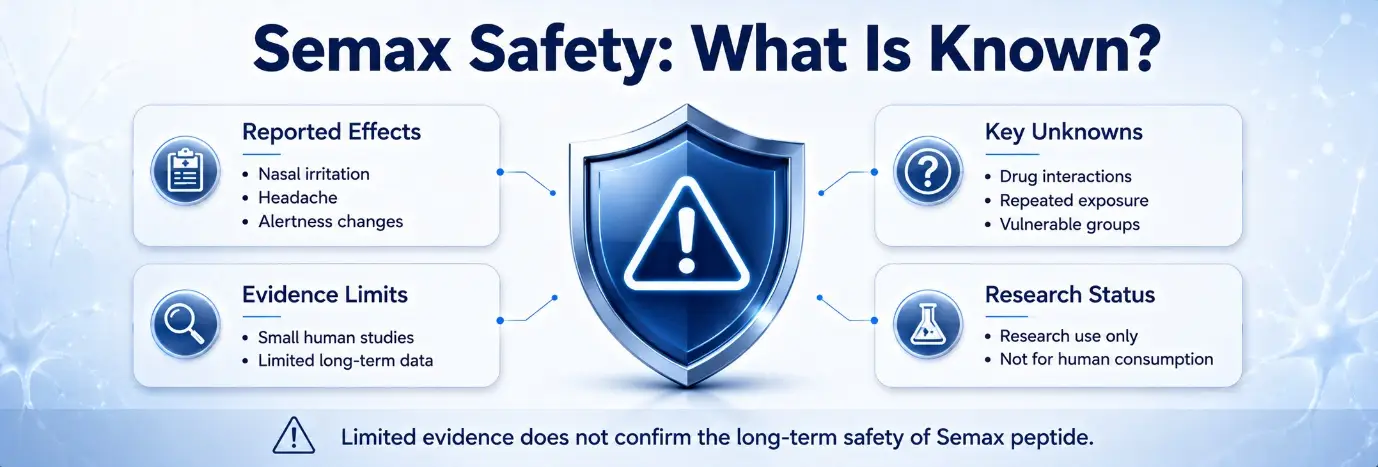
Available evidence is insufficient to establish a complete short- or long-term Semax safety profile. Limited reports describe relatively few adverse observations, but small study sizes and incomplete long-term monitoring prevent broad safety conclusions.
A product can appear to cause few reported problems because:
– Only small numbers of people were studied
– Follow-up periods were short
– Adverse events were not systematically recorded
– Research reports were inaccessible or incomplete
– Long-term outcomes were not examined
– The formulation differed between studies
Reported Safety Observations in Semax Studies
Published and review literature has reported observations including:
– Nasal irritation
– Nasal dryness or discomfort
– Changes in the appearance of the nasal cavity
– Headache
– Altered alertness
– Restlessness
– Drowsiness
– Individual hypersensitivity reactions
– Blood-glucose changes reported in limited study contexts
One evidence review reported nasal-cavity discolouration in approximately 10% of patients using an intranasal formulation and increased blood glucose in some people with diabetes. The same review emphasised that very little human evidence was available for evaluating side effects.
These findings do not establish how frequently adverse effects would occur across different products or populations.
Long-Term Safety Unknowns
Important unanswered questions include:
– Whether repeated exposure changes receptor or neurotransmitter activity
– Whether tolerance develops
– Whether cognitive or mood effects persist after exposure ends
– Human interaction data with other neuroactive compounds
– Whether it affects glucose regulation
– Whether it can trigger immune reactions
– Whether long-term exposure influences endocrine pathways
– Whether modified Semax analogues have different risks
– Effects of repeated route-specific exposure on local tissues
– Whether effects differ with age or neurological conditions
Research-Grade Semax Versus Therapeutic Products
Research-grade Semax is intended for controlled scientific investigation. It should not be treated as a medicine, supplement or personal-use product.
The term “research-grade” does not automatically guarantee:
- Sterility
- Freedom from endotoxins
- Pharmaceutical manufacturing standards
- Suitability for any human or veterinary administration route
- Accurate concentration after preparation
- Long-term stability
- Safety for human or veterinary consumption
Purity Does Not Equal Human Safety
A stated purity percentage normally describes how much of the measured sample corresponds to the intended compound under a specific analytical method.
It does not necessarily confirm:
- Microbial safety
- Sterility
- Endotoxin levels
- Absence of residual solvents
- Absence of synthesis by-products
- Correct vial concentration
- Safe packaging
- Clinical effectiveness
- Suitability for human use
A product can have a high analytical purity result and still be unsuitable for administration.
For a deeper explanation of analytical purity, see our Peptide Purity Explained guide.
Important Laboratory Documentation
Relevant documentation may include:
- Certificate of Analysis for Peptides
- Batch or lot number
- Peptide identity testing
- Purity testing
- Analytical method
- Molecular-weight confirmation
- Storage conditions
- Retest or expiry information
- Independent laboratory verification
Documentation supports research traceability. It does not convert a research material into an approved therapeutic product.
View Certificates of Analysis for Research Materials →
Semax in Australia: Regulatory and Research-Use Context
In Australia, therapeutic goods are generally required to be included in the ARTG unless a valid exemption, approval or other regulatory pathway applies. Products not included in the ARTG have not undergone the standard TGA pre-market assessment applicable to registered or listed therapeutic goods.
Semax should therefore be discussed according to its specific product classification and intended use rather than assumed to be an approved therapeutic product simply because it is available online.
ARTG Inclusion and Therapeutic Approval
A product should not be described as TGA-approved merely because:
- It is available from an Australian website
- It is shipped from within Australia
- It has a Certificate of Analysis
- It is labelled as high purity
- It has been studied overseas
- A related compound is used in another country
Claims about current ARTG inclusion should always be verified against the official register using the exact product, sponsor, formulation and indication.
The TGA has increased its compliance focus on unapproved peptide products during 2026 and warns that products promoted online may not have been assessed for safety, quality or effectiveness. Regulatory status should therefore be verified against the ARTG for the exact product and sponsor rather than inferred from marketing language.
Research Use Is Different From Therapeutic Use
Research Use Only Peptides are supplied for laboratory investigation and are not intended to diagnose, prevent or treat a medical condition.
Therapeutic use may involve claims or activities such as:
- Treating stroke
- Improving memory
- Managing anxiety
- Enhancing focus
- Preventing neurological decline
- Administering a compound to a person
- Recommending a product for a health condition
A research page may discuss published scientific findings, but those findings should not be converted into personal-use instructions or treatment promises.
Importation and Regulatory Pathways
Importation and supply requirements depend on the product, intended use, classification and applicable regulatory pathway. The TGA warns that unapproved peptide products promoted online may be poorly labelled, incorrectly identified or supplied outside lawful therapeutic pathways.
How Is Semax Studied?
Semax research can be divided into molecular, animal and human investigations.
In-Vitro Research
Laboratory studies may examine:
- Peptide stability
- Protein binding
- Receptor interactions
- Gene transcription
- Neurotrophin production
- Amyloid-related processes
- Oxidative-stress responses
- Cellular survival
These studies help determine what Semax may do at the molecular level.
Animal Models
Animal studies commonly evaluate:
- Cerebral ischemia
- Neurological tissue damage
- Learning and memory behaviour
- Stress responses
- Dopamine and serotonin activity
- BDNF and NGF expression
- Immune and inflammatory signalling
- Motor function
Animal models allow researchers to examine brain tissue and biological processes that cannot be investigated in the same way in human volunteers.
Human Research
Limited human research has used neurological assessments, attention tests, rehabilitation measures and brain imaging.
Intranasal delivery appears frequently in historical Semax research. This should be treated as a characteristic of those study protocols rather than administration guidance for research-use materials.
Common Research Endpoints
Researchers may measure:
- BDNF concentration
- NGF expression
- TrkB receptor activity
- Gene-expression changes
- Infarct volume
- Neurological function scores
- Motor recovery
- Attention-test performance
- Memory-test performance
- Functional brain connectivity
- Oxidative-stress markers
- Inflammatory cytokines
No single marker proves that Semax provides a clinically meaningful benefit.
Semax Versus Related Research Peptides
Semax is frequently compared with Selank and modified Semax analogues. These compounds should not be treated as interchangeable.
Semax Versus Selank
Semax and Selank are both synthetic heptapeptides, but they have different structures and origins.
Semax is mainly associated with:
- Neuroprotection
- Cognitive signalling
- Attention
- Memory
- Cerebral ischemia research
- BDNF-related pathways
Selank is more commonly investigated in relation to:
- Anxiety-like behaviour
- Stress regulation
- Immune signalling
- GABA-related pathways
- Emotional responses
Research into one peptide cannot be used to establish the effects or safety of the other.
For a dedicated side-by-side review, see our Selank vs Semax Research Comparison.
Semax Versus N-Acetyl Semax
N-Acetyl Semax is a chemically modified form of Semax in which an acetyl group is added to the N-terminus.
Acetylation may change:
- Chemical stability
- Resistance to degradation
- Metal-ion binding
- Distribution
- Biological activity
- Experimental results
Research using standard Semax should not automatically be applied to an acetylated analogue. Laboratory documentation should identify the exact compound being tested.
Comparison of Related Compounds
| Compound | Structure or Origin | Main Research Focus | Key Limitation |
| Semax | ACTH-fragment-related heptapeptide | Neuroprotection, cognition and ischemia | Limited large-scale human evidence |
| Selank | Tuftsin-related heptapeptide | Stress, anxiety and immune pathways | Evidence is mainly preclinical or regionally concentrated |
| N-Acetyl Semax | N-terminally modified Semax | Stability and neurological signalling | Cannot be assumed equivalent to standard Semax |
| Conventional stimulants | Non-peptide compounds | Wakefulness and attention | Different mechanisms and risk profiles |
| Approved neurological medicines | Clinically evaluated therapeutic products | Specific diagnosed conditions | Effects cannot be compared directly with research peptides |
How to Evaluate Semax Claims
Semax information ranges from cautious scientific discussion to unsupported promises. Several checks can help separate evidence from marketing.
Evaluate the Type of Evidence
- Was the study conducted in humans, animals or isolated cells?
- How many human participants were included?
- Was there a placebo or control group?
- Were participants randomly assigned?
- Was the study blinded?
- Were the findings independently replicated?
- Did the research measure a biological marker or a meaningful outcome?
- Was standard Semax or a modified analogue used?
- How long were participants followed?
- Were adverse effects systematically recorded?
Distinguish Mechanisms From Benefits
A mechanism explains how something might work.
For example, a change in BDNF expression may support a scientific hypothesis. It does not by itself demonstrate that Semax improves memory, prevents dementia or supports stroke recovery.
Clinical benefits require reliable improvements in meaningful outcomes, supported by well-designed human trials.
Warning Signs in Online Claims
Be cautious when information includes:
- Guaranteed improvements in focus or memory
- Claims that Semax prevents dementia
- Statements that animal evidence proves human effectiveness
- Claims of complete safety
- Claims that no reported side effects means no risk
- Detailed self-administration protocols for research products
- Encouragement to combine Semax with medicines or stimulants
- Claims that a Certificate of Analysis proves medical suitability
- Missing distinction between standard and modified Semax
- No explanation of regulatory status
- No research-use limitation
Semax is a synthetic heptapeptide investigated primarily in neuroprotection, neurotrophic signalling, cognition-related pathways and cerebral-ischaemia research.
Mechanistic studies have examined BDNF, NGF, dopamine, serotonin, inflammatory signalling and oxidative-stress pathways, while human evidence remains comparatively small and geographically concentrated.
These findings support continued scientific investigation but do not establish Semax as an approved cognitive enhancer, neurological treatment or long-term therapeutic intervention.
Laboratory research should rely on verified material identity, batch-specific analytical documentation and clear separation between preclinical findings and therapeutic claims.
For broader compound-level context, browse our Research Peptide Guides.
Explore Semax Peptide for Laboratory Research Only →
Frequently Asked Questions About Semax Peptide
What is Semax peptide used for?
Semax is primarily studied in neuroprotection, neurotrophic signalling, attention, memory, cerebral-ischaemia and related CNS research. Much of the evidence remains preclinical or based on relatively small human studies.
What Research Outcomes Are Being Investigated With Semax?
Research has examined BDNF and NGF signalling, attention, learning, memory-related endpoints, neuronal survival and recovery-related markers. These are research outcomes rather than established personal benefits.
Is Semax peptide safe?
A complete Semax safety profile has not been established. Human studies are limited, and long-term adverse-event and interaction data remain insufficient.
What are the side effects of Semax peptide?
Published literature has reported observations such as nasal irritation, local discomfort, headache and other transient effects in some study settings, but their frequency and long-term significance are not well characterised.
Is Semax a stimulant?
Semax is not generally classified as a conventional stimulant. It is investigated primarily through neurotrophic and neuromodulatory pathways.
Does Semax increase BDNF?
Semax has increased BDNF expression or activity in several animal studies. Limited human research has also measured changes in BDNF-related outcomes. These findings do not prove that Semax produces reliable cognitive or neurological benefits in humans.
Does Semax affect cortisol?
Semax is derived from an ACTH-related sequence but is generally described as lacking the conventional corticotropic activity of full ACTH. Human endocrine evidence remains limited.
Is Semax approved in Australia?
Approval should be verified against the Australian Register of Therapeutic Goods for the exact product and sponsor. Research-grade Semax should not be represented as TGA-approved simply because it is sold or shipped within Australia.
Is research-grade Semax intended for human use?
No. Research-grade Semax is intended for laboratory and scientific investigation and is not intended for human or veterinary administration.
What is the difference between Semax and Selank?
Semax and Selank are different synthetic peptides. Semax is primarily associated with cognitive, neuroprotective and cerebral-ischemia research, while Selank is more frequently studied for anxiety, stress and immune-related pathways. Evidence involving one peptide cannot be transferred directly to the other. For a detailed comparison, see our Selank vs Semax Research Comparison.
Is N-Acetyl Semax the same as standard Semax?
No. N-Acetyl Semax contains an additional acetyl modification at the N-terminus. This change may affect stability, chemical interactions and biological behaviour. Findings involving standard Semax should not automatically be applied to N-Acetyl Semax.
Has Semax Been Established as an ADHD Treatment?
No. Attention-related pathways have been investigated, but Semax has not been established as an approved or evidence-based ADHD treatment.
Does Semax Research Establish Dementia or Alzheimer’s Prevention?
No. Preclinical and molecular findings involving neurotrophic or amyloid-related pathways do not establish prevention or treatment of dementia or Alzheimer’s disease.
How strong is the clinical evidence for Semax?
Clinical evidence remains limited compared with established medicines. Available human studies are generally small, regionally concentrated and insufficient to establish broad efficacy or long-term safety.
Is Semax Available for Laboratory Research?
Australia Peptide Sciences lists Semax Peptide as a laboratory research material supplied for scientific research only.
References:
Research has examined how N-terminal acetylation may influence the chemical behaviour of Semax.
Semax has been studied for its effects on gene expression following focal cerebral ischemia.
Research has investigated the influence of Semax and Pro-Gly-Pro on BDNF and NGF transcription.
Semax has been evaluated in relation to BDNF levels and functional recovery after ischemic stroke.
A brain-imaging study examined the effects of Semax on the brain’s default mode network.