This peptide list and what they do guide explains 10 peptides and the biological pathways they are commonly studied for.
Peptides are short amino acid chains that may play roles in cellular signalling, metabolism, immune response, and tissue research.
Because peptides are smaller than proteins, their activity can vary depending on structure, sequence, and target pathway.
This article is for educational and research-use-only purposes.
It does not provide medical advice, dosing guidance, treatment recommendations, or personal-use instructions.
Research peptides are not intended for human consumption, injection, ingestion, topical application, diagnosis, treatment, or disease prevention.
For a broader introduction to laboratory peptide research, see our What Are Peptides for Research? guide.
What Are Peptides?
Peptides are short chains of amino acids joined together by peptide bonds. Amino acids are the same basic building blocks that make up proteins, but peptides are generally smaller and less complex than full proteins.
For more detail on the chemistry linking amino acids, see our Peptide Bond guide and Peptide Sequence guide.
A peptide may contain only a few amino acids, while proteins can contain long, folded chains with complex three-dimensional structures. This difference in size and structure is one reason peptides are studied for highly specific signalling roles in biological systems.
Researchers study peptides because they may interact with receptors, enzymes, cell membranes, inflammatory pathways, hormone-related systems, mitochondrial pathways, or neurochemical systems.
Different peptides can be investigated in very different ways depending on their molecular structure.
Common peptide research areas include:
- Cellular signalling
- Metabolic pathway research
- Tissue response models
- Growth hormone signalling models
- Neurobiology and cognitive pathway research
- Skin and extracellular matrix research
- Mitochondrial and oxidative stress research
- Immune and inflammatory pathway research
- Healthy aging and longevity-related models
A useful peptide list and what they do guide should not simply describe broad “benefits.” It should explain what each peptide is studied for, what pathway is commonly associated with it, and why research-use-only language matters.
Peptide List and What They Do: Quick Overview
The table below summarises 10 research peptides and the main biological pathways they are commonly discussed in relation to.
| Peptide | Research Category | Common Research Interest | Main Pathway Studied |
| BPC-157 | Tissue-response research | Gastrointestinal, tendon and inflammatory models | Vascular, fibroblast and cellular-response signalling |
| TB-500 | Cell-migration and tissue-response research | Cell migration and tissue response models | Actin and cell-movement pathways |
| GHK-Cu | Skin and matrix research | Collagen, extracellular-matrix, skin and hair-related models | Copper-binding and extracellular matrix signalling |
| CJC-1295 | Endocrine research | Growth hormone pathway models | GHRH and GH/IGF-1 signalling |
| Ipamorelin | GH secretagogue research | GH pulse and ghrelin receptor models | Growth hormone secretagogue receptor pathway |
| AOD-9604 | Metabolic research | Lipid metabolism and body-composition models | Lipid-metabolism and adipocyte-related pathways |
| MOTS-C | Mitochondrial research | Energy, metabolism, and stress-response models | Mitochondrial-derived peptide signalling |
| Epitalon | Cellular-aging research | Telomere, circadian and cellular-aging models | Telomerase and circadian-related pathways |
| Semax | Neuro research | Neurotrophic, cognition-related and cerebral-ischaemia models | ACTH fragment and BDNF-related signalling |
| Selank | Neuroimmune research | GABAergic, neuroimmune and stress-response models | Tuftsin-related neuroimmune pathways |
1. BPC-157 Peptide
BPC-157 is one of the most widely discussed experimental peptides in preclinical gastrointestinal, vascular, inflammatory and tissue-response research.
In research settings, BPC-157 is commonly associated with:
- Gastrointestinal research models
- Tissue-response studies
- Tendon and ligament models
- Angiogenesis-related research
- Inflammatory pathway investigation
- Fibroblast and cellular-response signalling
In research-use-only contexts, BPC-157 is best understood as a peptide investigated in preclinical models related to tissue response, angiogenesis, gastrointestinal biology, and inflammatory pathway modulation. These research findings should not be interpreted as evidence of approved therapeutic use or proven human outcomes.
It is not appropriate to claim that it “heals injuries,” “repairs tendons,” or “treats gut problems” in a research-use-only article. A safer and more accurate framing is that BPC-157 has been investigated in preclinical models for tissue response, angiogenesis, and inflammatory pathway modulation.
For Australian readers, this distinction is especially important. In Australia, the TGA specifically identifies products containing BPC-157 among examples of unapproved peptide products that have not undergone TGA assessment for safety, quality or effectiveness as therapeutic goods.
For the full evidence review, see our BPC-157 Peptide Research Guide.
2. TB-500 Peptide
TB-500 is discussed as a synthetic peptide fragment associated with a region of Thymosin beta-4 research. TB-500 and full-length Tβ4 are structurally different materials, so findings from one should not automatically be attributed to the other. In laboratory research, it is often explored in connection with cell migration, tissue response, wound models, and actin-related cellular processes.
Research discussions around TB-500 often involve:
- Cell migration
- Actin regulation
- Tissue-response models
- Wound-response research
- Inflammatory signalling
- Extracellular-matrix and migration-related research
Full-length Thymosin beta-4 is involved in actin-related cellular processes, while TB-500 represents a shorter research compound. TB-500 is therefore best discussed in relation to actin dynamics, cell migration and tissue-response models rather than athletic recovery or injury treatment.
3. GHK-Cu Peptide
GHK-Cu, also known as copper tripeptide-1, is a copper-binding peptide studied in skin biology, extracellular matrix research, tissue-response models, and hair follicle-related research. It is one of the better-known peptides in cosmetic science discussions, but research-use-only GHK-Cu should still be handled carefully from a claims and compliance perspective.
GHK-Cu is commonly studied for:
- Collagen-related signalling
- Skin biology models
- Extracellular matrix remodelling
- Wound-response research
- Copper-binding activity
- Hair follicle research models
A key distinction should be made between topical cosmetic ingredients and injectable or research-use-only peptide materials. A peptide may appear in skincare discussions, but that does not automatically mean every form, concentration, supplier, or route is approved for human use.
In research-use-only content, GHK-Cu is best described as a copper-binding peptide studied in collagen-related signalling, extracellular-matrix biology, fibroblast models and hair-related research rather than as a cosmetic or hair-growth treatment.
4. CJC-1295 Peptide
CJC-1295 is a synthetic analogue related to growth hormone-releasing hormone research. It is commonly discussed in connection with the growth hormone and IGF-1 signalling axis.
Researchers may study CJC-1295 in relation to:
- GHRH receptor activity
- Growth hormone signalling
- IGF-1 pathway models
- Endocrine communication
- Metabolic research models
The terminology surrounding CJC-1295 requires care. Authentic CJC-1295 was developed with a Drug Affinity Complex (DAC) that extends its pharmacokinetic profile. The shorter-acting compound often marketed or discussed online as “CJC-1295 without DAC” is generally associated with Modified GRF (1–29) terminology and should not automatically be treated as chemically identical to CJC-1295 with DAC.
CJC-1295 is most appropriately discussed in the context of growth hormone signalling research, GHRH receptor activity, and GH/IGF-1 pathway models, without presenting it as a bodybuilding, anti-aging, or human-use product.
The FDA has identified potential safety concerns with compounded CJC-1295, including risks related to immunogenicity, peptide-related impurities, API characterization complexity, and serious adverse events such as increased heart rate and systemic vasodilatory reaction.
For dedicated compound-specific information, see our CJC-1295 Peptide Research Guide, CJC-1295 No DAC guide and CJC-1295 DAC vs No DAC.
5. Ipamorelin Peptide
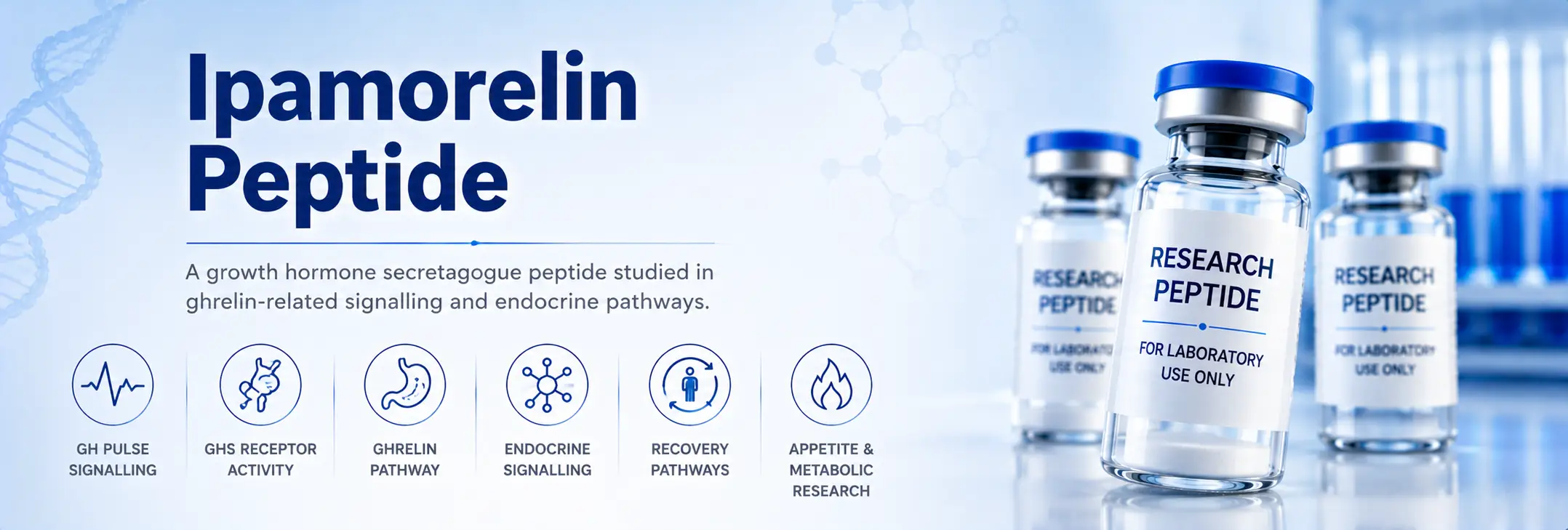
Ipamorelin is commonly discussed as a growth hormone secretagogue peptide. In research contexts, it is studied for its interaction with growth hormone secretagogue receptors and ghrelin-related signalling.
Ipamorelin research may involve:
- GH pulse signalling
- Growth hormone secretagogue receptor activity
- Ghrelin pathway models
- Endocrine signalling
- Appetite and metabolic research contexts
Ipamorelin is often grouped with peptides such as CJC-1295, GHRP-2, GHRP-6, sermorelin, and tesamorelin because of its relationship to growth hormone pathway research. However, each peptide has a different structure and research profile.
Ipamorelin is better positioned as a research peptide studied in growth hormone secretagogue activity, ghrelin-related signalling, and endocrine pathway models, rather than as a muscle-building, fat-loss, or human performance compound.
Ipamorelin Peptide Research Guide
6. AOD-9604 Peptide
AOD-9604 is a peptide fragment derived from a region of human growth hormone. It is commonly discussed in metabolic research, particularly in relation to lipid metabolism and body-composition models.
AOD-9604 is often studied in relation to:
- Lipid metabolism
- Adipocyte biology
- Fat metabolism pathways
- Metabolic signalling
- Body-composition research models
- hGH fragment research
AOD-9604 is most accurately discussed as a peptide investigated in laboratory and preclinical research related to lipid metabolism, adipocyte biology, and body-composition research models. It should not be interpreted as evidence of approved human fat-loss use.
The FDA has included AOD-9604 among certain bulk drug substances for which safety concerns or limited safety information have been identified in compounding contexts.
AOD-9604 Peptide Research Guide
7. MOTS-C Peptide
MOTS-C is a mitochondrial-derived peptide studied in relation to cellular energy, metabolic stress, and mitochondrial signalling.
It is part of a growing research area focused on how mitochondria communicate with the rest of the cell and influence broader metabolic function.
MOTS-C is commonly discussed in research involving:
- Mitochondrial signalling
- Cellular energy models
- Metabolic stress response
- Insulin-related pathway research
- Exercise-associated metabolic signalling models
- Oxidative stress pathways
Mitochondria are often described as energy-producing organelles, but modern research also studies them as signalling hubs. MOTS-C is relevant because it is investigated as a mitochondrial-derived peptide that may interact with metabolic and stress-response pathways.
In research-use-only contexts, MOTS-C is best described as a mitochondrial-derived peptide studied in cellular-energy, metabolic-stress, oxidative-stress and mitochondrial-signalling models.
8. Epitalon Peptide
Epitalon, also spelled Epithalon in some research discussions, is a short synthetic tetrapeptide often associated with cellular-aging, telomere and circadian-related research. It is commonly studied in relation to telomere biology, cellular aging models, and circadian or melatonin-related pathways.
Epitalon research topics may include:
- Telomere biology
- Telomerase-related research
- Cellular aging models
- Circadian signalling
- Melatonin-related pathways
- Cellular-aging and lifespan-related experimental models
Telomeres are protective structures at the ends of chromosomes, and telomere shortening is often studied in relation to cellular aging. Epitalon is discussed in this context because some research models investigate its relationship to telomerase activity and cellular aging markers.
For research-use-only content, Epitalon is best described as a peptide studied in experimental models related to telomere biology and cellular aging pathways, rather than as an anti-aging treatment or longevity product.
Epitalon Peptide Research Guide
9. Semax Peptide
Semax is a synthetic ACTH-fragment-related heptapeptide studied in neurotrophic, neurochemical, cognitive and cerebral-ischaemia research.
Semax research may involve:
- Neurotrophic signalling
- BDNF-related pathways
- Cognitive research models
- Neurochemical signalling
- Stress-response research
- Cerebral-ischaemia and neuroprotection-related models
Semax is most appropriately discussed as a research peptide investigated in neurobiology models related to neurotrophic signalling, cognitive pathways, stress-response research, and neurotransmitter regulation. It should not be presented as a nootropic product for personal use.
What Is Semax Peptide Used For?
10. Selank Peptide
Selank is a synthetic peptide related to tuftsin, a naturally occurring immunomodulatory peptide. It is commonly discussed in neuroimmune research, stress-response models, and neurotransmitter pathway studies.
Selank is often studied in relation to:
- Neuroimmune signalling
- Stress-response models
- Anxiety-related animal models
- Immune modulation research
- Serotonin and dopamine-related pathways
- Cognitive and behavioural research models
Selank is best discussed in research-use-only contexts as a peptide studied in laboratory and preclinical models related to neuroimmune communication, stress-response pathways, immune modulation, and neurotransmitter signalling. It should not be interpreted as a mental-health treatment or personal-use product.
For a direct mechanism comparison, see our Selank vs Semax Research Comparison.
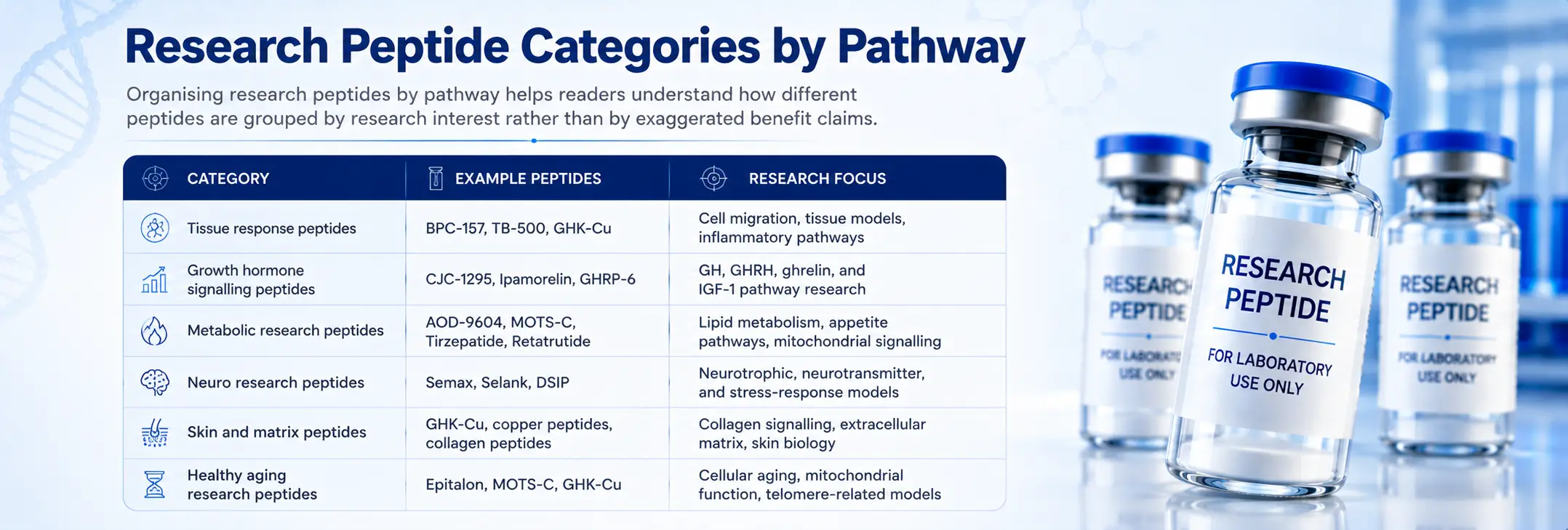
Research Peptide Categories by Pathway
Organising research peptides by pathway helps readers understand how different peptides are grouped by research interest rather than by exaggerated benefit claims.
| Category | Example Peptides | Research Focus |
| Tissue-response / cell-migration research | BPC-157, TB-500, GHK-Cu | Cell migration, tissue models, inflammatory pathways |
| Growth hormone signalling peptides | CJC-1295, Ipamorelin, GHRP-6 | GH, GHRH, ghrelin, and IGF-1 pathway research |
| Metabolic research peptides | AOD-9604, MOTS-C, Tirzepatide, Retatrutide | Metabolic, receptor and mitochondrial signalling |
| Neuro research peptides | Semax, Selank, DSIP | Neurotrophic, neurotransmitter, and stress-response models |
| Skin and matrix peptides | GHK-Cu, copper peptides, collagen peptides | Collagen signalling, extracellular matrix, skin biology |
| Cellular-aging research peptides | Epitalon, MOTS-C, GHK-Cu | Cellular aging, mitochondrial function, telomere-related models |
Research peptides are best understood when grouped by their biological pathways, providing a structured overview of their primary areas of investigation and the mechanisms explored in preclinical research.
Research Peptides vs Approved Peptide Medicines
One of the most important distinctions in peptide education is the difference between research peptides and approved peptide medicines.
Approved peptide medicines are regulated products assessed for specific indications, formulations, manufacturing standards, safety data, and clinical use conditions.
Examples of peptide-based medicines include insulin and certain GLP-1 receptor agonists used under medical supervision.
Research peptides are different. They are supplied for laboratory research purposes only and are not intended for human consumption or personal experimentation.
The difference depends on several factors:
- Regulatory approval status
- Intended use
- Manufacturing standards
- Route of administration
- Labelling and documentation
- Clinical evidence
- Product formulation
- Supplier compliance
- Jurisdiction-specific rules
The same peptide name can appear in different contexts. For example, a compound may be discussed in scientific literature, used in a regulated medicine, investigated in preclinical models, or sold as a research-use-only material.
These contexts are not interchangeable.
The TGA specifically lists products containing BPC-157, GHK-Cu, TB-500, retatrutide and CJC-1295 among examples of unapproved peptide products. Unapproved therapeutic goods have not been assessed by the TGA for safety, quality or effectiveness.
What Does Research Use Only Mean?
Research use only means a product is intended for laboratory investigation and not for direct human or animal use. For peptide products, this language is essential because many peptides are discussed online using wellness, fitness, beauty, or anti-aging claims that may not reflect approved clinical use.
A material labelled and supplied specifically as Research Use Only should not be represented as:
- An approved medicine
- A dietary supplement
- A therapeutic treatment
- A personal-use injectable
- A diagnostic product
- A product authorised for human or veterinary administration
The research-use material described here is not intended for injection, ingestion, topical self-application or other human or veterinary administration.
For research buyers, the focus should be on documentation and laboratory suitability rather than human outcomes. Important factors include:
- Certificate of analysis
- Batch number
- Purity testing
- Identity verification
- Storage requirements
- Solubility information
- Labelling clarity
- Supplier transparency
- Research-use-only disclaimers
In 2026, the TGA expanded its compliance focus on unapproved peptide products following increased detection of potentially unlawful importation, supply and advertising. Its peptide guidance was updated again in September 2026.
How to Compare Peptides in a Research Setting
When comparing peptides, researchers should avoid relying on marketing-style benefit lists. A better approach is to compare peptides by mechanism, evidence stage, documentation, and research suitability.
| Factor | Why It Matters |
| Peptide identity | Confirms the specific compound being studied |
| Molecular sequence | Helps determine structure and research relevance |
| Purity | Affects reliability of research observations |
| COA availability | Provides analytical documentation |
| Batch number | Supports traceability |
| Storage requirements | Helps preserve peptide integrity |
| Solubility data | Supports research preparation planning |
| Research pathway | Clarifies why the peptide is being studied |
| Evidence level | Separates preclinical data from clinical evidence |
| Supplier transparency | Reduces uncertainty around quality and documentation |
For detailed analytical guidance, see our Certificate of Analysis guide and Peptide Purity Explained.
View Certificates of Analysis for Research Materials →
A peptide list and what they do resource becomes more useful when it helps readers ask better research questions, such as:
- What pathway is this peptide studied for?
- Is the evidence preclinical, clinical, or mostly theoretical?
- Is the product clearly labelled for research use only?
- Is there a COA available?
- Are the claims written responsibly?
- Does the supplier avoid human-use language?
Common Mistakes When Reading a Peptide List
Many online peptide lists are too simplistic. They often reduce complex compounds into quick benefit claims, which can create confusion.
Common mistakes include:
- Treating research interest as proven human benefit
A peptide being studied for a pathway does not mean it has proven clinical effects. - Confusing research peptides with approved medicines
Approved peptide medicines and RUO peptide materials are not the same. - Ignoring regulatory context
Peptide rules vary by country and product type. - Overlooking purity and batch documentation
Without quality documentation, research reliability may be limited. - Assuming all formulations are equivalent
Different formulations, chemical forms, salts, modifications and regulatory categories may have different scientific and legal contexts. - Using supplement-style claims for RUO products
Terms like “best for fat loss,” “heals injuries,” or “boosts energy” are not appropriate for research-use-only content. - Ignoring safety uncertainty
Some peptides have limited human safety data, especially when sold outside regulated medical pathways.
Final Thoughts on Peptide List and What They Do
A useful peptide list should do more than assign simplified “benefits” to individual compounds. It should explain molecular identity, the pathways being investigated, the evidence level and the limitations of the available research.
The 10 peptides covered here span tissue-response, endocrine, metabolic, mitochondrial, extracellular-matrix, neurobiological and cellular-aging research. Their inclusion in scientific literature does not establish therapeutic approval, safety or suitability for personal use.
For laboratory investigation, researchers should prioritise compound identity, batch traceability, analytical documentation, storage conditions and evidence appropriate to the specific research question.
For dedicated compound-level information, browse our Research Peptide Guides.
Explore Research Peptide Guides →
FAQs About Peptide List and What They Do
What is a peptide list and what they do guide?
A peptide list and what they do guide is an educational resource that explains different peptides, their research categories, and the biological pathways they are commonly studied for.
What are peptides?
Peptides are short chains of amino acids joined by peptide bonds. Their sequence and structure influence how they interact with biological systems and how they are studied experimentally.
Are research peptides the same as approved medicines?
No. Research-use materials and approved peptide medicines are different product and regulatory categories. Approved therapeutic goods have defined regulatory status, formulation and evidence for specified uses.
What are common research peptide categories?
Common categories include tissue response peptides, metabolic research peptides, growth hormone signalling peptides, neuro research peptides, mitochondrial peptides, skin biology peptides, and healthy aging research peptides.
What does BPC-157 do in research?
BPC-157 is investigated primarily in preclinical gastrointestinal, vascular, inflammatory, fibroblast and tissue-response models.
What does TB-500 do in research?
TB-500 is investigated in relation to actin dynamics, cellular migration and tissue-response models. Findings involving full-length Thymosin beta-4 should not automatically be attributed to TB-500.
What does GHK-Cu do in research?
GHK-Cu is studied for copper-binding activity, collagen-related signalling, extracellular matrix remodelling, skin biology, and tissue-response models.
Are research peptides for human consumption?
No. The research-use materials discussed here are intended for laboratory and scientific investigation and are not intended for human or veterinary administration.
How should researchers compare peptides?
Researchers should compare peptides by identity, molecular sequence, purity, COA availability, batch documentation, storage requirements, research pathway, and evidence level.
Why is research-use-only language important?
Research-use-only language helps distinguish laboratory materials from therapeutic goods and prevents preclinical findings from being presented as approved medical outcomes.
Are All Peptides on a Peptide List Equivalent in Evidence Quality?
No. Some compounds have extensive preclinical literature, some have limited human studies, and others have mainly mechanistic or exploratory evidence. Evidence should be evaluated separately for each peptide.
Does a Peptide Being Studied for a Pathway Mean It Produces That Effect in Humans?
No. A molecular or animal finding may support a research hypothesis but does not establish a reliable human outcome.