Oxidative stress is a fundamental concept in cellular biology that researchers study to understand how cells respond to changes in their internal environment.
It plays an important role in research areas related to ageing, metabolism, inflammation, and molecular mechanisms of cellular damage.
At its core, oxidative stress involves complex interactions between reactive molecules and the protective systems that maintain cellular balance.
Exploring this process requires an understanding of free radicals, antioxidants, and the biological pathways that regulate redox balance within cells.
This guide focuses on oxidative stress as a cellular and biochemical research concept rather than as a standalone diagnosis or treatment target.
What Is Oxidative Stress?
Oxidative stress is a state in which the production of reactive oxygen species and other reactive molecules exceeds the capacity of cellular antioxidant and repair systems to maintain redox balance.
Reactive oxygen species (ROS) include both free radicals and non-radical reactive molecules. They are generated naturally during cellular metabolism, including mitochondrial energy production, and also arise through enzymatic, immune and environmental processes.
Oxidative stress develops when ROS production, antioxidant capacity and repair mechanisms become sufficiently imbalanced to alter cellular components or signalling pathways.
For broader context on mitochondrial signalling, see our What Is Mitochondrial Function? guide.
Related terms used in oxidative-stress research include:
- Redox imbalance
- Redox homeostasis disruption
- ROS accumulation
- Free radical overload
| Term | Meaning in Research Context |
| Oxidative stress | The overall imbalance between ROS and antioxidants |
| Redox homeostasis | The normal, balanced redox state against which oxidative stress is compared |
| ROS (reactive oxygen species) | The chemically reactive molecules driving oxidative stress |
| Antioxidant capacity | A measurable indicator of how well a system neutralises ROS |
What Are Free Radicals? Understanding Their Role in Oxidative Stress
Free radicals are atoms or molecules containing one or more unpaired electrons, which can make them highly reactive under biological conditions. Their unpaired electrons can make them reactive with nearby lipids, proteins, nucleic acids and other molecules, depending on the specific radical and cellular environment.
This reactivity can damage surrounding cellular structures, and it is the foundation of how oxidative damage begins at a molecular level.
Free radicals are not inherently harmful. In fact, low to moderate levels play recognised physiological roles, including:
- Supporting immune cell signalling
- Participating in cell communication pathways
- Assisting in the regulation of vascular tone
Common reactive species studied in oxidative stress research include:
| Reactive Species | Primary Source |
| Superoxide anion (O2•−) | Mitochondrial electron transport chain |
| Hydroxyl radical (•OH) | Reaction of hydrogen peroxide with metal ions |
| Hydrogen peroxide (H2O2) | Cellular metabolism, enzymatic reactions |
| Nitric oxide (NO•) | Endothelial and immune cell activity |
Not all ROS are free radicals. Hydrogen peroxide, for example, has no unpaired electron but remains an important reactive oxygen species because it participates in redox signalling and can contribute to the generation of more reactive species under certain conditions.
Oxidative stress can arise when reactive-species production exceeds antioxidant, repair and adaptive capacity, shifting redox signalling toward molecular damage or dysregulation.
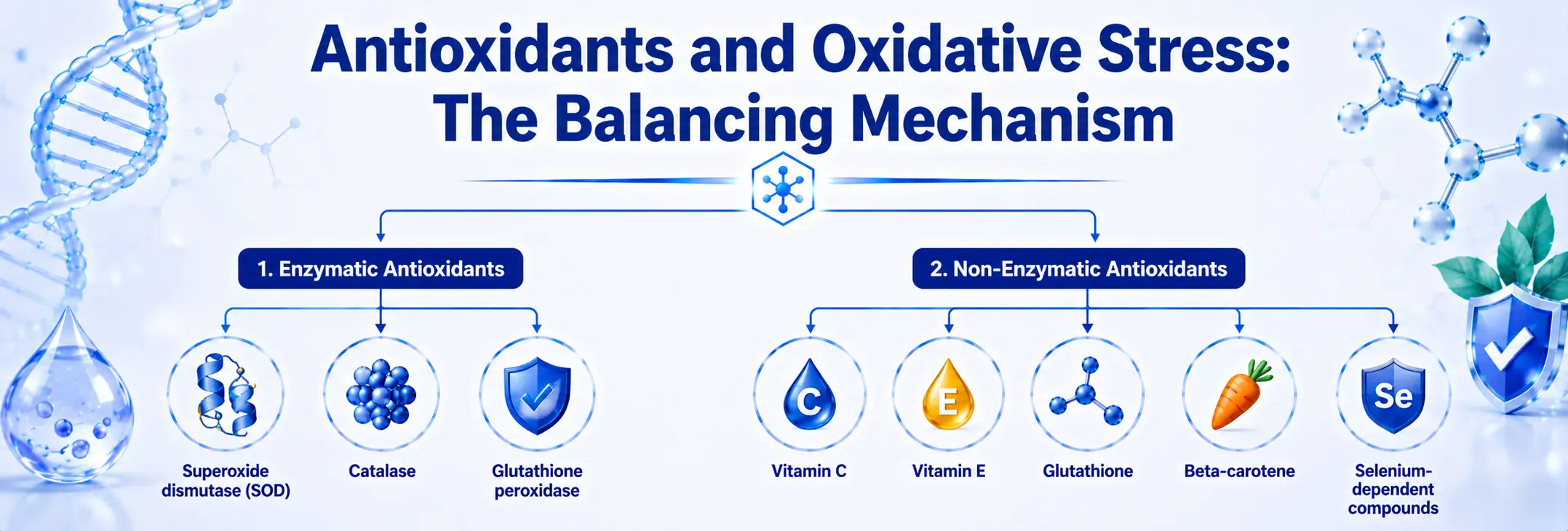
Antioxidants and Oxidative Stress: The Balancing Mechanism
Antioxidant systems help regulate reactive species and maintain cellular redox homeostasis. These systems include enzymes, low-molecular-weight antioxidants and interconnected metabolic pathways rather than a single antioxidant molecule.
For a focused comparison of two research areas linked to cellular redox biology, see our Glutathione vs NAD+ Cellular Research Guide.
Research generally separates antioxidant defences into two categories:
1. Enzymatic Antioxidants
produced internally by cells:
- Superoxide dismutase (SOD)
- Catalase
- Glutathione peroxidase
2. Non-Enzymatic Antioxidant Systems
Examples include endogenous and diet-derived molecules such as:
- Vitamin C
- Vitamin E
- Glutathione
- Beta-carotene
When antioxidant and repair systems adequately regulate reactive species, redox balance can be maintained. When these systems become overwhelmed or disrupted, oxidative damage and altered signalling may occur.
Mitochondrial redox signalling is also studied in relation to mitochondrial-derived peptides such as MOTS-C, although these research areas should not be presented as evidence of antioxidant treatment effects.
What Causes Oxidative Stress?
Researchers generally classify the causes of oxidative stress into two broad categories: endogenous (internal) and exogenous (external) factors.
1. Endogenous Causes:
- Normal mitochondrial metabolism
- Cellular ageing processes
- Chronic inflammatory activity
- Immune system activation
2. Exogenous Causes:
- Ultraviolet (UV) radiation exposure
- Air pollution and environmental toxins
- Cigarette smoke and tobacco compounds
- Alcohol consumption
- Dietary and metabolic conditions investigated in oxidative-stress research
- Physical-inactivity-associated metabolic models
Endogenous and exogenous ROS sources can be investigated using different experimental systems, including cellular models, animal studies, biochemical assays and controlled exposure research.
Oxidative Stress in Cells: Molecular and Cellular Impact
At the cellular level, oxidative stress does not act as a single, uniform process. Instead, it damages several distinct cellular components through separate but related chemical reactions.
1. Lipid Peroxidation
Free radicals react with fatty acids in cell membranes, generating a chain reaction that compromises membrane integrity and produces by-products such as malondialdehyde (MDA), a commonly measured biomarker.
2. Protein Oxidation
ROS can alter protein structure through a process called protein carbonylation, impairing enzyme function and cellular signalling.
3. DNA Damage
Oxidative stress in cells can generate DNA strand breaks and base modifications, most notably 8-hydroxy-2′-deoxyguanosine (8-OHdG), a widely used marker of oxidative DNA damage in research settings.
4. Mitochondrial Dysfunction
Because mitochondria can be both a source and a target of reactive oxygen species, mitochondrial damage may contribute to feedback loops involving altered electron transport, additional ROS production and impaired cellular energy regulation.
For broader background on this relationship, see our Mitochondrial Dysfunction guide.
| Cellular Target | Type of Damage | Common Research Biomarker |
| Cell membrane lipids | Lipid peroxidation | Malondialdehyde (MDA) |
| Proteins | Protein carbonylation | Protein carbonyl content |
| DNA | Oxidative DNA damage | 8-OHdG |
| Mitochondria | Dysfunction, reduced ATP output | Mitochondrial ROS assays |
Oxidative Damage Explained: How Free Radicals Affect Cells
Accumulated oxidative damage is studied across cardiovascular, neurobiological, metabolic and cellular-ageing models, including:
- Cardiovascular research models (arterial plaque formation studies)
- Neurodegenerative research models (protein misfolding and neuronal stress studies)
- Metabolic research models (insulin signalling and adipocyte studies)
- Cellular senescence and ageing research
For broader context on cellular ageing mechanisms, see our What Is Cellular Aging? guide.
It is important to note that oxidative damage is studied as a contributing mechanism within disease models, not a standalone diagnosis. Researchers typically examine it alongside inflammatory markers, genetic factors, and metabolic indicators rather than in isolation.
Cellular oxidative damage is most often assessed through biomarker analysis rather than direct observation, since the process occurs at a molecular scale invisible without laboratory methods.
Oxidative Stress and Inflammation: The Research Connection
Oxidative stress and inflammation are frequently studied as interconnected processes. Reactive species can influence inflammatory signalling, while activated immune cells can generate additional ROS as part of host-defence responses.
- ROS and redox changes can modulate signalling pathways including NF-κB, which may influence inflammatory gene expression depending on cellular context.
- Inflammatory immune cell activity, in turn, generates additional ROS as part of the immune response.
These reciprocal processes can form feedback loops in some experimental models and are studied in relation to chronic inflammation, metabolic dysfunction and cellular ageing.
How Is Oxidative Stress Measured in Research?
Unlike many biological processes, oxidative stress cannot be observed directly. Instead, researchers rely on a defined set of laboratory biomarkers and assay methods.
| Method | What It Measures | Common Use |
| HPLC (High-Performance Liquid Chromatography) | Can separate and quantify selected oxidative biomarkers | MDA and other lipid peroxidation products |
| ELISA (Enzyme-Linked Immunosorbent Assay) | Can quantify selected oxidative-damage markers depending on the assay | 8-OHdG, protein carbonyls |
| Spectrophotometric assays | Measures antioxidant enzyme activity | SOD, catalase, and glutathione peroxidase activity |
| Total Antioxidant Capacity (TAC) assays | Measures overall antioxidant defence level | General oxidative stress status in a sample |
These and related analytical methods allow researchers to estimate redox state, antioxidant activity and oxidative damage. No single biomarker provides a complete measurement of oxidative stress, so studies often use multiple complementary endpoints.
Oxidative Stress: A Continuing Area of Scientific Research
Oxidative stress describes a disruption in redox balance involving reactive species, antioxidant systems and cellular repair mechanisms.
Researchers study this process through biomarkers of lipid, protein and DNA oxidation, measurements of antioxidant activity and assays of mitochondrial and inflammatory signalling.
Because reactive oxygen species also participate in normal signalling, oxidative stress should not be reduced to the idea that all ROS are harmful. Interpretation depends on concentration, location, duration, cell type and experimental context.
For broader laboratory-focused information on related pathways, explore our Research Peptide Guides.
Explore Research Peptide Guides →
FAQs About what is oxidative stress?
What is oxidative stress in simple terms?
Oxidative stress is a disruption in redox balance in which reactive species exceed or alter the capacity of antioxidant, repair and regulatory systems, potentially changing cellular signalling or causing molecular damage.
What is the main cause of oxidative stress?
There is no single cause. Oxidative stress can result from increased reactive-species production, impaired antioxidant systems, mitochondrial dysfunction, inflammatory activity or environmental exposures.
What is the difference between oxidative stress and free radicals?
Free radicals are reactive species containing unpaired electrons. Oxidative stress is the broader biological state in which reactive species and protective systems become imbalanced. Not all ROS are free radicals.
What is the role of antioxidants in oxidative stress?
Antioxidant systems help regulate reactive species and maintain redox balance through enzymatic and non-enzymatic mechanisms.
What is oxidative damage at the cellular level?
Oxidative damage can include chemical modification of lipids, proteins and nucleic acids when reactive species exceed protective and repair capacity.
Is oxidative stress linked to inflammation?
Yes. Redox signalling and inflammatory pathways can influence each other, although the relationship varies by cell type, stimulus and experimental model.
How Is Oxidative Stress Identified in Research?
Researchers infer oxidative stress using combinations of biomarkers, antioxidant-enzyme activity, redox measurements and assays of lipid, protein or DNA oxidation.
How Is Oxidative Stress Measured in Laboratory Research?
Common approaches include assays for lipid-peroxidation products, 8-OHdG, protein oxidation, antioxidant-enzyme activity and total antioxidant capacity. No single test represents the entire redox state of a biological system.
Which Antioxidant Systems Are Studied in Oxidative Stress Research?
Researchers study enzymatic systems such as superoxide dismutase, catalase and glutathione peroxidase, together with molecules such as glutathione, vitamin C and vitamin E.
Are All Reactive Oxygen Species Harmful?
No. Reactive oxygen species also participate in normal cellular signalling. Their biological effect depends on concentration, location, duration and the ability of cells to regulate them.
Is Hydrogen Peroxide a Free Radical?
No. Hydrogen peroxide is a reactive oxygen species but not a free radical because it does not contain an unpaired electron.
Sources:
https://www.cancer.gov/about-cancer/causes-prevention/risk/diet/antioxidants-fact-sheet