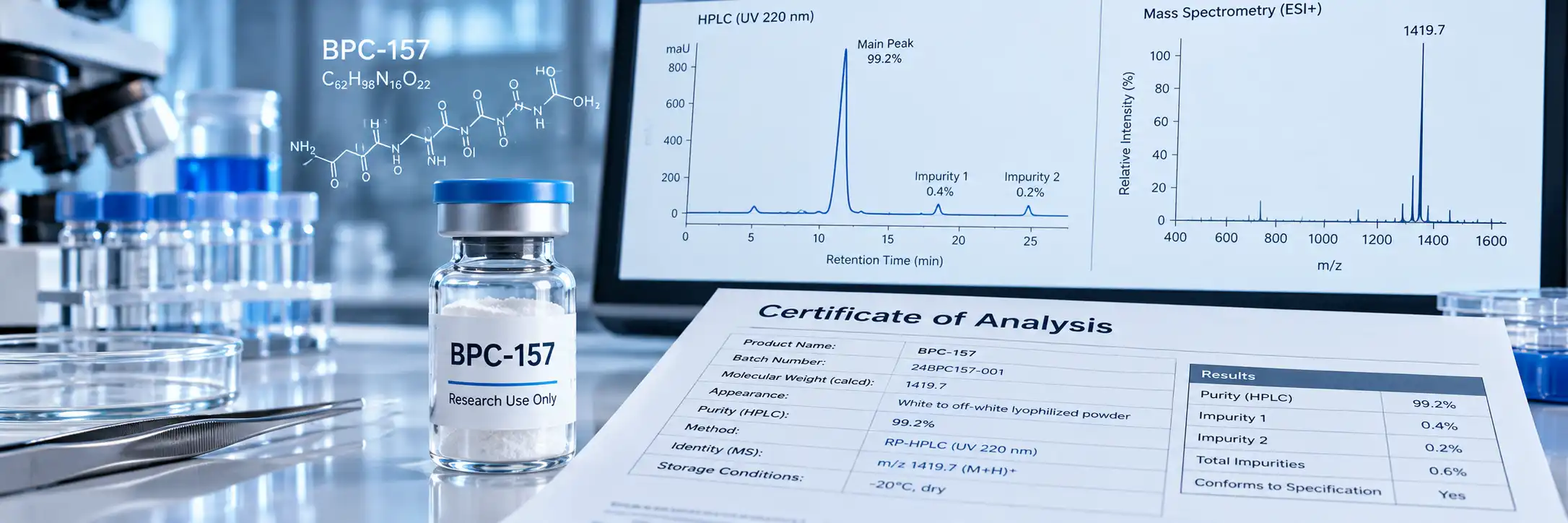
BPC-157 purity and COA testing help laboratories assess whether a research sample contains the expected peptide, how much detectable peptide-related impurity is present, and whether analytical results can be traced to a specific batch.
A BPC-157 Certificate of Analysis (COA) may report high-performance liquid chromatography (HPLC) purity, mass spectrometry results, peptide content and batch identification. These measurements answer different questions. A reported purity of 99% does not automatically establish molecular identity, actual peptide mass, sterility or suitability for a particular experiment.
This guide examines the analytical methods used to evaluate BPC-157, the limitations of reported purity percentages, common synthesis-related impurities, and how to interpret batch-specific laboratory results.
Research-use notice: BPC-157 is an investigational compound. This article concerns laboratory analytical characterisation only. It does not provide human or veterinary administration instructions, therapeutic recommendations or medical advice.
What Does BPC-157 Purity Mean?
BPC-157 purity generally describes the proportion of the principal detected component relative to other detected components under a specified analytical method.
For synthetic peptides, this is commonly reported using reversed-phase high-performance liquid chromatography (RP-HPLC). The resulting percentage is typically calculated from the integrated chromatographic peak areas.
However, chromatographic purity and the actual amount of peptide in a sample are not interchangeable.
For example, a BPC-157 sample with a reported HPLC purity of 99.5% may still contain residual water, counter-ions or substances that are not adequately detected by the chosen chromatographic method.
BPC-157 Purity, Identity and Content Compared
| Analytical characteristic | What it evaluates | What it does not establish |
| HPLC purity | Relative abundance of separated, detected components | Total peptide mass or definitive molecular identity |
| Mass spectrometry | Molecular mass consistent with the target compound | Complete sequence, purity or stereochemistry by itself |
| Peptide content or assay | Quantity of peptide under a defined quantitative method | Overall impurity profile |
| Sequence confirmation | Evidence supporting amino-acid order | Freedom from every impurity |
| Water content | Water present in the tested material | Peptide identity |
| Residual solvent testing | Specified remaining solvents | Total chemical purity |
| Microbial or endotoxin testing | Specified microbiological quality attributes | Molecular identity or human-use suitability |
The distinction matters because two samples with similar HPLC purity values may have different actual peptide contents or impurity profiles.
For a broader explanation of chromatographic results across synthetic peptides, see Peptide Purity Explained.
Why Does BPC-157 Require Compound-Specific Quality Testing?
BPC-157 is a synthetic pentadecapeptide consisting of 15 amino-acid residues.
Its commonly reported sequence is:
Gly-Glu-Pro-Pro-Pro-Gly-Lys-Pro-Ala-Asp-Asp-Ala-Gly-Leu-Val
In single-letter notation:
GEPPPGKPADDAGLV
The unmodified linear peptide has a molecular mass of approximately 1,419 Da, although the measured or reported mass must be interpreted according to the specified molecular form, including terminal modifications and salt or counter-ion information.
These structural details matter during analytical testing because peptide synthesis can introduce closely related impurities.
BPC-157 Analytical Reference Properties
| Property | Reference information |
| Compound | BPC-157 |
| Peptide class | Synthetic pentadecapeptide |
| Amino-acid residues | 15 |
| Sequence | GEPPPGKPADDAGLV |
| Approximate molecular mass | 1,419 Da |
| Cysteine residues | None |
| Aromatic residues | None |
| Common analytical approaches | RP-HPLC, LC-MS, MS/MS |
| Common supplied research form | Lyophilised powder |
The absence of cysteine means the specified linear sequence does not form conventional intramolecular disulphide bonds.
Its lack of tryptophan, tyrosine and phenylalanine is also important when choosing UV detection wavelengths for chromatography.
The sequence itself does not determine a batch’s purity. That requires testing the actual material.
For biological mechanisms and preclinical evidence, rather than analytical quality, refer to the BPC-157 Peptide Research Guide.
How Is BPC-157 Purity Tested?
BPC-157 purity testing typically uses complementary analytical methods rather than a single instrument.
HPLC examines the chromatographic impurity profile, mass spectrometry supports molecular identity, and additional methods may be required to establish peptide content, sequence-related characteristics or other quality attributes.
High-Performance Liquid Chromatography (HPLC)
HPLC separates components of a sample according to their interactions with the stationary phase and mobile phase.
For synthetic peptides such as BPC-157, reversed-phase chromatography is widely used because separation can exploit differences in hydrophobic interactions between peptide molecules and the chromatographic stationary phase.
A typical analytical workflow involves:
- Preparing a representative laboratory sample using a suitable validated or qualified method.
- Introducing the sample into the chromatographic system.
- Separating detectable components across a defined solvent gradient.
- Recording detector responses over time.
- Integrating the chromatographic peaks according to the method.
- Calculating the relative area of the principal peak.
The laboratory must establish that the method provides sufficient separation for the impurities relevant to the sample.
What Does an HPLC Chromatogram Show?
A chromatogram displays detector response against retention time.
Each resolved peak represents a detector response associated with a chromatographically separated component or group of co-eluting components.
The principal peak may correspond to BPC-157, but that assignment requires supporting evidence, such as a reference standard or mass spectrometry.
A dominant peak does not independently confirm the compound’s identity.
How Is HPLC Purity Calculated?
For a simple area-normalisation method:
\[ \text{HPLC Purity (\%)}=\frac{\text{Main Peak Area}}{\text{Total Integrated Peak Area}}\times100 \]
Consider an illustrative chromatogram:
| Peak | Relative integrated area |
| Main BPC-157-associated peak | 99.20% |
| Impurity peak A | 0.35% |
| Impurity peak B | 0.25% |
| Impurity peak C | 0.20% |
| Total | 100.00% |
The reported chromatographic purity would be 99.20%, assuming the assigned principal peak is BPC-157 and the stated integration procedure has been followed.
This example is hypothetical and does not represent a tested Australia Peptide Sciences batch.
Area normalisation has limitations. Detector responses can differ between compounds, unresolved substances may co-elute, and compounds without an adequate detector response may not be represented accurately.
Consequently, HPLC area percentage should not automatically be interpreted as the percentage of peptide by dry mass.
Which UV Wavelength Is Suitable for BPC-157 HPLC?
Detection wavelength affects the ability to observe peptide-related components.
Many peptide RP-HPLC methods use low-UV detection near 210–220 nm, where peptide bonds contribute to absorbance.
BPC-157 lacks the aromatic residues commonly responsible for strong protein absorbance near 280 nm. A method relying only on 280 nm detection therefore requires particular justification and may have insufficient sensitivity for this sequence.
A suitable COA should identify the analytical method and, where applicable, provide or make available the detection conditions.
Other relevant parameters include the chromatographic column, mobile-phase conditions, gradient, peak integration criteria and method sensitivity.
Liquid Chromatography–Mass Spectrometry (LC-MS)
Mass spectrometry provides complementary information about molecular identity.
Where HPLC primarily examines chromatographic separation, MS measures ions according to their mass-to-charge ratio (m/z).
For BPC-157, the observed ion signals can be compared with those expected for the specified peptide structure.
Because peptides may produce multiply charged ions, the observed m/z value is not necessarily equal to the neutral molecular mass.
For a positively charged ion, the simplified relationship is:
\[ m/z=\frac{M+zH}{z} \]
Where:
- \(M\) is the neutral molecular mass.
- \(z\) is the number of charges.
- \(H\) represents the mass contribution of a proton.
A BPC-157 mass spectrum may contain more than one charge state, depending on the ionisation conditions.
The laboratory must interpret the relevant ions and their isotope patterns correctly before assigning identity.
Can Mass Spectrometry Confirm BPC-157 Identity?
Mass spectrometry can provide strong evidence that a sample contains a molecule with a mass consistent with the expected BPC-157 structure.
However, a matching mass alone does not prove every structural feature.
Different peptide sequences may have identical molecular masses. Leucine and isoleucine, for example, have the same elemental composition, making their distinction challenging with conventional mass measurements alone.
Additional evidence may come from tandem mass spectrometry (MS/MS), sequence-specific fragmentation patterns or another appropriate structural method.
This distinction is particularly important if the analytical question concerns complete sequence identity rather than molecular mass consistency.
Tandem Mass Spectrometry and Sequence Confirmation
Tandem mass spectrometry can produce fragment ions that help establish the amino-acid sequence of a peptide.
A sequence-confirmation workflow may involve selecting an ion associated with the parent peptide and comparing its observed fragmentation pattern with the expected structure.
For BPC-157, sequence-level testing can help distinguish the intended compound from some incorrect or incomplete synthetic products.
Nevertheless, sequence coverage, fragmentation efficiency, isomeric residues and chemical modifications must be considered.
A laboratory should report the extent of confirmation supported by the data rather than treating all MS/MS results as definitive structural proof.
HPLC vs LC-MS vs MS/MS for BPC-157
| Method | Main purpose | Strength | Key limitation |
| RP-HPLC | Chromatographic purity profiling | Detects and separates many related impurities | Depends on resolution and detector response |
| LC-MS | Identity and impurity characterisation | Connects chromatographic components with mass information | Mass agreement is not full structural confirmation |
| MS/MS | Sequence-level evidence | Supports identification through fragment ions | Sequence coverage and isomer discrimination may be incomplete |
| Quantitative assay | Peptide content | Estimates the amount of target material | Requires suitable calibration and validation |
These methods provide different pieces of evidence. Using them together can improve analytical confidence when the procedures are appropriate for the intended purpose.
The principles of method specificity, accuracy, precision and suitability are addressed in the ICH Q2(R2) guideline on analytical procedure validation.
This guideline concerns pharmaceutical analytical validation. Its principles may inform research laboratory method assessment, but citing it does not imply that a research peptide or supplier has obtained pharmaceutical regulatory approval.
What Impurities Can Be Found in Synthetic BPC-157?
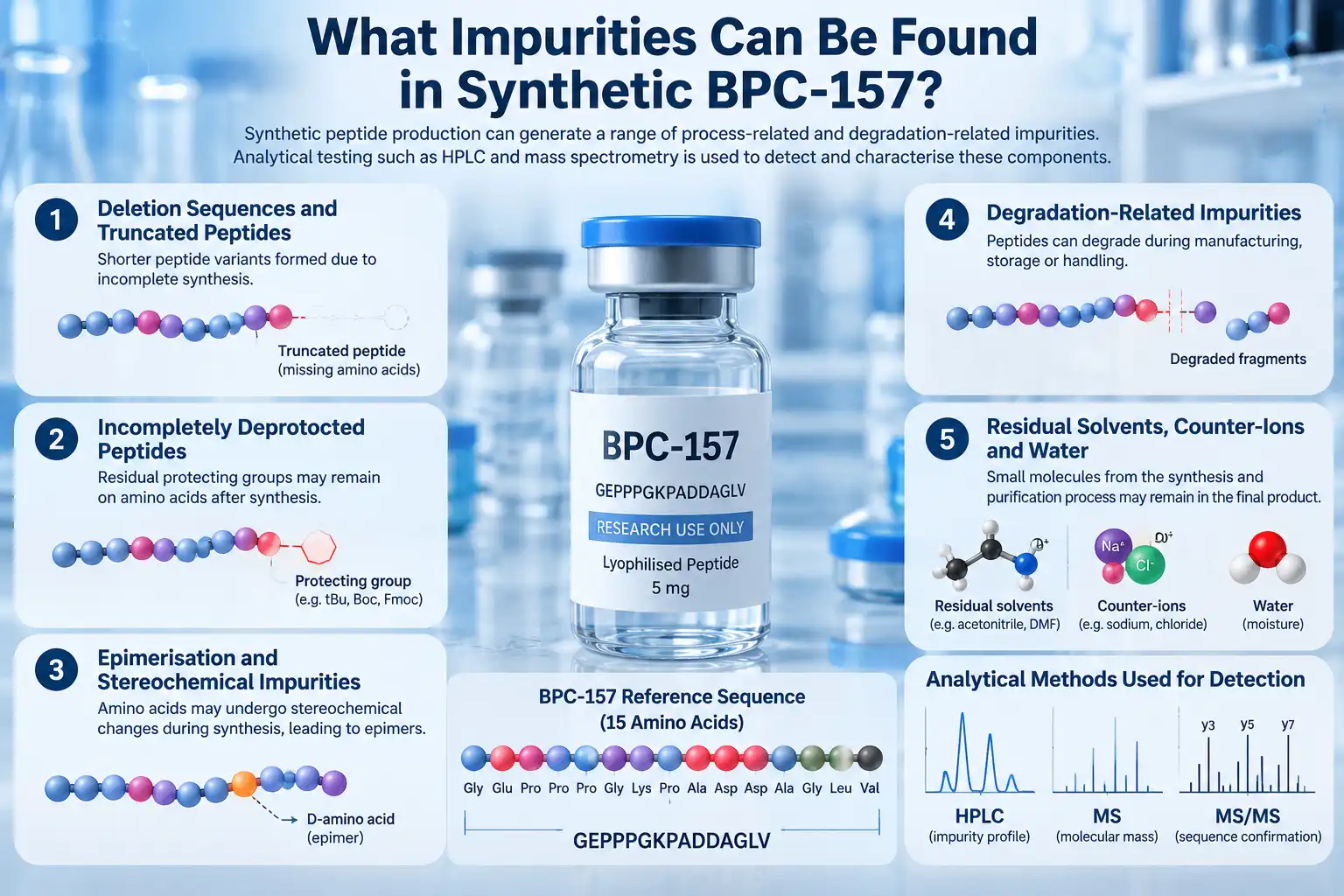
Synthetic peptide production involves repeated chemical reactions that build the intended amino-acid sequence.
Each synthesis and purification stage can introduce or leave behind substances that differ from the intended peptide.
The impurity profile of BPC-157 depends on the synthesis route, purification process, starting materials, storage conditions and analytical sensitivity.
Deletion Sequences and Truncated Peptides
Incomplete coupling can result in peptides that lack one or more intended residues.
These are commonly described as deletion sequences.
Other incomplete products may terminate before the full 15-residue BPC-157 sequence has been assembled.
Some related products can have chromatographic properties similar to the intended peptide, making sufficient separation important.
Mass spectrometry may help characterise a suspected deletion product when its molecular mass differs from the target.
Incompletely Deprotected Peptides
Chemical peptide synthesis commonly uses protecting groups to prevent unwanted reactions during chain assembly.
If deprotection or cleavage is incomplete, residual protected forms may remain in the crude material.
These products can differ in molecular mass or chromatographic retention from the target peptide.
Appropriate purification and analytical characterisation are therefore required before the final material can be adequately described.
Epimerisation and Stereochemical Impurities
Epimerisation can occur during peptide synthesis when the stereochemistry of an amino-acid residue changes.
A peptide containing a D-amino-acid residue in place of the intended L-amino-acid residue may have the same molecular formula and mass as the target.
Consequently, conventional mass spectrometry alone cannot reliably rule out every stereochemical impurity.
Where stereochemical integrity is a critical quality attribute, an appropriately selective chromatographic or other validated method may be necessary.
Degradation-Related Impurities
Peptides can undergo chemical changes during processing, storage or laboratory handling.
Potential degradation mechanisms include:
- Hydrolysis of susceptible peptide bonds.
- Deamidation of applicable amino-acid side chains.
- Aspartimide formation or related rearrangements at susceptible sequence positions.
- Oxidation where chemically susceptible groups are present.
- Other formulation- or environment-dependent chemical changes.
Not every degradation mechanism is equally likely for every peptide.
For BPC-157, the presence of aspartic acid residues makes sequence-specific degradation assessment relevant. However, the mere presence of these residues does not prove that a particular degradation product will form under normal storage conditions.
Actual degradation behaviour must be established experimentally.
Residual Solvents, Counter-Ions and Water
Purified synthetic peptides may contain material other than the target peptide.
Depending on the manufacturing process and final presentation, this may include:
- Residual processing solvents.
- Counter-ions associated with the peptide.
- Water remaining after drying.
- Other process-related substances.
These components can affect the mass composition of the supplied material without appearing as distinct peptide peaks in a routine HPLC purity chromatogram.
For this reason, the final material’s mass, chromatographic purity and net peptide content should be evaluated separately.
BPC-157 Impurity Types and Suitable Analytical Approaches
| Potential impurity | Possible origin | Relevant analysis |
| Deletion peptide | Incomplete coupling | HPLC, LC-MS |
| Truncated sequence | Incomplete synthesis | HPLC, MS |
| Protected intermediate | Incomplete deprotection | HPLC, LC-MS |
| Epimeric peptide | Stereochemical change during synthesis | Selective chromatography or suitable orthogonal method |
| Degradation product | Chemical instability or processing | Stability-indicating HPLC, LC-MS |
| Residual solvent | Manufacturing process | Suitable residual-solvent assay, often GC |
| Water | Moisture uptake or incomplete drying | Karl Fischer or other appropriate water determination |
| Counter-ions | Peptide salt form and purification | Appropriate ion or counter-ion assay |
A method must be demonstrated to detect the relevant impurity. Listing a technique does not establish that the technique has been validated for every impurity in a particular sample.
How to Read a BPC-157 Certificate of Analysis
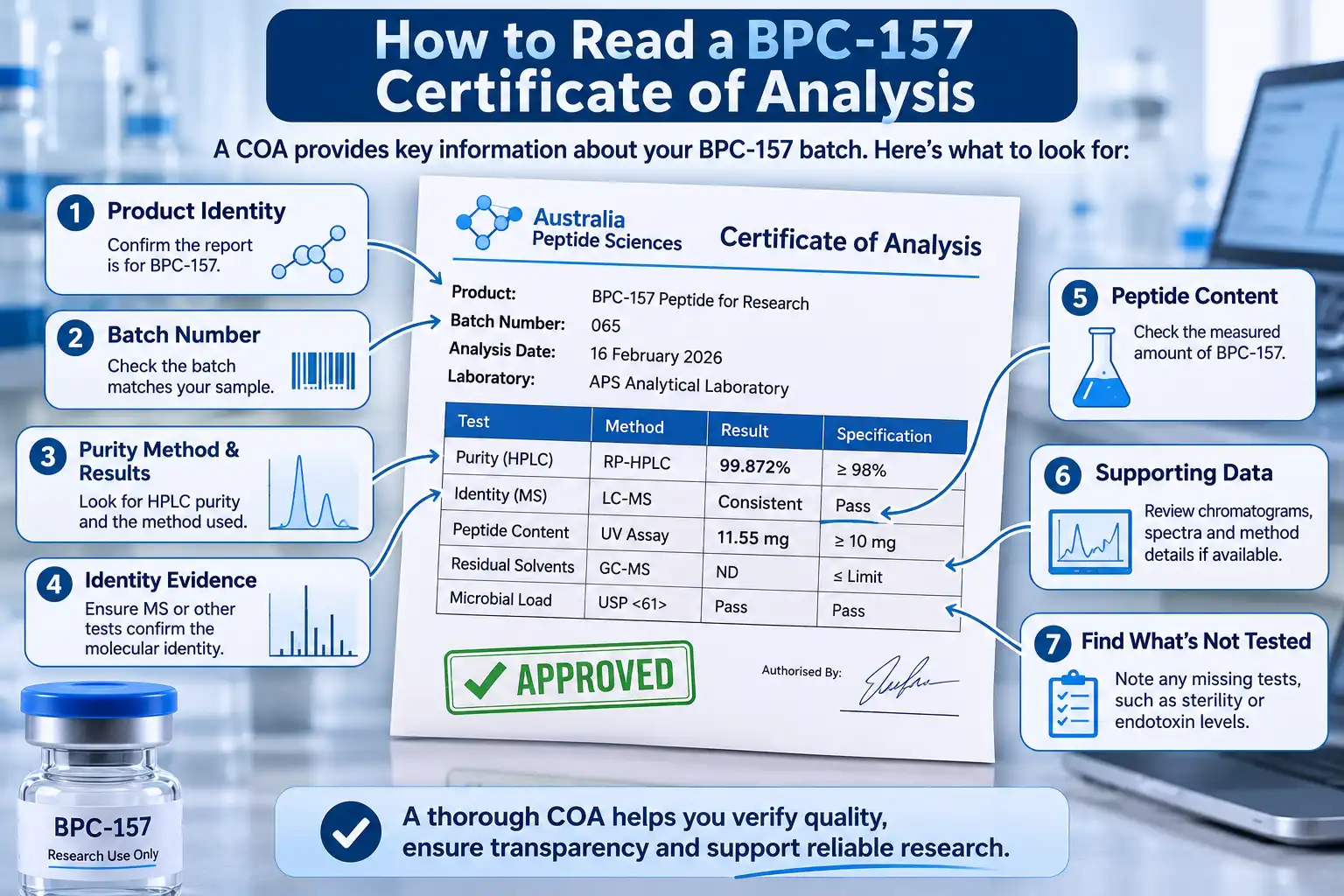
A BPC-157 Certificate of Analysis records the results of specified tests performed on an identified sample or batch.
The document should make it possible to determine what was tested, which methods were used, when testing occurred and what the reported findings mean.
Importantly, a COA does not necessarily contain every analysis relevant to the material. Its scope depends on the test panel and the specifications being applied.
Key Information to Look For on a BPC-157 COA
| COA field | What to check | Why it matters |
| Compound name | BPC-157 and relevant molecular form | Identifies the intended material |
| Batch or lot number | Matches the sample or supplied product | Supports traceability |
| Sample identification | Unique identifier, where provided | Links the report to the tested sample |
| Testing laboratory | Name and appropriate details | Identifies who performed the analysis |
| Analysis date | When testing occurred | Establishes the analytical timeline |
| HPLC purity | Reported percentage and method | Describes the chromatographic purity result |
| Identity analysis | MS or other appropriate results | Supports molecular identification |
| Peptide quantity | Value, units and assay basis | Describes measured content |
| Specifications | Acceptance criteria, where defined | Shows the basis for assessing results |
| Supporting data | Chromatograms, spectra or report references | Allows deeper review |
| Report authorisation | Appropriate review or issue details | Supports document accountability |
A COA may report only a subset of these fields. Missing information should be considered in relation to the intended laboratory application and the claims being made about the material.
Step 1: Confirm the Product and Molecular Form
Start with the product identity.
The report should identify BPC-157 rather than an unrelated peptide or an unspecified peptide blend.
Where relevant, check for information about terminal modifications, salt form and expected molecular characteristics.
A certificate for a different compound cannot establish BPC-157 identity, even if the reported purity percentage is high.
Step 2: Match the Batch Number
Batch identification links analytical results to a defined production lot or tested sample.
A certificate from an unrelated batch cannot independently verify the material currently being evaluated.
For laboratory traceability, the batch identifier should be recorded alongside the sample identifier and accompanying documentation.
If batch identifiers do not match, the discrepancy requires clarification.
Step 3: Identify the Purity Method
Check whether the reported value comes from HPLC, UPLC or another analytical procedure.
A percentage without an analytical method provides limited information because different methods can measure different characteristics.
For chromatographic results, useful supporting details include the detector, separation conditions and peak integration approach.
Step 4: Review Identity Evidence
Determine whether the COA includes a molecular identity test.
A mass spectrum showing ions consistent with the expected peptide supports identification, but interpretation should account for the molecular form and any appropriate adducts or charge states.
If only HPLC purity is reported, the document may not establish that the principal chromatographic peak is the intended BPC-157 molecule.
Step 5: Examine Content and Assay Results
Look for reported peptide mass or content.
The units and underlying analytical method matter.
A measurement reported in milligrams is not automatically equivalent to the mass printed on a product label, and the relationship between measured peptide, gross sample mass and labelled nominal quantity should be defined.
When reviewing quantitative results, confirm whether the figure represents total sample mass, net peptide mass, assay content or another measurement.
Step 6: Review Supporting Analytical Data
A numerical summary may be sufficient for some record-keeping purposes, but detailed technical evaluation benefits from access to the underlying laboratory evidence.
That may include:
- Chromatograms showing the principal and secondary peaks.
- Mass spectra identifying the expected ion signals.
- Integration reports.
- Analytical method references.
- Relevant quantitation and identification criteria.
- Method qualification or validation information where applicable.
The completeness required depends on the experimental purpose and the degree of analytical confidence needed.
Step 7: Check What Was Not Tested
The absence of a reported result does not establish that the corresponding quality attribute is satisfactory.
For example, a certificate reporting HPLC purity and MS identity does not necessarily establish:
- Microbial quality.
- Endotoxin levels.
- Sterility.
- Residual solvent limits.
- Stability after storage.
- Biological activity.
- Clinical safety.
These characteristics require separate evidence where relevant.
For a general introduction to analytical documentation across research peptides, see the Certificate of Analysis Peptides Guide.
Australia Peptide Sciences: BPC-157 Batch Testing Example
Australia Peptide Sciences publishes analytical information for research compounds through its Peptide Certificates of Analysis (COA) page.
The public listing includes information for a BPC-157 research peptide batch.
Published BPC-157 COA Information
| Field | Published result |
| Product | BPC-157 Peptide for Research |
| Batch number | 065 |
| Analysis date | 16 February 2026 |
| Listed BPC-157 quantity | 11.55 mg |
| Reported purity | 99.872% |
| Source | Australia Peptide Sciences COA listing |
These figures are reproduced from the publicly displayed certificate listing. They describe that specific record, not every historical or future BPC-157 batch.
What Does the 99.872% BPC-157 Purity Result Mean?
The website reports a purity value of 99.872% for batch 065.
To interpret that result correctly, the underlying certificate should be checked for the analytical procedure, calculation basis and supporting chromatographic evidence.
If the value represents HPLC area normalisation, it describes the relative area associated with the principal identified component under the stated test conditions.
It would not mean that 99.872% of the total vial mass has necessarily been established as chemically pure BPC-157 by weight.
The difference matters when comparing chromatographic purity with quantitative assay results.
What Does the 11.55 mg Result Indicate?
The public listing reports a BPC-157 quantity of 11.55 mg.
Without reviewing the underlying assay details, the precise quantitative basis of that figure should not be assumed.
In particular, researchers should distinguish between a reported mass measurement and the manufacturer’s nominal product strength.
Any comparison should use the corresponding batch, product presentation, analytical method and units.
How to Verify the Published BPC-157 Results
Researchers reviewing Australia Peptide Sciences documentation can compare the published information against the corresponding sample and laboratory records.
The process involves confirming that the product description, batch identifier, analysis date and reported results match the relevant material.
A public listing provides a useful starting point for traceability. The underlying report supplies the analytical context needed for more detailed interpretation.
The website also lists a BPC-157 peptide for research as a lyophilised laboratory material.
The presence of a product listing and an analytical certificate should not be interpreted as therapeutic approval, clinical safety verification or a guarantee that every supplied batch has the same analytical results.
Does 99% BPC-157 Purity Mean Pharmaceutical Grade?
No. A reported 99% chromatographic purity result does not independently establish pharmaceutical grade, Good Manufacturing Practice (GMP) compliance or approval for therapeutic use.
The term pharmaceutical grade should not be inferred from a purity percentage alone.
Assessment of a pharmaceutical material involves its intended use, applicable specifications, manufacturing controls, analytical method suitability and relevant regulatory requirements.
For example, a laboratory sample can show high chromatographic purity while lacking evidence for other attributes required in a different regulatory context.
High Purity vs Comprehensive Quality Assessment
| Claim or measurement | What it can support | What it cannot establish alone |
| 99% HPLC purity | A high reported proportion of the main chromatographic component | Pharmaceutical grade |
| MS identity match | Molecular mass consistent with the specified peptide | Clinical suitability |
| Batch-specific COA | Documented analytical results for an identified batch | Regulatory approval |
| Independent laboratory test | Assessment performed by a separate testing organisation | Complete quality assurance |
| GMP documentation | Evidence relevant to specified manufacturing quality systems | Approval of every possible use |
| Sterility test | A defined microbiological test result | Overall product safety or approval |
Researchers should therefore avoid treating a single laboratory percentage as a complete quality grade.
What Is the Difference Between BPC-157 Purity and Peptide Content?
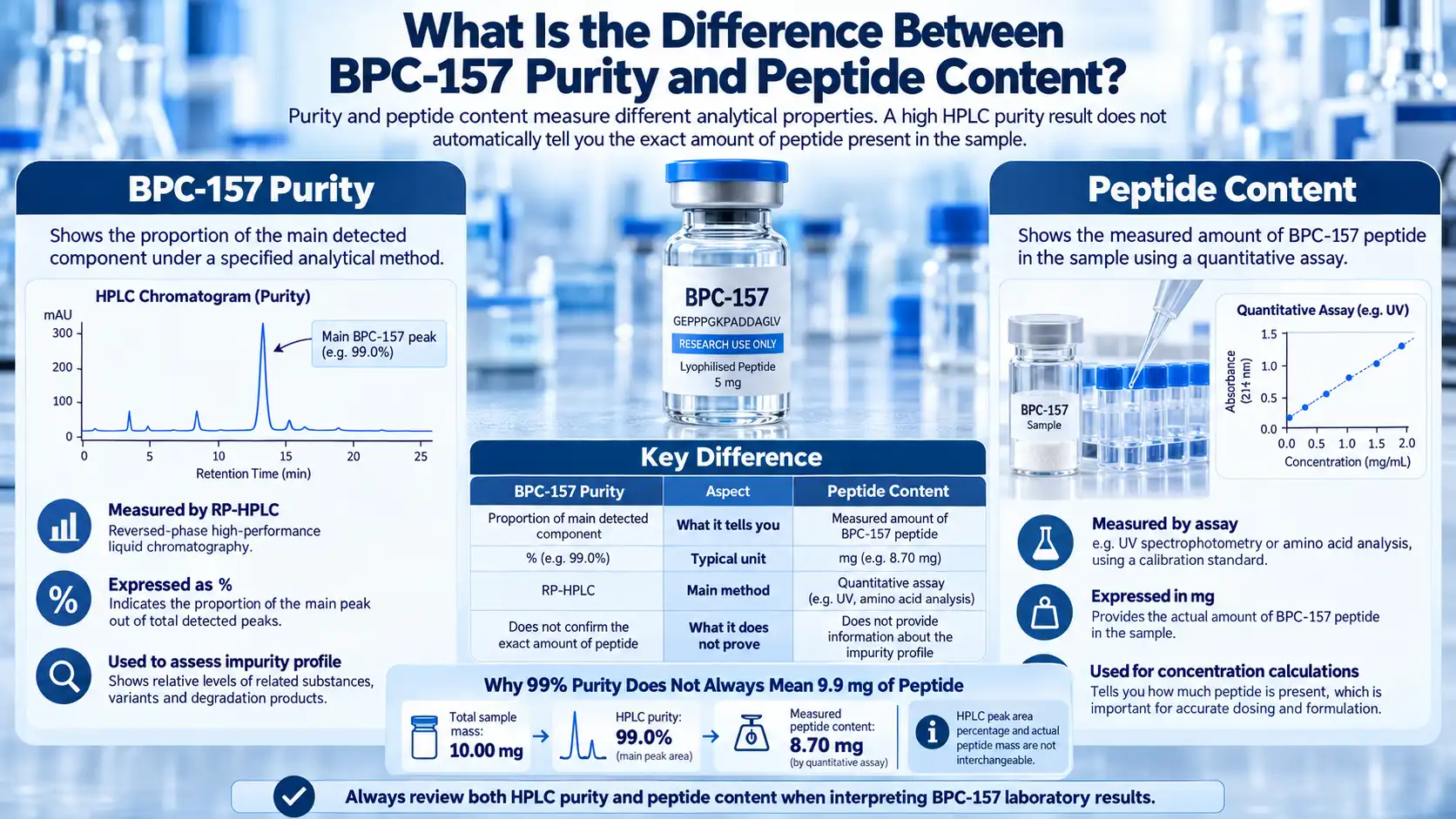
Purity and peptide content answer different analytical questions.
Purity describes the composition of detected materials under a specified analytical procedure.
Peptide content refers to the quantity of target peptide established through an appropriate quantitative determination.
The difference is particularly relevant for lyophilised peptide materials, where gross material mass may include associated water, counter-ions and other constituents.
Example: Why 99% Purity Does Not Necessarily Mean 9.9 mg of Peptide
Consider a hypothetical sample containing 10 mg of total dry material.
Assume the laboratory reports:
| Measurement | Illustrative result |
| Total sample mass | 10.00 mg |
| HPLC main-peak area purity | 99.0% |
| Independently measured net peptide content | 8.70 mg |
The HPLC chromatogram indicates that the main detected component accounts for 99.0% of the integrated chromatographic area.
The independent quantitative assay indicates that the sample contains 8.70 mg of peptide under its defined measurement basis.
These results are not necessarily contradictory.
They measure different properties and may reflect the presence of material not adequately represented by the chromatographic area percentage.
This example is hypothetical and is not a statement about the composition of an Australia Peptide Sciences product.
Why Multiplying Vial Mass by HPLC Purity Can Be Misleading
A calculation such as:
\[ 10\text{ mg}\times0.99=9.9\text{ mg} \]
is mathematically correct.
However, its analytical interpretation is not automatically valid.
It assumes that the 99% value represents an appropriate mass fraction, which is not generally established by an ordinary HPLC area-normalisation result.
For quantitative laboratory work, researchers should use a suitable peptide content or assay measurement where required, rather than substituting chromatographic area percentage.
BPC-157 Purity Testing and Laboratory Concentration Calculations
Laboratory concentration calculations require a defensible value for the amount of material being measured.
The standard relationship is:
\[ \text{Concentration (mg/mL)}=\frac{\text{Peptide Mass (mg)}}{\text{Final Solution Volume (mL)}} \]
If 10 mg of verified peptide content is present in a final solution volume of 2 mL, the calculated concentration is:
\[ 10\div2=5\text{ mg/mL} \]
This is a mathematical laboratory example, not a preparation protocol or administration recommendation.
Importantly, a concentration calculator does not establish peptide identity, purity, content or chemical stability.
It performs arithmetic using the values entered.
How Does the Peptide Calculator Relate to COA Results?
The Australia Peptide Sciences Peptide Concentration Calculator allows laboratory users to calculate mass-to-volume relationships and aliquot quantities from supplied inputs.
Its results should be interpreted alongside the material’s batch information and the applicable quantitative measurement.
| Input or information | Role |
| Peptide mass | Numerical basis for concentration |
| Final solution volume | Determines calculated concentration |
| COA purity result | Provides chromatographic composition information |
| Peptide assay or content | May establish the appropriate quantitative mass basis |
| Sample identity | Establishes which compound is being evaluated |
| Laboratory records | Support traceability and reproducibility |
If the supplied mass is a nominal label quantity rather than a verified assay value, the calculated concentration remains nominal.
A calculation cannot remove uncertainty in the original material measurement.
Why This Matters for Research Reproducibility
In quantitative experiments, uncertainty can arise from several sources:
- Inaccurate or unverified sample mass.
- Incomplete dissolution.
- Pipetting variation.
- Volume measurement error.
- Sample degradation.
- Analytical interference.
- Use of a nominal rather than measured peptide content.
A suitable experimental design should identify which sources of uncertainty matter for the specific research question.
Calculations are only one part of a broader measurement and quality-control process.
How Reliable Is Third-Party BPC-157 Laboratory Testing?
Third-party testing means that an organisation separate from the supplier or manufacturer performs specified analytical work on a submitted sample.
This separation can provide additional confidence in the independence of the reported measurements.
However, independent testing is not automatically comprehensive or technically sufficient.
The reliability of the result also depends on sample identification, analytical method suitability, laboratory competence and the tests actually performed.
What Should Researchers Check in a Third-Party Test Report?
A useful review examines four areas.
Sample traceability
The report should identify the analysed sample and connect it to the relevant batch through reliable documentation.
A laboratory cannot verify the history of a sample merely because it receives material with a particular label.
Testing laboratory competence
Where applicable, laboratories may demonstrate competence through recognised accreditation or other quality systems.
ISO/IEC 17025 is a widely recognised standard addressing competence, impartiality and consistent laboratory operation.
Accreditation should be checked for the specific testing scope. A laboratory may be accredited for some procedures but not for every test it offers.
Method suitability
The analytical method must be appropriate for its intended measurement.
A technique capable of measuring molecular mass is not necessarily suitable for quantitative impurity testing without additional development and validation.
Report transparency
Useful reports identify the measured property, result, method, units and relevant limitations.
Where specifications are used, the report should make clear how the result relates to those criteria.
Manufacturer COA vs Third-Party COA
| Consideration | Manufacturer testing | Third-party testing |
| Testing organisation | Manufacturer or associated laboratory | Separate analytical organisation |
| Knowledge of manufacturing process | May have detailed process information | May have limited process background |
| Analytical independence | Depends on internal arrangements | Greater organisational separation |
| Batch traceability | Requires documented controls | Requires reliable sample provenance |
| Method suitability | Must be established | Must also be established |
| Test scope | Defined by the requested analysis | Defined by the requested analysis |
Neither testing arrangement is automatically superior across every analytical question.
A well-characterised result from an appropriate laboratory is more informative than an impressive-looking percentage with insufficient methodological context.
How to Recognise an Incomplete or Questionable BPC-157 COA
Analytical documentation should allow researchers to understand what the test results support.
An incomplete report is not necessarily evidence of deliberate misrepresentation, but it may be insufficient for the intended laboratory decision.
Common BPC-157 COA Warning Signs
| Observation | Why further review is needed |
| No batch number | The report cannot readily be linked to a specific lot |
| No testing method | The meaning of the numerical result is unclear |
| No laboratory identification | The testing organisation cannot readily be verified |
| Purity claimed without units or basis | The measurement may be misinterpreted |
| MS used as the only evidence of purity | Molecular identity and chromatographic purity are different measurements |
| No supporting data available | Detailed independent interpretation may be limited |
| A different compound appears on the report | The document does not establish identity for BPC-157 |
| Product and certificate batches differ | The analytical record may not correspond to the material |
| Old report reused for new batches | Current batch quality has not been established by that report |
| Sterility claimed from HPLC results | HPLC does not independently establish sterility |
Does a COA Need to Display a Chromatogram?
Not every summary certificate includes the full chromatogram.
A laboratory may issue a concise COA with supporting raw data retained separately.
For an in-depth analytical review, however, the chromatogram and relevant integration information can help establish how the reported purity was determined.
Researchers may need to examine secondary peaks, baseline treatment, integration thresholds and method specificity.
The absence of an image on a public summary is not itself proof that a test was not performed.
Can a BPC-157 COA Be Verified Independently?
Verification may involve confirming the report’s authenticity with the issuing laboratory, checking sample identifiers, and comparing the results with the corresponding batch documentation.
An additional independent test can evaluate a newly submitted sample, but its results must still be interpreted within the limits of the chosen sampling and analytical methods.
No single verification step eliminates every source of uncertainty.
Does BPC-157 Purity Change During Storage?
The purity and chemical composition of peptide materials may change over time if degradation occurs.
The rate and nature of these changes depend on the peptide structure, physical state, formulation, moisture, temperature, pH, light exposure and other environmental conditions.
A certificate records results obtained from the tested sample at a particular time. It does not automatically establish the composition of every subsequent sample after an undefined storage period.
Lyophilised vs Dissolved BPC-157
Lyophilisation removes water through freeze-drying and may reduce some moisture-dependent degradation processes.
However, a lyophilised material is not necessarily chemically stable under every storage condition.
Dissolved peptides may be exposed to different chemical environments, including hydrolysis pathways and interactions with the solution matrix.
The relative stability of a particular BPC-157 formulation must be established by suitable analytical evidence rather than assumed from the physical state alone.
Stability-Indicating Testing
A stability-indicating analytical procedure is designed to measure the relevant analyte while adequately distinguishing it from degradation products.
For peptide research materials, a stability assessment may examine:
- Changes in principal peak area or quantitative assay.
- Formation of new chromatographic peaks.
- Changes in molecular identity or degradation-related masses.
- Relevant physical changes.
- Effects of specified storage conditions.
- Variability across sampled time points.
A high initial purity value does not establish the duration for which that value will remain unchanged.
The Peptide Storage Guide covers the broader laboratory factors that influence peptide storage and handling.
How Does BPC-157 Testing Differ in Multi-Peptide Blends?
Testing a single BPC-157 compound is analytically different from testing a formulation containing several peptides.
For a single-component sample, the laboratory primarily needs to distinguish the target peptide from related substances and other impurities.
For a multi-peptide sample, the laboratory must also identify and quantify the intended components separately.
A single overall HPLC purity percentage may not establish the identity or quantity of every peptide in a blend.
Example: BPC-157, TB-500 and GHK-Cu
Australia Peptide Sciences also lists a BPC-157 + TB-500 + GHK-Cu research blend.
Its published certificate listing includes separately reported quantities for the three components:
| Component | Listed quantity for batch 065 |
| BPC-157 | 11.34 mg |
| TB-500 (listed as TB4) | 10.22 mg |
| GHK-Cu | 51.95 mg |
The analysis date shown for the blend is 16 February 2026. These values refer to the listed batch and should not be generalised to different products or lots.
Australia Peptide Sciences
In this type of formulation, researchers need to consider the analytical specificity of each component.
For example, the laboratory may need to confirm that the selected methods distinguish each peptide from the others and from relevant degradation products.
Quantitative analysis may require suitable calibration for each target.
Can a BPC-157 COA Verify a Blend?
A COA for BPC-157 alone does not establish the composition of a multi-peptide blend.
Testing the blend requires methods appropriate for its components and formulation matrix.
The presence of several peptides can change the analytical challenges, including chromatographic separation, ionisation behaviour and quantitative interference.
For another formulation containing BPC-157, TB-500, GHK-Cu and KPV, researchers can examine the listed components and product specifications through the site’s Peptide Certificates of Analysis.
However, results from one blend should not be transferred to another formulation without appropriate supporting evidence.
How Does BPC-157 Analytical Quality Affect Laboratory Research?
The relationship between research material quality and experimental reproducibility is important.
A controlled experiment depends on knowing what substance was studied and maintaining consistent conditions across samples and experimental groups.
Insufficiently characterised research materials can introduce uncertainty into the interpretation of results.
Compound Identity
If the identity of a test compound is uncertain, a measured experimental response cannot be confidently attributed to the intended molecule.
Identity testing is therefore fundamental to chemical traceability.
Impurity-Related Interference
An impurity may have no measurable effect in a particular assay, or it may influence the experimental readout.
The significance depends on the impurity’s identity, concentration and the biological or chemical system being examined.
A purity value alone cannot determine whether a particular impurity will interfere with an experiment.
Quantitative Accuracy
Experiments comparing compound concentrations rely on the accuracy of the mass and volume measurements.
An unverified material-content assumption can introduce systematic errors across concentration-dependent comparisons.
Batch-to-Batch Consistency
Separate synthesis batches may show differences in their analytical profiles.
Documenting batch numbers, identities, impurity profiles and assay values helps researchers interpret whether changes in experimental results might be associated with material variation.
Reproducibility Across Laboratories
Reproducibility requires more than using compounds with the same name.
Researchers may need to record:
- Chemical identity and molecular form.
- Supplier and batch identifiers.
- Analytical purity and measurement method.
- Quantitative assay, where relevant.
- Storage and sample-handling conditions.
- Experimental controls.
- Instrumental and biological assay conditions.
These records make it easier to distinguish material-related uncertainty from differences in experimental technique or biological variability.
BPC-157 Quality Testing and Australian Regulatory Requirements
Analytical purity should be considered separately from regulatory status.
The Australian Therapeutic Goods Administration (TGA) identifies products containing BPC-157 among unapproved peptide products that have not undergone TGA assessment for safety, quality or effectiveness as therapeutic goods.
The TGA has also warned that unapproved peptide products may have inaccurate labels, uncertain composition and unverified manufacturing quality.
A research-purpose label or laboratory COA does not automatically exempt a product from applicable Australian legal obligations. Classification also depends on relevant factors such as intended use, presentation, claims and supply arrangements.
The distinction is especially important when interpreting product marketing claims involving quality, sterility or medical suitability.
Does a High-Purity BPC-157 COA Establish Human Safety?
No.
A laboratory purity result describes a defined analytical characteristic of a tested material.
It does not establish clinical efficacy, toxicological safety, appropriate human exposure, sterility or regulatory approval.
Those questions require different evidence and regulatory assessment.
The TGA’s guidance on how therapeutic peptide products are regulated explains the regulatory distinction between approved medicines and unapproved peptide products.
For the research-use context, the Research Use Only Peptides guide explains why laboratory materials must not be represented as approved products for human or veterinary administration.
BPC-157 Laboratory Quality Assessment Checklist
A structured checklist helps researchers separate documented analytical evidence from assumptions.
| Quality-control question | Evidence to review |
| Is the intended BPC-157 molecule identified? | MS, sequence-related data or appropriate reference comparison |
| Is chromatographic purity reported? | HPLC result and analytical method |
| Is the result traceable to a batch? | Batch number and sample identifiers |
| Is the peptide quantity established? | Appropriate quantitative assay |
| Are related impurities considered? | Chromatographic or orthogonal impurity methods |
| Are results supported by laboratory records? | Report identifiers and supporting analytical data |
| Are storage effects relevant? | Stability data and sample history |
| Is the report suitable for the intended experiment? | Method performance and experimental requirements |
| Are any additional quality attributes needed? | Project-specific analytical specifications |
The purpose of this checklist is to support technical evaluation.
It is not a universal product-release specification, and it does not establish therapeutic suitability.
Frequently Asked Questions About BPC-157 Purity and COA Testing
What is the purity of BPC-157?
BPC-157 purity varies by the material and batch tested. Australia Peptide Sciences lists a purity result of 99.872% for its BPC-157 batch 065, analysed on 16 February 2026. That figure should be interpreted according to the underlying analytical method and is not a universal purity value for BPC-157.
How is BPC-157 purity tested?
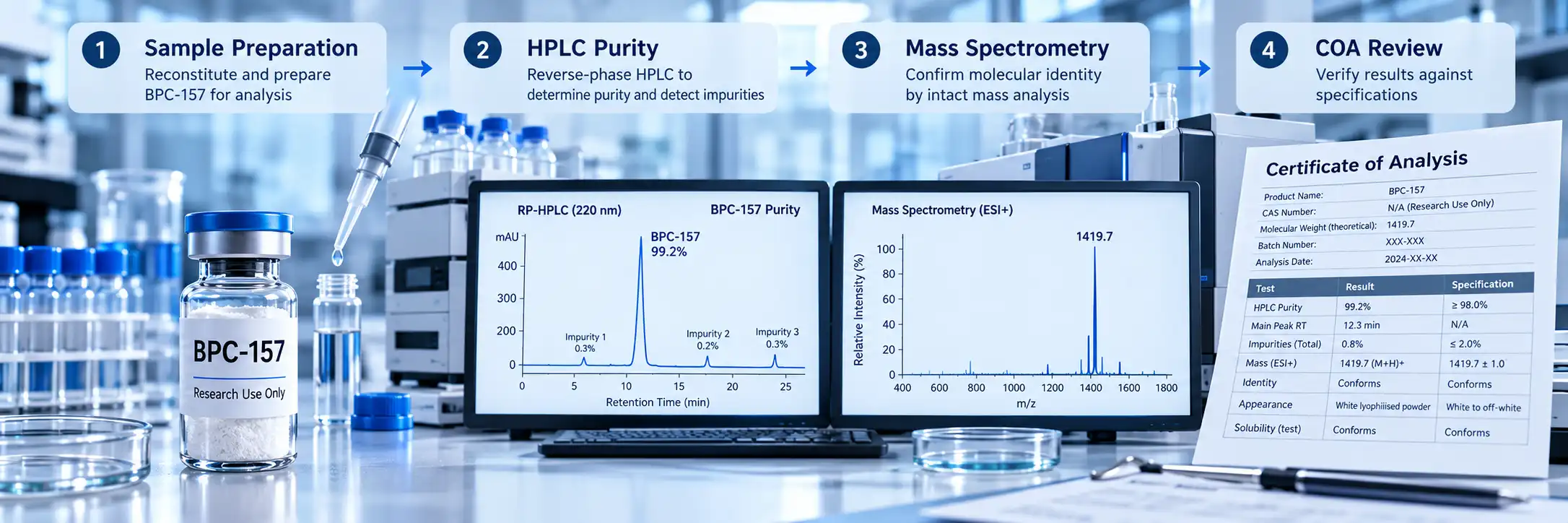
BPC-157 purity is commonly assessed using reversed-phase HPLC, which separates and measures detected components. Mass spectrometry can provide complementary molecular identity evidence, while other tests may be required for quantitative content and specific impurities.
What does a BPC-157 COA show?
A BPC-157 Certificate of Analysis may contain batch identification, analytical purity, molecular identity results, quantity measurements, testing dates and method information. The exact content depends on the report and tests performed.
Is 99% BPC-157 purity considered high?
A 99% HPLC result indicates a high proportion of the principal detected chromatographic component. However, there is no universal quality classification based on that percentage alone. The analytical method, impurity profile and intended laboratory purpose must also be considered.
Can HPLC confirm that a sample contains genuine BPC-157?
HPLC can separate and profile components, but chromatographic retention or peak dominance alone does not definitively establish molecular identity. Additional evidence, such as mass spectrometry or appropriate reference comparison, may be needed.
What is the difference between HPLC and mass spectrometry for BPC-157?
HPLC primarily separates sample components and evaluates the chromatographic profile. Mass spectrometry measures mass-to-charge ratios to support molecular identification. Their results are complementary rather than interchangeable.
Does a BPC-157 COA prove that the peptide is sterile?
No. HPLC purity and mass spectrometry do not establish sterility. Microbiological characteristics require separate testing and evidence.
Can a BPC-157 purity certificate verify the amount in a vial?
Not necessarily. HPLC area purity does not directly establish actual peptide mass. A suitable quantitative assay is required when verified peptide content is needed.
Does third-party testing guarantee BPC-157 quality?
No. Independent testing can provide useful analytical evidence, but reliability depends on the laboratory, sample traceability, testing methods and scope of analysis. No individual test guarantees every quality attribute.
Can BPC-157 purity decrease over time?
Chemical degradation may alter the composition of a peptide sample during storage. Whether this occurs, and at what rate, depends on the material and conditions. A stability-indicating method is needed to assess relevant changes.
Can the same COA be used for different BPC-157 batches?
A certificate for one batch does not independently establish the quality of another batch. Results should be linked to the specific tested material through documented traceability.
Can a peptide calculator verify BPC-157 purity?
No. A calculator determines numerical mass-to-volume relationships using entered values. It cannot analyse chemical identity, purity, content or degradation.
Understanding BPC-157 Purity Beyond a Percentage
BPC-157 purity and COA testing are most informative when analytical results are considered together.
HPLC describes the chromatographic impurity profile, mass spectrometry supports molecular identity, quantitative assays address peptide content, and batch documentation connects results to the tested material.
A high purity percentage can be useful evidence, but it does not independently establish complete chemical characterisation, clinical safety or therapeutic approval.
For laboratory research, the central question is whether the available analytical evidence is sufficiently specific, traceable and reliable for the intended experiment.
Scientific and Regulatory References
The following resources support the analytical principles, regulatory context and published product information discussed above.
- International Council for Harmonisation — Q2(R2): Validation of Analytical Procedures. Explains analytical procedure validation, including specificity, accuracy, precision and quantitative method performance. Official ICH guideline information.
- Therapeutic Goods Administration — ICH Q2(R2) Guideline Adopted in Australia. Australian regulatory reference for analytical procedure validation principles. TGA guideline.
- European Medicines Agency — ICH Q2(R2) Validation of Analytical Procedures. Covers identity, assay, purity and impurities testing and relevant validation characteristics. EMA scientific guideline.
- Therapeutic Goods Administration — Peptide Products. Australian regulatory information on peptide products, legal obligations and unapproved therapeutic goods. TGA peptide products.
- Therapeutic Goods Administration — Concerns Regarding the Public Health Risks Associated with Unapproved Peptide Products. Statement published 19 June 2026 addressing risks associated with unapproved peptide products, including BPC-157. TGA statement.