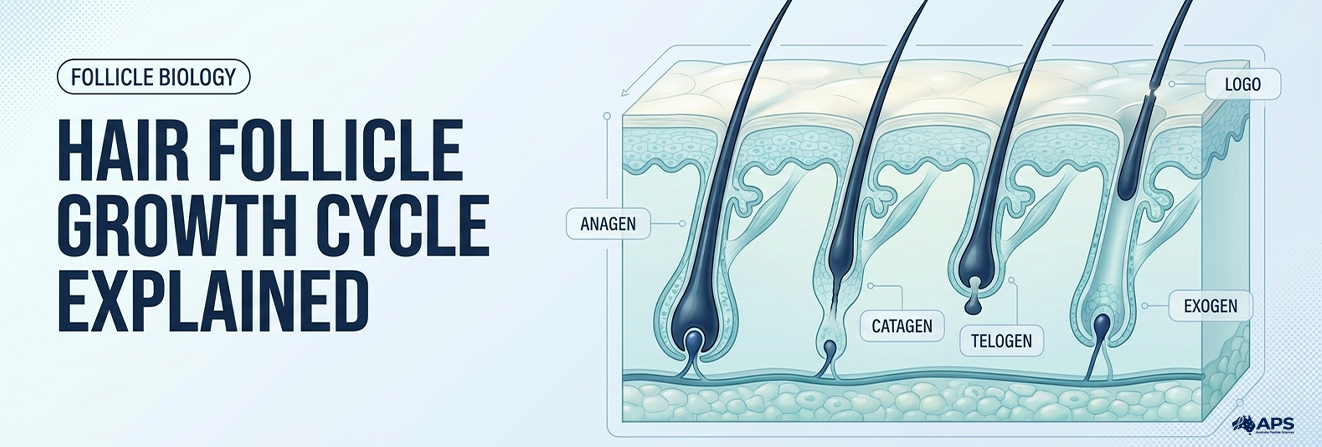
The hair follicle growth cycle refers to the repeating process through which a follicle produces hair, regresses, rests and releases an old strand.
These changes happen beneath the skin, while the visible hair shaft records earlier growth.
Individual scalp follicles follow different schedules. Some produce hair while others retain or release older strands, allowing overall coverage to remain relatively stable despite everyday shedding.
Understanding this process helps explain differences in hair length, delayed shedding after illness and changes with age. It also provides a foundation for interpreting laboratory research without confusing cellular findings with proven human regrowth.
What Is the Hair Follicle Growth Cycle?
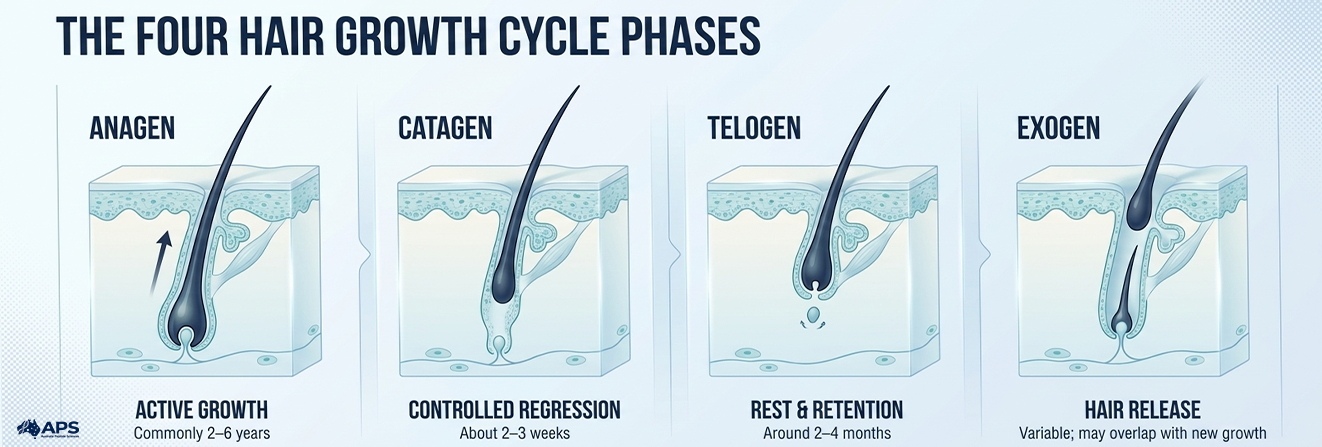
The cycle involves anagen, when hair is produced; catagen, when the lower follicle regresses; telogen, a period of relative rest; and exogen, when the retained strand sheds. Three stages describe the main follicle transformations, while exogen describes separately regulated shedding that can overlap with renewed growth.
Hair Follicle Structure: Where Growth Begins
1. Hair Bulb, Matrix and Shaft
Understanding hair follicle structure starts with separating the living organ from the strand it produces. The follicle extends into the skin, whereas the exposed shaft consists of keratinised cells.
During active growth, matrix cells within the hair bulb multiply and differentiate. Their descendants contribute to the shaft and its supporting inner root sheath. Cutting the exposed strand does not remove these growth-producing cells.
2. Dermal Papilla and Stem Cell Niche
The dermal papilla is a specialised cluster of connective-tissue cells at the follicle base. It exchanges signals with epithelial cells and helps regulate hair production and cycling. Related laboratory investigations examine copper-binding compounds such as GHK-Cu, while the GHK-Cu research guide explains why compound-specific findings do not establish control of the complete follicle cycle.
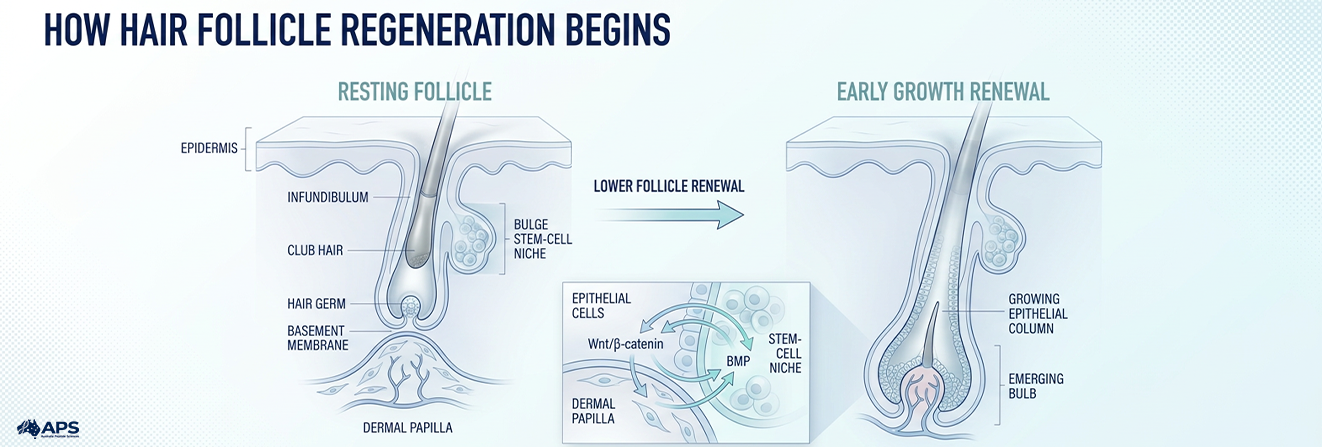
Stem and progenitor cells occupy distinct follicular regions, including the bulge region and hair germ. Communication between these populations and their surrounding environment supports renewal of the cycling lower follicle. The permanent upper portion remains, rather than the entire organ disappearing after each strand sheds.
The Four Hair Growth Cycle Phases
The stages of hair growth describe changes in both follicle activity and hair retention. These approximate timings apply to human scalp hair, with variation between individuals and published estimates.
| Phase | Main biological event | Approximate scalp timing |
| Anagen | Active shaft production | Commonly 2–6 years; longer ranges are reported |
| Catagen | Regression of the lower follicle | About 2–3 weeks |
| Telogen | Relative rest and retention of the club hair | Around 2–4 months |
| Exogen | Release of the retained shaft | Variable and potentially overlapping with renewed growth |
1. Anagen Phase: Active Hair Production
The anagen phase involves sustained matrix-cell division and formation of the hair shaft. Pigment-producing melanocytes contribute colour during active growth.
Most scalp follicles are normally growing at any given time. Growth continues while the follicle remains in anagen, although the speed of shaft production varies.
A longer growing period can support greater potential length. It does not automatically produce a thicker strand, because shaft diameter also depends on follicle characteristics.
2. Catagen Phase: Controlled Regression
The catagen phase marks the end of active shaft production. Much of the lower follicle regresses through tightly controlled cellular changes, including programmed cell death.
The remaining strand develops a club-shaped base and stays anchored. This is normal tissue remodelling, rather than destruction of the complete follicle.
3. Telogen Phase: Relative Rest
During the telogen phase, the retained club hair does not lengthen. However, the follicle remains biologically regulated and capable of responding to signals that prepare another growth period.
Calling telogen “resting” therefore describes reduced hair production, not complete inactivity throughout the organ.
4. Exogen Phase: Hair Release
The exogen phase concerns loosening and release of the old shaft. Shedding and follicle growth are related processes, but their timing is not identical.
An older strand may remain while another growth period begins. The hair growth cycle phases should therefore not be pictured as four sealed compartments with identical boundaries in every follicle.
How Long Does a Scalp Hair Follicle Cycle Last?
Overall hair growth cycle duration is dominated by the years spent producing a strand. There is no single timetable shared by every scalp follicle.
Differences in anagen phase duration help explain why some people can grow longer hair than others. Eyebrow and many body hairs have shorter growing periods, limiting their potential length.
Hair length also reflects growth rate and breakage. A strand that repeatedly breaks can appear to stop growing even when its follicle remains active.
For the hair follicle growth cycle, adding every phase into one exact total can be misleading because shedding may overlap with renewed growth. Approximate ranges describe biology more accurately than a fixed countdown.
Interpreting the hair follicle growth cycle requires distinguishing growth rate, growth duration and the number of follicles producing visible hair. Faster elongation does not necessarily mean greater density, and reduced shedding does not establish recovery of miniaturised follicles.
For a visual explanation of hair growth and shedding, watch this educational overview of the cycle’s phases.
Telogen vs Exogen: Resting and Shedding Differ
The distinction in telogen vs exogen concerns hair retention and release. During telogen, the follicle retains a non-growing club hair; exogen describes its release.
The small pale club visible on a shed hair is not the entire follicle. Much of the living structure remains within the skin.
This distinction matters because shedding alone does not demonstrate permanent follicle loss. Conversely, a reduction in visible density cannot be explained from shed-hair counts alone. Strand diameter, replacement growth and follicle damage also influence what becomes visible.
How Hair Follicle Regeneration Begins
1. Signals That Restart Growth
Hair follicle regeneration involves coordinated activity between epithelial cells, the dermal papilla and the surrounding tissue environment. Regulatory networks, including Wnt/β-catenin and bone morphogenetic protein (BMP) signalling, help balance growth activation and restraint.
These networks interact rather than operating as one simple switch. Their effects depend on cell type, cycle stage and experimental context. Much detailed mechanistic evidence comes from animal models.
2. Renewal Is Different From Creating New Follicles
Normal regeneration rebuilds the cycling lower portion of an existing follicle, rather than creating a new organ whenever a hair falls out. Related skin and tissue repair research examines cell migration and matrix remodelling, which are distinct from demonstrating complete follicle regeneration.
The hair follicle growth cycle depends on surviving structures that support repeated renewal. Where scarring destroys essential follicular regions, normal cycling may no longer be possible.
Likewise, experimentally inducing follicle-like structures differs from encouraging an existing follicle to enter anagen. Broader tissue-response studies involving BPC-157 also address separate experimental questions; their findings cannot establish new follicle formation or restored cycling.
Visit our research peptide shop
Factors Affecting Hair Growth and Timing
Several factors affecting hair growth can change phase transitions, shaft production or the tissue environment.
- Genetics and androgen sensitivity: In susceptible follicles, androgen-related signalling contributes to progressive miniaturisation and shorter growing periods.
- Hormonal changes: Pregnancy, postpartum changes and thyroid disturbances can influence cycling through different mechanisms.
- Illness and physiological stress: Fever, surgery and substantial weight loss can precede increased shedding.
- Nutrition: Severe dietary restriction or deficiencies can interfere with normal production. Associations with nutrient levels do not prove that supplements improve growth in everyone.
- Medications and inflammation: Particular medicines and inflammatory scalp conditions can affect hair through different pathways.
Damage to the shaft deserves separate consideration. Heat and chemical processing can cause breakage without directly demonstrating a disrupted hair follicle growth cycle.
Sustained traction can affect both hair shafts and follicles, so breakage and follicle damage may occur together.
Hair Growth Cycle and Ageing
The relationship between hair growth cycle and ageing involves changes within follicular cells and their surrounding niche. Research examines altered stem cell activity, signalling and tissue conditions that may reduce regenerative capacity.
Age-related thinning is not identical to androgenetic hair loss, although both can occur together. Greying also concerns pigment biology and does not, by itself, prove that a follicle has stopped producing hair.
Changes vary substantially between individuals. There is no fixed age when every follicle becomes inactive, and a sudden increase in shedding should not automatically be attributed to getting older.
What Happens When the Hair Growth Cycle Is Disrupted?
1. Telogen Effluvium and Delayed Shedding
A disrupted hair growth cycle can involve more follicles leaving active growth within a shorter period. In telogen effluvium, increased diffuse shedding often becomes noticeable several months after a trigger.
This delay reflects the interval between altered cycling and eventual hair release. A 2022 observational study of patients with telogen effluvium reported shedding after COVID-19. This finding illustrates the importance of recording earlier illness, but does not establish causation or a single mechanism.
2. Other Forms of Follicle Disruption
Pattern hair loss involves progressive miniaturisation, often with shortened anagen. Alopecia areata involves immune-mediated follicle dysfunction, while scarring disorders can destroy structures required for future growth.
These differences explain why the hair follicle growth cycle cannot identify a diagnosis on its own. Similar concerns about thinning may arise from different processes, and increased shedding can coexist with reduced strand diameter.
Clinical assessment considers the pattern, timing, scalp findings and relevant history rather than assigning every change to stress.
What Counts as Normal Hair Shedding?
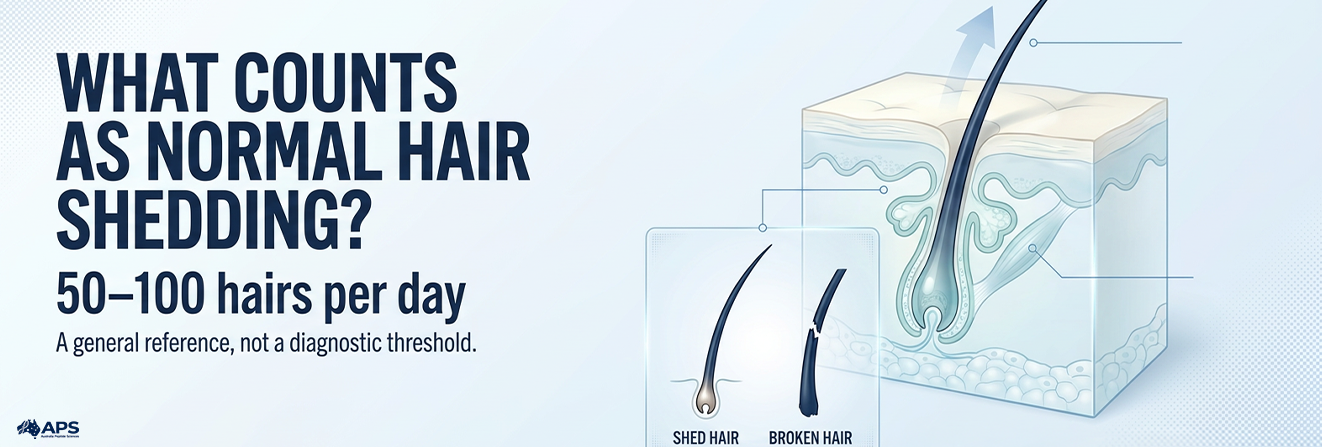
The American Academy of Dermatology cites 50–100 hairs a day as a reference for normal hair shedding. This range alone cannot determine the cause of a change in shedding.
Wash frequency affects how many loose strands appear together. Longer hairs can also make an ordinary amount look more substantial.
Useful observations include:
- A sustained change from usual shedding.
- A widening part or reduced visible density.
- Patchy loss or accompanying scalp symptoms.
- Short broken strands compared with complete shed hairs.
Persistent or sudden changes warrant assessment by a GP or dermatologist. Daily counting alone cannot distinguish every cause, and photographs taken under consistent conditions may help document visible changes over time.
How Researchers Study Follicle Cycling
Researchers investigate the hair follicle growth cycle using complementary methods. Each method captures different aspects of follicle activity and has specific limitations:
| Model or method | What it can show | Main limitation |
| Isolated cells | Cellular responses and signalling | Does not reproduce a complete follicle |
| Human follicle organ culture | Short-term shaft growth and tissue changes | Limited culture lifespan |
| Animal models | Cycling within living tissue | Species differ in timing and organisation |
| Human imaging and clinical measurements | Density, diameter and changes over time | Study design influences interpretation |
Laboratory findings do not establish durable human regrowth. Cell-migration and tissue-response findings involving TB-500 require follicle-specific investigation before conclusions about cycling can be drawn.
Research materials supplied by Australia Peptide Sciences are intended for laboratory research purposes only and are not for human or veterinary use.
Understanding Growth, Rest and Renewal
The hair follicle growth cycle links hair production with controlled regression, maintenance and shedding. Timings vary, and releasing a strand does not usually mean losing the follicle itself.
Understanding these distinctions makes normal shedding easier to interpret and helps separate established biology from experimental findings. Persistent changes in density, shedding or scalp condition still require assessment of their underlying cause.
Explore Australia Peptide Sciences
Frequently Asked Questions
What are the four phases of the hair growth cycle?
The four commonly described phases are anagen (growth), catagen (regression), telogen (relative rest) and exogen (shedding).
How long does a hair follicle cycle take?
A scalp follicle cycle usually spans several years, with most of that time spent in anagen; timing varies between follicles and individuals.
What happens during the anagen phase?
Matrix cells in the hair bulb divide and produce the hair shaft, while melanocytes contribute pigment.
What is the difference between telogen and exogen?
Telogen describes relative rest and retention of a non-growing hair, while exogen describes its release from the follicle.
Does shedding mean the hair follicle is dead?
No; normal shedding releases the old hair shaft while the living follicle remains within the skin.
Why does hair shedding start months after illness?
Illness can shift more follicles out of active growth, with visible shedding appearing later as those hairs reach the release stage.
How do I restart my hair growth cycle?
There is no single reset method; whether normal cycling resumes depends on the cause of disruption and the condition of the follicles.
Do hair follicles grow back if pulled out?
Plucking usually removes the hair rather than the entire follicle, so regrowth remains possible unless injury or scarring damages essential structures.
How does ageing affect the hair growth cycle?
Ageing can alter follicular cells and their surrounding environment, although changes in growth and density vary between individuals.
How do researchers study the hair follicle growth cycle?
Researchers use cell cultures, isolated human follicles, animal models and human measurements, each revealing different aspects of growth and cycling.
Sources
- The dermal papilla: an instructive niche for epithelial stem and progenitor cells.
- Anatomy, Hair.
- Integrative and Mechanistic Approach to the Hair Growth Cycle and Hair Loss.
- Resting no more: re-defining telogen, the maintenance stage of the hair growth cycle.
- Stem cell dynamics in the hair follicle niche.
- The Diagnosis and Treatment of Hair and Scalp Diseases.
- Aging of hair follicle stem cells and their niches.
- Evaluation of patients with telogen effluvium during the pandemic.
- American Academy of Dermatology: Do you have hair loss or hair shedding?.