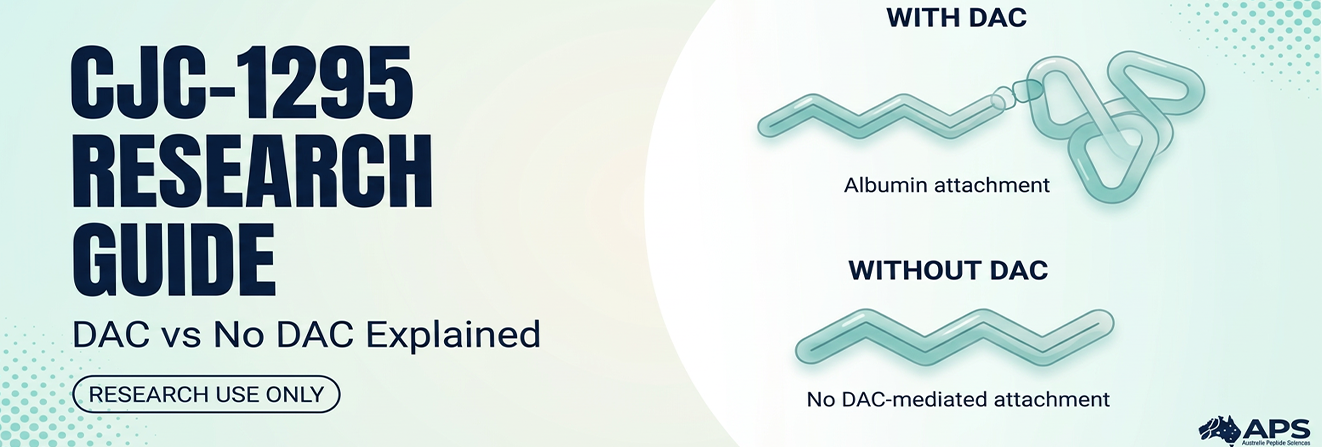
CJC-1295 is a synthetic growth hormone-releasing hormone analogue. The original compound uses a drug affinity complex, or DAC, to bind albumin, while “no DAC” materials are generally associated with modified GRF 1-29.
This difference changes circulating exposure and how the evidence should be interpreted. Half-life data for the DAC compound cannot automatically be applied to no-DAC material.
This guide compares both forms, their human pharmacology, research limits and Australian regulatory context.
Certificates of Analysis should identify the compound and batch. Research materials are not for human or veterinary use.
DAC vs No DAC: Quick Comparison
CJC-1295 DAC is the original albumin-binding compound studied for prolonged exposure; “CJC-1295 no DAC” commonly refers to modified GRF 1-29 without the DAC group.
Use the detailed comparison below to match each claim to the exact compound studied.
What Is CJC-1295?
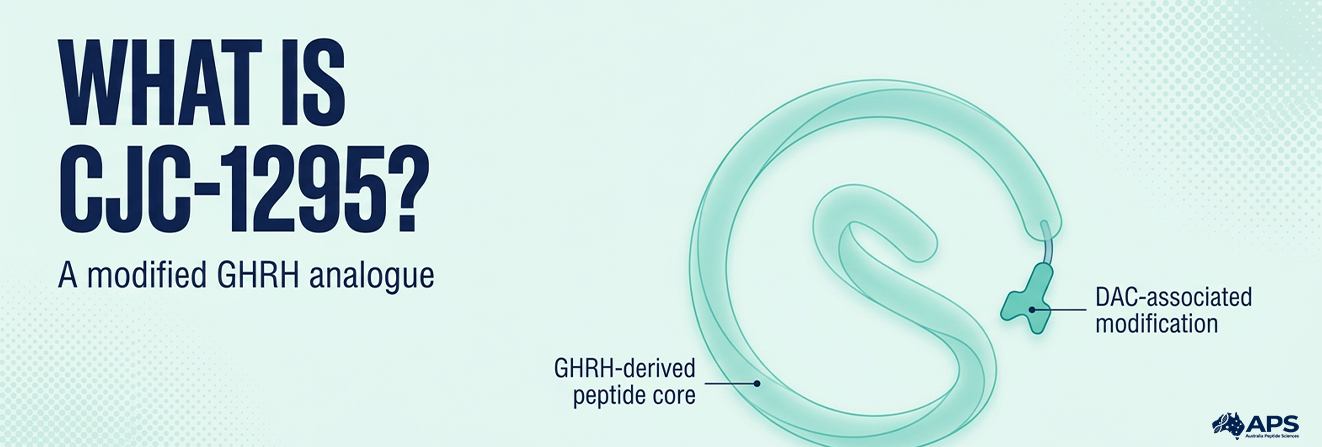
CJC-1295 was developed as a long-acting GHRH analogue based on growth hormone-releasing hormone. GHRH links hypothalamic signalling to growth hormone release from the pituitary gland.
The peptide core is derived from the first 29 residues of human GHRH, with substitutions that improve resistance to degradation. The original DAC compound also includes a modified lysine carrying the albumin-reactive group, so it is not simply an unmodified 29-amino-acid peptide.
A compound name is only a starting point for identification. The complete specification should establish residue order, stereochemistry, terminal groups and attached modifications.
As explained in our peptide sequence guide, the sequence must be considered alongside other chemical features when assessing the identity of a research material.
How CJC-1295 Affects Growth Hormone Signalling
GHRH acts on receptors in the anterior pituitary, where growth hormone-producing cells respond to the signal. Released growth hormone influences multiple tissues and stimulates production of insulin-like growth factor 1, commonly abbreviated to IGF-1.
CJC-1295 was investigated for its ability to stimulate this pathway while extending exposure beyond that of native GHRH.
Three concepts need to remain separate:
- Receptor activity: whether the compound activates the relevant biological target.
- Circulating exposure: how long measurable compound-related material persists.
- Downstream response: how GH, IGF-1 or another endpoint changes.
A longer circulating half-life does not show how long an individual molecule remains receptor-bound.
Researchers sourcing GH and IGF-1 peptides for laboratory use should note that a hormonal response does not establish changes in strength, recovery or body composition.
CJC-1295 DAC vs CJC-1295 No DAC: Detailed Comparison
The DAC distinction changes the compound’s chemistry and the evidence relevant to it.
| Feature | CJC-1295 DAC | CJC-1295 no DAC |
| Naming context | Original albumin-binding compound described in development research | Common label associated with modified GRF 1-29 |
| DAC attachment group | Present | Absent |
| Albumin interaction | Designed for covalent albumin attachment | Lacks DAC-mediated covalent attachment |
| Exposure extension | Prolonged exposure documented for the studied compound | DAC-associated exposure cannot be assumed |
| Half-life interpretation | Published human estimates apply to the investigated material | Requires evidence specific to the identified material |
| Documentation priority | Confirm peptide identity and DAC modification | Confirm sequence, terminal groups and absence of DAC |
What “No DAC” Means in Research
The term modified GRF 1-29 commonly describes the GHRH-derived peptide without the albumin-binding DAC group.
However, “no DAC” is not a complete chemical specification. It does not independently establish the sequence, terminal chemistry, purity or quantity of a sample.
Researchers should therefore compare the stated structure with analytical documentation. Similar product names do not establish equivalent materials.
Can Evidence Be Transferred Between the Two Forms?
Removing the exposure-extending modification changes the pharmacokinetic interpretation. Materials with related peptide cores may still have different time courses and experimental behaviour.
Identify the exact material in each publication and compare it with the specification of the sample being evaluated before transferring any finding.
How the Drug Affinity Complex Extends Exposure
The drug affinity complex enables the original CJC-1295 molecule to attach covalently to circulating albumin.
Development research described a reactive group designed to form a covalent linkage with the free thiol at albumin’s cysteine-34 residue. Albumin association was central to the compound’s prolonged circulating persistence.
DAC primarily changes exposure; it does not make the peptide universally “stronger” or establish superior outcomes across experimental endpoints.
The chemical environment also matters. A simplified receptor assay and a biological system containing albumin do not necessarily represent the same conditions.
For laboratory characterisation, the DAC attachment is part of the intended structure and must be included in the specification. Our peptide synthesis guide explains why terminal modifications and attached groups matter when defining a synthesis target.
CJC-1295 Half-Life: What Do the Numbers Mean?
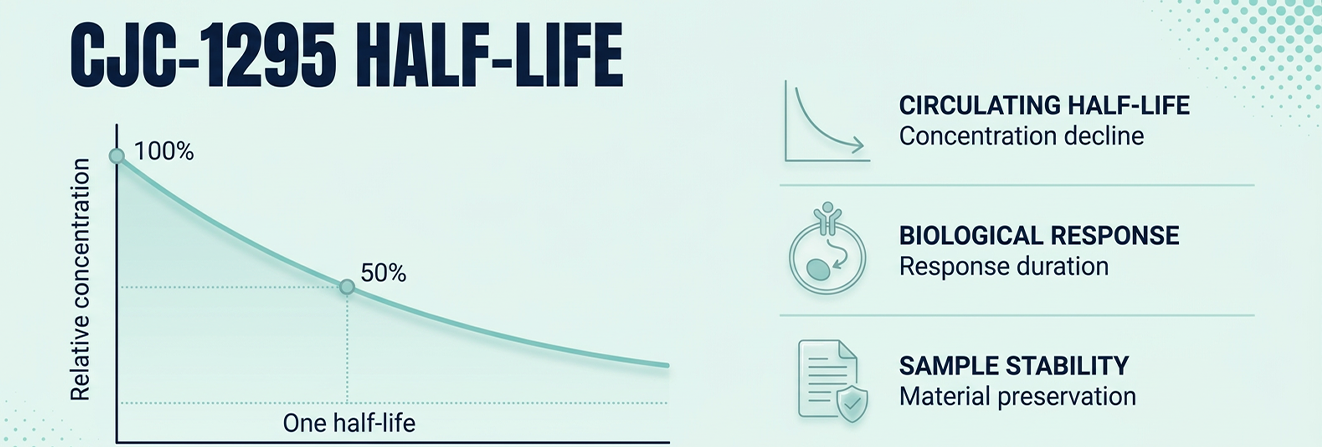
The frequently cited CJC-1295 half-life of approximately 5.8-8.1 days comes from a human study of the long-acting compound. It is a study-specific estimate, not a universal value for every material labelled CJC-1295.
Half-Life vs Response Duration
A pharmacokinetic half-life describes the decline of the measured compound-related concentration during a defined phase.
A biological response can follow a different time course. GH secretion, IGF-1 production and circulating peptide measurements describe related but separate processes.
Consequently, a hormone remaining above baseline does not mean that the peptide concentration remains unchanged throughout that period.
Half-Life vs Shelf Life
Three measurements are often confused:
| Measurement | What it describes |
| Circulating half-life | Decline of measured compound-related concentration in a biological system |
| Pharmacodynamic duration | Persistence of a measured biological response |
| Sample stability | Preservation of material under specified laboratory conditions |
A clinical half-life cannot establish a storage expiry date. Likewise, a stability result obtained under one laboratory condition cannot establish persistence in circulation.
A precise no-DAC half-life should only be quoted when the source identifies the tested molecule, model and measurement conditions.
Human Pharmacology: What the Studies Show
Two 2006 publications provide the main human evidence for the long-acting compound. They examine pharmacology and hormone secretion, not broad health or performance outcomes.
Teichman and Colleagues: Exposure and Hormonal Responses
This publication reported two randomised, placebo-controlled, double-blind trials lasting 28 and 49 days in healthy adults aged 21-61.
Following a single exposure, mean GH increased approximately 2-10-fold for at least six days, while mean IGF-1 increased approximately 1.5-3-fold for 9-11 days. Following repeated exposure, mean IGF-1 remained above baseline for up to 28 days.
Adverse events and the limits of these short trials are summarised in the safety section below (Teichman et al., 2006).
Ionescu and Frohman: Were GH Pulses Preserved?
The second publication examined overnight GH secretion in healthy men before and one week after CJC-1295 exposure.
GH pulsatility was preserved. Pulse frequency and magnitude were unaltered, while trough GH increased 7.5-fold, mean GH increased 46% and IGF-1 increased 45%.
The investigators proposed that higher trough GH could help explain IGF-1 production, although IGF-1 changes did not correlate with the measured GH secretion parameters.
The result shows that prolonged exposure and preserved GH pulses can coexist, challenging a simple “continuous” versus “pulsatile” distinction.
What the Human Studies Do Not Establish
Neither publication establishes improvements in muscle growth, fat loss, sleep, recovery or longevity; those outcomes require dedicated studies with relevant clinical endpoints.
Research Applications and Study Design
CJC-1295 provides a case study in how chemical modification can change peptide exposure without changing the broad receptor pathway being investigated. Our peptide list and what they do guide places these pathways in a broader research context.
Relevant research questions include:
- How albumin attachment influences exposure and measurable activity.
- How GH pulse characteristics differ from average hormone concentrations.
- How peptide identity affects interpretation of published pharmacokinetics.
- Whether findings remain consistent across different models and analytical methods.
An isolated receptor assay cannot reproduce the feedback mechanisms of an intact endocrine system.
Study comparisons must account for the sampling window. A single hormone measurement cannot characterise pulsatility as well as repeated sampling.
How Does CJC-1295 Differ from Ipamorelin?
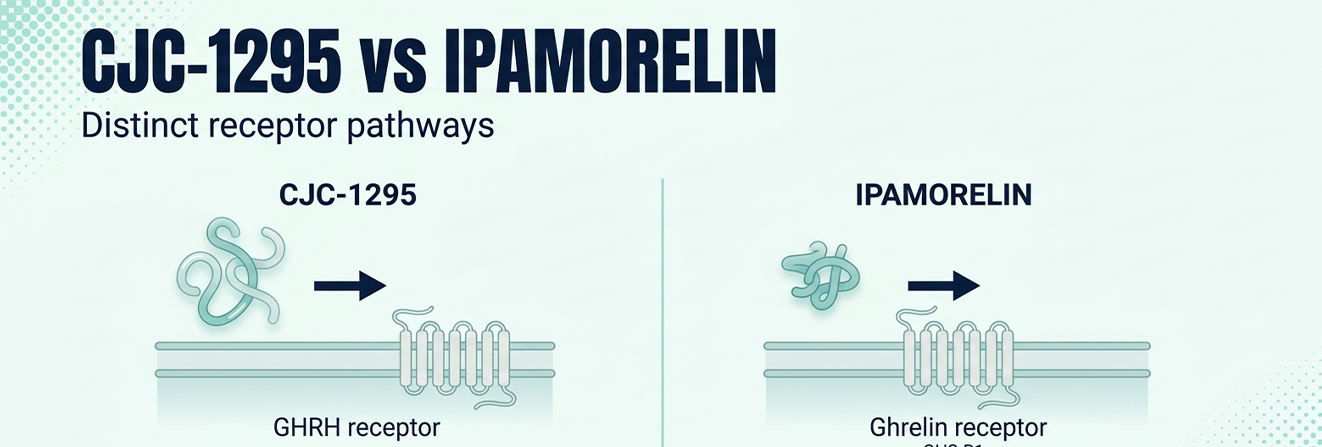
CJC-1295 and ipamorelin influence GH release through distinct receptor pathways. CJC-1295 acts on the GHRH receptor, while ipamorelin targets the growth hormone secretagogue receptor also known as the ghrelin receptor.
These different mechanisms make interaction studies scientifically relevant, though they do not establish superior outcomes or a confirmed safety profile for the combination.
Evidence generated for one compound cannot be extrapolated to a CJC-1295 and Ipamorelin blend; any combination research must identify and independently evaluate both components.
Any combination study should identify both compounds, define the model and sampling window, and evaluate interaction effects rather than extrapolating from either compound alone.
For a complementary discussion of CJC-1295 terminology, DAC versus no DAC, and the distinction between hormonal responses and demonstrated clinical benefits, watch the following video.
Safety Evidence and Research Limits
Adverse Events Reported in Short Human Studies
In the 2006 placebo-controlled trials of CJC-1295 DAC, reported events included injection-site reactions, headache, flushing, diarrhoea and occasional transient hypotension. No serious adverse reactions were reported during the short observation periods (Teichman et al., 2006).
The trials lasted 28 and 49 days and were not designed to detect uncommon, delayed or long-term harms. They do not establish safety for modified GRF 1-29, combination products or independently sourced materials.
Australian regulators have separately warned that unapproved peptide products as a broad category may be associated with serious adverse events, including severe allergic reactions and organ injury; this warning is not specific to CJC-1295 (TGA, 2026).
Preserved GH pulsatility is a pharmacodynamic observation, not a complete safety assessment. Long-term outcomes and the effects of sustained GH-IGF-1 changes remain uncertain.
CJC-1295 Australia: Regulatory and Anti-Doping Context
The TGA identifies CJC-1295 among unapproved peptide products. These products have not undergone TGA evaluation for quality, safety or effectiveness as approved medicines.
Research Use Only and Regulatory Limits
The TGA states that labels such as “research use only” or “not for human use” do not change a product’s regulatory status or remove applicable obligations.
Where therapeutic-goods regulation applies, relevant ARTG requirements or a valid exemption, approval or authority must be considered.
Is CJC-1295 Prohibited in Sport?
Sport Integrity Australia lists CJC-1295 among peptides prohibited in sport. Anti-doping status is separate from medicinal approval and does not prove a performance benefit.
How to Evaluate CJC-1295 Research Records
A useful analytical record links a defined compound, an identifiable batch, and a specific test result. Our peptide analysis guide explains how to read these records in a research context.
| Documentation item | What it helps establish |
| Compound specification | Intended sequence, terminal groups and DAC status |
| Batch identifier | Traceability between sample and report |
| Mass spectrometry | Whether measured mass supports the proposed identity |
| Chromatographic analysis | Purity under the stated analytical method |
| Content measurement | Quantity, when assessed separately |
| Method and analysis date | Context for interpreting the reported result |
Identity, purity and quantity answer different questions. High chromatographic purity does not prove complete structure, quantity, biological activity or sterility.
A matching mass supports identity but does not resolve every structural ambiguity.
Lyophilised presentation also does not establish a validated shelf life. Storage and stability claims require support specific to the material and conditions.
Key Takeaways
Understanding CJC-1295 requires linking the name to the complete structure. DAC-mediated albumin binding explains the prolonged exposure of the original molecule, while no-DAC materials require separate evidence.
Published human findings describe hormonal and pharmacokinetic effects under limited conditions. They do not establish clinical benefits, long-term safety or the properties of independently sourced samples.
Access the member research catalogue
Visit Australia Peptide Sciences and create a free account or log in to view the current catalogue and product documentation.
Frequently Asked Questions About CJC-1295
What is CJC-1295?
CJC-1295 is a synthetic GHRH analogue originally developed with an albumin-binding modification to prolong circulating exposure.
What does DAC stand for?
DAC stands for drug affinity complex, the modification enabling covalent attachment to albumin.
What is CJC-1295 no DAC?
It is a common label associated with modified GRF 1-29 without the DAC attachment group.
Is modified GRF 1-29 identical to the original CJC-1295?
No; the original albumin-binding compound includes additional chemistry absent from the material commonly called modified GRF 1-29.
What CJC-1295 half-life did human research report?
One study reported an estimated 5.8-8.1 days for the investigated long-acting compound.
Does DAC eliminate GH pulses?
No; one human study observed preserved GH pulsatility during prolonged stimulation.
Can DAC findings be applied directly to no-DAC materials?
No; differences in structure and exposure require compound-specific interpretation.
Does high purity establish sterility?
No; chromatographic purity and sterility are separate properties requiring different assessments.
Is CJC-1295 approved in Australia?
The TGA identifies CJC-1295 among unapproved peptide products.
Does RUO labelling establish lawful supply?
No; research-use wording alone does not change regulatory status or remove applicable obligations.
References
- Jetté L, Léger R, Thibaudeau K, et al. Human growth hormone-releasing factor (hGRF)1-29-albumin bioconjugates activate the GRF receptor on the anterior pituitary in rats: identification of CJC-1295 as a long-lasting GRF analog. Endocrinology. 2005;146(7):3052-3058.
- Teichman SL, Neale A, Lawrence B, et al. Prolonged stimulation of growth hormone and insulin-like growth factor I secretion by CJC-1295 in healthy adults. Journal of Clinical Endocrinology & Metabolism. 2006;91(3):799-805.
- Ionescu M, Frohman LA. Pulsatile secretion of growth hormone persists during continuous stimulation by CJC-1295. Journal of Clinical Endocrinology & Metabolism. 2006;91(12):4792-4797.
- Therapeutic Goods Administration. Understanding your responsibilities when importing, compounding and supplying unapproved peptide products.
- Therapeutic Goods Administration. How we regulate therapeutic peptide products.
- Therapeutic Goods Administration. Concerns regarding public health risks associated with unapproved peptide products. 19 June 2026.
- Sport Integrity Australia. Peptides explained.