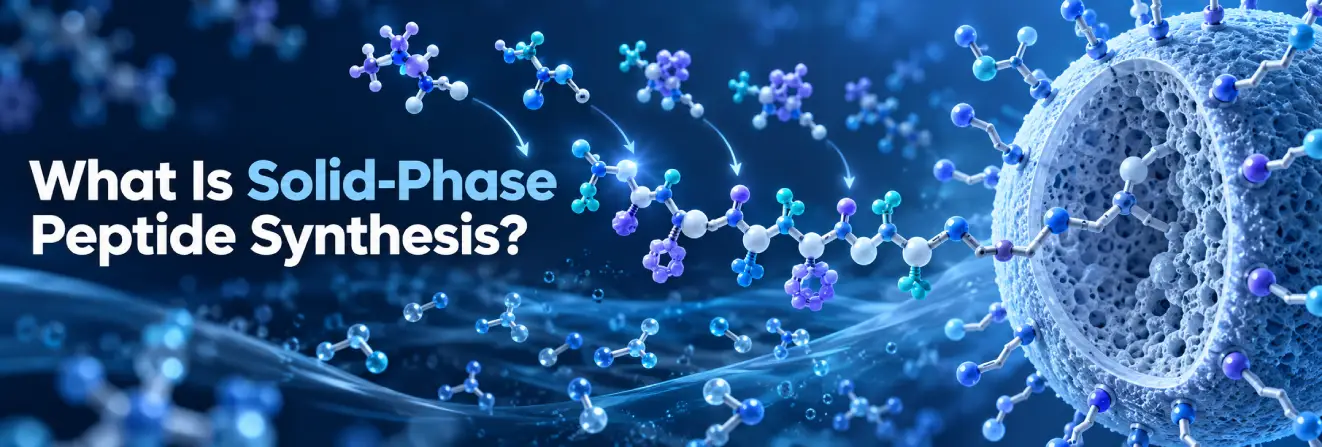
Solid phase peptide synthesis (SPPS) is a laboratory method for assembling peptides by adding amino acids sequentially while the growing chain remains attached to an insoluble support, usually a polymer resin. Repeated deprotection and coupling reactions extend the sequence; the completed peptide is then released, purified when necessary and characterised.
First reported by R. Bruce Merrifield in 1963, SPPS simplified peptide chemistry by avoiding isolation of the growing chain after every reaction. It remains central to producing defined sequences for biochemical, structural and analytical research. Fmoc chemistry, automated synthesisers and newer flow-based or lower-waste approaches have expanded its capabilities, although difficult sequences and impurity formation still present challenges.
How Does Solid-Phase Peptide Synthesis Work?
SPPS builds a peptide one residue at a time on a solid support. The resin retains the growing chain while soluble reagents and by-products are removed between reactions. Conventional SPPS proceeds from the peptide’s C-terminus towards its N-terminus, opposite to the direction of biological protein synthesis.
The Role of the Solid Support
The first amino acid is anchored through a chemical linker to a solid support such as crosslinked polystyrene or a polyethylene glycol (PEG)-containing polymer.
Compatible solvents allow many resins to swell, giving reagents access to reactive groups within their structure. Resin composition, solvent choice and aggregation of growing chains influence that accessibility. A suitable linker also determines how the peptide can ultimately be released.
Peptide Bond Formation and Chain Growth
The exposed amino group of the resin-bound chain reacts with the activated carboxyl group of an incoming, protected amino acid, forming an amide or peptide bond. Its temporary amino-protecting group is subsequently removed to make the next coupling possible.
Protecting groups on reactive side chains limit unwanted reactions throughout assembly. Side-chain protection is particularly important for residues with additional nucleophilic or acidic functionality, where uncontrolled chemistry could alter the molecular identity of the recovered peptide.
Repetition produces the predetermined sequence, although individual reactions may be incomplete. The efficiency of each stage affects the proportion of chains that reach full length. Soluble excess reagents can be washed away, but resin-bound deletion products remain until cleavage; this is why solid-phase handling and final purity are different concepts.
What Are the Main Solid Phase Peptide Synthesis Steps?
The essential solid phase peptide synthesis steps are attachment, deprotection, coupling, washing and repetition, followed by cleavage and analytical assessment. Specific reagents depend on the protecting-group strategy and target sequence.
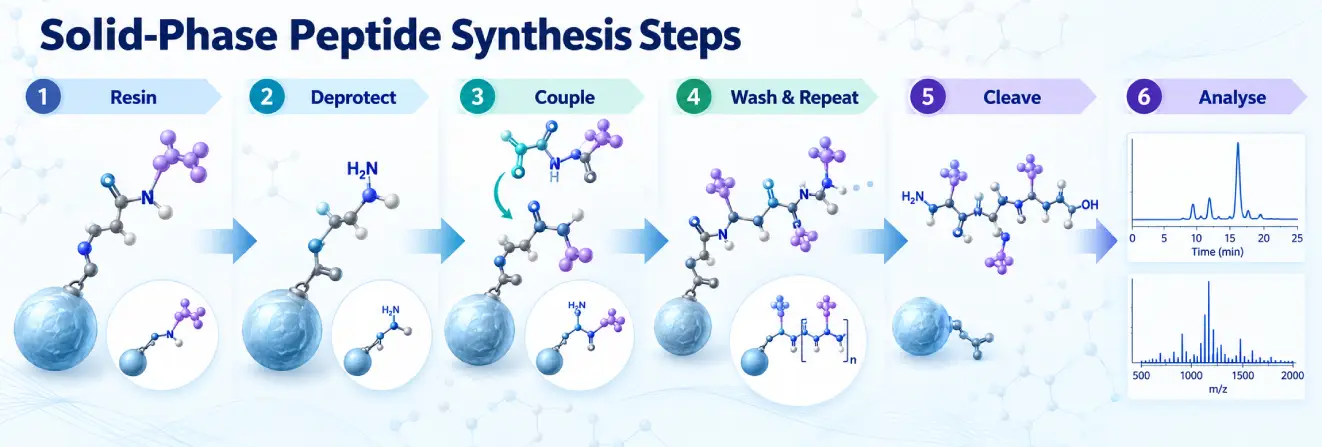
Step 1 - Resin Selection and Initial Amino Acid Attachment
A resin and linker are chosen to suit the required C-terminal structure and synthesis chemistry. The intended C-terminal residue is attached to the support or supplied preloaded. Wang-type linkers commonly yield a C-terminal carboxylic acid; Rink amide linkers yield a carboxamide. Protecting groups restrict unwanted reactions during subsequent cycles. Linkers and supports are selected together rather than independently: a chemically suitable linker must also withstand repeated exposure to the chosen coupling and deprotection conditions. The first attachment can influence the attainable loading and the final structure of the released material.
Step 2 - N-Terminal Deprotection
The temporary protecting group is removed from the resin-bound amino group, exposing the site for the next peptide bond. Fmoc groups are usually removed under basic conditions, commonly with an amine such as piperidine; Boc groups are removed using acid. Other protected functional groups must remain sufficiently stable during this stage.
Step 3 - Amino Acid Activation and Coupling
Coupling reagents activate the incoming protected amino acid’s carboxyl group so it can react with the resin-bound amino group. Examples include N,N′-diisopropylcarbodiimide (DIC), often combined with an additive such as OxymaPure. Reagent compatibility and sequence chemistry matter even for short peptides such as KPV (Lys-Pro-Val): incomplete coupling can produce chains missing the intended residue.
Step 4 - Washing and Repeated Coupling Cycles
Washing removes soluble reagents and reaction by-products without detaching the peptide. The newly incorporated residue is deprotected and another protected amino acid is coupled. This cycle repeats until the sequence is complete.
Reaction monitoring and, where appropriate, additional coupling can help identify or address incomplete conversion. Colour-based tests for residual free amino groups are used in some batch workflows; automated instruments may monitor reaction-related signals. These measurements assess specific stages rather than proving that the full peptide will be correctly assembled.
Step 5 - Peptide Cleavage and Side-Chain Deprotection
The finished chain is released by cleaving its linker. In conventional Fmoc/tBu synthesis, trifluoroacetic acid (TFA)-based conditions can also remove many acid-labile side-chain protecting groups. Other linkers allow recovery of protected fragments for further chemical assembly. Cleavage conditions must account for residues susceptible to unwanted modification.
Step 6 - Peptide Purification and Characterisation
Cleavage typically yields crude material containing the desired peptide and potentially deletion sequences or other related impurities. Reversed-phase high-performance liquid chromatography (RP-HPLC) can separate components, while mass spectrometry checks molecular mass.
These analytical stages are distinct from sequence assembly; retaining the peptide on resin does not guarantee a pure final product. Analytical requirements also vary by experiment: a qualitative binding assay and a quantitative reference standard may demand different levels of compositional confidence.
| Stage | Purpose | Outcome |
| Attachment | Anchor the starting residue | Resin-bound amino acid |
| Deprotection | Expose the amino group | Reactive site for coupling |
| Coupling | Form the next peptide bond | Extended chain |
| Washing and repetition | Remove solubles and continue assembly | Completed sequence |
| Cleavage | Release peptide from the support | Crude peptide |
| Purification and analysis | Separate and assess components | Characterised material |
The following video illustrates the fundamental principles and main stages of solid-phase peptide synthesis.
What Is Fmoc Solid-Phase Peptide Synthesis?
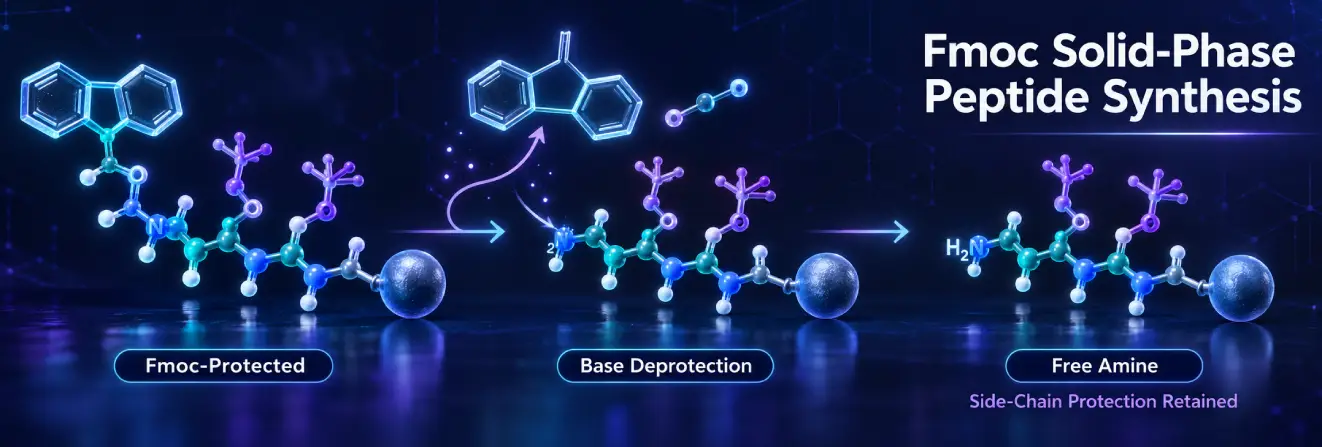
Fmoc solid-phase peptide synthesis uses the 9-fluorenylmethoxycarbonyl group to temporarily protect amino groups during stepwise peptide assembly. It is widely adopted because the amino-protecting group can be removed under conditions different from those used for many side-chain protections.
How Fmoc Protecting Groups Work
After an Fmoc-protected residue is coupled, a base removes the Fmoc group through an elimination reaction that generates dibenzofulvene and carbon dioxide.
Suitable reagents trap the reactive dibenzofulvene by-product. The newly exposed amino group can then react in the next coupling cycle. Efficient deprotection matters because residual protection can prevent chain extension.
Why Fmoc/tBu Chemistry Is Widely Used
Fmoc/tBu combines base-labile temporary amino protection with acid-labile side-chain protection. This orthogonal protecting-group strategy allows repeated amino-group deprotection without generally removing the protected side-chain groups.
It supports sequences containing residues such as lysine, serine and cysteine, while still requiring attention to sequence-dependent side reactions.
Fmoc vs Boc Peptide Synthesis
Fmoc and Boc are established approaches, differing primarily in how temporary amino protection is removed. Classical Boc/Bzl chemistry relies on differential acid sensitivity, whereas Fmoc/tBu uses base- and acid-labile groups.
| Feature | Fmoc/tBu | Classical Boc/Bzl |
| Amino deprotection | Basic conditions | Acidic conditions |
| Common side-chain protection | Acid-labile groups | Benzyl-based groups |
| Final cleavage | Often TFA-based | Traditionally stronger acid, including HF |
| Main consideration | Possible base-promoted side reactions | Repeated acid exposure and cleavage requirements |
Fmoc is common in automated systems, but Boc remains relevant for specialised chemistry. Neither approach eliminates aggregation or all unwanted reactions.
In particular, removal of a temporary protecting group must be distinguished from final global deprotection: these serve different purposes, occur at different stages and can present different risks to a sensitive peptide sequence.
Peptide Synthesis Resins and Linkers
A peptide synthesis resin supports the growing chain, while its associated linker controls attachment and release. Polymer composition governs properties such as swelling and reagent access; the linker can influence the resulting C-terminal group.
Common Types of Peptide Synthesis Resins
Crosslinked polystyrene is widely used, while PEG-containing supports provide alternative polymer environments. A named resin may describe its linker rather than a unique support material.
| Resin or linker | Typical released product | Distinctive feature |
| Wang | C-terminal carboxylic acid | Common acid-labile linker |
| Rink amide | C-terminal carboxamide | Produces peptide amides |
| 2-Chlorotrityl chloride | Often C-terminal carboxylic acid | Can release protected fragments under mild conditions |
| PEG-containing support | Linker-dependent | Alternative solvation properties |
How Resin Selection Affects Peptide Structure
A C-terminal acid and an amide differ in composition and ionisation behaviour, potentially affecting molecular interactions in an assay. Some linkers can release protected fragments that undergo later condensation or cyclisation. Resin choice therefore reflects both the intended structure and the chemistry needed to obtain it.
Resin Loading, Swelling and Reaction Efficiency
Loading is the number of reactive sites per dry mass of support, usually expressed in millimoles per gram. Higher loading provides more attachment sites but can intensify interactions between neighbouring peptide chains.
Swelling and pore architecture affect reagent diffusion; high loading is not automatically more efficient, particularly for aggregation-prone sequences. Bead size, crosslink density and mechanical stability also matter, especially when transferring a synthesis from a manually mixed vessel to an automated or flow-based apparatus.
Manual vs Automated Solid-Phase Peptide Synthesis
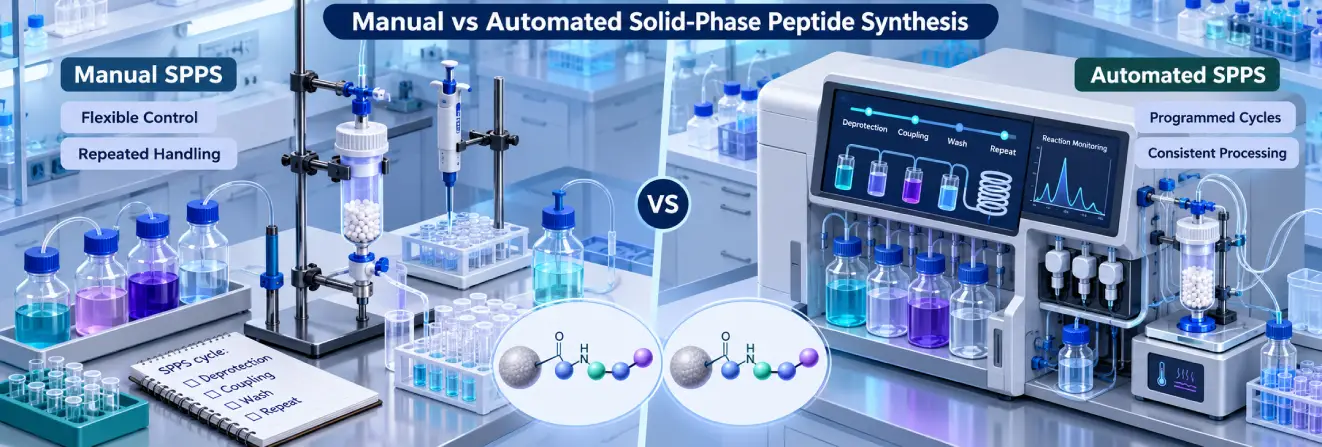
SPPS may use manual vessels, automated batch synthesisers, microwave-assisted heating or continuous-flow equipment. These are process configurations rather than fundamentally different peptide-bond chemistry.
Manual SPPS in Research Laboratories
Manual solid-phase peptide synthesis can provide flexible experimental control and, in parallel configurations, support the production of multiple defined peptide sequences. However, repeated liquid handling is labour-intensive, and consistent results require careful control of each stage.
Automated Peptide Synthesisers
An automated solid-phase peptide synthesiser performs programmed dispensing, mixing, washing and, in some systems, heating and reaction monitoring. Automation reduces routine handling and can improve consistency.
It cannot independently overcome difficult sequence chemistry or replace final analytical testing. Instrument settings can standardise operations, yet a sequence that consistently aggregates or reacts incompletely may still require a different support, a revised chemistry or an alternative assembly strategy.
Microwave-Assisted Peptide Synthesis
Microwave-assisted systems heat reaction mixtures to accelerate suitable coupling or deprotection stages. A 2023 comparative study involving two sequences found that manual, microwave-assisted and parallel tea-bag protocols differed in speed, yield and purity.
Outcomes depended on the particular sequence and conditions; faster cycles did not always mean the highest yield.
Continuous-Flow Solid-Phase Peptide Synthesis
In flow systems, reagents pass through a vessel or column containing resin-bound peptide. Flow rate and temperature can be controlled, potentially improving processing efficiency. A 2025 review in the Australian Journal of Chemistry highlighted advances alongside support-compatibility issues: some conventional resins swell or change volume in ways unsuitable for high-pressure flow.
| Approach | Potential strength | Main limitation |
| Manual batch | Flexible experimental adjustment | Intensive handling |
| Automated batch | Consistent repetitive operations | Equipment cost and chemistry constraints |
| Microwave-assisted | Faster suitable reactions | Heat-related side reactions |
| Continuous flow | Controlled reagent delivery | Resin and pressure compatibility |
Microwave-assisted and continuous-flow technologies may themselves be automated, so these categories overlap.
What Challenges Affect Solid-Phase Peptide Synthesis?
Incomplete reactions, aggregation and side chemistry can reduce the proportion of the desired sequence. Their effects often grow more significant as peptide length and complexity increase.
Incomplete Coupling and Deletion Sequences
If incomplete coupling occurs on some resin-bound chains, later reactions may extend those chains without the missed residue.
The resulting deletion sequences can closely resemble the target peptide and be difficult to separate. Capping unreacted amino groups may prevent subsequent elongation but creates terminated fragments instead.
Peptide Aggregation and Difficult Sequences
Hydrophobic interactions and hydrogen bonding can cause neighbouring resin-bound chains to associate. This limits access to reactive sites and interferes with coupling.
Alternative supports, modified chemistry and backbone-protecting groups have been investigated, but effectiveness depends on the specific sequence.
Side Reactions During SPPS
Epimerisation changes stereochemistry at a chiral centre. Aspartimide formation, particularly in susceptible aspartic-acid-containing sequences, can produce rearranged or stereochemically altered products. Oxidation and incomplete protecting-group removal present additional risks.
A 2025 scientific review examined protecting-group and deprotection strategies intended to reduce aspartimide-related impurities.
Why Longer Peptides Are More Difficult to Synthesise
Small conversion losses accumulate over repeated cycles; a 15-residue peptide such as BPC-157 requires more coupling stages than a tripeptide.
If 40 consecutive couplings each reached 99% conversion, their idealised cumulative conversion would be approximately 67%, before cleavage, purification or other losses.
Actual outcomes vary with each residue and reaction. Long sequences may also aggregate or produce complex impurity mixtures. Fragment condensation and chemical ligation provide alternatives when uninterrupted SPPS becomes difficult.
How Are SPPS Peptides Purified and Analysed?
Synthesis produces a molecular mixture unless reactions and isolation are effectively selective. Analytical methods therefore establish identity and composition rather than merely confirming that material was recovered.
Crude Peptide vs Purified Peptide
Crude peptide can contain the desired sequence, deletion products and other synthesis-related impurities. Purification enriches the target component but does not by itself establish a specific purity level or confirm identity.
The selected analytical methods determine what can reasonably be concluded about a sample. When interpreting a laboratory certificate of analysis, the reported test, acceptance criteria and sample identity should therefore be considered together. A single chromatogram is not a complete structural characterisation.
High-Performance Liquid Chromatography (HPLC)
RP-HPLC separates peptides according to their differing interactions with stationary and mobile phases. Analytical HPLC helps assess sample composition; preparative HPLC can collect separated fractions.
Peak-area purity depends on detection conditions and does not necessarily equal peptide content by mass, particularly if components co-elute or respond differently to the detector.
Mass Spectrometry and Molecular Identity
Electrospray ionisation (ESI-MS) and matrix-assisted laser desorption/ionisation time-of-flight (MALDI-TOF-MS) methods can compare observed mass with the expected peptide mass.
Tandem MS may provide additional sequence evidence. A mass match alone cannot distinguish every positional or stereochemical variant; for copper-binding complexes such as GHK-Cu, additional evidence may be needed to assess metal coordination.
Orthogonal methods can strengthen identification by providing evidence about different molecular properties. Results should therefore be reported with the analytical technique, its resolution and any relevant limitations.
Understanding Peptide Purity and Yield
| Measurement | Meaning | Caution |
| Chromatographic purity | Relative target signal under a specified method | Not necessarily mass percentage |
| Peptide content | Amount of peptide substance in a sample | Water and counterions contribute to sample mass |
| Synthesis yield | Recovered amount relative to a defined basis | Depends on calculation and processing stages |
A peptide can show high HPLC purity but lower content by mass. Likewise, a large crude yield does not guarantee substantial recovery of purified target peptide.
Purity reports should also identify the analytical method and the basis of the reported percentage. Since some impurities share similar retention or mass characteristics, combining independent analytical measurements can provide stronger evidence than a single test. The necessary level of confirmation depends on the intended laboratory investigation.
Solid-Phase vs Liquid-Phase Peptide Synthesis
Solid-phase peptide synthesis keeps the growing chain resin-bound, whereas conventional liquid-phase peptide synthesis (LPPS) handles intermediates in solution. Both are established peptide synthesis methods, and the choice depends on sequence, scale and process requirements.
Key Differences Between SPPS and LPPS
SPPS simplifies intermediate washing and is compatible with iterative automation. LPPS may involve extraction, precipitation or chromatography between reactions but can offer advantages for selected shorter peptides or isolated fragments.
Neither method is universally superior in reagent efficiency or scalability. Solid-phase workflows trade convenient intermediate washing for the cost of supports and frequent reagent excess, whereas liquid-phase routes may make isolation of individual intermediates a greater part of the overall process.
| Feature | SPPS | LPPS |
| Growing chain | Resin-bound | In solution |
| Intermediate processing | Washing and filtration | Often isolation or separation |
| Typical strengths | Iterative assembly, automation | Certain short peptides and fragments |
| Challenges | Aggregation and solvent consumption | Solubility and intermediate handling |
When Are Hybrid Peptide Synthesis Methods Used?
Hybrid routes can combine SPPS-made fragments with solution-phase coupling or chemical ligation. Classical native chemical ligation joins a peptide thioester with a fragment bearing an N-terminal cysteine; expanded strategies enable other junctions. These approaches are useful for more complex or longer polypeptides that are difficult to assemble through uninterrupted SPPS.
Fragment strategies also create new analytical checkpoints, since the identity and purity of each component can be evaluated before the final joining reaction. However, selecting fragment boundaries and ensuring suitable chemical compatibility remain important design constraints.
Applications of Solid-Phase Peptide Synthesis in Research
The principal research value of SPPS is access to defined research peptides whose sequences can be modified systematically and characterised experimentally.
Peptide Libraries and Structure-Activity Research
Libraries of related sequences help investigate how substitutions, residue order or modifications alter molecular behaviour. Parallel synthesis supports screening experiments, epitope mapping and studies of sequence-function relationships, provided individual materials are adequately characterised.
Learn more about peptide research at Australia Peptide Sciences.
Molecular Recognition and Protein Interaction Studies
Synthetic peptide fragments can be used to investigate protein-peptide recognition and identify sequence features associated with binding.
Experimental approaches may combine biochemical measurements, spectroscopy and molecular modelling. Controlled residue substitutions help assess the influence of charge, hydrophobicity or side-chain chemistry.
Peptide Biomaterials and Structural Research
Defined peptides are used to investigate self-assembly into nanofibres, hydrogel networks and other supramolecular structures. Comparing sequences allows researchers to study how residue arrangement and interactions affect material structure and behaviour under laboratory conditions.
Analytical Standards and Laboratory Assays
Characterised peptides can serve as reference substances and controls in mass spectrometry, enzyme assays and analytical method development. Their suitability depends on established identity, composition and purity; impurities or incorrect concentration assignments can distort quantitative findings.
A characterised reference material helps researchers interpret measurement variability, but the analytical method must still be validated for its particular matrix and concentration range.
Explore our research peptide shop for compounds intended exclusively for laboratory research.
Recent Advances in Solid-Phase Peptide Synthesis
New research aims to reduce solvent use, improve reagent delivery and develop solid supports compatible with alternative processes. Improvements must be evaluated against chemical performance, waste generation and energy demand together.
Greener Solvents and Reduced Chemical Waste
Conventional Fmoc SPPS frequently uses N,N-dimethylformamide (DMF) and excess reagents, generating substantial waste. A 2026 Green Chemistry study investigated a macroporous polystyrene support and alternative solvent mixtures. Under the tested process conditions, solvent recovery by distillation reduced reported process mass intensity from 3,206 to 1,137.
These figures are specific to the evaluated system, not a general reduction achievable in every peptide synthesis.
Water-Based Solid-Phase Peptide Synthesis
Water-based chemistry is challenging because many conventionally protected amino acids dissolve poorly in water. A February 2026 Nature Sustainability study reported an aqueous approach using water-soluble Fmoc-amino acid salts and a hydrophilic poly-ε-lysine-based support.
The work demonstrated feasibility under investigated conditions but did not establish compatibility with every sequence or protecting-group system.
Improved Heating, Flow Systems and Automation
Controlled heating, online monitoring and new flow technologies offer opportunities for faster or more reproducible synthesis.
Their benefits depend on the sequence and equipment, and performance claims should be assessed using yield, impurity profile and material consumption rather than reaction time alone.
Remaining Challenges in Sustainable SPPS
Environmental assessment must account for solvents, reagents, resin manufacture and disposal, heating, solvent recovery and purification.
A replacement solvent may reduce one burden while increasing another. Process mass intensity and other clearly defined measures help compare methods without assuming that newer chemistry is necessarily greener.
Advantages and Limitations of Solid-Phase Peptide Synthesis
SPPS offers sequence control, straightforward removal of soluble reaction materials, compatibility with automation and flexibility for modified residues or specialised linkers. It supports peptide libraries, interaction studies and analytical research without requiring isolation after every chain-extension step.
Its limitations include cumulative conversion losses, aggregation, side reactions, considerable solvent or reagent consumption and post-synthesis purification requirements. Resin behaviour, mixing and heat transfer can also complicate process scale-up. The balance of benefits depends on the target sequence and the quality criteria of the research project.
The Role and Future of Solid-Phase Peptide Synthesis
Solid-phase peptide synthesis assembles defined peptides through repeated deprotection and coupling reactions on an insoluble support. Fmoc chemistry, selectable resins and automated equipment make it a versatile laboratory technique, but incomplete conversion and related impurities still demand careful analysis.
Recent aqueous, continuous-flow and solvent-recycling approaches show how SPPS may become more efficient and sustainable; their broader usefulness depends on sequence-specific evidence and full-process evaluation.
FAQs About Solid Phase Peptide Synthesis
What Does SPPS Stand for in Peptide Synthesis?
SPPS means solid-phase peptide synthesis. It joins protected amino acids sequentially while the growing peptide remains attached to an insoluble resin, enabling repeated washing and controlled chain extension.
Why Is Solid-Phase Peptide Synthesis Used?
It supports reproducible preparation of defined peptide sequences and simplifies removal of soluble reagents. Applications include peptide libraries, molecular interaction experiments and preparation of analytical reference materials.
What Is the Difference Between Fmoc and Boc Peptide Synthesis?
Fmoc is generally removed under basic conditions, whereas Boc is removed under acidic conditions. Each temporary protection strategy requires compatible side-chain protection and cleavage chemistry.
Why Is a Resin Used in Solid-Phase Peptide Synthesis?
The resin retains the growing chain while soluble reagents are washed away. Its linker also influences how the completed peptide is released and which C-terminal group it contains.
In Which Direction Are Peptides Synthesised During SPPS?
Conventional SPPS builds peptides from the C-terminus towards the N-terminus, adding incoming residues to the amino end of the growing resin-bound chain.
Can Solid-Phase Peptide Synthesis Produce Long Peptides?
Yes, but longer sequences often present greater aggregation and cumulative reaction losses. Researchers may assemble shorter fragments and join them through condensation or chemical ligation.
Does Solid-Phase Peptide Synthesis Require Purification?
Often, particularly when defined purity is important. Washing removes soluble reaction materials but not every peptide-related impurity. Chromatography and other analyses help assess the released material.
Is Solid-Phase Peptide Synthesis Environmentally Friendly?
Conventional SPPS can consume substantial solvents and reagents. Research into alternative supports, aqueous chemistry and solvent recycling may reduce some impacts, but the full process must be evaluated.