
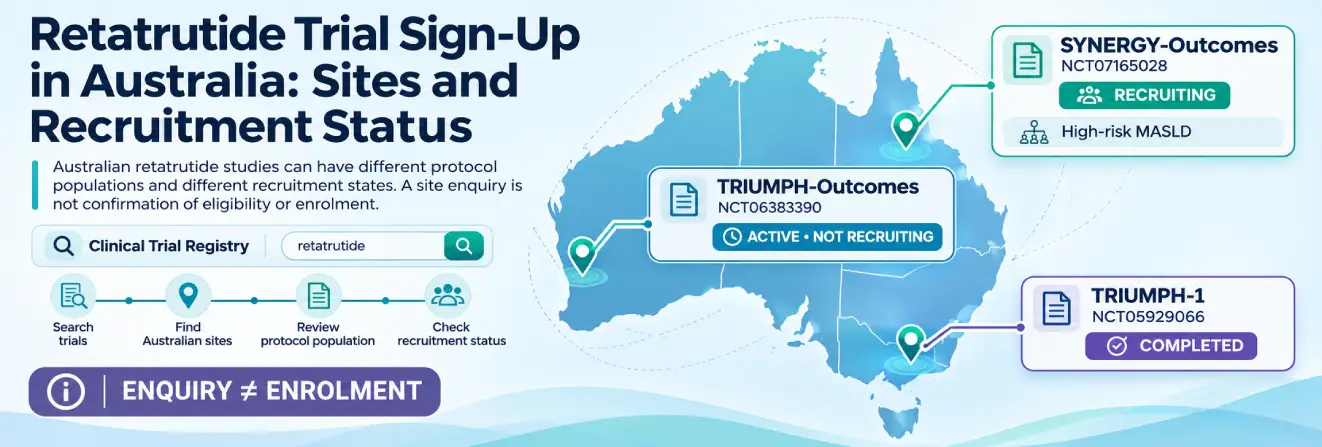
Retatrutide trial sign-up in Australia depends on the study and site. On 20 November 2026, Gallipoli Medical Research at Greenslopes listed SYNERGY-Outcomes as recruiting.
This Phase 3 study is for adults with high-risk metabolic dysfunction-associated steatotic liver disease (MASLD). It is not a general weight-loss trial, and an enquiry is not confirmation of enrolment.
A separate study, TRIUMPH-Outcomes, has Australian sites but is active and no longer recruiting. TRIUMPH-1, a completed obesity study with Australian sites, has published Phase 3 results. These studies all involve the investigational peptide retatrutide (LY3437943), but they investigate different conditions and measure different outcomes. The name of a study and its registration number identify which protocol, population and recruitment status a listing refers to.
Which Retatrutide Trials Are Recruiting in Australia?
SYNERGY-Outcomes and High-Risk MASLD
The Australian Government’s clinical trials portal listed SYNERGY-Outcomes (NCT07165028) as recruiting overall on 20 November 2026. Gallipoli Medical Research also lists the study as recruiting at Greenslopes Private Hospital in Queensland. The study uses a master protocol, a shared framework that sets out how several interventions or comparisons are studied. The registered study includes retatrutide, tirzepatide and placebo groups.
For background on the compound being investigated, see what Reta peptide is and how it works.
MASLD involves a build-up of fat in the liver in association with cardiometabolic risk. The study focuses on adults whose test results indicate an increased risk of serious liver complications. Its primary endpoint is the time until the first event in a defined group of major adverse liver outcomes. The group includes events such as progression to cirrhosis, certain complications of advanced liver disease and liver transplantation. This is a different question from whether liver fat or body weight changes during a study.
This comparison of retatrutide and tirzepatide explains how the receptor targets of the two study compounds differ.
TRIUMPH Studies That Are No Longer Enrolling
TRIUMPH-Outcomes (NCT06383390) is a Phase 3 study of cardiovascular and kidney outcomes in adults with an elevated body mass index and established atherosclerotic cardiovascular disease, chronic kidney disease or both. The ClinicalTrials.gov record for TRIUMPH-Outcomes lists the study as active, not recruiting. The study continues to collect information but is not accepting new participants. A listing that uses the word “enrolling” for the same NCT number conflicts with that registry status and does not establish a current Australian opening.
Learn more about Australia Peptide Sciences and its focus on peptides for laboratory research.
TRIUMPH-1 (NCT05929066) is listed as completed. It evaluated retatrutide in adults with obesity or overweight without diabetes and assessed specific outcomes in groups with knee osteoarthritis or obstructive sleep apnoea. Its Australian locations document where the research took place. A hospital name in the completed record does not make it a current enrolment site.
The retatrutide peptide is listed for non-clinical laboratory research and is separate from the investigational material supplied in the trials described above.
Selected Phase 3 retatrutide studies with Australian sites
| Study and registry ID | Population and research question | Overall registry status |
| SYNERGY-Outcomes NCT07165028 |
High-risk MASLD. Time to major adverse liver outcomes. | Recruiting |
| TRIUMPH-Outcomes NCT06383390 |
Established cardiovascular disease, chronic kidney disease or both. Major cardiovascular and kidney events. | Active, not recruiting |
| TRIUMPH-1 NCT05929066 |
Obesity or overweight without diabetes. Weight change, with knee pain and sleep apnoea measures in defined groups. | Completed |
Source: ANZCTR records checked on 20 November 2026. The statuses refer to the overall studies. See the ClinicalTrials.gov record for TRIUMPH-Outcomes for the cardiovascular and kidney study.
Where Are the Australian Retatrutide Trial Sites?
SYNERGY-Outcomes Locations by State
The Australian New Zealand Clinical Trials Registry (ANZCTR) lists facilities across five states. Gallipoli Medical Research publishes a separate, study-specific recruitment notice. The other locations below are identified in the registry, but their individual screening status is not confirmed here. A facility can appear in the study record even when its screening capacity or local recruitment status is not shown.
Australian sites listed for SYNERGY-Outcomes
| State | Facility and location | Local status |
| Queensland | Gallipoli Medical Research at Greenslopes Private Hospital (Greenslopes) | Recruiting on the site’s own listing |
| Queensland | Royal Brisbane and Women’s Hospital, Core Research Group and Mater Misericordiae (Brisbane), Ipswich Hospital (Ipswich), and Gold Coast University Hospital (Southport) | Listed, local status not confirmed |
| New South Wales | Genesis Research Services (Broadmeadow) and Westmead Hospital (Westmead) | Listed, local status not confirmed |
| South Australia | Nightingale Research and Flinders Medical Centre (Adelaide area) | Listed, local status not confirmed |
| Victoria | Box Hill Hospital (Box Hill), Barwon Health (Geelong), Austin Health (Heidelberg) and The Royal Melbourne Hospital (Parkville) | Listed, local status not confirmed |
| Western Australia | Fiona Stanley Hospital (Murdoch) and TrialsWest (Osborne Park) | Listed, local status not confirmed |
Sources: ANZCTR record NCT07165028 and the Gallipoli Medical Research study notice. See the Australian Clinical Trials listing for the overall study status. Records checked 20 November 2026.
What a Recruitment Label Can and Cannot Confirm
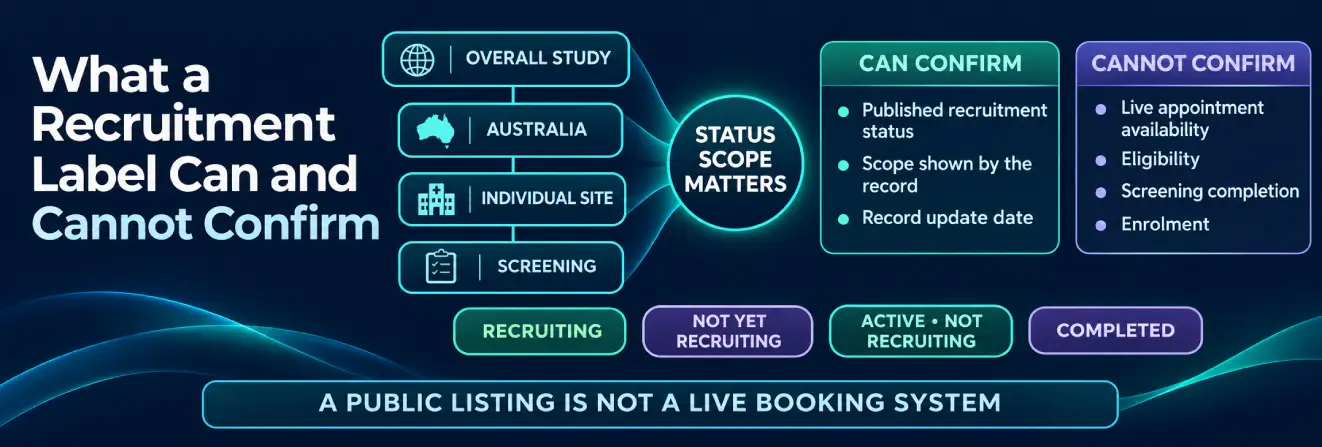
The overall recruitment label covers the entire study. In an international trial, recruiting can mean that a facility in another country is open even if an Australian site has not begun screening. An individual site label is more specific, but public records are not live booking systems. A recruiting label does not show how many screening appointments are available or whether the site is taking enquiries for every part of the protocol.
- Recruiting means the study or site is seeking new participants, depending on where the label appears.
- Not yet recruiting means enrolment has not started at the level described by the record.
- Active, not recruiting means the study is continuing for participants already enrolled, without taking new ones.
- Completed means the study has ended. It does not say whether results are available in the registry or a journal.
The date a record was updated and the date its status was checked are different. ANZCTR also imports some international study records from ClinicalTrials.gov, so the same NCT number in both databases does not necessarily represent two independent reports. A dated notice from the individual Australian facility provides a separate check on local status.
This short video explains what clinical trials are and how they contribute to medical research in Australia.
How Retatrutide Trial Enrolment Works in Australia
Finding the Study Record and Local Contact
A retatrutide trial listing can usually be located by the compound name, the development code LY3437943 or the NCT number. The NCT number is the most precise identifier when the same compound appears in studies with similar names. For example, NCT07165028 identifies the liver outcomes study, while NCT06383390 identifies the cardiovascular and kidney outcomes study.
Australian Clinical Trials and ANZCTR can be used to identify registered studies with Australian locations. The original ClinicalTrials.gov entry provides a Contacts and Locations section where details are available. A study-specific notice from a participating facility can clarify whether that site is recruiting and how it handles enquiries. Public records do not always include a direct site contact, particularly when enrolment is closed.
A general research expression-of-interest form is different from a notice for a named protocol. The general form may record an interest in future research, while a study-specific enquiry concerns a particular trial at a particular site. Neither confirms a screening appointment, eligibility or acceptance into the study.
Why Eligibility Is Specific to Each Protocol
Eligibility varies by trial. A diagnosis or body mass index alone does not establish whether someone meets a study’s inclusion and exclusion criteria.
Screening for SYNERGY-Outcomes includes three measures that assess different aspects of liver disease.
- Magnetic resonance imaging (MRI) measures liver fat.
- The Enhanced Liver Fibrosis (ELF) blood test measures markers associated with liver scarring.
- Vibration-controlled transient elastography estimates liver stiffness.
The study team reviews these results alongside the protocol’s other eligibility criteria.
Informed consent is a separate step. Australian Clinical Trials’ guidance on informed consent explains that the consent form sets out the study’s purpose, procedures, risks and expected duration. Consent is required before study-specific procedures begin, but signing the form does not confirm enrolment.
Randomisation, Study Visits and Follow-Up
Randomisation assigns enrolled participants to a study group by chance. A placebo group helps researchers distinguish the effects of the investigational intervention from changes that also occur without it. Some protocols include an active comparator or more than one comparison. In SYNERGY-Outcomes, the registered groups include retatrutide, tirzepatide and placebo. Enrolment therefore does not guarantee assignment to retatrutide.
The study record describes a main study period of approximately 224 weeks, with about 25 to 30 clinic visits planned. These are protocol estimates for SYNERGY-Outcomes, not standard requirements for retatrutide trials. Follow-up gives researchers time to record outcomes that may take years to occur. Visit schedules, allowances and travel reimbursement are study-specific. Participation is voluntary, and the consent information explains what withdrawal means for any data already collected.
What Phase 3 Retatrutide Research Can Establish
What Triple Receptor Agonism Means
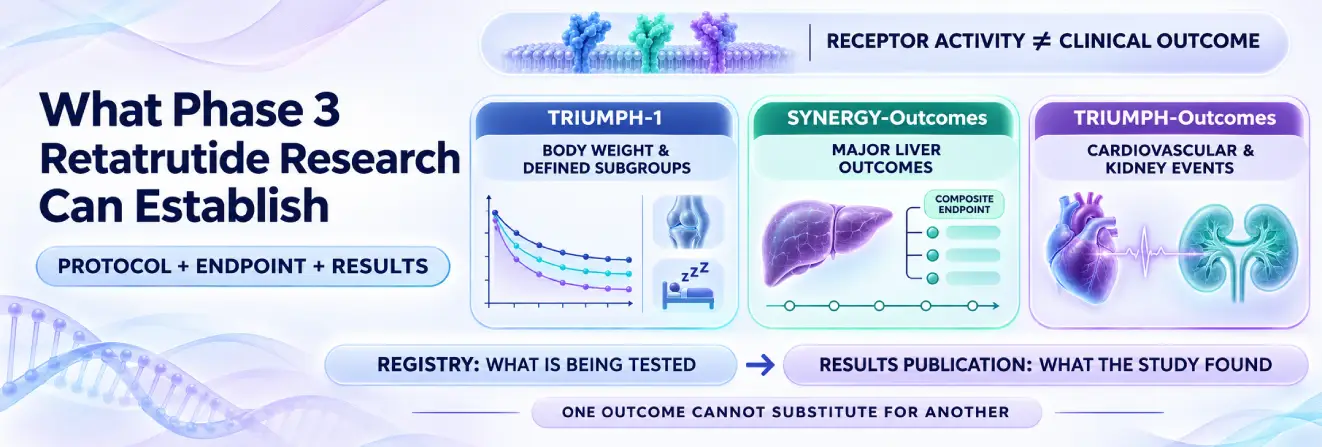
Retatrutide is a single investigational peptide that activates three hormone receptors. These are the receptors for glucose-dependent insulinotropic polypeptide (GIP), glucagon-like peptide-1 (GLP-1) and glucagon. An agonist activates a receptor and produces a measurable signal. The three receptors participate in overlapping aspects of metabolism, including glucose regulation, energy balance and nutrient handling.
For more detail on the molecular mechanism, see why retatrutide is called a triple agonist.
The original discovery work by Coskun and colleagues in Cell Metabolism characterised activity at the three receptors in experimental systems. Receptor assays can show that a molecule activates a target under defined conditions. They cannot establish how much each receptor contributes to a clinical outcome or whether the compound changes the frequency of serious disease events. Those questions require different study designs and measurements.
Peptides for Laboratory Research
The GLP-1 Peptides category groups laboratory materials relevant to GLP-1 and metabolic signalling research.
The tirzepatide peptide has a different receptor profile from retatrutide, with activity at GIP and GLP-1 receptors.
The mazdutide peptide provides another point of comparison in receptor research because it targets GLP-1 and glucagon receptors.
Published Weight and Subgroup Findings From TRIUMPH-1
The 2026 TRIUMPH-1 paper in The New England Journal of Medicine reported results from 2,339 randomised participants. At 80 weeks, average body weight had fallen by 23.7% and 25.0% in the two retatrutide groups used for the primary comparisons, versus 3.9% in the placebo group. These are group averages, not predictions for individuals. Gastrointestinal events were the most commonly reported adverse events.
For a closer look at how the trial measured weight change and why the reported percentages differ by analysis, see our breakdown of the Retatrutide Phase 3 results from TRIUMPH.
The main weight analysis compared participants in their originally assigned groups and accounted for events such as stopping the study intervention. This answers a different question from an analysis that assumes participants continued their assigned intervention.
The study also measured two outcomes in specific subgroups.
- Knee osteoarthritis - knee pain scores.
- Obstructive sleep apnoea - breathing pauses and episodes of reduced airflow per hour of sleep.
These findings apply to the subgroups studied and do not establish the same effects in people who did not meet the subgroup criteria.
Browse the research peptide shop for laboratory-use product listings and specifications.
Why Liver, Heart and Kidney Endpoints Need Separate Trials
Liver imaging can show whether liver fat has decreased. It cannot, on its own, establish whether fewer participants develop cirrhosis or need a liver transplant.
SYNERGY-Outcomes uses a composite endpoint that counts the first occurrence of any event in a prespecified set of major liver outcomes. Combining events helps researchers evaluate serious outcomes that may be individually uncommon. The contribution of each event still matters when interpreting the results. A difference in the combined endpoint could be driven mainly by the more common events. It would not, by itself, show that the intervention changed every component in the same way.
TRIUMPH-Outcomes also uses defined event measures, but for cardiovascular and kidney disease. Its registry lists outcomes such as non-fatal heart attack or stroke in the cardiovascular assessment and sustained loss of kidney function in the kidney assessment. A change in body weight cannot answer either event question on its own. The trial record describes what the study is designed to test. Its findings can be assessed once results are posted in the registry or reported in a publication.
Retatrutide’s Regulatory Status in Australia
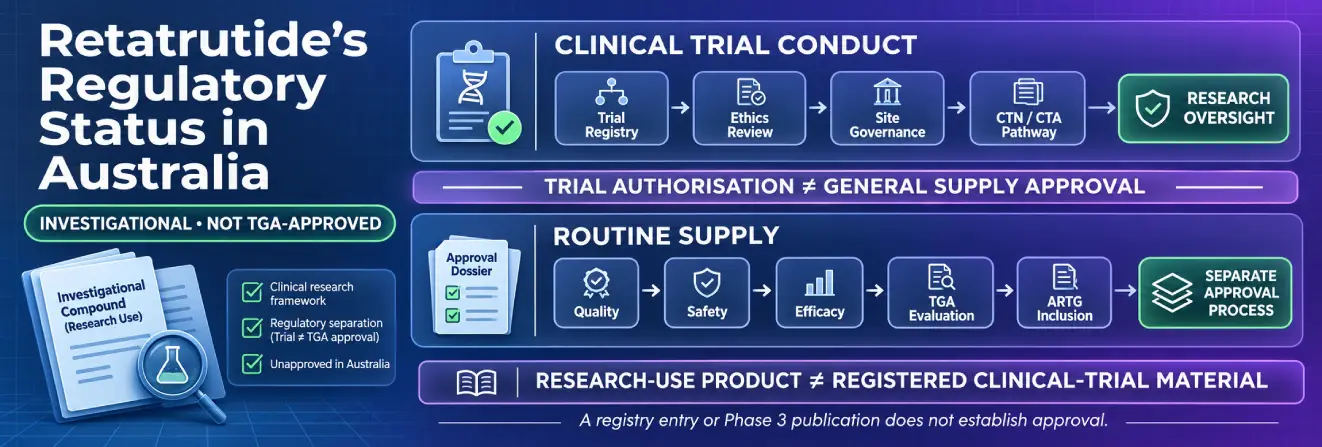
The Therapeutic Goods Administration (TGA) has identified retatrutide as an unapproved investigational compound. A trial can be registered and conducted under Australian research oversight without the study compound being approved for routine supply. Registration records the study and its procedures. Ethics review, site governance and the applicable TGA pathway address whether and how the trial may be conducted. Approval and inclusion in the Australian Register of Therapeutic Goods are separate from those steps.
The TGA’s Australian clinical trial handbook explains the Clinical Trial Notification (CTN) and Clinical Trial Approval (CTA) schemes for trials involving unapproved therapeutic goods. Neither a trial registry entry nor a published Phase 3 paper by itself establishes approval for general supply. The same distinction applies to an estimated trial completion date, which is not a forecast of regulatory approval.
A retail product labelled “research use only” is not material supplied under a registered clinical trial and has no bearing on enrolment. The TGA’s November 2026 laboratory testing update reported that the products it tested contained less retatrutide than stated on their labels, with the amount varying between samples. That finding concerns the products tested and does not describe the material used in a registered trial. The two are not interchangeable.
What Australian Trial Listings Can Tell You
Australian records show that SYNERGY-Outcomes is recruiting for a specific liver disease population, with recruitment publicly listed at Greenslopes. They also show that TRIUMPH-Outcomes is ongoing without new enrolment, while TRIUMPH-1 is complete. The trial name alone cannot tell these statuses apart.
The NCT number identifies the protocol. The overall status describes the study, the local notice describes the Australian site, and the study team determines eligibility. Keeping those distinctions clear is more useful than any single “sign up” label.
FAQs About Retatrutide Trial Sign-Up in Australia
Can I sign up for a retatrutide trial in Australia now?
As of 20 November 2026, Gallipoli Medical Research at Greenslopes listed SYNERGY-Outcomes (NCT07165028) as recruiting. It is for adults with high-risk MASLD who meet the protocol criteria. The listing confirms recruitment at that site, not a guaranteed place or an opening in a general weight-loss trial.
Is TRIUMPH-Outcomes still recruiting in Australia?
No. The ANZCTR record for TRIUMPH-Outcomes (NCT06383390) lists it as active, not recruiting. Australian locations remain in the record because they are study sites. Their presence does not indicate new enrolment.
Is a GP referral required to enquire about a trial?
Not always. Some sites accept direct enquiries and others use a referral pathway or request relevant records during screening. The site’s study-specific notice describes its process when that information is publicly available.
Does an expression of interest mean I am enrolled?
No. An expression of interest is an initial enquiry. Informed consent, screening against the protocol and confirmation by the study team are separate steps. An online form does not establish eligibility or reserve a place.
Will everyone who joins receive retatrutide?
No. Assignment depends on the study design. In SYNERGY-Outcomes, participants may be assigned to a group involving retatrutide, tirzepatide or placebo. The study is designed to compare outcomes between groups.
What does active, not recruiting mean?
It means the trial continues for people already enrolled, but new participants are not being recruited. Follow-up visits and data collection can continue after the study has closed to enrolment.
What can make someone ineligible for a retatrutide trial?
Exclusion criteria depend on the study protocol. For example, SYNERGY-Outcomes excludes people with type 1 diabetes or a form of liver disease other than MASLD. These rules apply to that study and should not be assumed to apply to every retatrutide trial. The research team assesses eligibility against the full protocol during screening.
Can a GP routinely prescribe retatrutide in Australia?
No. Retatrutide remains investigational and is not approved by the Therapeutic Goods Administration for routine prescribing in Australia. A registered clinical trial operates under a research protocol, which is separate from prescribing an approved medicine in routine practice.
What adverse events were reported in TRIUMPH-1?
Gastrointestinal events, including nausea and diarrhoea, were among the most frequently reported. The study also recorded dysaesthesia, a change in skin sensation that can include burning or unusual sensitivity. These findings describe what was observed in the trial. They do not establish retatrutide’s full long-term safety profile.
Are clinical trial participants reimbursed in Australia?
Sometimes. A study may reimburse out-of-pocket expenses such as travel or parking, and some studies may also offer payment for time or inconvenience. Neither is automatic. The study’s participant information and consent form is the place to check what the trial covers, if anything.