
Benzyl alcohol is the antimicrobial preservative in many bacteriostatic water formulations. In peptide research, its effects on sample stability and assay results depend on the formulation and method.
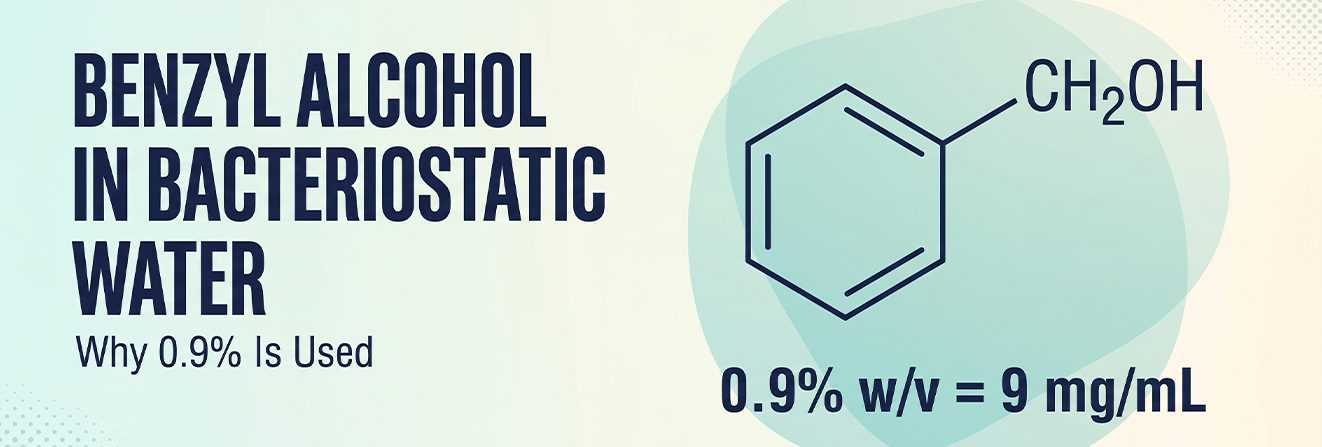
A label that states 0.9% w/v indicates 9 mg of preservative per millilitre of finished solution. The product label, batch report and peptide-specific data each answer a different question about the diluent.
Quick Answer
Bacteriostatic water commonly contains 0.9% benzyl alcohol by weight per volume, equivalent to 9 mg/mL. This concentration helps inhibit the growth of susceptible bacteria that may enter a multidose vial during repeated access. Check the product label for its exact strength.
What Is Benzyl Alcohol?
Benzyl alcohol, also called phenylmethanol, is an aromatic alcohol with the formula C₆H₅CH₂OH. The PubChem record also lists uses in solvents and fragrances.
In bacteriostatic water, the benzyl alcohol preservative is an excipient with an antimicrobial function, as described on the Hospira product label.
The molecular formula identifies the elements in the compound. The structural formula shows where they sit. Here, the hydroxyl group is attached to the side chain beside the aromatic ring. In phenol, the hydroxyl group attaches directly to the ring.
For a research record, a chemical identifier can resolve ambiguity when suppliers use different names. PubChem lists CAS 100-51-6 for phenylmethanol. The identifier establishes the ingredient’s identity. The product label establishes the concentration and grade described for that particular formulation.
Why Is 0.9% Benzyl Alcohol Used in Bacteriostatic Water?
1. What Does 0.9% w/v Mean on the Label?
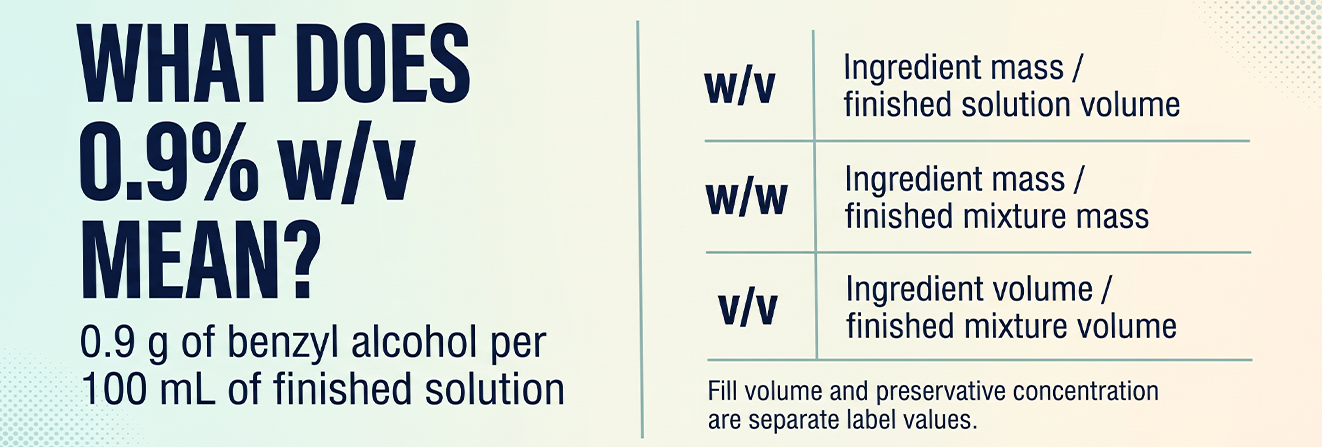
In the reference formulation, 0.9% w/v means 0.9 grams of benzyl alcohol per 100 mL of finished solution.
2. How to read the units
- w/v expresses the mass of an ingredient in a given volume of finished solution.
- w/w expresses the mass of an ingredient relative to the mass of the finished mixture.
- v/v expresses the volume of an ingredient relative to the volume of the finished mixture.
The denominator matters when comparing reports. A value written as a percentage needs its concentration basis before it can be compared with a value in mg/mL. If a label provides both units, use the stated mass concentration to confirm the interpretation.
A separate number may describe the fill volume. Vial size and preservative strength report different properties. A smaller fill can have a higher concentration, so the volume printed on the container cannot identify the strength by itself.
Why Multidose Formulations Include a Preservative
Repeated vial access can introduce microorganisms. The preservative helps inhibit their growth. USP General Chapter 〈51〉 describes how antimicrobial effectiveness is assessed in multidose formulations.
The stated benzyl alcohol concentration is one part of the formulation. A review of formulation preservatives describes how other ingredients and container materials can affect preservative performance.
What an effectiveness result covers
- Formulation: the finished composition as tested, including relevant excipients.
- Organisms: the microorganisms included in the assessment.
- Time: the measurement points over which microbial control was evaluated.
Read the result alongside those details. Evidence from one finished formulation applies to the product as tested. When a different container or composition is involved, product-specific evidence gives a better basis for judging performance than the concentration on the label alone.
The container matters because its closure and other surfaces are in direct contact with the solution. The formulation review describes cases where preservatives interacted with packaging materials. Those observations explain why a study of one vial system should identify the packaging it evaluated.
Browse our Australian peptide catalogue for research use only
Is 0.9% a Universal Requirement?
The U.S. Hospira label lists two strengths. Both are described as containing benzyl alcohol for the same preservative purpose.
| Strength on the label | Preservative per 100 mL | Preservative per mL |
| 0.9% w/v | 0.9 g | 9 mg |
| 1.1% w/v | 1.1 g | 11 mg |
What Does 0.9% Benzyl Alcohol Mean in Bacteriostatic Water?
The Hospira product label lists two strengths, 9 mg/mL and 11 mg/mL, for the same preservative purpose. To compare antimicrobial performance, use effectiveness results from the finished formulations tested under comparable conditions.
The difference between the two strengths is 2 mg/mL of preservative. That calculation describes chemical content. To compare antimicrobial performance, look for effectiveness results obtained under comparable conditions. The label alone supplies the concentration needed for the arithmetic.
This video uses two worked examples to explain mass-volume percentage, the same calculation behind the 0.9% w/v shown on a bacteriostatic water label.
Bacteriostatic Water Ingredients and Label Claims
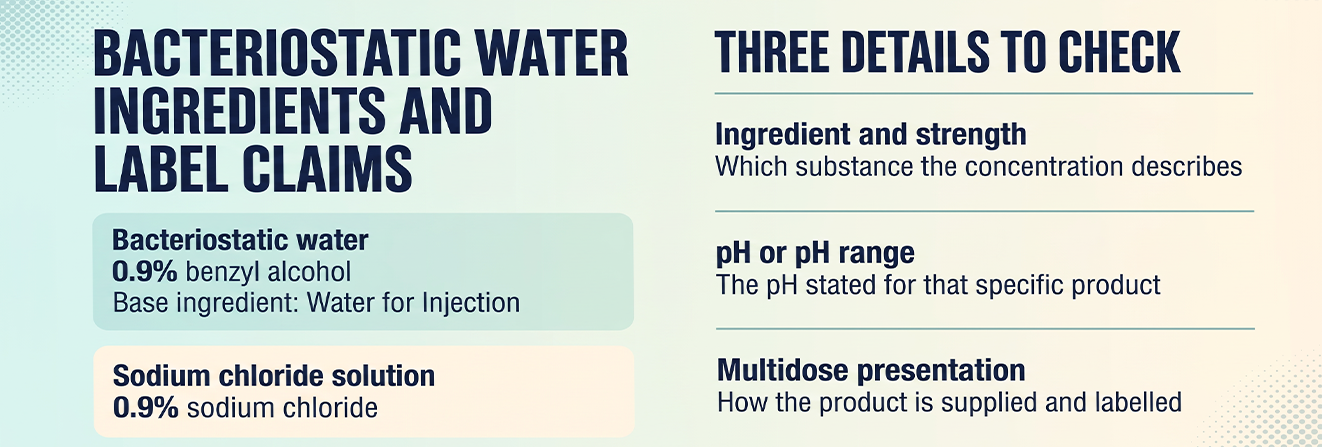
The bacteriostatic water ingredients in the reference formulation are Water for Injection and benzyl alcohol. On a 0.9% sodium chloride label, the percentage refers to the salt.
The APS guide to bacteriostatic water for peptide research explains how formulation and packaging details are documented.
Browse peptide reconstitution solutions for product information and check the label for the formulation you are assessing.
Three details that appear together on a label
| Label detail | What it tells the reader |
| Ingredient and strength | Which substance the concentration describes. |
| pH or pH range | The stated acidity range for that specific product. |
| Multidose presentation | How the container is supplied and labelled. |
For example, the Hospira description lists a pH range of 4.5 to 7.0. Treat that as a specification for the named product. The pH of a final research sample may depend on the buffer and other components present in that sample.
A U.S. pharmaceutical label provides a reference for the formulation it describes. For a separately supplied research material, use the manufacturer’s product documentation and the relevant batch record to establish which claims apply.
Use the supplier’s label for APS bacteriostatic water for research. A laboratory-grade acetic acid solution has a different composition and should be recorded as a separate sample matrix.
For a laboratory report, wording such as “preserved aqueous diluent containing benzyl alcohol” identifies the sample matrix. Record:
- The product name and lot.
- The preservative concentration and units.
- The final sample composition, if it differs from the diluent.
Precise records help when two laboratories use the same analytical method and source their diluents separately. If both reports say only “water”, a difference in formulation can be missed. Recording the preservative and the final matrix gives readers a way to assess whether that difference could affect the comparison.
How Does Benzyl Alcohol Inhibit Bacterial Growth?
1. Effects on Bacterial Membranes
In an experimental study of bacterial surface structures, researchers observed that benzyl alcohol increased membrane fluidity and affected membrane protein function. These effects suggest how benzyl alcohol may inhibit growth.
The membrane study also examined interactions with benzalkonium chloride. Its findings apply to the experimental systems tested. The antimicrobial effectiveness of a finished formulation requires separate testing.
2. Bacteriostatic vs Bactericidal Activity
Bacteriostatic means inhibiting bacterial growth. Bactericidal means killing bacteria under specified conditions. Aseptic handling remains necessary when working with preserved solutions.
3. What Each Quality Test Measures
| Test | What it measures |
| Preservative assay | How much preservative is present in the tested sample. |
| Antimicrobial effectiveness test | How well the formulation controls microbial growth under defined conditions. |
| Sterility test | Whether viable microorganisms are detected under the test conditions. |
The Hospira label lists sterile and nonpyrogenic as separate quality attributes. When reviewing a batch record, match each claim to the test that supports it.
Are Some Peptides Sensitive to Benzyl Alcohol?
1. What Did the Interferon α-2a Study Find?
In one laboratory study, researchers examined interferon α-2a, a protein, and observed increasing aggregation as benzyl alcohol concentration rose. The interferon α-2a study also found evidence of partial unfolding and reported that the protein began aggregating at a lower temperature as the preservative concentration increased under the study conditions.
How Does pH Affect Protein Aggregation?
A review of protein and peptide preservatives describes a study of recombinant human granulocyte colony-stimulating factor. Aggregation outcomes differed at pH 3.5 and pH 7.0 in the formulations tested.
2. What Should Researchers Check for a Specific Peptide?
These protein studies identify aggregation as one outcome worth checking. For short peptides, other useful measurements include how much peptide is recovered and whether degradation products appear over time.
For lyophilised research material such as APS GHK-Cu, assess solution stability using data for the dissolved compound in the intended liquid formulation.
What Evidence Supports Peptide Compatibility?
| Research question | Evidence to look for |
| Does the peptide stay in solution? | Solubility or recovery data. |
| Does the peptide change over time? | Data on degradation or aggregation over the relevant period. |
| Does the diluent affect the assay? | Method selectivity and recovery in the final sample matrix. |
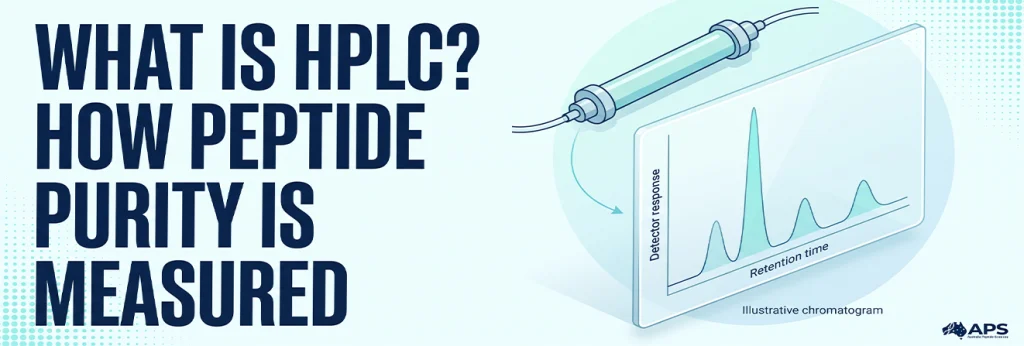
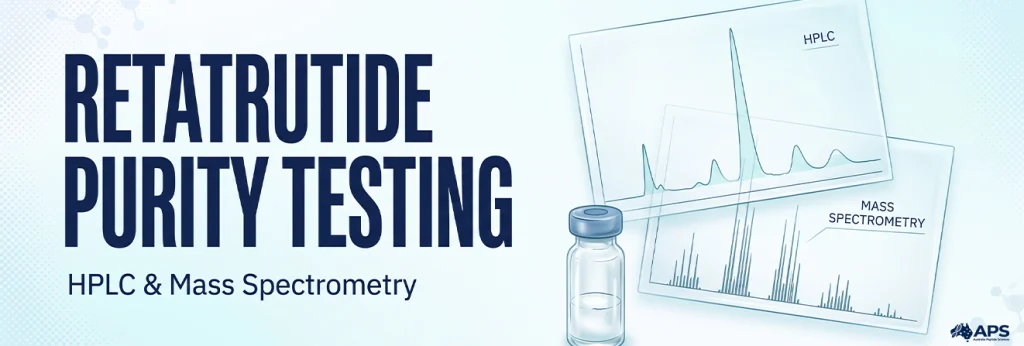
A lower peak signal may reflect reduced peptide recovery or a change in detector response caused by the sample matrix. A matrix blank can reveal background interference, and a reference sample compared across the two matrices can show whether the matrix changes the response. The ICH Q2(R2) guideline covers selectivity and accuracy in pharmaceutical analytical validation. The APS guide to HPLC peptide purity testing explains how to interpret chromatographic results.
Selectivity shows whether the method distinguishes the peptide from other components. Recovery shows how much of the expected amount the method measures.
To assess change over time, compare initial and later measurements. Check that the study reports the peptide, preservative, buffer, pH and measurement times.
How to Verify Benzyl Alcohol Content on a Label and COA
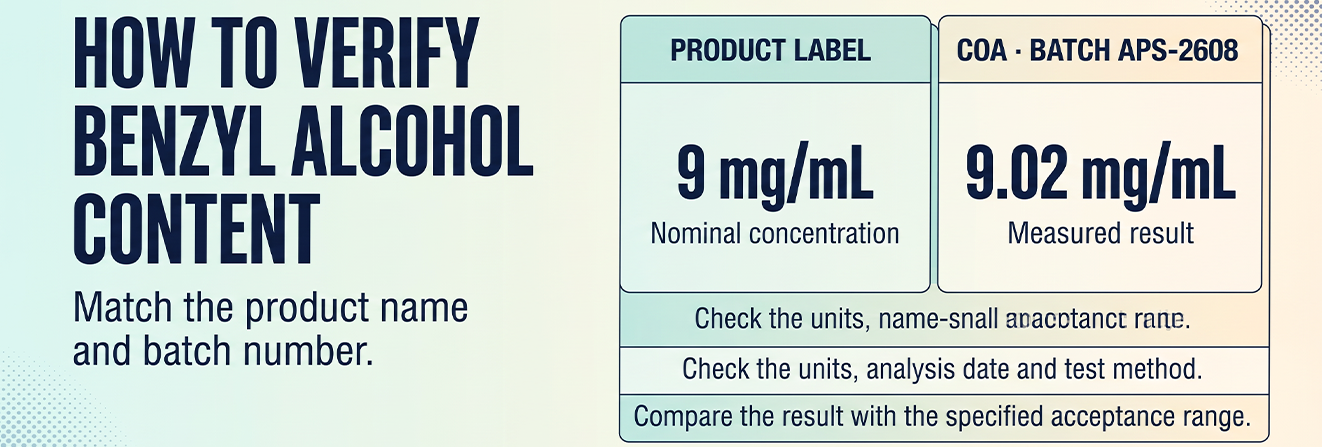
1. Check the Label and Match the Batch
The label states the nominal concentration. The certificate of analysis (COA) can report a measured result for the tested batch. APS lists 9.02 mg/mL of benzyl alcohol for Bacteriostatic Water for Research, batch APS-2608. To determine whether the result meets the specification, compare it with the documented acceptance range for that product.
Review the bacteriostatic water batch results and match the product name and batch number to your label.
2. Interpret the Assay Result
A preservative assay answers how much benzyl alcohol was measured. To interpret the result:
- Check the units and analysis date. A concentration in mg/mL describes the amount per millilitre of solution.
- Check the test method, if reported, and keep the original decimal places when recording the value.
- Compare the result with the specified acceptance range, where available.
For APS-2608, 9.02 mg/mL is the measured result and 9 mg/mL is the nominal concentration. The acceptance range determines whether the measured result meets the concentration specification.
What the Label and Batch Report Tell You
On a bacteriostatic water label, 0.9% w/v means 9 mg/mL of benzyl alcohol. Use the batch report to verify the measured concentration and peptide-specific data to assess compatibility with the intended assay.
Explore Australia Peptide Sciences and our range of peptides for research use only
Frequently Asked Questions
What is benzyl alcohol?
Benzyl alcohol is an aromatic alcohol also called phenylmethanol.
Why does bacteriostatic water contain 0.9% benzyl alcohol?
A 0.9% w/v formulation contains 9 mg/mL of benzyl alcohol to help control bacterial growth in a multidose vial.
How does benzyl alcohol inhibit bacterial growth?
It can alter bacterial membrane fluidity and affect membrane protein function.
Are some peptides sensitive to benzyl alcohol?
Sensitivity depends on the peptide and formulation. Look for data on stability and recovery in the intended matrix.
Does 0.9% w/v mean 0.9 mL per 100 mL?
It means 0.9 grams of preservative per 100 mL of finished solution.
Is the benzyl alcohol concentration in the final research sample always 9 mg/mL?
The 9 mg/mL figure applies to the labelled diluent. The final concentration depends on the sample composition.
Does a clear solution show that a peptide is stable?
A clear sample can still contain dissolved degradation products. Stability is assessed with a suitable analytical method.
Can a COA report both preservative content and sterility test results?
Yes. A COA can report a preservative assay and a separate sterility test result for the same batch. The preservative assay measures benzyl alcohol content, while the sterility test reports whether viable microorganisms were detected under the test conditions.
Does a published protein study establish a shelf life for a research peptide?
Shelf life requires stability data for the specific peptide and formulation under defined conditions.
Can benzyl alcohol affect an analytical result even when the peptide is stable?
Yes. The diluent can alter the analytical signal even when the peptide is stable.
References
- National Library of Medicine, PubChem. Benzyl Alcohol, CID 244.
- National Library of Medicine, DailyMed. Hospira Bacteriostatic Water for Injection, USP.
- United States Pharmacopeia. General Chapter 〈51〉 Antimicrobial Effectiveness Testing.
- Pentanol and Benzyl Alcohol Attack Bacterial Surface Structures Differently. Applied and Environmental Microbiology.
- Antimicrobial Preservatives for Protein and Peptide Formulations: An Overview. Pharmaceutics.
- Role of Benzyl Alcohol in the Unfolding and Aggregation of Interferon α-2a. Journal of Pharmaceutical Sciences.
- International Council for Harmonisation. Q2(R2) Validation of Analytical Procedures.
- National Library of Medicine, DailyMed. 0.9% Sodium Chloride Injection, USP.