
Mitochondrial function describes the processes that allow mitochondria to generate ATP and participate in cellular signalling, redox regulation, calcium handling and programmed cell death. These organelles are central to cellular bioenergetics, but their research significance extends beyond ATP production to multiple pathways involved in cell physiology and stress responses.
What Are Mitochondria?
Mitochondria are membrane-bound organelles found in most eukaryotic cells. They convert energy from metabolic substrates into ATP through coordinated biochemical pathways, including the citric acid cycle and oxidative phosphorylation. Mitochondria also contain mitochondrial DNA (mtDNA) and participate in several signalling and quality-control processes.
Different cell types contain different mitochondrial densities according to their bioenergetic requirements. Tissues with high ATP demand are frequently used in mitochondrial research because changes in mitochondrial activity can be measured through defined cellular and biochemical endpoints.
What Is Mitochondrial Function?
Mitochondrial function refers to the ability of mitochondria to maintain ATP production and participate in processes such as redox regulation, calcium handling, metabolic signalling, apoptosis and mitochondrial quality control. These functions can be studied through biochemical assays, cellular models and measurements of mitochondrial respiration, membrane properties and molecular markers.
Key mitochondrial processes include ATP generation, oxidative phosphorylation, substrate metabolism, calcium handling, redox signalling, apoptosis, mitochondrial dynamics and quality-control pathways.
Changes in mitochondrial abundance and cellular adaptation are discussed further in Mitochondrial Biogenesis.
How Mitochondria Produce Energy
The primary role of mitochondria is energy production. This process happens through several connected steps.
1. Nutrients Are Broken Down
The body breaks down carbohydrates, fats, and proteins from food into smaller molecules. These molecules are then used as fuel.
For example:
- Carbohydrates break down into glucose
- Fats break down into fatty acids
- Proteins break down into amino acids
These fuel sources eventually enter energy pathways that support ATP production.
2. The Krebs Cycle Produces Energy Carriers
Inside the mitochondria, a process called the Krebs cycle, also known as the citric acid cycle, helps generate energy-carrying molecules.
These energy carriers include:
- NADH
- FADH2
They do not directly power the cell yet. Instead, they carry electrons to the next stage of energy production.
This is also why NAD is widely discussed in cellular energy research, because NAD-related pathways are closely connected to mitochondrial metabolism and ATP production.
3. The Electron Transport Chain Creates ATP
The electron transport chain is located in the inner mitochondrial membrane. This is where most ATP is produced.
During this process:
- Electrons move through protein complexes
- Oxygen acts as the final electron acceptor
- A proton gradient is created
- ATP synthase uses this gradient to produce ATP
This process is called oxidative phosphorylation.
4. ATP Powers Cell Activity
Once ATP is produced, cells use it to perform work. Without ATP, cells cannot maintain normal function.
| Stage | What Happens | Main Result |
| Nutrient breakdown | Food is converted into usable fuel | Glucose, fatty acids, amino acids |
| Krebs cycle | Fuel is processed inside mitochondria | NADH and FADH2 are produced |
| Electron transport chain | Electrons move through mitochondrial proteins | ATP production increases |
| ATP use | Cells use ATP for biological work | Energy supports cell function |
This process explains why mitochondrial function is essential for life.
Structure of Mitochondria and Why It Matters
Mitochondria have a unique structure that allows them to produce energy efficiently. They are not simple containers inside cells. Their design is directly connected to their function.
| Mitochondrial Structure | Function |
| Outer membrane | Protects mitochondria and controls movement of molecules |
| Inner membrane | Contains the electron transport chain and supports ATP production |
| Cristae | Folded structures that increase surface area for energy production |
| Matrix | Inner space where the Krebs cycle occurs |
| Mitochondrial DNA | Provides instructions for some mitochondrial proteins |
The inner membrane is especially important because it contains the machinery needed for ATP production. Its folds, called cristae, increase surface area, allowing mitochondria to produce more energy.
Mitochondria also contain their own DNA, known as mitochondrial DNA or mtDNA. This makes them different from many other organelles. Mitochondrial DNA plays an important role in producing some of the proteins required for energy metabolism.
Key Functions of Mitochondria Beyond Energy
Energy production is the best-known mitochondria function, but it is not the only one. Mitochondria influence many other biological processes that affect health.
Cell Signalling
Mitochondria participate in cellular signalling through changes in metabolic activity, redox state and reactive oxygen species. Experimental studies examine these processes using defined molecular and functional endpoints.
Calcium Regulation
Mitochondria take up and release calcium, linking calcium signalling with metabolic activity. Laboratory models can measure mitochondrial calcium handling alongside membrane potential and respiration to examine how these processes interact.
Apoptosis
Mitochondria participate in intrinsic apoptosis, a regulated form of cell death. Changes in outer-membrane permeability can release proteins such as cytochrome c and activate downstream cell-death pathways. Experimental assessment may combine measurements of protein release, caspase activity and cell viability.
Heat Production
Mitochondria can also help produce heat. This process is especially important in brown fat tissue, where mitochondria help the body maintain temperature.
Oxidative Stress Balance
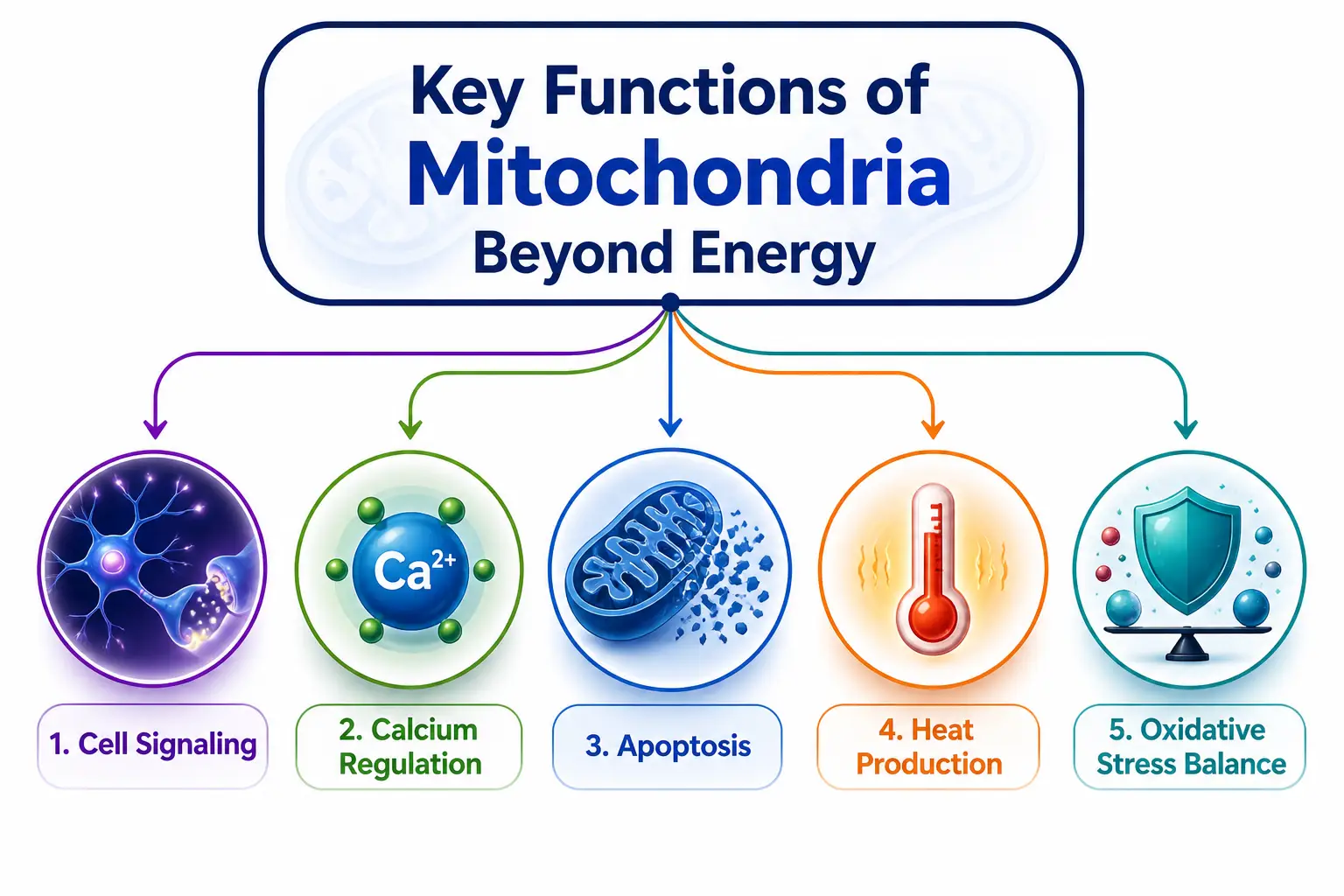
Mitochondrial electron transport can generate reactive oxygen species that participate in signalling but may also contribute to oxidative damage under some experimental conditions. The relationship between reactive species and cellular damage is discussed further in Oxidative Stress and Cellular Damage.
Why Mitochondrial Function Matters in Cellular Research
Mitochondrial activity influences cellular ATP availability, redox state, calcium signalling and stress responses. Because bioenergetic demand varies among cell types, mitochondrial research may compare respiration, ATP production, membrane potential, reactive-species generation and other defined endpoints across different experimental systems.
What Is Mitochondrial Dysfunction?
Mitochondrial dysfunction describes measurable impairment in one or more mitochondrial processes, which may include oxidative phosphorylation, ATP generation, redox regulation, mitochondrial genome maintenance, dynamics or quality control. The specific definition depends on the experimental model and endpoints being measured.
Mechanisms and experimental markers are examined in more detail in Mitochondrial Dysfunction.
SS-31 for Research is studied in mitochondrial and membrane models.
Birk et al.’s cardiolipin study examined SS-31 interactions with cardiolipin and effects on mitochondrial respiration. These endpoints concern membrane-associated mechanisms rather than demonstrated benefits in people.
Factors Investigated in Mitochondrial Dysfunction
Experimental models of mitochondrial dysfunction may examine genetic variation, mitochondrial DNA damage, defects in respiratory-chain activity, altered redox state, disrupted mitochondrial dynamics, impaired quality-control pathways and exposure to defined cellular stressors. The mechanisms involved can differ substantially between genetic mitochondrial disorders and secondary mitochondrial changes associated with other biological conditions.
Mitochondrial Function Across Experimental Systems
Mitochondrial research is conducted across neuronal, muscular and other high-energy cellular models because ATP demand and mitochondrial organisation vary between tissues. Studies may examine respiration, ATP production, calcium handling, oxidative stress, mitochondrial turnover and changes in mitochondrial structure or abundance.
Age-associated cellular models also investigate changes in mitochondrial function alongside oxidative stress, mitochondrial DNA integrity and quality-control pathways. Related cellular mechanisms are discussed further in Cellular Aging.
Mitochondrial Function, Capacity and Dysfunction
| Term | Research meaning |
| Mitochondrial function | Measurable performance of mitochondrial processes |
| Mitochondrial capacity | Ability of a mitochondrial system to respond under defined experimental demand |
| Mitochondrial dysfunction | Measurable impairment in one or more mitochondrial processes |
MOTS-C for Research is a mitochondrial-derived peptide investigated in cellular metabolism models.
Lee et al.’s MOTS-c study examined folate-cycle and purine-metabolism pathways associated with AMPK activation. These mechanistic findings must be interpreted within the experimental systems studied.
Research Areas in Mitochondrial Biology
Mitochondrial research spans bioenergetics, oxidative phosphorylation, redox biology, mitochondrial genetics, organelle dynamics, quality control, calcium signalling and cellular stress responses. These mechanisms are investigated using biochemical, cellular and molecular methods rather than through broad claims about health, performance or longevity.
Peptides specifically investigated in mitochondrial research are discussed further in Mitochondrial Peptides.
Mitochondrial function encompasses ATP production together with multiple processes involved in cellular signalling, redox regulation, calcium handling and organelle quality control. Its experimental evaluation depends on the biological model and the specific endpoints being measured. Understanding mitochondrial function therefore requires separating measurable cellular mechanisms from broader claims about personal energy, performance or health outcomes.
Peptide materials discussed in mitochondrial research should remain within their stated laboratory purpose and should not be interpreted as treatments or personal-use products. Further context is available in the Research Use Only Peptides guide.
FAQs About Mitochondrial Function
What is mitochondrial function?
Mitochondrial function refers to the processes that allow mitochondria to generate ATP and participate in cellular signalling, redox regulation, calcium handling and quality control.
How do mitochondria produce ATP?
The citric acid cycle supplies electron carriers such as NADH and FADH₂. Electron transfer through the respiratory chain drives proton pumping across the inner mitochondrial membrane, and ATP synthase uses the resulting gradient to produce ATP.
What is oxidative phosphorylation?
Oxidative phosphorylation is the mitochondrial process in which electron transport generates a proton gradient across the inner mitochondrial membrane that drives ATP synthesis.
What is mitochondrial dysfunction?
Mitochondrial dysfunction describes measurable impairment in one or more mitochondrial processes, such as oxidative phosphorylation, ATP generation, redox regulation or organelle quality control.
Why does mitochondrial DNA matter?
Mitochondrial DNA encodes a subset of proteins and RNAs required for mitochondrial function and is therefore relevant to mitochondrial genetics and bioenergetic research.
What is the role of reactive oxygen species in mitochondria?
Mitochondria can generate reactive oxygen species during electron transport. These molecules may participate in signalling but can also contribute to oxidative damage under some experimental conditions.
What is mitochondrial biogenesis?
Mitochondrial biogenesis is the coordinated process through which cells increase mitochondrial components and capacity through regulation of nuclear and mitochondrial gene expression.
How is mitochondrial function studied in laboratories?
Laboratory methods may measure oxygen consumption, ATP production, membrane potential, redox markers, mitochondrial morphology, enzyme activity and other compound- or model-specific endpoints.
What are mitochondrial-derived peptides?
Mitochondrial-derived peptides are peptides encoded within mitochondrial genetic regions and investigated for roles in cellular signalling and stress-response pathways.