Bacteriostatic water for peptides is a sterile aqueous diluent that typically contains benzyl alcohol as an antimicrobial preservative. In peptide research, it may be used for controlled laboratory solution preparation when its formulation is compatible with the compound and experimental protocol.
Benzyl alcohol helps inhibit the growth of susceptible bacteria but does not sterilise contaminated solutions or replace aseptic laboratory procedures. Preservative content alone does not establish peptide solubility, chemical stability or compatibility with analytical methods.
For Australian research laboratories, evaluating bacteriostatic water involves examining its preservative composition, quality specifications and compatibility with the intended peptide and analytical method. Manufacturer documentation provides essential information for assessing these characteristics.
What Is Bacteriostatic Water?
Bacteriostatic water is a sterile aqueous diluent distinguished by the inclusion of an antimicrobial preservative. Common formulations contain approximately 0.9% benzyl alcohol, although the exact composition must be verified against the manufacturer’s product documentation.
Benzyl alcohol helps inhibit the growth of susceptible bacteria. Its presence does not eliminate contamination risks or replace controlled aseptic laboratory procedures.
In peptide research, the suitability of a preserved aqueous diluent depends on its formulation, compound compatibility, and the requirements of the validated experimental protocol.
Typical Formulation and Packaging Characteristics
| Formulation or Packaging Element | Research Relevance |
| Sterile aqueous base | Functions as the solvent vehicle. |
| Benzyl alcohol (commonly 0.9% in labelled formulations) | Helps inhibit susceptible bacterial growth. Concentration must be verified for the specific product. |
| Sealed container and closure (not a solution ingredient) | Supports container integrity and contamination control during appropriate laboratory handling. |
Bacteriostatic water is supplied in labelled vial formats that may vary by product. Researchers can review available bacteriostatic water for laboratory research and verify vial volume, preservative composition, and product specifications against current documentation.
Relevant formulation and quality characteristics include:
- Visual clarity
- Absence of unexpected discoloration
- Documented sterility specifications
- Verified preservative identity and concentration
- Container integrity and stated laboratory research purpose
Preservative inclusion may support laboratory workflows involving repeated vial access where permitted by the product label. However, experimental suitability must be established through compound-specific compatibility and validated laboratory requirements.
How Does Bacteriostatic Water Work?
Benzyl alcohol is the antimicrobial preservative commonly responsible for the bacteriostatic properties of this aqueous diluent. It helps inhibit the multiplication of susceptible bacteria under appropriate formulation conditions.
Its antimicrobial effectiveness depends on factors such as preservative concentration, formulation characteristics and handling conditions. Benzyl alcohol does not sterilise contaminated solutions or guarantee the elimination of microorganisms.
In laboratory research, preservative activity must be evaluated separately from peptide stability, solvent compatibility and analytical requirements.
Preservative inclusion does not automatically make a solution suitable for repeated vial access. Permitted handling conditions depend on the product label, container specifications and validated laboratory procedures.
Its main properties and laboratory handling considerations are summarised below:
- The aqueous vehicle provides a liquid medium for compatible laboratory preparations.
- Benzyl alcohol inhibits the growth of susceptible bacteria when present at an appropriate concentration.
- Preservative activity provides limited antimicrobial protection but does not eliminate contamination risks.
- Repeated vial access is appropriate only when permitted by product documentation and supported by established aseptic procedures.
In peptide research, understanding these properties helps laboratories evaluate preservative function alongside compound-specific compatibility, solution integrity and experimental requirements.
Bacteriostatic Water for Peptides: Why Is It Used?
Bacteriostatic water for peptides is used in selected laboratory preparation workflows where a preserved aqueous diluent is compatible with the research compound and experimental requirements.
Lyophilised research peptides may require preparation in a compatible solvent before certain laboratory analyses. However, solvent suitability depends on peptide characteristics, formulation requirements and the intended experimental method.
Diluent selection is an important consideration in peptide reconstitution research, where solubility, stability and experimental compatibility are evaluated separately.
Bacteriostatic water is one possible laboratory diluent, but its preservative content must be compatible with the peptide and analytical methods. It should not be considered a universal solvent for lyophilised research materials.
Where compatibility is established, the benzyl alcohol preservative may help inhibit susceptible bacterial growth during laboratory handling permitted by the product documentation.
Researchers must also consider aseptic handling, container integrity, preservative sensitivity and experimental reproducibility. These factors determine whether a preserved diluent is appropriate for a particular laboratory workflow.
Selecting a laboratory diluent involves more than achieving visible peptide dissolution.
Appropriate solvent selection helps researchers maintain controlled experimental conditions while reducing variability associated with formulation incompatibility or preparation materials.
The article What Are Peptides for Research? explains how research peptides are investigated in laboratory environments and characterised through scientific methods.
Common Research Applications of Bacteriostatic Water
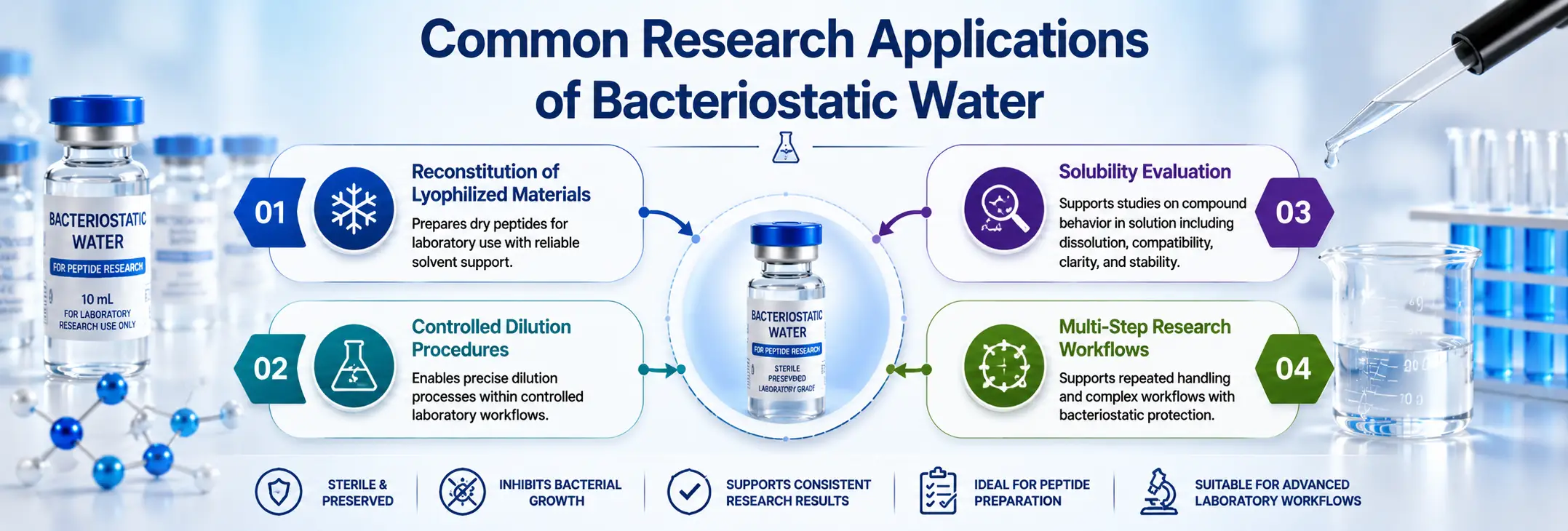
In compatible peptide-research protocols, bacteriostatic water may serve as a preserved aqueous diluent. Its suitability depends on the compound, preservative compatibility and experimental requirements.
Researchers may evaluate bacteriostatic water for several laboratory applications, provided its formulation is appropriate for the intended analytical method.
1. Preparation of Compatible Lyophilised Peptides
Certain lyophilised research peptides may require a compatible aqueous diluent before experimental analysis. Bacteriostatic water is one potential option when supported by compound-specific documentation.
Successful dissolution does not independently establish peptide stability or analytical suitability. Researchers must consider formulation characteristics and validated laboratory requirements.
2. Controlled Dilution and Analytical Preparation
Laboratory experiments may require solutions with defined concentrations and consistent solvent composition to support reproducible measurements.
Where bacteriostatic water is compatible with the experimental method, its benzyl alcohol content must be considered because preservatives may influence certain analytical assays.
3. Solubility and Compatibility Assessment
Researchers may investigate how a preserved aqueous environment influences peptide solubility, physical stability and compatibility with analytical methods.
Relevant laboratory assessments include:
- Dissolution behaviour and precipitation
- Compatibility with experimental reagents and assay conditions
- Turbidity and visible particle formation
- Analytical evaluation of chemical and physical stability
4. Documented Multi-Access Laboratory Workflows
Some laboratory workflows involve repeated access to preparation materials under documented aseptic conditions.
The preservative may help inhibit susceptible bacterial growth where repeated access is permitted by the product label. However, it does not eliminate contamination risks or replace established laboratory controls.
Across these applications, laboratories should prioritise documented sterility, preservative composition, compound compatibility and experimental reproducibility when evaluating bacteriostatic water for peptides.
Preservative Content and Laboratory Diluent Selection
Preservative content is an important factor when evaluating bacteriostatic water for peptide research. Unlike preservative-free sterile water, bacteriostatic water commonly contains benzyl alcohol to inhibit the growth of susceptible bacteria.
However, antimicrobial preservative activity does not guarantee peptide stability, prevent all contamination or establish compatibility with a particular laboratory protocol.
| Feature | Bacteriostatic Water | Sterile Water |
| Sterile | Yes | Yes |
| Contains Preservative | Yes | No |
| Benzyl Alcohol | Usually 0.9% | None |
| Bacterial Growth Inhibition | Present | Limited |
| Research Workflow Use | Common | Context dependent |
For a detailed comparison of preservative composition, sterility and laboratory handling characteristics, see Sterile Water vs Bacteriostatic Water.
The effects of sodium chloride, ionic strength and formulation compatibility are examined separately in Bacteriostatic Water vs Saline.
Laboratory diluent selection should be based on compound-specific compatibility, preservative sensitivity and validated experimental requirements rather than assuming one formulation is universally preferable.
Laboratory Storage and Handling Considerations
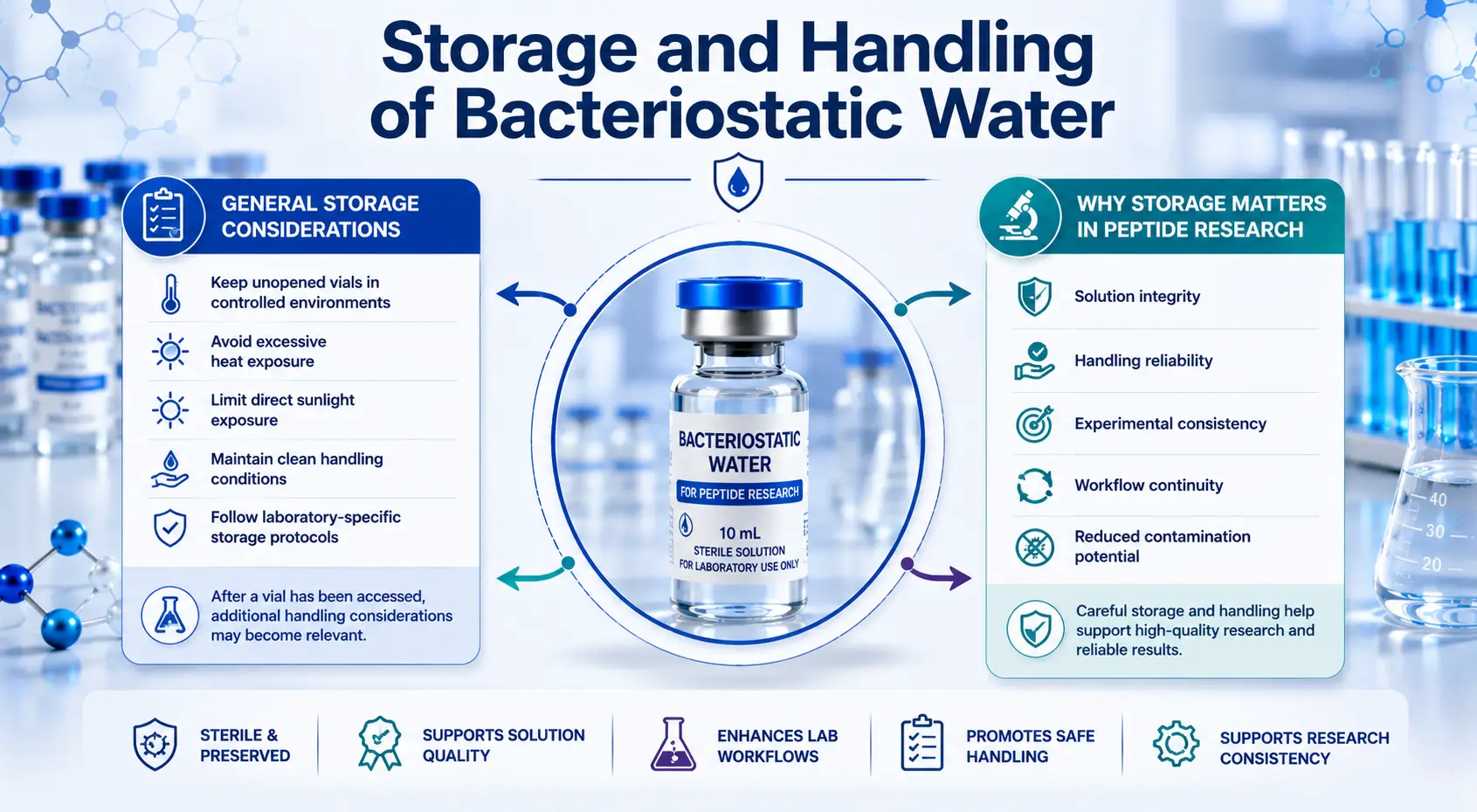
Storage and handling should follow the applicable product documentation and laboratory protocol. Relevant variables may include temperature, light exposure, container integrity, contamination control and compound-specific compatibility after preparation.
After a vial has been accessed, additional handling considerations may become relevant depending on laboratory procedures and internal protocols.
Evaluating Bacteriostatic Water for Laboratory Research in Australia
As peptide research expands, sourcing reliable laboratory materials has become increasingly important.
Laboratories evaluating bacteriostatic water in Australia may consider formulation transparency, preservative concentration, container integrity, storage information, manufacturing documentation and consistency with the intended research workflow.
Laboratory Material Evaluation Criteria
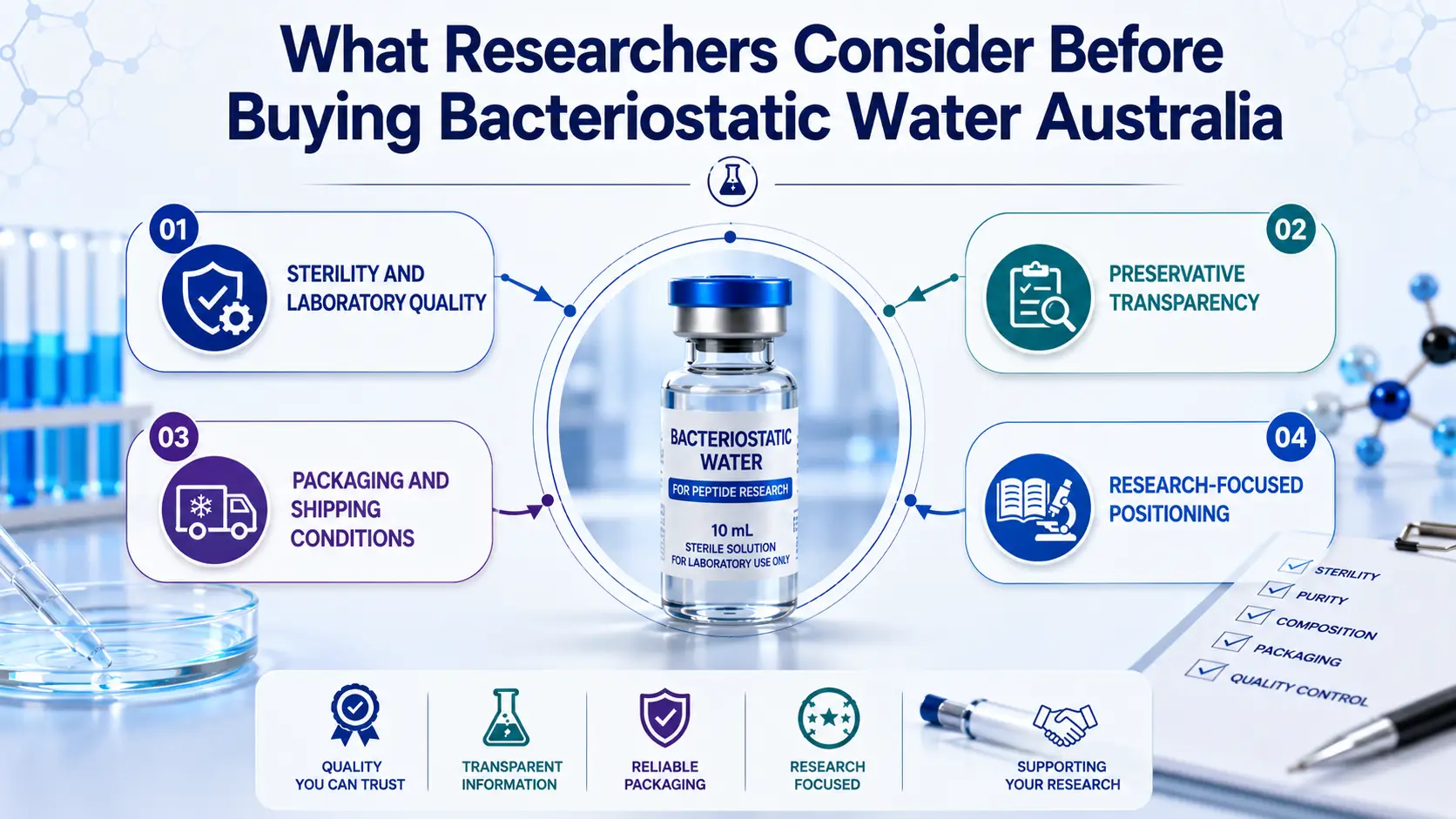
1. Sterility and Laboratory Quality
Laboratories should examine the manufacturer’s sterility specifications, product documentation and quality-control information before selecting bacteriostatic water for research preparation.
Relevant verification criteria include:
- Documented sterility specifications and testing information
- Manufacturing and quality-control standards
- Confirmed formulation and intended laboratory application
- Product specifications, batch identification and available analytical documentation
Product specifications should be reviewed independently of promotional claims. For additional information about interpreting batch-specific peptide documentation, see the Certificate of Analysis Peptides Guide. A peptide COA does not independently verify diluent sterility.
2. Preservative Transparency
Bacteriostatic function depends on preservative inclusion.
Researchers often prefer products with clearly described composition information.
Typical information may include:
| Product Detail | Why It Matters |
| Water Composition | Product transparency |
| Benzyl Alcohol Content | Bacteriostatic function |
| Vial Volume | Workflow planning |
| Storage Guidance | Handling consistency |
| Manufacturing Information | Quality evaluation |
Transparency helps researchers understand whether a product aligns with laboratory expectations.
3. Packaging and Shipping Conditions
Shipping and storage conditions may influence laboratory materials.
Researchers commonly review:
- Protective packaging
- Temperature considerations
- Sealed vial integrity
- Handling procedures
For laboratories ordering bacteriostatic water online, transportation reliability can become an additional factor.
4. Research Documentation and Supplier Transparency
Supplier evaluation should prioritise verifiable product information, formulation transparency and documentation relevant to the intended laboratory workflow. The Research Peptides Australia guide provides broader context on research materials and laboratory quality considerations.
Relevant supplier documentation and resources may include:
- Technical product information
- Formulation specifications and analytical documentation
- Accurate research-use classification and labelling
- Preservative concentration and batch identification
- Documented storage conditions and compatibility limitations
These details support material traceability and help laboratories assess whether a particular diluent meets their experimental requirements.
Additional considerations for assessing research-material suppliers are discussed in the Where to Buy Research Peptides in Australia guide.
Bacteriostatic Water for Peptides: Key Research Considerations
Bacteriostatic water is a laboratory diluent distinguished by the presence of a bacteriostatic preservative, commonly benzyl alcohol. Its suitability in peptide research depends on formulation compatibility, sterile handling, container integrity, storage conditions and the requirements of the specific experimental protocol. Use of a preserved diluent should not be interpreted as evidence of peptide stability or suitability beyond the defined laboratory workflow.
Bacteriostatic water and peptide materials supplied for research should remain within their stated laboratory purpose. The distinction is covered further in the Research Use Only Peptides guide.
Available laboratory diluent formats can be reviewed in the BAC Water category.
FAQs About Bacteriostatic Water for Peptides
Do all research peptides require bacteriostatic water?
No. Bacteriostatic water is not suitable for every research peptide. Diluent selection depends on compound solubility, preservative compatibility, stability data and validated laboratory requirements.
Where can Australian laboratories source bacteriostatic water for research?
Australian laboratories can evaluate research-material suppliers based on formulation transparency, preservative concentration, container specifications and available quality documentation. Australia Peptide Sciences offers bacteriostatic water for laboratory research.
Which diluents are considered in peptide research?
Research laboratories may evaluate sterile water, bacteriostatic water, buffered solutions or specialised laboratory solvents. Selection depends on compound-specific compatibility and experimental requirements. Further considerations are discussed in the Peptide Reconstitution Guide.
What is bacteriostatic water for peptides?
Bacteriostatic water is a sterile aqueous diluent containing an antimicrobial preservative, commonly benzyl alcohol. Its bacteriostatic properties help inhibit susceptible bacterial growth, but suitability for peptide research remains compound-specific.
Is bacteriostatic water the same as sterile water?
No. Bacteriostatic water contains an antimicrobial preservative, while preservative-free sterile water does not. Their formulation and handling differences are explained in Sterile Water vs Bacteriostatic Water.
Does bacteriostatic water guarantee peptide stability after reconstitution?
No. Benzyl alcohol provides bacteriostatic activity but does not guarantee peptide stability. Chemical degradation, aggregation and changes in solubility depend on peptide structure, formulation, storage conditions and experimental handling.
Sources:
- https://dailymed.nlm.nih.gov/dailymed/lookup.cfm?setid=3a6422e1-feee-4095-8883-2b0837039e6e
- https://dailymed.nlm.nih.gov/dailymed/lookup.cfm?setid=87d6e9dc-fe3b-4593-ac9a-d7493d1959c7
- https://pmc.ncbi.nlm.nih.gov/articles/PMC4830481/
- https://www.bachem.com/knowledge-center/handling-and-storage-guidelines-for-peptides/