
Answering “how much bac water for 10mg retatrutide” requires two separate checks: calculate the final solution volume that would produce the target concentration, then confirm that the material, diluent and preparation conditions are suitable for the intended laboratory method. A 10 mg label supplies the nominal mass for the calculation; it does not complete either decision on its own.
This guide explains the concentration calculation and the documentation needed to assess the second check. It is not a dosing, injection or validated reconstitution protocol.
Quick Answer: How Much BAC Water for 10mg Retatrutide?
There is no single correct BAC water volume for a 10 mg retatrutide vial. The nominal peptide mass alone cannot establish the appropriate diluent volume or target research concentration. These depend on the specific laboratory method, material characteristics and supporting documentation.
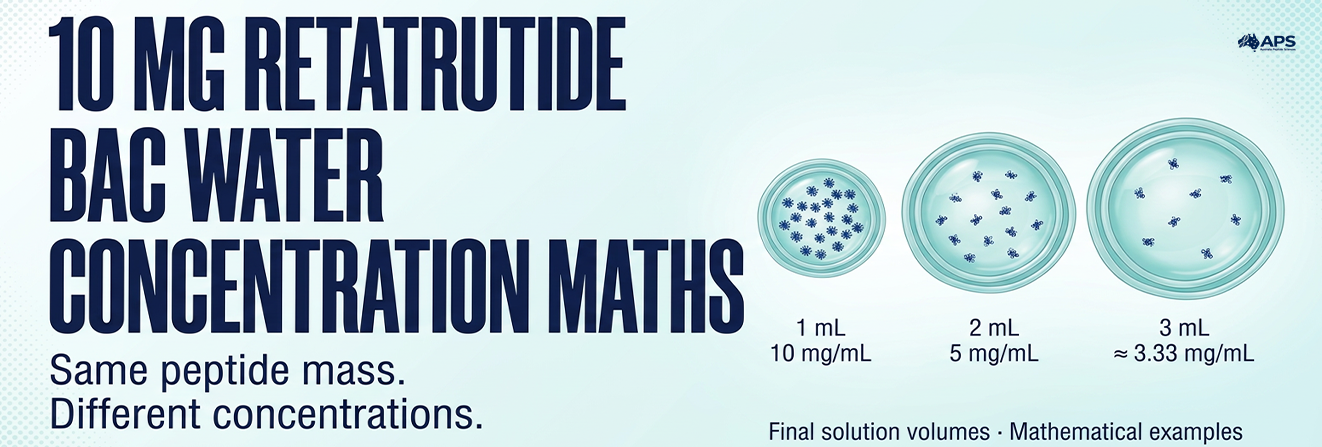
For concentration calculations, a nominal 10 mg peptide amount combined with assumed solution volumes of 1 mL, 2 mL and 3 mL corresponds to 10 mg/mL, 5 mg/mL and approximately 3.33 mg/mL, respectively. These examples follow the mathematical assumption used by the Retatrutide concentration calculator and do not represent recommended preparation volumes or validated reconstitution instructions.
What Do mg, mL and mg/mL Mean in Retatrutide Calculations?
The three quantities describe different properties:
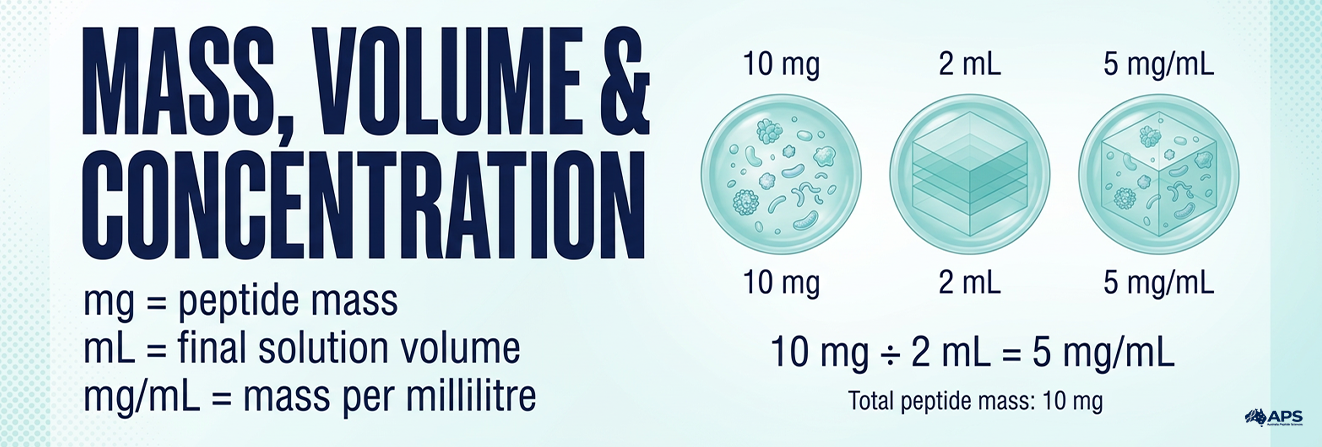
- mg: mass of peptide used in the calculation.
- mL: volume of the final solution.
- mg/mL: mass of peptide per millilitre of solution.
The governing equation is:
Concentration (mg/mL) = peptide mass (mg) ÷ final solution volume (mL)
This is mass concentration. The IUPAC Gold Book defines mass concentration as a constituent’s mass divided by the volume of the mixture, making final solution volume the relevant denominator.
A result of 5 mg/mL describes the composition of the solution. It does not mean that the vial contains only 5 mg in total. For the nominal example, the full 2 mL solution still contains 10 mg, assuming complete dissolution and no material loss.
Keep the quantity labels beside the numbers when checking an equation. Writing “10 ÷ 2 = 5” hides the distinction between mass, volume and concentration; writing “10 mg ÷ 2 mL = 5 mg/mL” makes the relationship explicit.
Comparing 10 mg in 1 mL, 2 mL and 3 mL
The following table compares the volume inputs used in the concentration calculation, consistent with the calculator’s “Diluent Volume” field. Each example assumes the entered volume represents the final solution volume, while the nominal peptide mass remains fixed.
| Nominal peptide mass | Volume used in calculation | Calculated concentration | Relative to the 2 mL example |
| 10 mg | 1 mL | 10 mg/mL | Twice the concentration |
| 10 mg | 2 mL | 5 mg/mL | Reference example |
| 10 mg | 3 mL | Approximately 3.33 mg/mL | Two-thirds of the concentration |
These values compare concentration only; they are not recommended preparation volumes.
1. Why more volume means lower concentration
Concentration and volume have an inverse relationship when dissolved peptide mass stays constant. Increasing the denominator lowers the calculated result.
Moving from 1 mL to 2 mL doubles the volume and halves the concentration. Moving from 2 mL to 3 mL increases volume by 50%, while concentration decreases by approximately 33.3%. The percentage changes differ because concentration is inversely proportional to volume.
The lower concentration does not, by itself, indicate that peptide has disappeared or degraded. It means the same nominal mass is distributed through a larger volume. Claims about actual degradation require separate evidence.
2. Why 3.33 mg/mL is approximate
Dividing 10 by 3 produces a recurring decimal: 3.3333… . The value 3.33 mg/mL is rounded for readability.
For a subsequent calculation, retain the original fraction or sufficient calculator precision until the final reporting step. Multiplying the rounded value by 3 gives 9.99 rather than 10; that small difference comes from rounding and does not demonstrate material loss.
Use the Retatrutide concentration calculator to compare concentration calculations using different mass and volume inputs. The calculator uses the entered “Diluent Volume” as the volume basis for its calculation, assuming it represents the resulting solution volume. This mathematical assumption does not verify the actual final volume or validate the laboratory preparation.
Calculating Final Volume from a Specified Concentration
If a validated laboratory method already specifies concentration, rearrange the equation:
Final solution volume (mL) = peptide mass (mg) ÷ concentration (mg/mL)
For example, a hypothetical method specifying 5 mg/mL and a nominal peptide amount of 10 mg gives:
10 mg ÷ 5 mg/mL = 2 mL
The result identifies the final volume corresponding to those inputs. It does not select the concentration on the laboratory’s behalf.
A useful check is to substitute the result into the original equation. Dividing 10 mg by the calculated 2 mL should return 5 mg/mL. If it does not, review the arithmetic and units before accepting the result.
The same record-keeping rule applies across GLP-1 research peptides: once a stock solution has been partly used, the original vial label no longer states the mass remaining in that stock.
Shop peptides for sale in Australia for Research Only
Water Added Versus Final Solution Volume
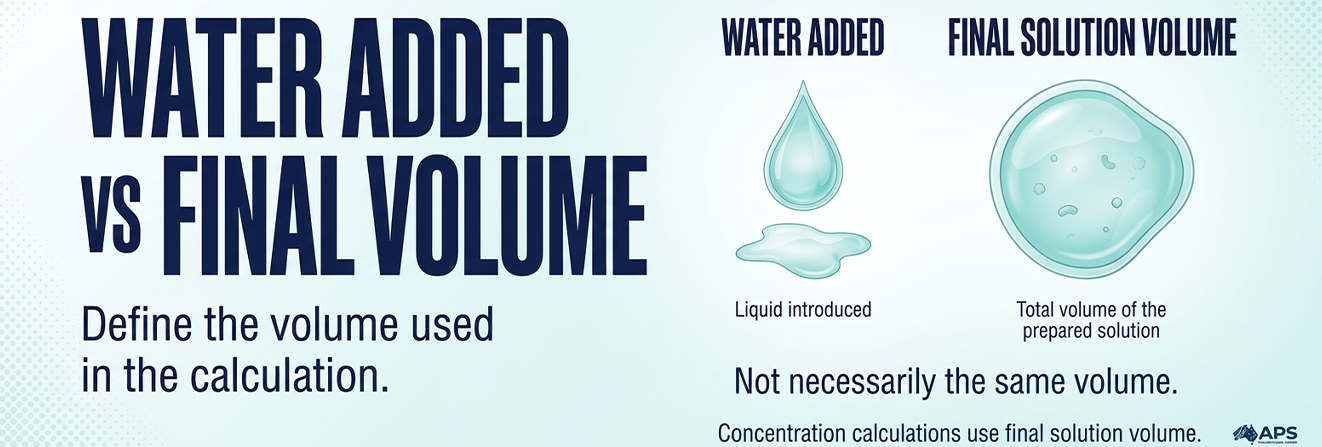
“Add 2 mL of water” and “prepare a final solution volume of 2 mL” are not necessarily the same instruction.
The first describes the volume of liquid introduced, while the second describes the resulting solution volume. In the Retatrutide concentration calculator, “Diluent Volume” is the user-entered volume used as the denominator in the concentration calculation. The calculator assumes this input represents the resulting solution volume but does not independently measure or verify the actual final volume.
For a simplified illustration, the amount added may be treated as the final volume. Quantitative laboratory work should instead use the volume definition and measurement accuracy specified by the method.
The nominal capacity of a vial is also separate from final solution volume. A container capable of holding a particular volume does not establish how much solution it currently contains, and the printed peptide mass does not describe its capacity.
Record the volume basis alongside the result. “5 mg/mL, calculated from nominal 10 mg and 2 mL final volume” is more informative than an isolated concentration without its assumptions.
For a practical example of measuring a defined final volume, the Royal Society of Chemistry’s standard solution demonstration shows general laboratory technique. It does not establish a retatrutide preparation method.
How Volume Errors Change the Calculated Concentration
An incorrect volume input produces an incorrect calculated concentration even when the arithmetic is performed correctly.
Consider a nominal 10 mg preparation recorded as 2 mL. Its stated concentration would be 5 mg/mL. If the actual final volume were different, the corresponding concentration would change:
| Hypothetical final volume | Calculation | Concentration | Difference from 5 mg/mL |
| 1.8 mL | 10 ÷ 1.8 | Approximately 5.56 mg/mL | Approximately 11.1% higher |
| 2.0 mL | 10 ÷ 2.0 | 5 mg/mL | No difference |
| 2.2 mL | 10 ÷ 2.2 | Approximately 4.55 mg/mL | Approximately 9.1% lower |
This table illustrates sensitivity to the denominator. It does not establish acceptable measurement tolerances or describe the accuracy of any particular instrument.
1. Why equal volume differences give unequal percentage changes
The two altered volumes are both 0.2 mL away from 2 mL. However, dividing by 1.8 and dividing by 2.2 do not produce symmetrical concentration changes.
To compare either result with the reference, use:
Percentage difference = [(calculated concentration − reference concentration) ÷ reference concentration] × 100
Use unrounded intermediate values when calculating the percentage. Round the reported result afterwards.
2. Decimal places do not establish measurement accuracy
As NIST measurement guidance illustrates, a display reading 5.0000 mg/mL may look more precise than 5 mg/mL, but extra digits do not improve the underlying mass or volume measurements.
Report precision appropriate to the method and its inputs. Keep the intended target, recorded preparation volume and calculated result distinguishable so that an apparent difference can be traced to its source.
What a 10 mg Concentration Calculation Assumes
For compound background, the question “what is Reta peptide?” is addressed separately. The calculation here still depends on the documented retatrutide mass and final solution volume for the preparation being described.
The mass input represents the relevant peptide amount
For a Reta peptide preparation, use the retatrutide mass documented for the relevant batch or analytical method. Total formulated powder mass, label content and independently measured peptide content are not interchangeable.
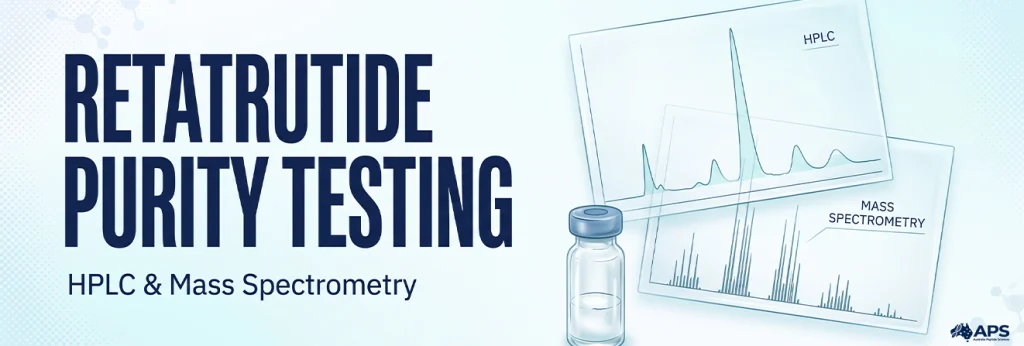
A batch-specific Certificate of Analysis can document identity, tested amount, purity and batch details for the sample analysed. It does not by itself establish sterility, diluent compatibility or stability after preparation.
The stated amount is dissolved in the stated volume
Dividing the nominal vial content by a volume gives a nominal concentration. If some material remains undissolved or has been lost, the arithmetic alone cannot determine how much is present in solution.
Similarly, a calculated starting concentration does not prove that concentration remains unchanged throughout an experiment. Any claim about the measured solution needs evidence beyond the initial division.
Both inputs refer to the same preparation
Keep every input tied to the same compound and preparation. This rule also applies to a Tirzepatide peptide or Mazdutide 10mg preparation: each has its own batch, mass basis and final volume, so its values cannot be transferred to a retatrutide calculation.
Explore Australian peptides for Research Only
Retatrutide Reconstitution: What Concentration Maths Cannot Establish
Retatrutide is an investigational compound and is not approved by the TGA. This section is limited to concentration arithmetic and does not provide a clinical dosing, injection or treatment protocol.
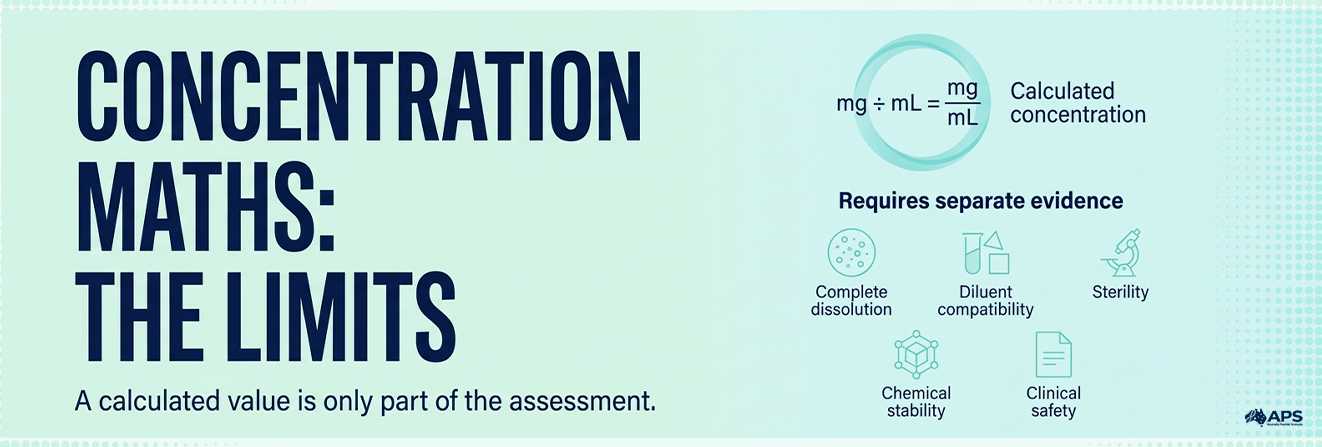
Concentration maths describes the relationship between mass and volume; it does not establish complete dissolution, solvent compatibility, sterility, chemical stability or clinical safety. For that reason, questions about reta peptide side effects sit outside the calculation and require appropriate safety evidence.
When assessing how to mix retatrutide with bac water, separate two decisions: the concentration produced by the stated inputs, and whether the material, diluent and preparation method are supported by appropriate documentation.
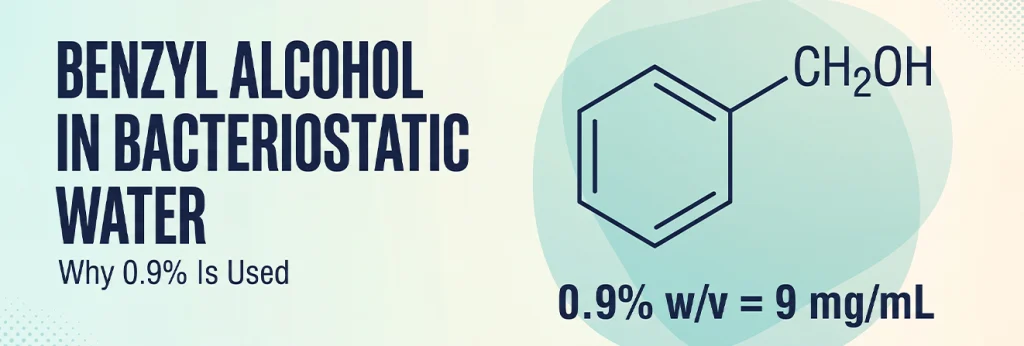
Bacteriostatic water is a preserved aqueous diluent that commonly contains benzyl alcohol. Pfizer’s product labelling directs users to follow the instructions for the substance being dissolved and to consider compatibility rather than assuming universal suitability.
When BAC Water is being evaluated for laboratory use, compare its formulation and analytical documentation with the requirements of the specific material. The product page can describe the diluent, but it cannot validate a retatrutide preparation.
Conditions for reta peptide storage must be supported for the prepared solution, including its diluent and concentration. A calculated mg/mL value cannot supply a storage temperature or holding period; consult material-specific stability data and the manufacturer’s diluent labelling.
Keeping the Calculation Meaningful
Answering how much bac water for 10mg retatrutide starts with a defined concentration target and a clear final-volume basis. Keep the mass, volume and resulting mg/mL together in the preparation record, and make the assumptions explicit.
Before relying on the result, verify that the compound identity, batch, mass basis and final volume all refer to the same preparation, then review the relevant analytical, compatibility and stability documentation.
Frequently Asked Questions
How does diluent volume affect concentration in a 10 mg vial?
Increasing final solution volume lowers concentration when the dissolved peptide mass remains constant. Doubling final volume halves concentration; it does not double or halve the nominal total peptide amount.
What is the concentration of 10 mg in 1 mL, 2 mL and 3 mL?
The calculated concentrations are 10 mg/mL, 5 mg/mL and approximately 3.33 mg/mL, respectively. Each assumes complete dissolution of 10 mg in the stated final solution volume.
Why is bacteriostatic water used for lyophilised peptides?
It can serve as a preserved aqueous diluent where the specific peptide and laboratory method are compatible with its formulation. Preservative inclusion does not establish peptide stability or make it universally suitable.
How should reconstituted retatrutide be stored in the laboratory?
Follow documented conditions for the specific material and prepared solution. Temperature and holding time require relevant stability information; neither can be inferred from a concentration calculation or a generic online timeframe.
Is 2 mL always the correct volume for a 10 mg vial?
No. It corresponds mathematically to 5 mg/mL when final volume is 2 mL. Whether that concentration and diluent are appropriate depends on the validated laboratory method.
Does adding more water increase the amount of retatrutide?
No. Dilution alone changes concentration while the nominal total peptide mass remains constant, assuming no material loss or degradation.
Can concentration be calculated from the vial mass alone?
No. Both peptide mass and final solution volume are needed. A 10 mg label alone cannot provide a value in mg/mL.
Does “how to mix reta with bac water” describe a different calculation?
No. “Reta” is an informal abbreviation for retatrutide. The mass-volume relationship is unchanged, although terminology does not establish a valid mixing method.
Can the full vial capacity be used as the volume input?
Only if it is also the established final solution volume. Container capacity and the volume actually present are separate quantities.
Is calculated concentration the same as measured concentration?
No. Calculated concentration follows from stated inputs. Measured concentration requires an appropriate analytical method and may reveal differences that the nominal calculation cannot detect.
Sources
- IUPAC Gold Book: Mass concentration. Definition of mass concentration and the relevant mixture volume.
- Pfizer/Hospira: Bacteriostatic Water for Injection, USP - product labelling. Preservative composition, compatibility cautions and manufacturer-specific requirements for reconstituted solutions. This source does not establish compatibility or stability for retatrutide research preparations.
- NIST: Good Laboratory Practice for Rounding Expanded Uncertainties and Calibration Values. Guidance on carrying precision through calculations and rounding reported values appropriately.
- Australia Peptide Sciences: Certificates of Analysis. Batch-specific analytical documentation for listed research materials.
- Royal Society of Chemistry: Standard solution demonstration. General technique for preparing a defined final solution volume.
- Therapeutic Goods Administration: Unapproved GLP-1 receptor agonist products illegally sold online. Australian regulatory context for retatrutide and other unapproved peptides.
- Australia Peptide Sciences: Retatrutide Concentration Calculator. Calculator interface and its use of mass, diluent volume and concentration inputs.